 BIS Certification
 CDSCO
CDSCO
 PESO
PESO
 CPCB
CPCB
 LMPC
LMPC
 WPC Approval
 Global Approvals
 TEC
TEC
 ARAI
ARAI
 BEE
BEE
 ISO Certification
 DGCA Certification
 NOC For Steel
 APEDA Registration























 Business Registration
 FSSAI Mark Certification












 (32).jpg)
 Legal Services
 Trademark Registration
 Copyright Registration
 Patent Registration
 By
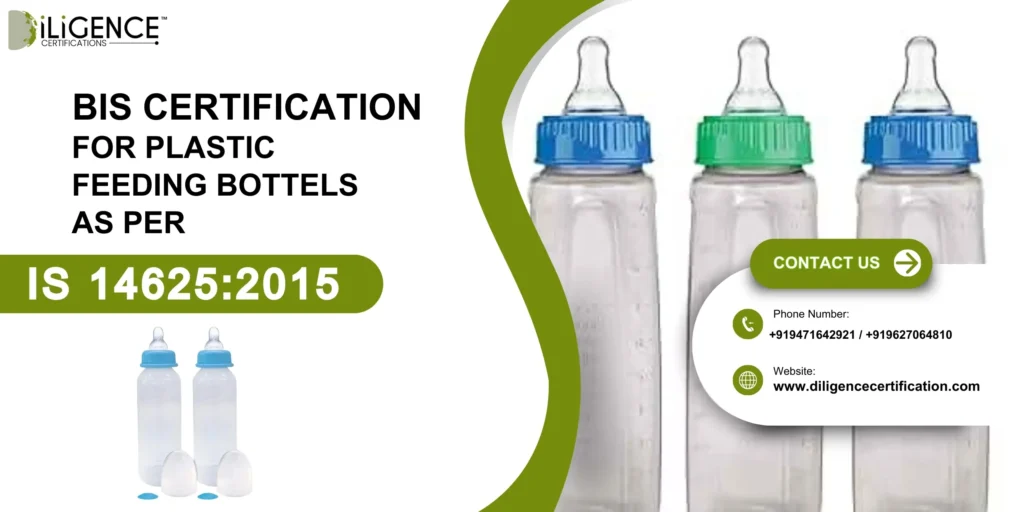
By - BIS for plastic feeding bottles in India is established by IS 14625:2015.
- It is guaranteed that bottles with the ISI mark have passed tests for child health, chemical safety, and durability.
- BIS certification is necessary in order to manufacture, sell, or import feeding bottles into the Indian market.
- In addition to giving parents safety guarantees, certified feeding bottles assist brands in building enduring trust.
- The certification process includes factory audits, lab testing, and periodic BIS compliance checks.
Introduction

For parents, there is no greater concern than the safety of their child. It should be very apparent the rationale as to why India has some of the strictest, if not the strictest, rules in the world about the composition and manufacture of plastic feeding bottles. The standard which governs safety, quality of materials, hygiene aspects of feeding bottles, IS 14625:2015, was established by the Bureau of Indian Standards (BIS), and that is the rule that governs this.
The ISI mark on a feeding bottle represents much more than compliance; for parents, it establishes an expectation that the product has been tested for migration of hazardous chemicals, durability, and child safety criteria. For manufacturers and importers to gain BIS registration for feeding bottles is both a legal requirement and a market differentiator that allows product placement on retail shelves, international export, and long-term consumer confidence in BIS certification.
What is BIS for Plastic Feeding Bottles?
BIS Certification in India as per IS 14625:2015 standards related to infant safety. The IS 14625 standard approved certain food-grade plastics such as polypropylene, polyethersulfone, etc., and tests for leakage, durability, ageing, and toxic chemicals. The manufacturers need to have their own in-house labs, submit separate samples for testing, provide detailed specification sheets along with the bottles manufactured, and submit to BIS for inspection.
The certificate, after approval, is issued for the bottle quality and the in-house testing lab. Once approved, the feeding bottles will have an ISI mark showing the license number. Once an application is submitted, everything must be completed in a period of roughly 30 days for domestic manufacturers, up to 180 days for foreign manufacturers.
Understanding IS 14625:2015

Indian Standard IS 14625:2015 provides a specification for polyethylene terephthalate (PET) bottles for packaging beverages, specifically water.
It covers
- Material quality - bottles must be made from virgin, food-grade PET resin.
- Mechanical properties - properties such as wall thickness, strength, and impact resistance.
- Migration limits - No harmful substances must migrate into the liquid.
- Hygiene requirements - hygiene, including cleanliness during manufacturing and sealing.
In summary, IS 14625:2015 is more than a technical standard and is a compliance passport for bottle manufacturers. Non-compliance would expose companies to rejection by regulatory authorities and rejection from large retail buyers.
Why the BIS for Plastic Feeding Bottles Matters?
For babies, even the smallest compromises in the quality of the product can affect their overall health. The ISI mark on plastic feeding bottles - as laid out in IS 14625:2015 - is important because it represents a legal requirement, but most importantly, provides parents with some comfort that the bottle is fit for everyday use.
Key reasons the ISI mark matters for feeding bottles:
- Child Safety First - All bottles are checked for chemical migration to ensure that no dangerous, toxic chemicals migrate into milk or other liquids.
- Durability & Hygiene - A certified bottle has to show it can endure ongoing sterilisation, boiling, and washing without losing its integrity.
- Mandatory Compliance - Certification is now compulsory with BIS for the manufacture, sale, or importation of feeding bottles in India.
- Trust - Parents naturally choose ISI-marked feeding bottles over non-certified bottles.
- Market & Export Acceptability - Certificated bottles are widely accepted by major retail chains and have passed international safety standards.
The ISI mark on a feeding bottle represents more than a label - it is a parent’s guarantee of safety, hygiene, and trust.
Benefits of BIS Certification For Plastic Feeding Bottles
Key Benefits:
- Child Safety Assurance - Certified products are rigorously evaluated to ensure that there is no harmful chemical migration into your milk or liquid.
- Durability & Hygiene - BIS-certified products can be boiled, sterilised, and repeatedly cleaned without degrading.
- Regulatory Compliance - Compliance with IS 14625:2015 is mandatory, enabling the legal sale or import of bottles in India.
- Consumer Trust & Preference - Parents instinctively choose ISI-marked products rather than non-certified versions.
- Market & Export Access - Endorsed by top retail chains and acknowledged by various international buyers.
- Brand Reputation - Builds credibility for baby-care brands and reinforces long-term customer loyalty.
For baby-care brands, BIS certification is not simply compliance; it is the cornerstone of consumer trust.
Required Documents for BIS Certification of Plastic Feeding Bottles
To obtain a BIS license under IS 14625:2015, manufacturers and importers must submit a complete set of documents. These help BIS verify compliance, factory setup, and product quality.
Mandatory Documents:
- Business Registration Certificate - Company incorporation, GST, or MSME certificate.
- Manufacturing Licence - Proof of legal production unit or factory setup.
- Factory Layout & Process Flow - Detailed schematic showing production stages and hygiene controls.
- Machinery & Equipment List - Inventory of equipment for production and testing purposes.
- Raw Material Details - Source, grade, and specifications (must be food-grade and BPA-free).
- Quality Control Certificates - Internal testing procedures, quality checks, and lab reports (if available).
- Letter of Authorisation - If the application is filed by an authorised representative/agent.
- Import Documents (if applicable) - IEC code, customs clearance, contracts with foreign manufacturer.
Process for BIS Certification for Plastic Feeding Bottles
The process for obtaining BIS certification under IS 14625:2015 for plastic feeding bottles may look daunting at first glance, but it is relatively uncomplicated once you know the stages involved. Below is a simple step-by-step procedure.
1. Application Filing
Manufacturers or importers must apply through the BIS online portal with product details, manufacturing unit information, and category (feeding bottles).
2. Document Submission
Essential documents include:
- Company registration and manufacturing licenceFactory layout and process flow chart
- Quality control and hygiene pla
- Test reports (if pre-tested)
3. Sample Testing
Representative samples of feeding bottles are sent to a BIS-recognised laboratory. Tests check for:
- Chemical safety (migration of heavy metals, BPA, etc.)
- Strength and durability
- Resistance to sterilisation and boiling
4. Factory Inspection
BIS officials make an on-site assessment to verify the source of raw materials, production hygiene, and IS 14625:2015 compliance.
5. Grant of Licence
On successful evaluation, BIS issues a licence authorising the manufacturer to use the ISI mark on feeding bottles.
6. Ongoing Surveillance
Certification is not a one-time activity. BIS conducts periodic audits and random testing to ensure consistent compliance.
“Many Indian SMEs underestimate the audit stage. In our consulting, we always tell clients: Treat the factory visit as seriously as the testing phase.”

Validity and Timings of BIS Certification for Plastic Feeding Bottles
When applying for BIS certification in accordance with IS 14625:2015, manufacturers and importers often ask two very practical questions: How long will it take? And how long will the licence remain valid?
Timelines
- Average Processing Time - 2 to 3 months (includes document review, lab testing, and factory audit).
- Fast-Track Cases - If documents and samples are complete, some applications may be cleared in 6-8 weeks.
- Delays - Commonly caused by incomplete paperwork, test failures, or factory non-compliance.
Validity
- New Licence - BIS certification is issued for a period of 02 years.
- Renewal - a Licence can be renewed after the initial two years for up to 5 years, depending on the manufacturer demonstrating a record of compliance and timely payments.
- Surveillance - BIS conducts regular surveillance and sample testing during the validity period to ensure ongoing product quality.
Renewal of BIS Certification for Plastic Feeding Bottles
Like the new license, renewal of their BIS certification for plastic feeding bottles under IS 14625:2015 is also required if the manufacturer intends to continue to legally use the ISI mark. Renewal shows the company has not only maintained consistency of product quality but has also complied with the requirements safety standards of the Bureau of Indian Standards.
Renewal Validity
- The maximum 5-year licence can be renewed, depending on their performance and compliance history. Generally, manufacturers with a proven compliant history have an easier time with the renewal process.
- In general, manufacturers with a compliant behaviour history will have an easier path to renewal.
When you complete renewals in a proper fashion, there is a continual sales flow, no breach of penalty clauses, and consumers build credibility with the products that carry a BIS certification of plastic feeding bottles.
Eligibility Requirements for BIS Certification of Plastic Feeding Bottles
Bureau of Indian Standards (BIS) requirements, certification under IS 14625:2015 is mandatory for all plastic feeding bottles manufactured, sold, or imported in India to ensure that products intended for infants comply with adequate safety and hygiene requirements.
Who can apply for the ISI mark on plastic feeding bottles?
- Manufacturers of plastic feeding bottles in India.
- Importers and brand owners are bringing feeding bottles into India for sale.
- Private labels outsource bottle production but market under their own brand.
- FMCG or baby-care companies manufacturing bottles in-house as part of their product line.
“Eligibility is not about company size but about the end-use of the bottle. If your bottles are meant for human consumption packaging, certification is compulsory.”
Cost of BIS Certification for Plastic Feeding Bottles
The cost depends on production capacity and testing requirements. Broadly, it includes:
Cost Components:
- Application Fee - A nominal government filing charge for submitting the licence application.
- Testing Fee - Charges by a BIS-recognised laboratory to evaluate samples for chemical migration, durability, and sterilisation resistance.
- Audit/Inspection Fee - Expenses related to the BIS officer’s visit for factory inspection.
- Licence Fee - Annual fee payable to BIS for granting and maintaining the right to use the ISI mark.
- Renewal & Surveillance Costs - Periodic expenses for licence renewal and sample testing during surveillance audits.
Why Choose Diligence Certification?
BIS certification for plastic feeding bottles can be challenging, with different steps including document preparation, laboratory testing, audits, compliance checks, and compliance with IS 14625:2015. This is where Diligence Certification adds value. Diligence Certification will help at every step, based on many years of experience with regulatory approvals. From eligibility assessments and document preparation to liaising with BIS labs/authorities, our team ensures full support during the process. Diligence Certification streamlines the process, reduces timelines, and enables businesses to gain certification in the minimum time possible without compromising on compliance. Diligence Certification guarantees efficiency, reliability, and peace of mind.
Conclusion
The ISI certificate for plastic feeding bottles in accordance with IS 14625:2015 plays a regulatory compliance role, but more fundamentally is a protection for children’s health and the basis for product quality. The ISI mark gives parents reassurance that every certified bottle is free of harmful substances, as stated in Indian requirements, and that every bottle is tested/certified for chemical safety, strength, and cleanliness. For manufacturers and importers, certification means legal compliance in selling BIS-certified bottles, a level of trust with consumers, and greater acceptance by retailers.
Frequently Asked Questions
What is BIS Certification for plastic feeding bottles?
BIS Certification means you have obtained approval from the Bureau of Indian Standards (BIS) under IS 14625:1999. This approval means that you can assuredly say that feeding bottles sold in your shops are safe, non-toxic and suitable for babies.
Is BIS Certification compulsory for plastic feeding bottles?
Yes, as per BIS rules feeding bottles cannot be sold in India without BIS Certification.
Why is BIS Certification important?
BIS Certification is important because of the wide range of plastic used and ensuring feeding bottles are produced from safe plastic protecting infants from potential illness or injuries.
Who will require BIS Certification?
All manufacturers and importers that manufacture and/or sell plastic feeding bottles in India.
What documents are required?
Proof of business license, all relevant product details, test reports for plastic feeding bottles and proof of factory inspection.
How long does it take to get BIS Certification?
Generally, a period of 30 - 45 days depending on tests and inspection.
Can foreign manufacturers apply?
Yes, they can apply under the Foreign Manufacturers Certification Scheme (FMCS) through an Indian agent.
What happens if bottles are sold without BIS Certification?
It is illegal; the seller may be fined, have the product seized or be barred from selling the product.
What standard is applicable to feeding bottles?
IS 14625:1999 - Plastic Feeding Bottles.
How can I get help from Diligence Certifications?
Diligence Certifications will fully assist you from document preparation to approval, simplifying the process.


