BIS Certification
 CDSCO
CDSCO
 PESO
PESO
 CPCB
CPCB
 LMPC
LMPC
 WPC Approval
 Global Approvals
 TEC
TEC
 ARAI
ARAI
 BEE
BEE
 ISO Certification
 DGCA Certification
 NOC For Steel
 APEDA Registration























 Business Registration
 FSSAI Mark Certification












 (32).jpg)
 Legal Services
 Trademark Registration
 Copyright Registration
 Patent Registration
 By
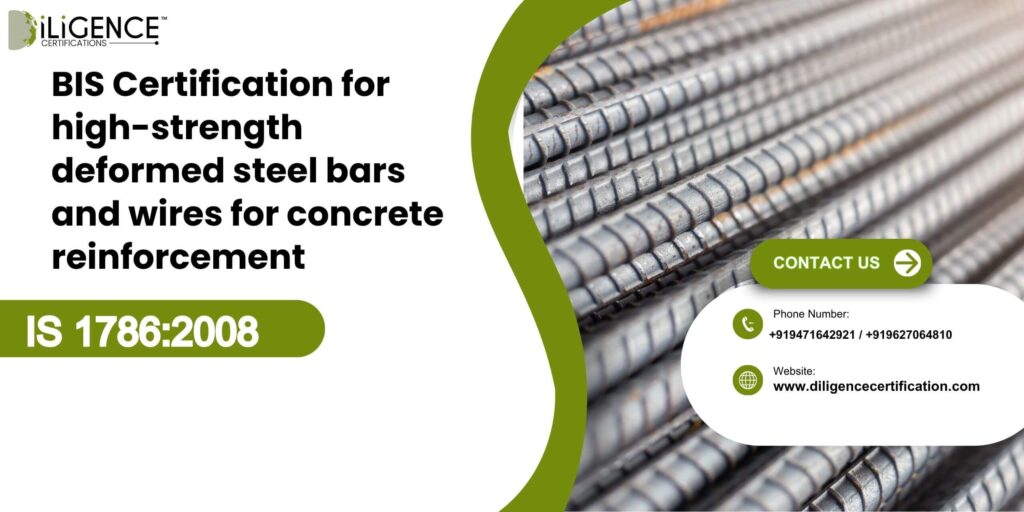
By - High-strength steel bars and wires for concrete use require a BIS certification under IS 1786:2008.
- It is a comprehensive process involving factory audits, testing, and BIS surveillance to maintain the quality.
- The standard specifies the aspects of the product such as grades, high-strength deformed steel, elongation, and dimensional tolerances.
- Certified bars are safe, durable, and compliant with the regulations which are advantageous to builders and clients.
- It is always a good practice to check the ISI mark, BIS licence number, and test certificates before using the product.
Introduction
A project at a site in Delhi came to a stop after the reinforcements bars delivered were found not to have the BIS mark. Low yield strength was revealed by the tests, thus a replacement had to be made at a high cost. Such are the instances that explain why certified steel is the most essential element in the safety of the structure. BIS Certification for High Strength Deformed Steel Bars and Wires for Concrete Reinforcement as per IS 1786:2008 is the way to ensure that each bar is up to the mark in terms of strength, ductility, and quality. Bureau of Indian Standards
What is IS 1786:2008?

IS 1786:2008 is a standard that defines the attributes of a good product, its strength, and how the product is tested for high tensile strength, deformed steel bars and wires used for reinforced concrete. In other words, this is the standard that guarantees the safety, ductility, and reliability of the structural use of rebar in the construction of buildings or any other types of structures.
Key Points:
- It is a standard establishing the quality requirements set up by the Bureau of Indian Standards (BIS) for structures made of reinforced concrete.
- The document specifies the geometry and chemistry of the four grades of iron 415, 500, 550, and 600.
- In addition to the chemical composition, the standard also determines the mechanical strength and the elongation percentage.
- The final elements that are limited by this standard are those which are verified by the tests of bending, rebending, and measuring the surface deformations of the samples.
- It also permits very accurate dimensions, quality uniformity, and corrosion resistance as well. ISI MARK
Why is BIS Certification Mandatory
The main purpose of mandatory BIS certification for high-strength deformed steel bars and wires under IS 1786:2008 is to ensure that the reinforcement materials used in concrete are safe and of high quality. It is a measure that supports the safety of the public, the quality of construction, and impedes the flow of substandard steel in the market.
Key Points:
- It is the main instrument to ensure adherence to national standards of safety and quality for construction materials.
- It is a barrier for counterfeit or low-grade products to get into the market of reinforcement bars.
- It is obligatory under the Quality Control Order (QCO) issued by the Ministry of Steel.
- Facilitates the uniformity and reliability of standards between the different manufacturers and projects.
- It is an instrument that creates the trust and the confidence of engineers, builders, and consumers that the steel is going to be as strong as per IS 1786:2008 standards.
Importance & Benefits of BIS Certification
| Importance | Benefits |
| Contributes to the safe use of materials meeting IS 1786:2008 standards in terms of strength and quality. | Ensures the use of dependable, top-of-the-line steel in the execution of construction projects. |
| Supports the continuation of consistent production and testing methodologies. | Decreases the likelihood of structural defects or instances of material failure. |
| Offers legal security under BIS and Quality Control Orders. | Helps builders and manufacturers meet regulatory requirements |
| Promotes trust among engineers, contractors, and clients | Enhances brand reputation and market acceptance |
| Contribute to the safety standards of the national infrastructure. | Ensure the safety of the end-users and, at the same time, reduce the long |
Step-by-Step Process of BIS Certification

Step1:Documentation
- Collect company registration, manufacturing details, and process flow charts.
- Prepare quality control plans and product specifications per IS 1786:2008.
- Include test reports, calibration certificates, and lab details (in-house or NABL).
- Ensure all documents are accurate, signed, and ready for BIS scrutiny.
Step2:Product Testing
- Product samples should be taken to a laboratory that is either BIS-recognized or NABL-accredited for testing.
- Along with chemical and mechanical tests, a bend and rebend should also be performed as per IS 1786:2008.
- Obtain a detailed test report indicating the product’s conformity to the standard.
- Save the records of all the tests along with the BIS certificate for the future reference.
Step3:Application Submission
- Submit the online application through the BIS portal with complete documentation.
- Pay application and testing fees as per the current BIS fee structure.
- Mention product type, grade, and sizes to define the licence scope.
- Upload the lab test report and quality documents for preliminary verification.
Step4:Scrutiny and Inspection
- BIS officials review the documents and test results for compliance.
- A factory inspection is conducted to assess manufacturing and quality systems.
- Inspectors verify raw materials, equipment, testing facilities, and record keeping.
- Any non-conformities must be corrected before final approval.
Step5:Grant of Licence
- Once inspection and testing are approved, BIS issues the licence.
- The manufacturer can now use the Standard Mark (ISI mark) on certified products.
- The licence specifies the product scope, grades, and valid period.
- Regular surveillance audits ensure continued conformity and licence renewal.
Documents required for BIS Certification
| Category | Documents Required |
| Company Details | Incorporation/GST/Udyam certificate, factory licence |
| Manufacturing Info | Process flow chart, machinery list, production capacity |
| Quality Control | QC manual, test records, calibration certificates |
| Product Details | Grade, size, and specification sheet per IS 1786:2008 |
| Testing Reports | NABL/BIS lab report confirming standard compliance |
| Factory Proof | Land papers or lease deed, factory layout plan |
| Personnel Info | Details of technical and QC staff |
| Raw Material | Source certificates and chemical test data |
| Marking & Packaging | Sample label showing ISI mark and licence number |
| Authorization | Letter authorizing BIS liaison or signatory |
Timelines, Costs, Validity & Renewal
- Timelines: The estimated time is approximately 30 to 45 days for an Indian manufacturer, while it can take 120 to 180 days for a foreign manufacturer.
- Costs: The costs that are mentioned refer to the expenses for the application, testing, and inspection.
- Validity: The license is valid for a time span of two years.
- Renewal: The continuation of the concession will be possible for up to five years if the user is in compliance with
Why Choose Diligence Certifications
Diligence Certifications offers expert guidance and complete support in getting a BIS certification under IS 1786:2008. The crew that it sends coordinates smoothly with the BIS officials, maintains the correctness of the documents, and obtains the approvals in time.
- Skilled consultants with a focus on the licensing of BIS and ISI marks.
- Complete support from submission to audit and licence issue.
- Deep understanding of IS 1786: 2008 standard and source of compliance.
- Good performance record resulting in quicker approvals and fewer rejections.
- Client-centric approach, complete transparency of the process, and compliance guarantee.
Conclusion
The BIS Certification of High-Strength Deformed Steel Bars and Wires as per IS 1786:2008 is a must to preserve the security and trust in the construction sector. It is the guarantee that each rebar is up to the standards in terms of strength, ductility, and general performance as laid down by the national standards. By engaging Diligence Certifications, you are making the whole journey effortless and convenient with proper documentation and less waiting time for the approvals. In the end, the use of certified steel is the key to safety and sustainability in construction.
Frequently Ask Questions
What is BIS Certification under IS 1786:2008 cover?
BIS Certification under IS 1786:2008 is a confirmation of High-strength deformed steel bars and wires for the use of reinforced concrete to be the nation standard compliant in terms of strength, ductility, and quality.
Why is it necessary that steel bars be certified by BIS?
The major reasons for the need for certification are the securing of the public safety, the prevention of the supply of substandard steel to the market, and the retention of the uniform quality of construction materials (as laid down by the Quality Control Order (QCO) of the Ministry of Steel), of which the last is also a result of the first two.
Who issues the BIS licence in India?
The Bureau of Indian Standards (BIS), under the Ministry of Consumer Affairs, is the official body that grants licences after evaluating product testing and factory inspection.
What kind of tests should be taken for IS 1786:2008 certification?
They are to include chemical analysis, tensile strength, yield stress, bend and rebase tests for checking the conformity of the bar with the IS 1786: 2008 standard.
How much time is required for the BIS certification?
The procedure is usually a 30-45-day matter for Indian manufacturers and may be 120-180 days for foreign manufacturers because of the additional verification steps.
What documents do one need to have for BIS certification?
Most significant documents are company registration, process flow chart, quality control manual, product specifications, factory layout, and NABL/BIS test report.
How long is the BIS licence valid?
The BIS licence is valid for two years and can be renewed for up to five years upon continued compliance and satisfactory audit results.
Can a manufacturer use the ISI mark without certification?
No. Using the ISI mark without an active BIS licence is a legal offence and can result in penalties or licence cancellation.
What are the main grades covered under IS 1786:2008?
The standard covers Fe 415, Fe 500, Fe 550, and Fe 600, defining their mechanical properties and permissible chemical composition.
Why would one want to be assisted by Diligence Certifications when applying for BIS approval?
This is because the company will guarantee expert advice, provide you with accurate documents, facilitate speedy approval, and be at your complete disposal for coordinating with BIS.