BIS Certification
 CDSCO
CDSCO
 PESO
PESO
 CPCB
CPCB
 LMPC
LMPC
 WPC Approval
 Global Approvals
 TEC
TEC
 ARAI
ARAI
 BEE
BEE
 ISO Certification
 DGCA Certification
 NOC For Steel
 APEDA Registration























 Business Registration
 FSSAI Mark Certification












 (32).jpg)
 Legal Services
 Trademark Registration
 Copyright Registration
 Patent Registration
 By
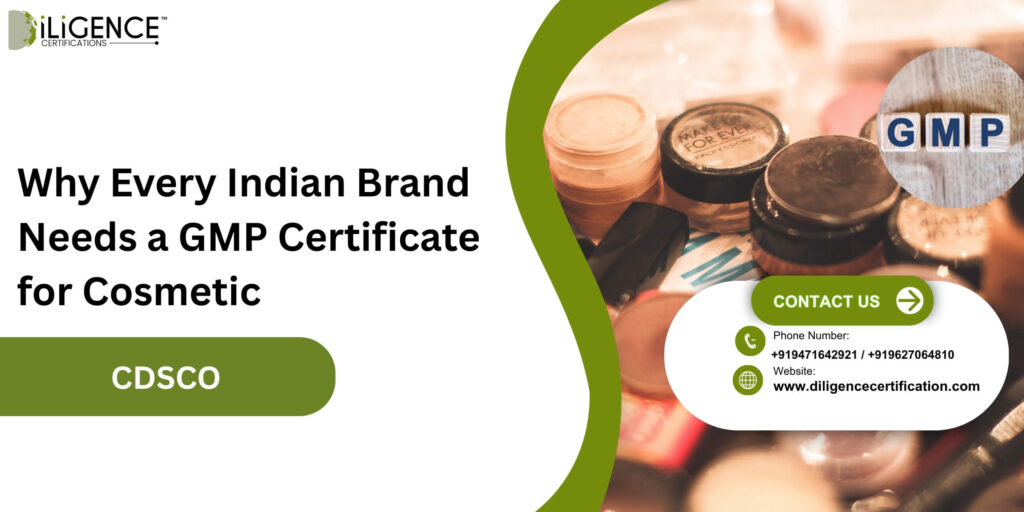
By - A gmp certificate for cosmetic plants the foundation of trust and regulatory compliance in India and globally.
- The framework centres on standards such as ISO 22716:2007 (for cosmetics) and national norms under the Central Drugs Standard Control Organization (CDSCO) and Bureau of Indian Standards (BIS).
- The process demands documented procedures, clean facilities, trained personnel, and batch-wise control from raw materials to finished goods.
- Achieving the certificate adds market advantage - domestically for brand credibility, and internationally for export access.
- Maintaining the certificate means internal audits, corrective actions, and keeping up with regulatory updates (so the gmp certificate for cosmetics never becomes a one-time tick box).
Introduction
When a Mumbai-based start-up came to me with a promising herbal face-cream formulation, they encountered an unexpected speed bump: their contract manufacturer did not hold a valid gmp certificate for cosmetic manufacture. Because of this missing credential, their product could not easily be registered or marketed under major retail chains. The brand owner realised that superior formulation alone would not win the trust of regulators and consumers - the manufacturing backbone had to be verified.
This blog captures why a gmp certificate for cosmetic manufacture matters, how you secure it in India, and what it does for your brand in real terms.
What does a gmp certificate for cosmetic mean?
Understanding the scope
In simple terms, a gmp certificate for cosmetic is a formal attestation that a manufacturing facility adheres to Good Manufacturing Practices (GMP) specific to cosmetics - covering personnel, premises, processes, documentation, hygiene, and control from raw material to finished product. Internationally, ISO 22716:2007 provides the guideline for cosmetics-GMP. In India, while the Drugs & Cosmetics Rules focus largely on medicines, cosmetics companies align with equivalent GMP expectations and sometimes with BIS requirements.
Why not just any certificate?
A generic manufacturing certificate may not suffice. What gives weight is the alignment to the recognised standard. For example, the ISO 22716 standard defines specific controls and records for cosmetics manufacturing - from “personnel & training” to “complaints & recalls”. A simple factory licence alone doesn’t convey the layered discipline that a true GMP certificate for cosmetic production does.
Why your cosmetic brand needs a gmp certificate for cosmetic
Brand credibility and consumer trust
When you display that your manufacturing partner holds a gmp certificate for cosmetic production, you send a strong signal: your product is safely made, batch-controlled, and you respect quality. In the Indian market - where consumers are increasingly discerning and online reviews spread fast - this kind of credibility becomes a differentiator.
Regulatory compliance and export readiness
Under the Central Drugs Standard Control Organization (CDSCO) portal for cosmetic registration, documentation such as a GMP certificate is often required or at least facilitates smoother approval. For exports, many overseas importers expect a facility to be GMP-certified (or to at least follow ISO 22716) to avoid regulatory objection.
Efficiency, risk mitigation and cost savings
From internal audits to process clarity, a GMP regime reduces errors, recalls, rejects and wastage. One Indian contract manufacturer I worked with reduced customer complaints by 45 % within a year of formalising GMP documentation. Thus a gmp certificate for cosmetic manufacture isn’t just compliance - it’s performance improvement.
Key requirements and pillars of a gmp certificate for cosmetic
What needs to be in place?
Facility and equipment
Your premises must be laid out to avoid contamination/cross-mixing. Storage areas must keep raw materials, packaging, and finished goods separate. Equipment must be calibrated and maintained. Details are stipulated under ISO 22716 and equivalent GMP guides.
Personnel and training
All staff must be trained in GMP, hygiene, procedures, control measures. A cosmetic company told me they lost a major deal because their batch records showed untrained temporary staff - an internal audit flagged it. Training records must be maintained.
Documentation and traceability
From procurement to dispatch the production history must be documented. The principle of “what you cannot document, you cannot prove” applies. ISO 22716 emphasises documentation, audits and control of non-conformities.
Quality control and testing
The process should include in-process checks, finished product testing (microbial, heavy-metals), batch-wise release. For cosmetics in India, documents submitted for registration include this data.
Complaint/recall system
There must be a formal mechanism to record, investigate, and recall if needed. ISO 22716 makes provisions for this.
How to obtain the gmp certificate for cosmetic
Step-by-step process
- Gap analysis - Assess current setup versus GMP requirements. Check infrastructure, documentation, processes.
- Remediation - Fix areas of non-compliance: write SOPs, train staff, re-design layout, install calibrations.
- Select a certification body or auditor - In India you may use recognised bodies for ISO 22716 certification, or for the cosmetic GMP certificate under BIS/State licensing.
- Stage 1 audit/document review, then Stage 2 on-site audit. Based on findings you may need corrective actions.
- Issue of certificate - Once you meet requirements the certificate is granted (valid for a defined period, with surveillance audits).
- Maintain compliance - Internal audits, management reviews, continual improvement. Certificate won’t help if you lapse.
Documents typically required
- Proof of facility ownership/lease, layout drawings, storage records.
- Equipment calibration records.
- SOPs for production, cleaning, quality control.
- Training records of staff.
- Batch records, internal audit reports, corrective action logs.
Timelines and cost
While exact numbers vary widely by size and complexity, for cosmetic manufacturing units in India the process from gap-analysis to certificate may take several months if done from scratch. Export-oriented units’ preferred timeframe is quicker because delays cost global orders.
Real Cosmetic Companies Apply GMP in Practice
Consider the analogy of building a house: you might get a flashy facade, but if the foundation is weak you risk collapse. In cosmetics, the formulation is your “façade” (shiny appealing product) but the manufacturing foundation is the gmp certificate for cosmetics - it ensures structural integrity under consumer use, scrutiny and time.
One Indian brand I advised had a great product yet their packaging partner lacked a GMP-certified facility. They suffered a recall because the barrier-laminate used degraded under humidity, triggering complaints. Had they insisted on a gmp certificate for cosmetics ahead of production, this cost could have been avoided.
Brands like Biotique and Forest Essentials (noting premium Indian skin-care) emphasise that their manufacturing partner is GMP/ISO 22716 compliant - this becomes part of their brand story and differentiates them from lower-cost entrants.
Market implications and export advantages
Domestic market benefit
In India, as consumer awareness grows, retailers, e-commerce platforms and quality-certification organisations increasingly ask for proof of GMP compliance. Having the gmp certificate for cosmetic strengthens your listing application, retailer trust, and consumer perception.
Export readiness
Countries in the EU, Middle East, ASEAN and Africa expect cosmetics to be manufactured under recognised GMP frameworks. A manufacturer holding a certificate aligned to ISO 22716 or recognised GMP makes it easier to clear import screening, pass audits, and build partnerships. For example, a contract manufacturer with WHO-GMP certification is more attractive to D2C global brands.
Private labels and contract manufacturing
If you are a brand owner looking for a contract manufacturer, insisting on a gmp certificate for cosmetics is one of the key filters. It ensures the partner has systems, audits, and documentation in place - reducing your brand risk. One Mumbai-based private label business dropped a vendor after discovering their certificate had expired and corrective actions from audit were unresolved - the potential risk to brand reputation was too high.
Common Challenges and how to avoid them
Certificate expired or not maintained
A certificate isn’t enough; the facility must stay compliant. I witnessed a case where a factory’s certificate was valid, but no fresh internal audit had been done after six months and procedures were outdated. The initial audit was good, but surveillance was weak. The brand had to halt shipments until compliance improved.
Certificate obtained but poor implementation
Some brands treat the certificate as tick-box - but if staff aren’t trained, documentation is absent, or production isn’t audited, the value is lost. Training and implementation are the soil in which the certificate grows.
Using a non-relevant GMP standard
For example, a glove manufacturer might have GMP for medical devices, but a cosmetic plant needs GMP specific to cosmetics (such as ISO 22716). Using wrong standard may create issues during audits or export.
Ignoring local regulatory linkages
In India, cosmetic registration under CDSCO’s SUGAM portal requires correct documentation. Without aligning manufacturing GMP with registration requirements, you may face rejections.
How to select a reliable certification body and audit partner
Criteria for selecting the right partner
- Ensure the body is accredited or recognised by a national or international accreditation forum.
- Check their experience with cosmetic manufacturing and audits under ISO 22716; some bodies are more familiar with pharmaceuticals but cosmetics differ.
- Review past audit performance, client testimonials, and their approach to corrective actions.
- Contract clarity: what happens if non-conformities are found ? How long will certification take? What’s the validity period?
- Support services: Some bodies provide gap-analysis, mock audits, training - which are valuable especially for newer plants.
Questions to ask the audit partner
- Will they conduct an on-site audit of your manufacturing facility?
- Will they review documentation in advance and indicate non-conformities?
- Do they offer surveillance audits or just one-time certification?
- How are major vs minor non-conformities treated? What is the timeframe for corrective action?
- Can they certify for ISO 22716 and local Indian regulatory compliance simultaneously (so you don’t duplicate audits)?
Maintenance, surveillance and continuous improvement
What happens after you obtain your gmp certificate for cosmetics?
Achieving certification is not the end - it’s the beginning of ongoing compliance. You must:
- Conduct periodic internal audits (typically every 6-12 months) and corrective action tracking.
- Maintain management review meetings: review quality metrics, complaints, recall data, customer feedback.
- Update procedures whenever processes change (equipment upgrade, formulation change, new packaging).
- Keep training fresh. Staff turnover is high in manufacturing, so new hires must be onboarded under GMP.
- Be ready for surveillance audits by the certification body. Failure to address findings can lead to suspension of certificate.
Build a continuous improvement culture
One D2C cosmetics client of mine instituted a “Quality Hour” every Friday afternoon where all staff discuss one non-conformity, root cause and corrective action. Over a year they halved waste and improved batch consistency. Certificates alone don’t drive change - culture does.
Market trends and regulatory updates impacting the gmp certificate for cosmetic
Indian regulatory developments
The Indian industry is tightening. For example, the Drugs Ministry’s revised GMP rules (though currently more anchored in pharmaceuticals) indicate a direction toward higher stringency. For cosmetics, the Cosmetic Rules 2020 emphasise standards for manufacture, import, labelling and more.
Global expectations rising
Globally, buyers-especially pharmacies, dermatologists and premium retailers-expect GMP-certified facilities even for cosmetics. The standard NSF/ANSI 455‑3 is an example of certification specific to personal care manufacturing.
Consumer awareness and brand demand
Consumers in India increasingly read labels, search for “made in GMP certified factory” and associate that with safer, higher-quality products. As a founder once told me: “Our 30-second Instagram story now shows our GMP badge - it matters.”
Conclusion
Securing a gmp certificate for cosmetic manufacturing facility is a strategic investment, not simply a compliance checkbox. It underpins brand integrity, regulatory readiness and operational excellence. Whether you are launching your first product, outsourcing poduction or planning export, aligning with recognised GMP standards will enhance your brand story, mitigate risk and open doors.
If you would like help assessing your facility, selecting a certification body or building the required procedures, feel free to reach out - your next batch can be made in a truly certified environment, and your brand can comfortably claim “manufactured under GMP standards
Frequently Asked Questions
What does a GMP certificate mean for cosmetic manufacturing?
This is an acknowledgement that an organization operates GMP, such as ISO 22716, to promote safety, quality and hygiene during cosmetic manufacture.
Who issues the GMP certificate to cosmetic plants in India?
An accredited certification body or agency recognised under BIS or ISO 22716 does the audits and issues the certificate.
Is GMP certification mandatory for cosmetics in India?
Not required in all cases, but highly recommended and may be necessary for CDSCO cosmetic registration and export approval.
What are the key requirements for a GMP certification?
Clean premises, trained employees, audit, SOP written procedures, quality testing, handling complaints, and documentation that can be traced.
How long is a GMP certification valid?
Typically 3 years and requires annual surveillance or audit to retain certification.
Is there any benefit in exports with certified GMP?
Yes, a GMP certification is frequently a requirement for export approval to countries such as the EU, ASEAN and the Middle East.
What is the difference between ISO 22716 and GMP certification?
ISO 22716 is the international guideline; GMP certification means that is has been verified by a third party that you are following that guideline at your facility.
What can a cosmetic brand do to maintain GMP compliance?
Conduct regular internal audits, update SOPs, retrain staff, and close corrective actions after each inspection.