 BIS Certification
 CDSCO
CDSCO
 PESO
PESO
 CPCB
CPCB
 LMPC
LMPC
 WPC Approval
 Global Approvals
 TEC
TEC
 ARAI
ARAI
 BEE
BEE
 ISO Certification
 DGCA Certification
 NOC For Steel
 APEDA Registration











 Business Registration
 FSSAI Mark Certification


 (32).jpg)
 Legal Services
 Trademark Registration
 Copyright Registration
 Patent Registration
 By
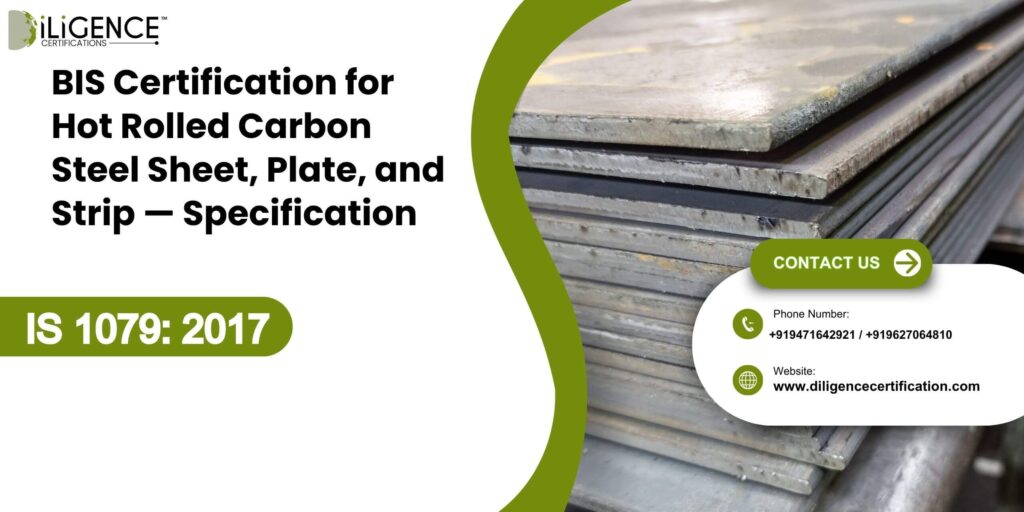
By - Hot-rolled carbon steel products made of carbon steel require a mandatory BIS certification in India.
- It specifies grades HR0-ISH270E with elaborated technical standards.
- It specifies testing, factory audit, and BIS approval.
- It calls for quality control to be thorough and also requires records to be kept.
- It guarantees that the mandate is adhered to and increases the trust of the market.
Introduction
The story goes that a steel manufacturer in Raipur was forced to give up a large OEM contract as their hot-rolled carbon steel sheets were not certified by BIS according to IS 1079:2017. Even though their products were of good quality, they were not allowed to supply without a BIS licence. This certification is basically a guarantee that sheets, plates, and strips conform to the Indian standards in terms of chemical composition and mechanical strength. It is an indispensable requirement for manufacturers who are suppliers of government projects and OEMs. Apart from compliance, BIS certification is also a means of gaining market credibility and customer trust. Bureau of Indian Standards
What is IS 1079:2017?
IS 1079:2017 is the Indian Standard titled “Hot Rolled Carbon Steel Sheet, Plate, and Strip - Specification.” It sets the technical and quality requirements for hot-rolled carbon steel products used in forming, drawing, and general engineering applications.

- It defines the grades HR0 to ISH270E as different levels of formability and strength.
- It bases the specification of the chemicals on carbon, manganese, phosphorus, and sulphur.
- It defines the mechanical characteristics of the material such as tensile strength, yield stress, and elongation.
- Moreover, it also specifies the dimension allowances, surface, and methods of testing.
- This is the standard that serves as a reference for BIS certification under the Steel and Steel Products (Quality Control) Order. ISI MARK
Why is BIS Certification Mandatory
BIS certification is mandatory in the case of hot-rolled carbon steel sheets, plates, and strips that meet the requirements of IS 1079:2017. The reason behind it is that such materials are among those that are mentioned in the Steel and Steel Products (Quality Control) Order issued by the Government of India. The particular Order requires that only those products bearing the ISI mark and conforming to the relevant Indian Standard are the ones that can be sold, imported, or distributed in India.
Key reasons:
- Consumer safety: Aims at assuring the use of steel, which is the core of engineering, automotive, and construction industries, to be strong and free of any kind of defect.
- Regulatory compliance: This is a legal requirement imposed by the Bureau of Indian Standards Act, 2016.
- Quality assurance: Provides the same chemical makeup and mechanical properties.
- Market eligibility: Only products with a BIS certificate can be used for OEMs, PSUs, and government projects.
- Counterfeit export products prevention: It plays a key role in protecting Indian industries and final consumers from cheap and/or harmful materials.
Importance & Benefits of BIS Certification
| Importance | Benefits |
| Legal compliance under the Steel and Steel Products (Quality Control) Order | Permits the production, import, and sale that are legal within India |
| Guarantee of product quality and stability | Leads to customer loyalty and better brand image |
| Conformity with IS 1079:2017 standards | Assures that the material is of specified chemical and mechanical properties |
| Indispensable condition for OEMs and government tenders | Leading to more business possibilities and getting access to bigger markets |
| Security from inferior or fake products | Gives the company more trustworthiness and less chance of their product being rejected |
| Periodic BIS surveillance and audits | Facilitates the implementation of quality improvement and better control of processes |
Step-by-Step Process of BIS Certification

Step1:Documentation
- Collect the details of the factory, the manufacturing process flow, and the quality control records.
- Prepare documents like test equipment list, raw material sources, and layout plans.
- Make sure that all the documents are in line with the determined BIS standard (e.g. IS 1079:2017).
- Have both digital and hard copies ready for filing and subsequent audits.
Step2:Product Testing
- Take product samples to a lab that is recognized by BIS for testing.
- Tests should be done for chemical composition, mechanical strength, and dimensional checks.
- Get a certified test report which indicates that the product meets the Indian Standard.
- Use testing to confirm that the production is consistent before the audit.
Step3:Application Submission
- File the BIS online application through the Manak Online portal.
- Upload test reports, factory documents, and a proof of manufacturing facility.
- Application and inspection fees are paid as per the schedule.
- Keep up with the application status and BIS questions by being prompt in your replies.
Step4:Scrutiny and Inspection
- BIS officials examine documents and test reports for completion and correctness.
- A factory audit is held to confirm production, quality systems, and testing setup.
- Non-conformity, if any, is pointed out for clearing before a licence is issued.
- An inspection that is successful leads the application to the final evaluation stage.
Step5:Grant of License
- If the product and factory meet all requirements of the standard, BIS grants the licence.
- The manufacturer is permitted to put the ISI mark on the product and packaging.
- The licence mentions the grade, size range, and validity period.
- Periodic surveillance audits are performed to ensure that the manufacturer continues to comply with BIS regulations.
Documents required for BIS Certification
| Document | Purpose |
| Factory Registration / GST Certificate | Proof of legal manufacturing entity |
| Manufacturing Process Flow Chart | Shows production and inspection stages |
| List of Machinery & Testing Equipment | Verifies production and lab capability |
| Test Reports from BIS-Approved Lab | Confirms compliance with IS 1079:2017 |
| Quality Control Plan (QCP) | Details quality checks and test frequency |
| Raw Material Certificates | Confirms input material quality |
| Factory Layout & Location Map | Identifies facility structure and layout |
| Calibration Certificates | Validates accuracy of test instruments |
| Authorized Signatory Letter | Names representative for BIS communication |
| Trademark or Brand Authorization | Confirms right to use product branding |
Timelines, Costs, Validity & Renewal
- Timelines: For Indian manufacturers, it may take about 30-45 days; for foreign applicants, it could take up to 6 months
- Costs: Application, Test, Inspection and Marking fee.
- Validity: Licence 2 years.
- Renewal: Every 2 years + updated documents and test reports.
Why Choose Diligence Certifications
- Expert Support: Specialized team with extensive knowledge of BIS certification under IS 1079:2017.
- Full Support: We help you with documenting, product testing, submitting, and preparing for an audit.
- Regulatory Accuracy: Handle all BIS compliance to avoid delays and rejections.
- Experience: Documented knowledge and expertise with BIS certifications in steel, construction, and engineering.
- Time Saved: Manage the entire process for quicker certification and access to the market.
Conclusion
The BIS Certification is a must for the Indian market of Hot Rolled Carbon Steel Sheet, Plate, and Strip products manufactured according to IS 1079:2017. It is the confirmation that the materials supplied are in conformity with the necessary safety, quality, and performance standards. The certification acts as a lever for customer confidence and thus facilitates the entry of your product line into OEM and government projects. The journey can be easy and dependable if you have the right documents, do the proper tests, and follow the correct path. It is always great to have the expert and punctual support of Diligence Certifications in your BIS approval journey.
Frequently Ask Questions
What is BIS Certification According to IS 1079:2017?
BIS certification is a compulsory instrument that is used to indicate that hot rolled carbon steel sheets, plates, and strips meet the Indian Standard IS 1079:2017 in terms of quality, safety, and performance.
Who Need BIS Certification?
The certification is compulsory for all manufacturers and importers of hot-rolled carbon steel sheets, plates, and strips, who by either selling or distributing their products in the Indian market, make them available to consumers.
Is There a Need for BIS Certification of Exported Products?
BIS certification is not necessary for each export shipment; however, it is frequently requested by Indian buyers and OEMs as it is a requirement for domestic supply chains.
Duration of BIS Certification Process?
The typical length of the certification process for local Indian manufacturers is from one to one and a half months, while for overseas companies, the time period can be extended as inspections have to be done on the site, and it can be up to half a year.
What Tests are Done for Certification to IS 1079:2017?
The tests refer to analyses of the material, its mechanical strength, its flexibility, and its dimensional accuracy to assure that the product meets IS 1079:2017 requirements.
Is the Testing Service Available in Any Laboratory?
Tests should be conducted in a laboratory recognized by BIS and which is accredited for the parameters of the IS 1079:2017 standard.
What Does the BIS Factory Inspection Entail?
BIS factory inspectors do a complete investigation of the factory, testing lab, quality assurance department, and records, after which they grant the licence.
How Long is the BIS Licence Valid?
The BIS licence that is issued is valid for a period of two years and has to be renewed every couple of years through submission of updated test reports and compliance certificates.
What If a Person or a Company Sells Without BIS Certification?
Where sales involve uncertified products that are subject to the Quality Control Order, it is considered illegal and the person may be liable to a penalty or confiscation of goods.
Reasons for Getting BIS Clearance Through Diligence Certifications?
Diligence Certifications is your one-stop shop for the BIS clearance process. They provide you with efficient and comprehensive support at every step - from document handling, test arranging, application filing to audit preparation - and thus, giving you the confidence that your BIS certification under IS1079:2017 will not only be accomplished with ease but also in due time.