 BIS Certification
 CDSCO
CDSCO
 PESO
PESO
 CPCB
CPCB
 LMPC
LMPC
 WPC Approval
 Global Approvals
 TEC
TEC
 ARAI
ARAI
 BEE
BEE
 ISO Certification
 DGCA Certification
 NOC For Steel
 APEDA Registration























 Business Registration
 FSSAI Mark Certification











 (32).jpg)
 Legal Services
 Trademark Registration
 Copyright Registration
 Patent Registration
 By
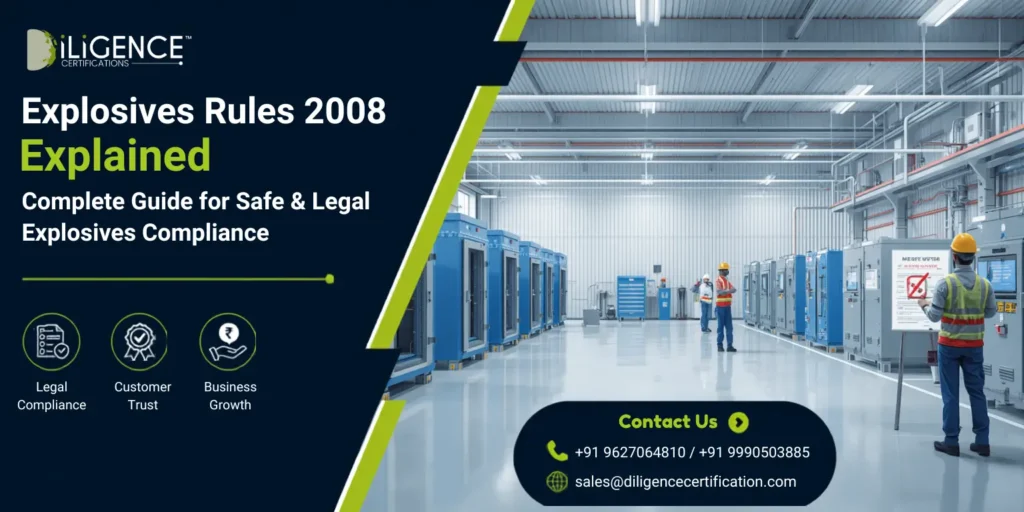
By - The Explosives Rules 2008 play an important role in the compliance of companies working on the manufacture, storage, transport, sale, handling, and usage of explosives in India.
- The rules contain information about the guidelines for license, safety, inspection, approvals, and operations concerning explosives.
- Professional help can be very useful for businesses to cope with documentation and other requirements effectively.
Introduction
Explosives are highly reactive substances that find applications in many sectors like mining, construction, defense, infrastructure development, quarrying, and manufacturing. Being highly reactive and explosive in nature, care has to be taken during manufacturing, storage, transportation, and use of explosives.
A slight mistake made in the process of manufacture, storage, transport, or handling of explosives can result in severe consequences like explosions, fires, loss of property, and safety hazards.
It becomes important, therefore, for businesses working with explosives to take appropriate safety precautions as well as to adhere to relevant laws and regulations.
The Petroleum and Explosives Safety Organization (PESO) looks after the safety regulations regarding explosives in India. The Explosives Rules 2008 came into force for setting up appropriate safety guidelines and regulatory procedures for manufacture, possession, sale, transport, and use of explosives.
Adherence to Explosives Rules 2008 helps businesses to follow standard safety procedures, documentation, and conduct of explosives business in accordance with relevant regulations.
What are Explosives Rules 2008?
The Explosives Rules 2008 are safety laws enacted by the Government of India to govern activities concerning explosives and ensure their safe handling, storage, transportation, and use.
These rules state the guidelines needed to obtain petroleum & Explosives Safety Organization approvals and maintain safety standards, operational procedures, and inspections for explosives activities.
This set of rules ensures that manufacturers, suppliers, transporters, and users of explosives use appropriate safety measures to avoid any risks from explosive substances.
Activities of business establishments involved in manufacturing, importing, storing, selling, transporting, and using explosives may have to comply with the Explosives Rules 2008.
Who Needs Compliance Under Explosives Rules 2008?
Observance of Explosives Rules 2008 might be necessary for business organizations engaged in various processes concerning explosives according to types of explosives, purpose of usage, and operation needs.
These include:
- Explosives Manufacturing Units
- Explosives Storage Facility Operators
- Mining and Quarrying Organizations
- Construction Companies Handling Explosives
- Explosives Importers and Suppliers
- Firework Manufacturers
- Organizations using Industrial Explosives
- Defence and Research Organizations
New establishments or modification of current explosives handling processes by business organizations should observe safety requirements according to Explosives Rules 2008.
Types of Compliance Under Explosives Rules 2008
The compliance requirement of Explosives Rules 2008 varies depending on a number of factors including types of explosives, manufacturing processes, storage capacity, modes of transportation, safety measures, and operation activities.
Approval for Explosives Manufacturing Facility
This approval is necessary for companies engaged in the manufacture of explosives through approved manufacturing processes and safety systems.
Applicable For:
- Explosives Manufacturing Units
- Industrial Explosive Manufacturers
- Fireworks Manufacturing Units
- Special Purpose Explosive Manufacturers
Explosives Storage and Safety Compliance
Explosives storages need to have appropriate safety arrangements, authorized storage arrangements, security, and handling arrangements in order to avoid incidents and unauthorized access.
Uses:
- Magazines for Explosive Storage
- Explosives Storage Areas for Industries
- Storage Areas for Fireworks
- Areas for Explosives Handling
The proper storage will ensure that the explosives are safely stored and handled.
Explosives Transportation and Handling Compliance
Transportation of explosive material involves following safety measures, use of right vehicles, personnel and also adherence to transportation guidelines in order to lower down the associated dangers.
Following are some of the various transportation and handling needs:
- Approved Transportation Systems
- Safety Handling Procedures
- Explosive Handling Personnel Training
- Emergency Preparedness Plans
- Security and Monitoring System
Transportation and handling compliance assists organizations to operate safely and fulfill regulatory requirements of Explosives Rules 2008.
Importance & Benefits of Explosives Rules 2008
| Importance | Benefits |
| Ensures compliance with applicable safety regulations governing the manufacturing, storage, transportation, handling, and use of explosives. | Helps build trust among regulatory authorities, customers, suppliers, and business partners through proper explosives compliance. |
| Provides legal approval to perform explosives-related activities according to prescribed safety standards and regulatory requirements. | Enhances the credibility and professional reputation of the organization within the explosives industry. |
| Promotes safe explosives operations through proper licensing, inspection procedures, safety measures, and operational controls. | Supports uninterrupted business operations by reducing compliance issues, approval delays, and regulatory interruptions. |
| Helps maintain approved manufacturing systems, storage facilities, transportation procedures, and safety management practices. | Reduces the risk of penalties, legal complications, operational restrictions, or rejection due to non-compliance. |
| Protects workers, customers, surrounding communities, and facilities from risks associated with unsafe handling or storage of explosives. | Simplifies future approvals, renewals, modifications, and expansion of explosives-related activities. |
Documents Required for Explosives Rules 2008 Compliance
The documentation needed to be compliant with Explosives Rules 2008 varies depending on type of explosives activity, process of manufacture, storage conditions, mode of transport, safety precautions taken, and regulations applicable.
Generally, the required documents may include:
- Identification of the applicant
- Photo identification (passport size) of the applicant
- Proof of address of applicant and business address
- Documents establishing business registration (proprietorship, partnership, LLP, company)
- Certificate of Incorporation, wherever applicable
- Proof of ownership/lease/rat agreement of the premises
- Site plan/drawing
- Details of explosives storage facilities and infrastructure
- Explosives manufacturing process, wherever applicable
- Details of machinery and equipment used in the explosives activities
- Raw materials and specifications used
- Safety management procedures
- Risk assessment
- Fire safety and emergency preparedness plans
- Details of storage facility and security arrangements
- Details of mode of transport and safety procedures
- Details of technically qualified manpower
- Employee training in handling of explosives
- Standard Operating Procedures (SOP)
- Quality Control/Inspection Procedures
- Calibration certificates of test instruments, wherever applicable
- Factory License and other applicable approvals
- Environmental Approvals or NOCs, wherever applicable
Documents as required by the authority based on the explosives activity
Proper documentation helps companies in avoiding unnecessary delay in the process of compliance with Explosives Rules 2008.
Step-by-Step Compliance Process Under Explosives Rules 2008
Adherence to Explosives Rules 2008 will become easy if businesses adhere to proper procedure which includes documentation, safety measures, and regulatory requirements.
Step 1: Determination of Relevant Requirements
The first step entails identification of relevant requirements of Explosives Rules 2008 taking into consideration various factors like type of explosives, nature of activities, storage requirements, manufacturing process, and operations carried out.
Step 2: Documentation Process
Businesses have to ensure that all technical and other related documents are prepared prior to initiating compliance process.
Step 3: Application for Approval
The application is filed with relevant authority along with relevant documents, technical data, safety information, and compliance information.
Step 4: Document Verification
These documents are checked by the concerned authority in order to verify whether the concerned party satisfies the safety and regulations.
Step 5: Technical Inspection of the Facility
In some cases, an inspection of the manufacturing facility, storage facility, or working premises is done by the concerned authority in order to make evaluation regarding safety arrangements, infrastructure, equipment, storage system, and compliance.
Step 6: Approval under Explosives Rules 2008
Once document verification and technical inspection have been successfully completed, the business can get approval/ license for conducting its activities related to explosives.
Step 7: Ongoing Compliance
On getting the approval, the business has to maintain safety standards, records, inspection, and operational requirements under Explosives Rules 2008.
Timeline, Cost & Validity of Explosives Rules 2008 Compliance
The timeline, cost, and validity related to Explosives Rules 2008 compliance depend on various factors such as type of explosives activity, approval requirements, document verification, inspection process, and compliance with applicable safety regulations.
| Timeline | Cost | Validity |
| The approval timeline depends on document verification, technical evaluation, and inspection of the explosives facility. | The cost depends on the type of approval, explosives activity requirements, documentation expenses, and applicable compliance charges. | The validity depends on applicable explosives regulations, approval conditions, and regulatory requirements. |
| Technical review and inspection of explosives systems may influence the overall processing period. | Government fees, inspection charges, testing expenses, and professional consultancy charges may apply. | Renewal or extension may be required within the prescribed period to continue explosives-related operations. |
| Complete documentation and proper compliance preparation help avoid unnecessary delays. | Additional expenses may vary depending on technical requirements and inspection obligations. | Businesses must maintain continuous compliance with safety and security standards during the approval period. |
| Processing time may vary depending on the complexity of explosives manufacturing, storage, transportation, or handling activities. | Proper planning helps manage overall compliance-related expenses efficiently. | Maintaining updated records supports smooth renewal and compliance management. |
Why is Compliance Under Explosives Rules 2008 Important?
The significance of compliance with Explosives Rules 2008 is that any activity involving explosives should be done in accordance with safety standards and regulations. Given that explosives consist of high-risk materials, any failure in their manufacturing, storage, transport, and handling may lead to accidents such as explosions, fire cases, and damages.
Compliance with Explosives Rules 2008 helps businesses operate in line with proper licensing procedures, safety procedures, inspections, and controls in relation to the use of explosives.
Why compliance with Explosives Rules 2008 is crucial:
- Ensures safety in the manufacture, storage, transport, handling, and use of explosives.
- Aids businesses in meeting technical and safety requirements in relation to explosives.
- Reduces the likelihood of accidents, explosions, fires, and unsafe operations.
- Increases the level of trust from the side of customers, regulatory bodies, and business partners.
Consequences of Non-Compliance with Explosives Rules 2008
Non-compliance with the compliance requirement in Explosives Rules 2008 may lead to a number of problems faced by companies that conduct manufacturing, storage, transportation, sale, or use of explosives. In fact, explosives are extremely dangerous materials, so firms should adhere to certain safety requirements to prevent any risks and complications.
Non-compliance with Explosives Rules 2008 may cause problems with safety, regulation, operation, and continuation of activities connected with explosives.
Some of the possible consequences of non-compliance with Explosives Rules 2008 include:
- Regulatory measures taken by the competent authority.
- Suspension or revocation of approvals or licenses in relation to the activities with explosives.
- Non-compliance with safety and legal requirements.
- Explosion, fire accidents, or other kinds of damage from dangerous actions.
- Problems with further approvals or amendments.
- Negative impact on reputation and trust of clients and business partners.
Adherence to Explosives Rules 2008 compliance requirement may be beneficial for companies.
Renewal of Compliance Under Explosives Rules 2008
The organizations who get clearance or licensing through Explosives Rules 2008 should be sure that they comply with the new regulations and remain compliant.
The renewal process might include an assessment of whether the explosive production units, storage, transportation system, safety practices, and operating practices remain in compliance with the regulations or not.
During the process of renewal, various things can be assessed by the concerned organization, such as:
- Present regulations according to Explosives Rules 2008.
- Safety regulation compliance concerning explosives handling and storage.
- Storage facility condition and operation equipment.
- Records of inspections and compliance.
- Safety training records and explosives handling practices.
- Emergency management and fire safety measures.
- Any modification in explosives facilities.
It helps organizations to manage their renewals process easily and operate without any disturbance.
How Professional Assistance Helps in Explosives Rules 2008 Compliance?
Compliance to Explosives Rules 2008 will require knowledge, documentation, safety planning, readiness for inspection and cooperation with the regulatory authorities. Professional consultancy services make it easy for organizations to comply with the regulations effectively and without making any mistakes and delaying the process.
Professional services will include:
- All information relating to the requirements of Explosives Rules 2008.
- Documentation, safety plans, and record keeping.
- Help with collecting and preparing documentation.
- Helping to prepare and submit applications.
- Coordinating with the verification and inspection process.
- Helping in modifying, renewing and continuing compliance.
- Updates on changing explosives safety regulations.
Professional services enable organizations to manage explosives compliance without diverting from their main business operations.
Why Choose Diligence Certifications for Explosives Rules 2008 Compliance?
Compliance under Explosives Rules 2008 is a procedure which has several technical considerations, evaluation considerations, documentation considerations and compliance considerations.
Several advantages of Diligence Certifications are:
Low probability of making mistakes during documentation and approval processes.
Full support in filling up all required documentation.
Guidance on understanding explosives safety rules.
Coordination with authorities in the course of inspections and approvals.
Help in handling renewals and compliance in case of any changes in explosives handling.
Professional consultancy assists businesses in undertaking explosives handling activities in an assured manner.
Conclusion
Compliance with Explosives Rules 2008 is a critical need for organizations involved in the manufacture, storage, transportation, selling, and usage of explosives. Compliance will help guarantee that explosives-related activities are conducted within the framework of appropriate safety and regulatory standards.
As explosives pose great dangers, adherence to appropriate protocols on handling, storage, transportation, and related activities will ensure prevention of accidents, fires, and unsafe situations.
Through compliance with Explosives Rules 2008, organizations can ensure regulatory compliance and workplace safety along with efficient management of explosives.
Efficient documentation, planning, and regulatory preparedness will make the compliance process easy for organizations. Professional help and guidance will enable organizations to manage their Explosives Rules 2008 requirements easily.
Frequently Asked Questions
Explosives Rules 2008 - What is it?
Explosives Rules 2008 are regulations formulated to ensure the safe manufacture, storage, transport, handling, sale, and use of explosives in India as per set safety standards.
Who requires compliance with Explosives Rules 2008?
Compliance may be required by explosives manufacturers, storage facilities, mines, construction firms, suppliers, transporters, and any organization engaged in explosives operations.
Who oversees Explosives Rules 2008 compliance?
It is the Petroleum & Explosives Safety Organization (PESO) that oversees and monitors the safety requirements of explosives operations in India.
Why is compliance with Explosives Rules 2008 necessary?
Necessary for safe manufacture, storage, transportation, and use of explosives, as well as complying with relevant laws and safety requirements.
What are the necessary documents to ensure compliance with Explosives Rules 2008?
Necessary documents are the documents relating to the registration of business, documents related to the applicant, documents about the layout plan, technical aspects, safety measures, storage facility documents, and others.
Is there any inspection process for Explosives Rules 2008?
Yes, there can be an inspection process to confirm explosives facility, safety measures, storage arrangement, equipment and compliance with all requirements.
Are changes allowed in an approved explosives facility?
Yes, change can be done in an explosives facility with the prior permission or as per the applicable requirements.
Is renewal needed after getting approval under Explosives Rules 2008?
Yes, businesses may require renewal and extension based on applicable requirements and the approval received.
What are the consequences of operating without compliance under Explosives Rules 2008?
Operating without proper compliance can result in regulatory action, suspension of operations, and legal troubles and other issues.
How can professional consultants help to comply with Explosives Rules 2008?
Professional consultants can help in documentation, application, technical requirements, inspection process, and compliance with explosives rules.