BIS Certification
 CDSCO
CDSCO
 PESO
PESO
 CPCB
CPCB
 LMPC
LMPC
 WPC Approval
 Global Approvals
 TEC
TEC
 ARAI
ARAI
 BEE
BEE
 ISO Certification
 DGCA Certification
 NOC For Steel
 APEDA Registration























 Business Registration
 FSSAI Mark Certification












 (32).jpg)
 Legal Services
 Trademark Registration
 Copyright Registration
 Patent Registration
 By
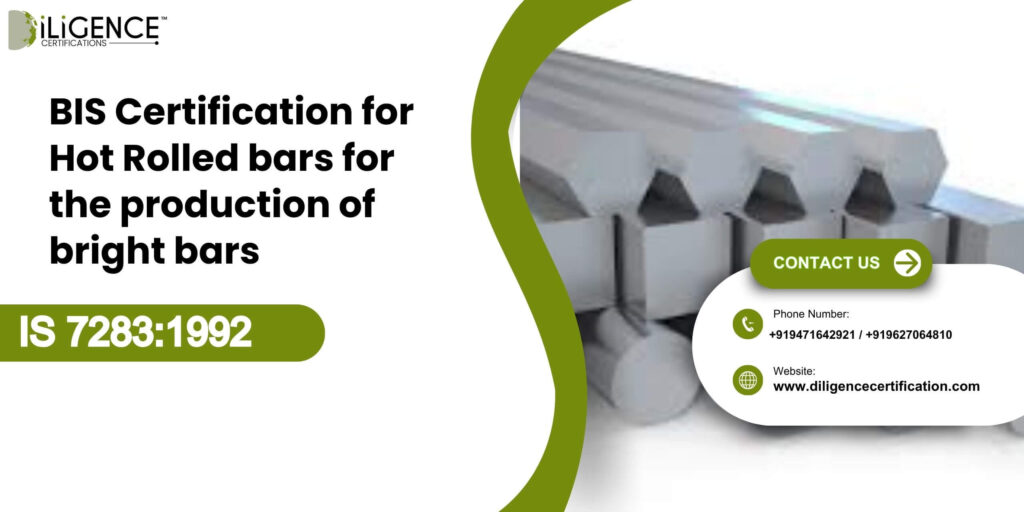
By - BIS Certification for Hot Rolled Bars under IS 7283:1992 is a quality assurance measure for engineering applications.
- It verifies that the product meets chemical, mechanical, and surface standards.
- It requires BIS-approved testing, factory inspections, and complete traceability.
- It helps the purchaser feel more confident and is in compliance with Indian regulatory standards.
- It is accompanied by continuous surveillance and the periodic renewal of the licence.
Introduction
It happened that one lost a major order a steel components manufacturer in Pune due to the fact that their supplier’s hot rolled bars did not have BIS Certification under IS 7283:1992. The material was inspected for dimensions but compliance was rejected, so it could not be used for bright bars and precision parts. As a result, such situations underscore how important it is for a company to have certification in order to be considered credible and to have trouble-free functioning. BIS certification for hot rolled bars used in the production of bright bars and machined parts for engineering applications under IS 7283:1992 is a guarantee that the product meets stringent national standards. Bureau of Indian Standards
What is IS 7283:1992?
IS 7283:1992 is an Indian Standard established by the Bureau of Indian Standards (BIS) It describes the quality and the exact technical requirements of the hot-rolled bars that are the source materials for bright bars manufacturing and the metal parts production that are machined and used for the purpose of engineering. The standard is about ensuring the metal used in these applications to be of consistent quality regarding performance, safety, and machinability.
Key Points:

- Specifies chemical composition, mechanical strength, and surface quality of hot rolled bars.
- Ensures suitability of bars for machining and bright bar production.
- Includes testing, inspection, and marking procedures for traceability.
- Covers dimensional tolerances and defect limits for consistent quality.
- Aims to standardize material for reliable use in engineering industries. ISI MARK
Why is BIS Certification Mandatory
BIS Certification is mandatory to ensure that hot rolled bars used for bright bars and machined engineering parts meet India’s national quality and safety standards. It protects end users, supports fair trade, and enhances industry credibility through regulated compliance.
Key Points:
- Regulatory Requirement: The Ministry of Steel mandates BIS certification under the Quality Control Order for products covered by IS 7283:1992.
- Assures Product Quality: Certification confirms that bars meet chemical, mechanical, and surface specifications required for machining and bright bar production.
- Builds Market Trust: The ISI mark assures buyers that the material is tested and approved by BIS.
- Prevents Non-Conforming Imports: Ensures only certified and traceable material enters the Indian market.
- Supports Legal Compliance: Selling or using uncertified material under a notified standard can attract penalties and rejection by clients or authorities.
Importance & Benefits of BIS Certification
| Importance | Benefits |
| It assures that the product meets the quality standards laid down in IS 7283:1992. | It is a certificate that assures the consumer that the material is defect-free and can be used for machined processes. |
| Mandatory under BIS and Ministry of Steel regulations. | Allows legal sale and smooth market entry in India. |
| Confirms product reliability and performance. | Builds buyer trust and strengthens brand credibility. |
| Promotes uniform testing and manufacturing practices. | Reduces rejections, rework, and quality disputes. |
| Ensures traceability and accountability in production. | Improves efficiency and supports long-term growth. |
Step-by-Step Process of BIS Certification

Step1:Documentation
- Collect technical details of the product, including grade, size, and manufacturing process.
- Prepare a quality manual and internal testing procedures as per IS 7283:1992.
- Ensure availability of raw material traceability and production records.
- Gather legal documents such as factory license, GST certificate, and authorization letters.
Step2:Product Testing
- Collect product samples and send them to a laboratory that is recognized by BIS for testing.
- Focus on the chemical and physical parameters of the product such as chemical composition, mechanical strength, and surface quality.
- Ensure tests are conducted as per the methods specified in IS 7283:1992.
- Collect and review test reports for conformity before submission to BIS.
Step3:Application Submission
- Fill out the application form for BIS certification available on the official online BIS portal with the relevant data.
- Submit all necessary documents and laboratory test reports along with the application form.
- Application and inspection fee payments accompany the submission of the application as per the rules.
- Make sure that the application corresponds to product scope, grade, and size as per IS 7283:1992.
Step4:Scrutiny and Inspection
- The BIS officials who carry out the scrutiny of the application documents look for the accuracy and completeness of the documents.
- An on-site visit to the production unit is planned to have a word with the management and workers.
- The inspectors check if the testing facilities meet the required standards and at the same time, they monitor the production control and traceability systems.
- If any non-conformities are identified, they will be notified for rectification before the issuance of approval.
Step5:Grant of License
- Once the license comes with the inspection and test certificates, it is, in fact, a BIS license, which is granted.
- The manufacturer gets the permission to put the ISI Mark on the product.
- The license contains the standard number (IS 7283:1992) as well as the product details.
- To be able to keep the license, the follow-up and renewal audits are carried out regularly.
Documents Required for BIS Certification
| Document Type | Description / Purpose |
| Application Form | Filled BIS application with product and manufacturer details. |
| Test Reports | Laboratory test results proving compliance with IS 7283:1992. |
| Quality Manual | Details of quality control and inspection procedures at the plant. |
| Manufacturing License | Valid proof of factory registration or industrial license. |
| Product Specifications | Technical data sheet mentioning grade, size, and composition. |
| Factory Layout & Process Flow | Overview of manufacturing and testing facilities. |
| Authorisation Letter | For authorised representative or consultant (if applicable). |
| GST & Identity Proofs | Business registration, GST certificate, and authorised signatory ID. |
Timelines, Costs, Validity & Renewal
- Timelines: Generally, the time period given is 30-45 days for the Indian manufacturers and can be up to 180 days for the foreign applicants.
- Costs: The money part is made up of the application, testing, inspection, and annual marking fee which changes depending on the product scope.
- Validity: A BIS licence is valid for a period of 2 years from the issuing date.
- Renewal: Every two years one has to renew the license with the submission of the latest test reports and with the payment of the renewal fee.
Why Choose Diligence Certifications
- Expertise in BIS Standards: A very competent team which has a record of success in carrying out certification under IS 7283:1992 for steel and engineering products.
- Complete Process Management: The entire journey from assembling the documents to the granting of the licence is thoroughly managed.
- Time-Efficient Execution: The closest relationship with BIS offices is the reason for the fast approval and the least number of the waiting periods.
- Accurate Compliance Handling: Makes sure that all the technical and regulatory requirements are met in order to prevent the application from being rejected.
- Reliable Ongoing Support: Offers the next level of support for surveillance audits, renewals, and new certifications.
Conclusion
The BIS Certification of Hot Rolled Bars used in the production of bright bars and machined parts for engineering applications under IS 7283:1992 serves as a mark of reliability, consistency, and trust for both the manufacturers and the buyers. It confirms that the material is in accordance with the national standards for strength, surface finish, and machinability which are the most essential factors for precision engineering.Diligence Certifications you are assured that the procedure will be performed smoothly and you will be able to achieve your compliance objectives while consolidating your status in the Indian and global market.
Frequently Ask Questions
What is BIS Certification for Hot Rolled Bars under IS 7283:1992?
BIS certification is a quality certification that is mandatory. It is issued by the Bureau of Indian Standards and is aimed at maintaining the quality of hot rolled bars that are the base used in bright bars and machined parts made of steel for engineering applications.
Why is this certification necessary?
Such a certification is essential in that it certifies product quality and safety and compliance with Indian standards which makes the material legally acceptable for industrial and engineering use.
Who must get this certification?
Manufacturers, importers, and suppliers of hot rolled bars that are used in bright bar production or for machining in engineering applications are the ones who must get this certification.
What tests are performed for the certification?
The tests include the chemical and mechanical testing of the material and the surface finish, decarburisation depth, inclusion rating and dimensional accuracy that are carried out as per IS 7283:1992.
How long does it take to get BIS certification?
For Indian manufacturers, the entire procedure takes about 30 to 45 days and for foreigners, the waiting period may be up to 180 days depending on the factory readiness and submission of documents.
What is the validity period of the BIS licence?
The BIS licence is valid for two years. The licence may be renewed every two years by submitting the latest documents and test reports.
Is a certification under IS 7283:1992 obligatory for exports?
Export consignment is not always mandated to have that certification though this certification is highly recommended for global trust and conforming to international markets, particularly where quality assurance is a prerequisite.
What if a manufacturer sells without BIS certification?
By selling under the BIS Act without the proper certification, the offending manufacturer can be punished with fines, seizure of goods, and legal action.
Can a single BIS licence cover several sizes or grades?
If the manufacturer has the laboratory and the production line for all the size groups as mentioned in BIS grouping guidelines, then the answer is affirmative.
Who can help with the BIS certification process?
Trusted consultants like Diligence Certifications can meet your needs completely-they take care of all the steps from documentation and testing to audits and issuing the licence, thus ensuring hassle-free compliance.