BIS Certification
 CDSCO
CDSCO
 PESO
PESO
 CPCB
CPCB
 LMPC
LMPC
 WPC Approval
 Global Approvals
 TEC
TEC
 ARAI
ARAI
 BEE
BEE
 ISO Certification
 DGCA Certification
 NOC For Steel
 APEDA Registration























 Business Registration
 FSSAI Mark Certification












 (32).jpg)
 Legal Services
 Trademark Registration
 Copyright Registration
 Patent Registration
 By
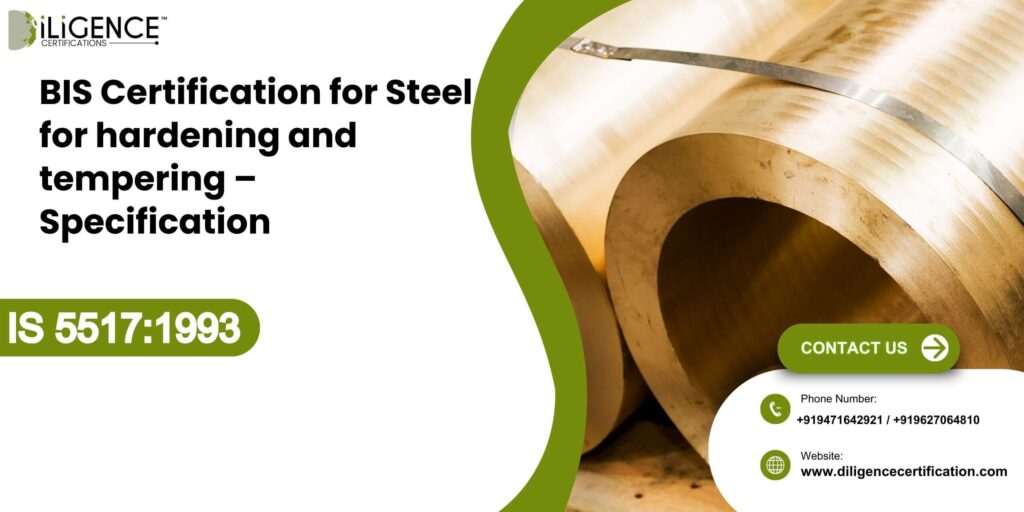
By - Any Steel for hardening that is produced in India must have a BIS Certification according to IS 5517:1993.
- It assesses the chemical composition, hardness, and mechanical properties.
- The certification is obtained through the factory inspection and testing at the BIS lab.
- Non-certified steel is facing customs-related issues and OEM rejections.
- Compliance with standards increases the reliability of the product and thus, its acceptance in the market.
Introduction
Only a single batch of a single alloy steel that had not been certified is said to have caused the Coimbatore tooling manufacturer’s equipment to heat up, crack, and stop the whole production of the dies throughout the heat treatment.BIS Certification for Steel for hardening and tempering - Specification IS 5517:1993 is a standard that was particularly created to prevent such incidents from happening. It offers a common standard to manufacturers, OEMs, and importers against which every batch is expected to behave consistently during heat treatment. In fact, it is far more compliant and component safe than a dispute. Bureau of Indian Standards
What is IS 5517:1993?
IS 5517:1993 is an Indian standard describing the quality of steel alloys that are suitable for hardening and tempering. Essentially, the standard serves as the reference for reliable heat treatment results, strength that can be relied upon, and safety, when the metals are used as heavy-duty parts in an industrial sector.

Key Points:
• Defines chemical composition and impurity limits.
• Specifies hardness and mechanical property requirements.
• Includes hardenability and microstructure criteria.
• Applies to bars, rods, flats, and similar steel products.ISI MARK
• Forms the technical basis for mandatory BIS certification.
Why is BIS Certification Mandatory
BIS certification is compulsory because hardening and tempering steels are used in critical applications where any inconsistency can lead to failure, safety issues, or product defects. The government enforces this through Quality Control Orders to ensure only compliant steel enters the Indian market.
Key Points:
- Guarantees that steel conforms to IS 5517:1993 standards of quality and safety.
- Stops the sale and import of sub-standard or non-certified alloy steel.
- Guards OEMs and the final users against the risks of heat-treat failures and resulting structural problems.
- Gives access to regulators and purchasers for checking conformity through a BIS licence.
- Supports uniformity and reliability across the manufacturing supply chain.
Importance and Benefits of BIS Certification
| Importance | Benefits |
| Ensures steel meets IS 5517:1993 quality requirements | Reduces failures during hardening and tempering |
| Confirms material safety and reliability for critical components | Improves product performance and consistency |
| Mandatory under Quality Control Orders | Avoids customs issues and regulatory penalties |
| Builds trust with OEMs and major buyers | Strengthens market acceptance and supplier approval |
| Enables traceability and quality assurance | Lowers rejection rates and enhances brand credibility |
Step-by-Step Process of BIS Certification

Step1:Documentation
- Collect required technical documents
- Prepare product specifications
- Gather company registration details
- Ensure documents follow BIS format
Step2:Product Testing
- Send samples to a BIS-approved lab
- Conduct safety and quality tests
- Receive test reports
- Confirm compliance with BIS standards
Step3:Application Submission
- Fill out the BIS application form
- Upload all required documents
- Attach valid test reports
- Pay the necessary BIS fees
Step4:Scrutiny and Inspection
- BIS reviews submitted documents
- Authority verifies test results
- Factory/product inspection may occur
- Clarifications requested if needed
Step5:Grant of License
- BIS approves the application
- License number is issued
- Product can carry BIS mark
- Renewal required before expiry
Documents Required for BIS Certification
| Category | Documents Required |
| Business Documents | Business license/registration, ISO certificate, organizational details |
| Manufacturer Details | Factory layout, process flow chart, machinery list, production details |
| Product Documents | Product specifications, component list, user manual, model details |
| Testing Documents | Test report from BIS-recognized lab, sample details, test request form |
| Legal & Compliance | Authorization letter, brand ownership proof, trademark certificate (if any) |
| Import/Foreign Manufacturer (If applicable) | AIR (Authorized Indian Representative) details, contract agreement, overseas manufacturer documents |
Timelines, Costs, Validity & Renewal
- Timelines: Usually from 20 to 30 days, with only 7-15 days for the testing.
- Costs: The cost of the government and the test varies depending on the product. There can be some additional charges though.
- Validity: The validity period is 2 years in most situations.
- Renewal: The renewal is done before the expiration; there should be updated documents/tests; the renewal
Why Choose Diligence Certifications
- Expert team with strong BIS and regulatory knowledge
- Fast, streamlined processing to reduce approval delays
- Accurate documentation and testing coordination
- Transparent guidance with clear communication
- High success rate and complete end-to-end support
Conclusion
BIS certification based on IS 5517:1993 for hardened and tempered specified steel gives a very good structure to manufacturers and importers to keep up quality and consistency. As a result, the problem of production delays due to the failure of the product is minimised because the behaviour of the heat treatment becomes predictable. When steel meets this standard, heat-treat behaviour becomes predictable, reducing failures and production delays. Buyers also gain confidence because certified material meets mandatory regulatory norms. For suppliers, it opens doors to OEM approvals and smoother audits. With proper preparation and testing discipline, the certification process becomes straightforward and adds long-term value to the business.
Frequently Ask Questions
What is IS 5517:1993?
IS 5517:1993 identifies the standard of alloy steel for hardening and tempering that is in line with the Indian Standard. It lays down the requirements for the chemical composition, hardness, mechanical properties, and hardenability of alloy steels used for hardening and tempering.
Why is BIS certification mandatory for hardening and tempering steel?
As the metal is the mainstay in the critical area of the industry, the Government, through its Indirect Control Agency (BIS), insists on the certification of the latter to confirm the security, the reliability, and the stability of the product during the heat treatment.
Who needs BIS certification under IS 5517:1993?
The manufacturing, importing, and supply businesses of such alloy steel as are meant for hardening and tempering and which include products like bars, rods, and flats must acquire a BIS certification if they are to be allowed to trade their goods or bring the latter into the Indian market.
What are the major tests done under IS 5517:1993?
Besides test methods for product characterization and the detection of the chemical composition in the molten metal, tests cover hardness measurement, tensile strength and impact strength evaluation, microstructure investigation, and hardenability determination.
How long does the BIS certification process take?
The entire operation is rather slow-paced and thus, 20-30 days are usually required to complete the grant, including 7-15 days for laboratory testing.
What documents are required for BIS certification?
The relevant papers are business registration, product specifications, factory layout, and machinery list as well as test reports from the BIS lab and compliance or authorization documents.
Is factory inspection mandatory for BIS certification?
Indeed, some BIS audits may include a factory check to see first hand how the production of the product is being done, and if the level of quality control and test result consistency is up to standard.
How long is the BIS license valid?
BIS certification usually has a validity period of 2 years and a renewal is required to be granted time prior to the expiration date.
What happens if a manufacturer imports or sells non-certified steel?
An uncertified steel product may be subjected to rejection at customs, a lack of trust from original equipment manufacturers (OEMs), a fine being levied on the offender, and legal ramifications under the Quality Control Orders may also be incurred.
Can foreign manufacturers apply for BIS Certification under IS 5517:1993?
Yes. To begin with, a foreign manufacturer needs to have an Authorized Indian Representative (AIR). Further, from testing to documentation, a foreign manufacturer has to abide by the same norms as an Indian one.