 BIS Certification
 CDSCO
CDSCO
 PESO
PESO
 CPCB
CPCB
 LMPC
LMPC
 WPC Approval
 Global Approvals
 TEC
TEC
 ARAI
ARAI
 BEE
BEE
 ISO Certification
 DGCA Certification
 NOC For Steel
 APEDA Registration












 Business Registration
 FSSAI Mark Certification










 (32).jpg)
 Legal Services
 Trademark Registration
 Copyright Registration
 Patent Registration
 By
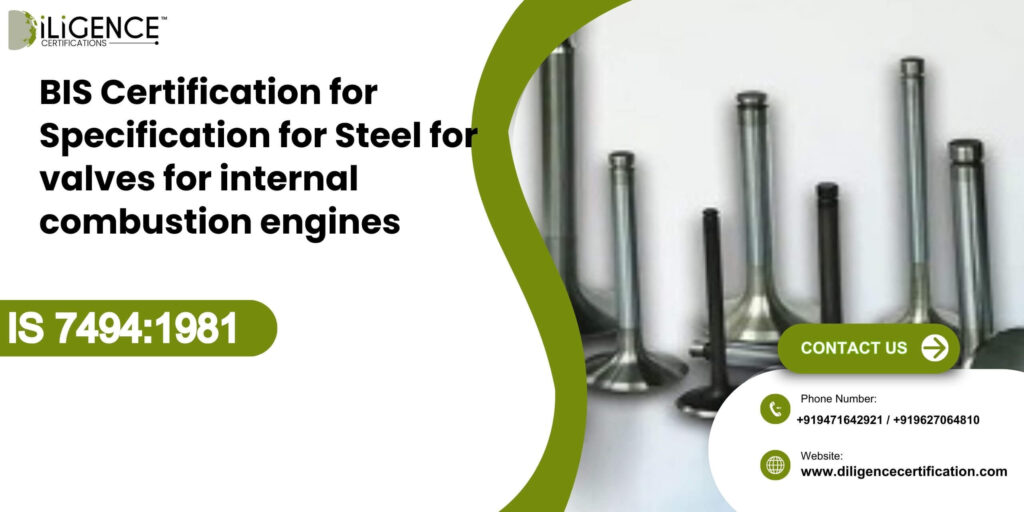
By - BIS Certification for IS 7494:1981 acts as a measure to ensure the quality and safety of the Specification for Steel for valves that are used in the production of valves for the engine.
- It is in conformity with the regulations set for the chemical composition, mechanical properties, and heat-treatment.
- It is a must-have for steel-producing companies, makers of valve components, and importers who supply to automotive OEMs.
- The process includes various means of testing such as lab testing, factory audit, documentation review, and traceability checks.
- A licence possession is a viable business tool that a supplier uses to showcase their reliability and thus, eliminate the possibility of rejection along the supply-chain.
Introduction
BIS Certification for Specification for Steel for Valves for Internal Combustion Engines IS 7494:1981. The quality of their product was not the issue; it was formal compliance and traceability that were the problem. OEMs in the entire automotive sector require that the first proof of each batch of valve steel be in accordance with the chemical and mechanical specifications. Since engines are getting hotter under the BS VI norms, the stakes have become higher, and the documentation is as important as the metallurgy. For producers, this certification has become their main hurdle, from merely being a procedural formality to a factor that leads to winning and retaining supply contracts. Bureau of Indian Standards
What is IS 7494:1981?
IS 7494:1981 Indian Standard that details the technical requirements for the steel used in the production of valves for internal combustion engines. The equipment is required to operate under high temperatures, cyclic stress, corrosive gases, and continuous mechanical load. To ensure the safety of both intake and exhaust valves, the standard specifies very exact chemical, mechanical, heat-treated, and microscopic structure requirements.
Key Points

- It defines the chemical composition of the steel used for the production of valves specifying carbon, chromium, nickel, and molybdenum.
- It prescribes tensile strength, hardness, and elongation as mechanical properties.
- It also strictly enforces the use of certain heat-treatment methods to attain the desired performance.
- Includes microstructure controls like grain size and decarburisation limits. ISI MARK
- Ensures consistent, safe, and traceable material for automotive engine valve manufacturing.
Why is BIS Certification Mandatory
BIS Certification for IS 7494:1981 has to be there as the fire-grade metal oxygen steel has a direct impact on the safety and the longevity of the engine. The certification is the one that really checks that the material is up to the standard in terms of composition, mechanical properties, and heat treatment, thus making sure that it is capable of enduring the most severe conditions in the engine. Furthermore, it eliminates the possibility of sporadically manufactured or low-quality steel finding their way into the automotive supply chain.
Key Points
- Ensures safety compliance for critical engine components.
- Confirms chemical and mechanical properties align with IS 7494:1981.
- Prevents supply of substandard or untested steel.
- Provides batch-wise traceability for OEM requirements.
- Strengthens supplier credibility and reduces rejection risks.
Importance and Benefits of BIS Certification
| Importance | Benefits |
| Ensures valve-grade steel meets safety and performance standards | Reduces risk of engine valve failure and warranty claims |
| Confirms compliance with chemical, mechanical, and heat-treatment requirements | Increases acceptance by OEMs and Tier-1 suppliers |
| Prevents entry of substandard or counterfeit steel | Improves brand reputation and market trust |
| Provides mandatory batch traceability for audits | Minimises supply-chain rejections and delays |
| Supports regulatory requirements for automotive materials | Helps access new contracts and export opportunities |
Step-by-Step Process of BIS Certification

Step1:Documentation
- Collect required technical documents
- Prepare product specifications
- Gather company registration details
- Ensure documents follow BIS format
Step2:Product Testing
- Send samples to a BIS-approved lab
- Conduct safety and quality tests
- Receive test reports
- Confirm compliance with BIS standards
Step3:Application Submission
- Fill out the BIS application form
- Upload all required documents
- Attach valid test reports
- Pay the necessary BIS fees
Step4:Scrutiny and Inspection
- BIS reviews submitted documents
- Authority verifies test results
- Factory/product inspection may occur
- Clarifications requested if needed
Step5:Grant of License
- BIS approves the application
- License number is issued
- Product can carry BIS mark
- Renewal required before expiry
Documents Required for BIS Certification
| Category | Documents Required |
| Business Documents | Business license/registration, ISO certificate, organizational details |
| Manufacturer Details | Factory layout, process flow chart, machinery list, production details |
| Product Documents | Product specifications, component list, user manual, model details |
| Testing Documents | Test report from BIS-recognized lab, sample details, test request form |
| Legal & Compliance | Authorization letter, brand ownership proof, trademark certificate (if any) |
| Import/Foreign Manufacturer (If applicable) | AIR (Authorized Indian Representative) details, contract agreement, overseas manufacturer documents |
Timelines, Costs, Validity & Renewal
- Timelines: Usually from 20 to 30 days, with only 7-15 days for the testing.
- Costs: The cost of the government and the test varies depending on the product. There can be some additional charges though.
- Validity: The validity period is 2 years in most situations.
- Renewal: The renewal is done before the expiration; there should be updated documents/tests; the renewal
Why Choose Diligence Certifications
- Expert team with strong BIS and regulatory knowledge
- Fast, streamlined processing to reduce approval delays
- Accurate documentation and testing coordination
- Transparent guidance with clear communication
- High success rate and complete end-to-end support
Conclusion
BIS Certification for Specification for Steel for Valves for Internal Combustion Engines IS 7494:1981 has become a must-have for any serious supplier. It is the proof that every batch is in compliance with the stringent chemical and mechanical requirements and therefore the risk of OEM rejection is minimized. Apart from that, producers become more trustworthy and get facilitated access to the supply chains of high-value. With support from Diligence Certifications, companies can complete documentation, testing, and audits without confusion or delays. This certification ultimately protects both product quality and long-term business opportunities.
Frequently Ask Questions
What is IS 7494:1981 used for?
The standard defines perfect requirements for the chemical, mechanical, and heat treatment features of the steel used for the manufacture of valves made for internal combustion engines.
Who needs BIS Certification under IS 7494:1981?
Need to get the Bis certification are steel providers, the manufacturers of the valve components, the loosening units and the importers that supply the valve-grade steel to automotive OEMs or Tier-1 suppliers.
Is BIS Certification for IS 7494:1981 mandatory?
Definitely, it is a must because steel for valves is a safety-critical material that has to be compliant with BIS standards before it gets into the automotive supply chain.
What tests are required for IS 7494:1981 certification?
Tests of the chemical composition, tensile tests, hardness tests, microstructure evaluation, and heat-treatment confirmation have to be performed through a laboratory certified by BIS.
How long does the BIS Certification process take?
Usually, between 20 and 45 days depending on the readiness of the documents, the time required for lab testing, and the scheduling of factory inspection.
What documents are needed for BIS Certification?
Documents required are business registration, factory layout, process flow chart, machinery list, product specifications, and test reports, compliance documents too.
Does BIS conduct a factory inspection?
Yes, BIS officials regularly visit the plant to check the production line, quality control, traceability systems, and records of equipment calibration.
How long is the BIS licence valid?
Usually, the majority of BIS licences granted under this standard have a validity period of 2 years, and after this period, they can be renewed with updated compliance documents and test reports.
What happens if test samples fail?
An application may be put on hold if test samples fail. Manufacturers must address the technical problem, perform the tests again on the samples and send the documentation once more.
How can Diligence Certifications help?
Diligence certifications help you in all the stages starting from the preparation of documentation till the completion of the audit. They are there to provide you with testing, filing, and the whole support you need for your fast approval.