BIS Certification
 CDSCO
CDSCO
 PESO
PESO
 CPCB
CPCB
 LMPC
LMPC
 WPC Approval
 Global Approvals
 TEC
TEC
 ARAI
ARAI
 BEE
BEE
 ISO Certification
 DGCA Certification
 NOC For Steel
 APEDA Registration























 Business Registration
 FSSAI Mark Certification












 (32).jpg)
 Legal Services
 Trademark Registration
 Copyright Registration
 Patent Registration
 By
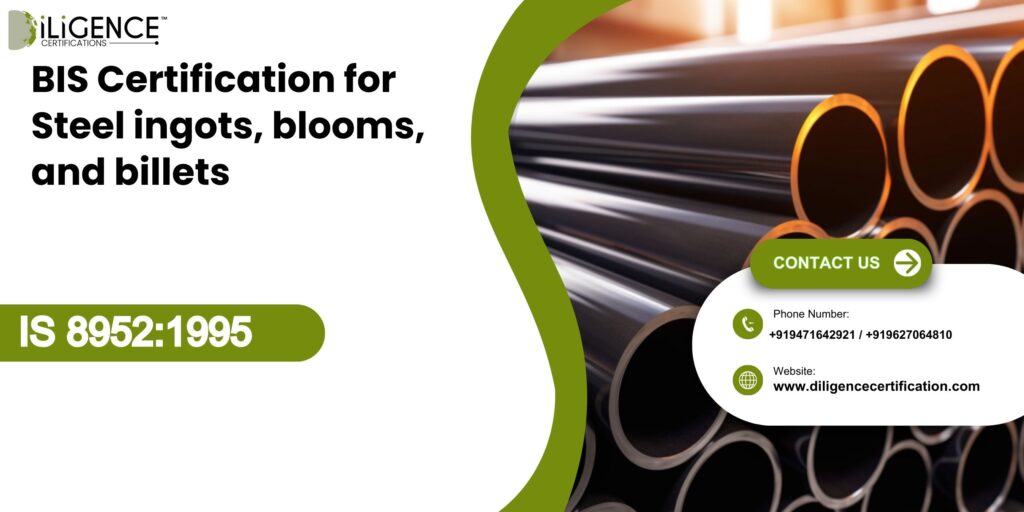
By - IS 8952:1995 defines quality norms for ingots, blooms, and billets used in mild Steel ingots rods.
- BIS certification verifies chemical, mechanical and surface-quality compliance.
- Plants need calibrated labs and heat-wise traceability.
- Most delays stem from documentation gaps and surface defects.
- Proper testing and record control speed up licence approval.
Introduction
A few months ago, a billet manufacturer from Nagpur approached us after two failed BIS audits under IS 8952:1995. His chemistry reports were within limits, yet the licence kept getting deferred because heat traceability and macro-etch procedures weren’t aligned with BIS expectations. Many steel plants face the same issue: production is stable, customers are interested, but certification stalls due to procedural gaps rather than quality. BIS Certification for steel ingots, blooms and billets is now a prerequisite for supplying to most wire-rod producers, so even minor inconsistencies can hold back orders. This guide outlines how manufacturers can meet the standard requirements without repeated interruptions. Bureau of Indian Standards
What is IS 8952:1995?

IS 8952:1995 is an Indian Standard outlining the quality, chemical composition, mechanical properties, and testing standards of steel ingots, blooms, and billets to be used for the production of mild steel wire rods for general engineering purposes. It is the source of standards that guarantee the integrity of the semi-finished steel both from a structural and a chemical point of view as well as its capability of being further rolled without the occurrence of any defects.
Key Points:
- Covers ingots, blooms and billets used specifically for mild steel wire rod production.
- Specifies chemical limits for carbon, manganese, sulphur and phosphorus.
- Requires mechanical tests such as tensile and bend tests.
- Mandates macro-etch examination to check internal defects. ISI MARK
- Ensures traceability, marking and quality control during manufacturing.
Why is BIS Certification Mandatory
BIS certification has been made mandatory due to the fact that the government controls the quality of the essential steel products that are to be used in the following engineering applications. Steel wire rods of a low-grade quality are largely the result of the direct influence of ingots, blooms, and billets on their performance, and therefore BIS is the one that guarantees that only those materials that meet the requirements are allowed to be used.
Key Reasons:
- Protects end-users from defective or inconsistent steel.
- Ensures uniform chemistry and mechanical properties across batches.
- Prevents structural failures in engineering and fabrication applications.
- Enforces plant-level traceability, testing and quality control.
- Helps buyers, OEMs and public-sector projects source only approved materials.
Importance and Benefits of BIS Certification
| Importance | Benefits |
| Ensures uniform quality of ingots, blooms and billets | Better acceptance from wire-rod manufacturers and OEMs |
| Protects downstream processes from defects and failures | Fewer rejections and lower production losses |
| Enforces mandatory testing and traceability | Stronger documentation and audit readiness |
| Aligns products with national safety standards | Easier entry into government and regulated sectors |
| Builds market confidence and accountability | Higher credibility, brand value and long-term contracts |
Step-by-Step Process of BIS Certification
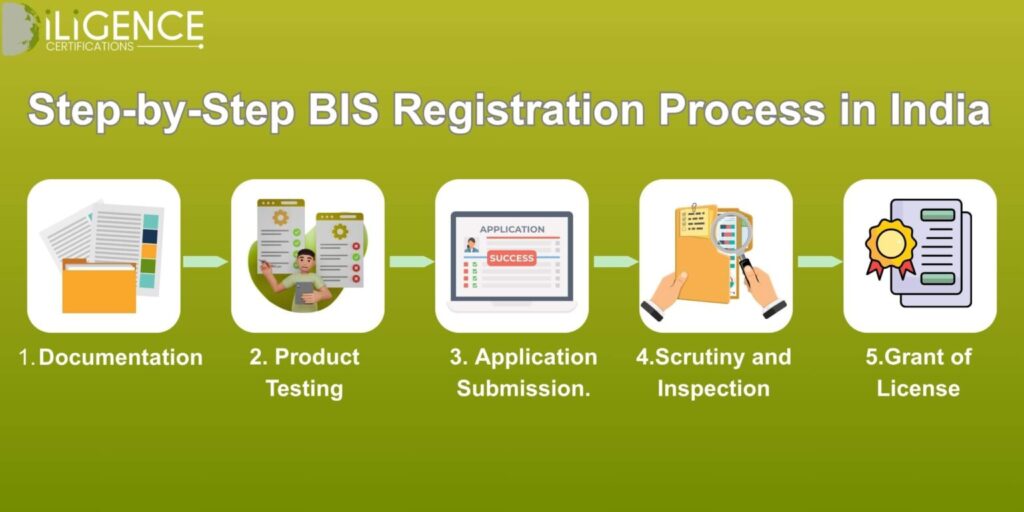
Step1:Documentation
- Collect required technical documents
- Prepare product specifications
- Gather company registration details
- Ensure documents follow BIS format
Step2:Product Testing
- Send samples to a BIS-approved lab
- Conduct safety and quality tests
- Receive test reports
- Confirm compliance with BIS standards
Step3:Application Submission
- Fill out the BIS application form
- Upload all required documents
- Attach valid test reports
- Pay the necessary BIS fees
Step4:Scrutiny and Inspection
- BIS reviews submitted documents
- Authority verifies test results
- Factory/product inspection may occur
- Clarifications requested if needed
Step5:Grant of License
- BIS approves the application
- License number is issued
- Product can carry BIS mark
- Renewal required before expiry
Documents Required for BIS Certification
| Category | Documents Required |
| Business Documents | Business license/registration, ISO certificate, organizational details |
| Manufacturer Details | Factory layout, process flow chart, machinery list, production details |
| Product Documents | Product specifications, component list, user manual, model details |
| Testing Documents | Test report from BIS-recognized lab, sample details, test request form |
| Legal & Compliance | Authorization letter, brand ownership proof, trademark certificate (if any) |
| Import/Foreign Manufacturer (If applicable) | AIR (Authorized Indian Representative) details, contract agreement, overseas manufacturer documents |
Timelines, Costs, Validity & Renewal
- Timelines: Usually from 20 to 30 days, with only 7-15 days for the testing.
- Costs: The cost of the government and the test varies depending on the product. There can be some additional charges though.
- Validity: The validity period is 2 years in most situations.
- Renewal: The renewal is done before the expiration; there should be updated documents/tests; the renewal
Why Choose Diligence Certifications
- Expert team with strong BIS and regulatory knowledge
- Fast, streamlined processing to reduce approval delays
- Accurate documentation and testing coordination
- Transparent guidance with clear communication
- High success rate and complete end-to-end support
Conclusion
BIS Certification for one batch of steel ingots, blooms and billets as per IS 8952:1995. The operation might look complicated, however, after the plant’s testing, traceability and documentation systems are in line with the BIS requirements, the certification turns into a reliable benefit rather than a compliance burden. It reassures buyers that every heat meets national standards and that your material will perform consistently during rolling and downstream applications. If you need guidance on audit preparation, lab setup or documentation, we can help streamline the process and ensure your certification moves without unnecessary delays.
Frequently Ask Questions
What is IS 8952:1995?
It is an Indian Standard that specifies the minimum requirements in terms of chemistry, mechanical and structural aspects for the steel ingots, blooms, and billets which form the primary raw material of mild steel wire rods.
Is BIS Certification compulsory for ingots, blooms, and billets?
Yes. A certification by the Bureau of Indian Standards is a prerequisite for these products when they are intended for the local production of mild steel wire rods.
Which manufacturers require BIS Certification under IS 8952:1995?
Both the Indian and foreign producers of the ingots, blooms or billets the wire-rod industry is using must obtain the BIS nod before marketing their goods in India.
What are the necessary tests to comply with IS 8952:1995?
The mandatory tests cover chemical analysis, tensile test, bend test, macro-etch examination, and also surface-quality inspection.
What is the duration of the BIS Certification process?
The entire process is generally completed within 20-30 days. Nevertheless, the exact duration depends on document readiness, factory inspection, and lab testing.
What closely correspond to the main reasons for BIS application delays?
Among the major reasons for that setback are such issues as that of incomplete documents, calibration errors, surface defects presence, and incorrectly performed heat traceability.
Are foreign manufacturers allowed to apply for this BIS license?
It is a "yes". The only limitation is that they must submit their application through the BIS FMCS and also have an Authorized Indian representative.
What is the duration of the BIS licence?
The license is typically valid for two years from the day it is issued and, after that, it may be renewed upon submission of recent documents and test reports.
What are the documents required for BIS Certification under IS 8952:1995?
Apart from the essential items for filing a BIS cert application, there are business registration, factory layout, process flow chart, machinery list, test reports from a lab recognized by BIS, and local compliance documents.
Is certification possible for a plant lacking an in-house lab?
Yes, it is. Nevertheless, BIS is not very supportive of plants that are almost entirely reliant on third-party labs for testing as they do not possess their own calibrated testing facilities. Very often, this leads to holding up of audits or the raising of queries.