BIS Certification
 CDSCO
CDSCO
 PESO
PESO
 CPCB
CPCB
 LMPC
LMPC
 WPC Approval
 Global Approvals
 TEC
TEC
 ARAI
ARAI
 BEE
BEE
 ISO Certification
 DGCA Certification
 NOC For Steel
 APEDA Registration























 Business Registration
 FSSAI Mark Certification












 (32).jpg)
 Legal Services
 Trademark Registration
 Copyright Registration
 Patent Registration
 By
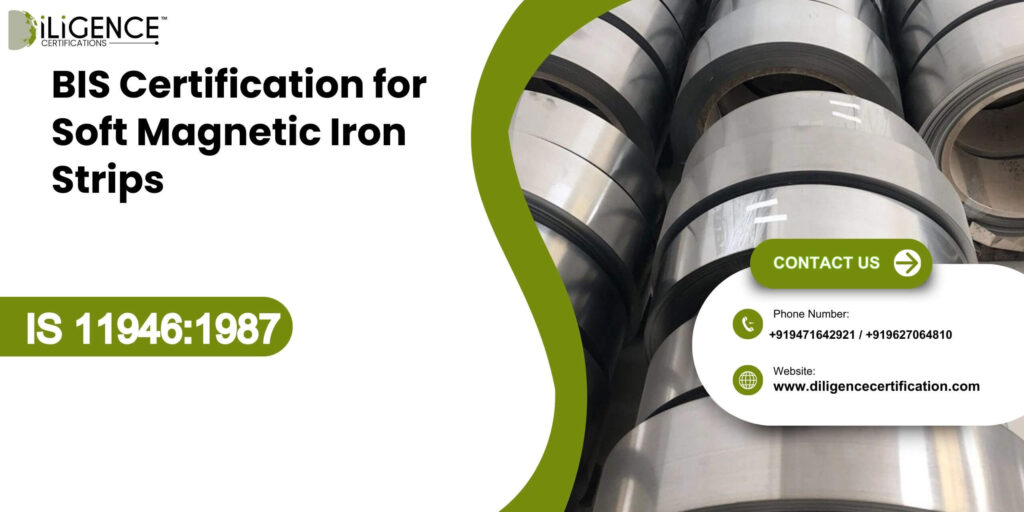
By - BIS Certification for Soft Magnetic Iron Strips IS 11946:1987 ensures compliance with Indian quality and safety standards.
- Certified strips maintain consistent magnetic properties, chemical composition, and mechanical tolerances.
- BIS certification is instrumental in widening the access to the market, gaining the confidence of the clients, and being qualified for government and industrial projects.
- The certification journey is marked by steps such as application, documentation verification, factory inspection, and product testing.
- Getting certification is one of the ways that brand trust is boosted, the risk of law breaking is lowered, and the brand gets a competitive advantage in the sector of electrical manufacturing.
Introduction
A major transformer maker in Pune was suffering from project approval delays. Their soft magnetic iron strips for transformers were not BIS certified under IS 11946:1987, which was the major cause of the problem. Although the manufacturer was using good-quality materials, the buyers and suppliers were asking for the product to be in compliance with Indian standards before they could place the orders. Manufacturers of various products have been downplaying the significance of BIS certification of soft magnetic iron strips. Besides being a legal requirement, product certification is a quality assurance tool, a marketing tool, and a road opener to expensive industrial and government projects. Bureau of Indian Standards
What is IS 11946:1987?
IS 11946:1987 is the Indian Standard that specifies the requirements for soft magnetic iron strips used in electrical machines such as transformers, motors, and inductors. It defines the chemical composition, magnetic properties, and mechanical tolerances necessary to ensure optimal performance, safety, and reliability in electrical applications. Compliance with this standard is essential for manufacturers seeking BIS Certification and acceptance in the Indian market.
Key points:

- It defines the chemical composition of the limiting element for carbon, silicon, and other alloys.
- The standard sets the magnetic properties such as magnetic permeability, power loss in the core, and saturation flux density.
- It stipulates the dimensional/mechanical tolerances for thickness, width, and surface finish of the strips.
- IS 11946 ensures consistent performance and safety of electrical machines.
- Forms the basis for BIS Certification for soft magnetic iron strips in India. ISI MARK
Why is BIS Certification Mandatory
BIS Certification is a must for soft magnetic iron strips in India to uphold product safety, quality, and conformity with the regulations. These strips are the ones which electrical machines like transformers and motors use for the efficient conduction of magnetic flux and even a slight change in the material properties can lead to the loss of the performance or the breaking of the equipment.
Key reasons for mandatory BIS Certification:
- It is aimed at ensuring the adherence to IS 11946:1987 standards covering areas like chemical composition, magnetic properties, and mechanical tolerances.
- It is a quality assurance measure that drastically lessens the chances of defects and subsequent failures in the electrical applications where these products are involved.
- It offers compliance with the law and protection to manufacturers against fines or rejection of their shipments.
- By allowing access to government projects and industrial contracts, the certification improves the market reputation of the products.
- Besides, BIS certification is the key to maintaining the trust of consumers and clients which makes certified manufacturers the best choice as reliable suppliers in the industry.
The Importance and Benefits of BIS Certification
| Importance of BIS Certification | Benefits of BIS Certification |
| Ensures compliance with IS 11946:1987 standards | Improves market access and eligibility for government projects |
| Guarantees consistent quality and performance of soft magnetic iron strips | Builds brand credibility and client trust |
| Reduces risk of product failures in electrical machines | Provides a competitive edge over non-certified manufacturers |
| Ensures legal and regulatory compliance | Enhances long-term business growth and reputation |
| Validates manufacturing processes and material quality | Simplifies approvals from contractors and industrial buyers |
Step-by-Step Process of BIS Certification

Step1:Documentation
- Collect required technical documents
- Prepare product specifications
- Gather company registration details
- Ensure documents follow BIS format
Step2:Product Testing
- Send samples to a BIS-approved lab
- Conduct safety and quality tests
- Receive test reports
- Confirm compliance with BIS standards
Step3:Application Submission
- Fill out the BIS application form
- Upload all required documents
- Attach valid test reports
- Pay the necessary BIS fees
Step4:Scrutiny and Inspection
- BIS reviews submitted documents
- Authority verifies test results
- Factory/product inspection may occur
- Clarifications requested if needed
Step5:Grant of License
- BIS approves the application
- License number is issued
- Product can carry BIS mark
- Renewal required before expiry
Documents Required for BIS Certification
| Category | Documents Required |
| Business Documents | Business license/registration, ISO certificate, organizational details |
| Manufacturer Details | Factory layout, process flow chart, machinery list, production details |
| Product Documents | Product specifications, component list, user manual, model details |
| Testing Documents | Test report from BIS-recognized lab, sample details, test request form |
| Legal & Compliance | Authorization letter, brand ownership proof, trademark certificate (if any) |
| Import/Foreign Manufacturer (If applicable) | AIR (Authorized Indian Representative) details, contract agreement, overseas manufacturer documents |
Timelines, Costs, Validity & Renewal
- Timelines: Usually from 20 to 30 days, with only 7-15 days for the testing.
- Costs: The cost of the government and the test varies depending on the product. There can be some additional charges though.
- Validity: The validity period is 2 years in most situations.
- Renewal: The renewal is done before the expiration; there should be updated documents/tests; the renewal
Why Choose Diligence Certifications
- Expert team with strong BIS and regulatory knowledge
- Fast, streamlined processing to reduce approval delays
- Accurate documentation and testing coordination
- Transparent guidance with clear communication
- High success rate and complete end-to-end support
Conclusion
BIS Certification for Soft Magnetic Iron Strips IS 11946:1987 is more than a compliance necessity, in fact, it is a tactical move that helps manufacturers to stay ahead of the competition. The certification is in line with Indian standards, provides assurance of quality level, and hence, is confidence-building among customers and industrial purchasers. BIS certified goods have a smooth entry into government schemes and can-winning opportunities, besides lowering the chances of legal disputes and elevating brand prestige. If a manufacturer is willing to expand his/her business in the Indian electrical sector, then getting the BIS Certification is the way to go in terms of gaining the required credentials, being trustworthy and having a sustainable business presence.
Frequently Ask Questions
What is BIS Certification for Soft Magnetic Iron Strips?
BIS Certification indicates that the magnetic strips are in line with IS 11946:1987 standards in terms of quality, safety, and performance.
Is BIS Certification mandatory in India?
As a matter of fact, it is a must for those manufacturers and importers who supply the market of India.
What does IS 11946:1987 specify?
The standard defines the chemical makeup, magnetic properties, and size variations of the product.
Who needs BIS Certification?
BIS Certification is a must for all Manufacturers/Importers/Exporters, who deal in soft magnetic iron strips, and are located in India.
How long is the certification procedure?
Usually, it is around 20 to 30 days and includes the testing time in a laboratory accredited by BIS.
What are the necessary documents?
Business registration, factory details, product specifications, test reports, and in case of a foreign manufacturer, information about the Authorized Indian Representative (AIR).
Are there any restrictions on foreign manufacturers?
Absolutely not. They can just do this through an Authorized Indian Representative (AIR).
For how many years is the license valid?
The license is generally valid for 2 years, and a renewal will be required before the date of expiration.
What are the reasons to obtain a BIS Certification?
It is a wise move to get it since it brings along with it quality assurance, conformity to the law, easier access to the market, and the trust of the brand.
What if they sold without BIS Certification?
At the border or places of sale, such products may be rejected, or the seller might not be allowed to participate in certain projects, or he might be sanctioned for non-compliance.