 BIS Certification
 CDSCO
CDSCO
 PESO
PESO
 CPCB
CPCB
 LMPC
LMPC
 WPC Approval
 Global Approvals
 TEC
TEC
 ARAI
ARAI
 BEE
BEE
 ISO Certification
 DGCA Certification
 NOC For Steel
 APEDA Registration




















 Business Registration
 FSSAI Mark Certification










 (32).jpg)
 Legal Services
 Trademark Registration
 Copyright Registration
 Patent Registration
 By
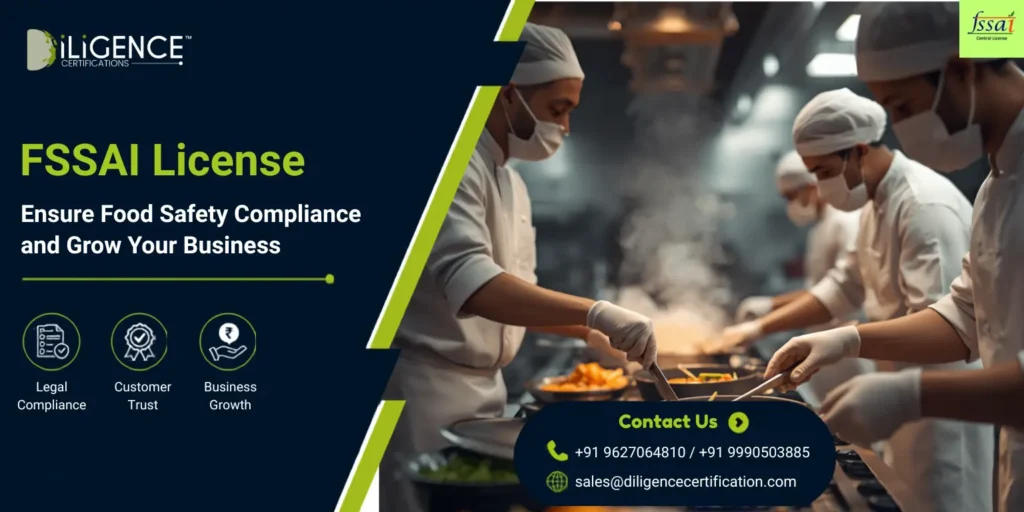
By - FSSAI license for conducting your food business lawfully in India.
- Maintain food safety standards and gain customer’s trust by acquiring FSSAI certificate.
- Professional guidance for FSSAI registration, document preparation, licensing and renewal.
Introduction
There is rapid growth happening in the Indian food industry, which makes it necessary for companies to have an effective food safety and quality system in place. Be it a restaurant, cloud kitchen, bakery, grocery store, food manufacturing unit, or even any food business operated from home, the FSSAI Licence is a must-have for operating your business in accordance with law.
The FSSAI Licence not only ensures compliance with legal requirements but also adds to the reputation of the business. This Licence shows that your company takes care of the hygiene, quality, and food safety. Today, in such a competitive market environment, the FSSAI Licence has become much more than just a legal requirement; it is a mark of trustworthiness for a business.
What is an FSSAI Licence?
An FSSAI Licence is a certificate issued by the Food Safety and Standards Authority of India to companies engaged in the activities of manufacturing, processing, packing, storage, distribution, transport, import, export, and sale of food products.
The Licence certifies that the food company meets the food safety standards set under the Food Safety and Standards Act, 2006. It is mandatory for every eligible Food Business Operator to register or get an FSSAI Licence before starting any business.
Moreover, having an FSSAI Licence number on the food packaging or invoice or business place enables the consumers to distinguish between authentic and non-authentic food companies.
Who Needs an FSSAI Licence?
Any individual or organization involved in the food supply chain may require an FSSAI Licence or Registration, depending on the nature and scale of the business.
The following businesses generally require an FSSAI Licence:
- Restaurants and Cafés
- Cloud Kitchens
- Home-Based Food Businesses
- Bakeries and Confectioneries
- Dairy and Milk Processing Units
- Food Manufacturers
- Food Processors
- Grocery and Kirana Stores
- Supermarkets
- Wholesalers
- Retailers
- Food Distributors
- Food Storage Units
- Transporters of Food Products
- Caterers
- Hotels
- Sweet Shops
- Meat and Poultry Businesses
- Seafood Businesses
- Online Food Sellers
- Food Importers
- Food Exporters
- E-commerce Food Businesses
- Packaged Drinking Water Manufacturers
- Edible Oil Manufacturers
- Spice Manufacturers
- Beverage Manufacturers
Regardless of whether your food business is small or large, obtaining the correct FSSAI Licence helps ensure legal compliance and promotes customer trust.
Types of FSSAI Licence
FSSAI issues different types of licences based on the size, turnover, and nature of a food business. Choosing the correct licence is important to ensure compliance with regulatory requirements.
Basic FSSAI Registration
Basic FSSAI Registration is suitable for small food businesses operating on a limited scale. It is generally applicable to petty food business operators such as small retailers, home-based food businesses, temporary stall holders, and local vendors who meet the prescribed eligibility criteria.
Suitable For
- Home kitchens
- Small food vendors
- Local retailers
- Cottage industries
- Small-scale food businesses
State FSSAI Licence
The State FSSAI License is meant for medium food firms which function within a specific state. Firms such as restaurants, food processing units, manufacturing firms, transporters, distributors and storage firms fall within this license depending on their eligibility criteria.
Suitable For
- Restaurants
- Medium-sized manufacturers
- Food processing units
- Warehouses
- Distributors
- Transporters
- Hotels
Central FSSAI Licence
The Central FSSAI Licence is mandatory for large food business enterprises, importers, exporters, multi-state businesses, and any companies dealing with large-scale food production or processing. The Central FSSAI Licence is granted by the Central Licensing Authority of FSSAI.
Suitable For
- Importers
- Exporters
- Large manufacturers
- Large food processing units
- E-commerce food businesses
- Businesses operating across multiple states
- Government food establishments
- Large warehouses
Importance & Benefits of FSSAI Licence
| Importance | Benefits |
| Ensures that food businesses follow FSSAI rules and food safety regulations. | Helps build customer trust by assuring quality and safe food practices. |
| Provides legal recognition to food businesses for smooth operations. | Improves brand reputation and creates a professional business image. |
| Helps maintain proper hygiene and quality standards in food handling. | Opens opportunities to work with online platforms, retailers, and corporate buyers. |
| Protects consumers by ensuring safe and standardized food products. | Helps avoid penalties and legal issues related to non-compliance. |
| Supports transparency and accountability in the food industry. | Makes business expansion easier by fulfilling regulatory requirements. |
| Acts as a mark of authenticity and reliability for food businesses. | Encourages better quality control and long-term business growth. |
Documents Required for an FSSAI Licence
The documents required may vary depending on the type of licence and the nature of the business. However, the following documents are commonly required during the application process.
- Aadhaar Card, PAN Card, or any valid identity proof
- Passport-size photograph of the applicant
- Address proof of the business premises
- Proof of business constitution (Company, LLP, Partnership, Proprietorship, etc.)
- Certificate of Incorporation or Business Registration Certificate (if applicable)
- List of food products or food categories
- Layout plan of the food premises (for applicable businesses)
- List of machinery and equipment used
- Water quality test report (where applicable)
- No Objection Certificate (NOC), if required
- Import Export Code (IEC) for importers and exporters
- Authority letter or Board Resolution (if applicable)
Keeping all the required documents ready before applying helps avoid delays and ensures a smoother approval process.
Step-by-Step FSSAI Licence Registration Process
The application process for the FSSAI Licence becomes easier when all the necessary documentation and information is available. By following the right procedure, one can easily get the Licence and also avoid any rejections.
Step 1 - Identify the Appropriate Licence
The first step is to determine whether your business requires a Basic Registration, State Licence, or Central Licence based on its nature, scale, and eligibility.
Step 2 - Gather the Required Documents
Collect all the necessary identity proofs, business documents, address proofs, and supporting documents before starting the application.
Step 3 - Submit the Application
Complete the FSSAI Licence application by providing accurate business information and uploading the required documents on the designated portal.
Step 4 - Document Verification
The concerned authority will examine the application and check the documentation provided. In case of any further documentation requirement, the applicant may be requested for the same.
Step 5 - Inspection of Business Premises (If Applicable)
Depending on the type of food business, the licensing authority may inspect the business premises to ensure compliance with food safety and hygiene standards.
Step 6 - Licence Approval
Once the verification process is successfully completed and all requirements are met, the FSSAI Licence is issued by the concerned authority.
Step 7 - Download the FSSAI Licence Certificate
Once the licence is approved, then the licence certificate can be downloaded, and it must be prominently displayed in the business premises. Also, wherever required, the FSSAI Licence Number must also be provided, for example, on food packets.
FSSAI Licence Timeline, Cost & Validity
Time taken for the processing of the licence, payment of the charges and validity period for the FSSAI Licence depends on the category of FSSAI Licence that you require for your business. The submission of correct documents can speed up the procedure of getting the license. Below is the table that gives a brief about the same.
| Licence Type | Timeline | Cost & Validity |
| Basic FSSAI Registration | Usually processed after successful document verification and authority review. | Government fee as prescribed by FSSAI. Validity can be selected from one year to five years. |
| State FSSAI Licence | Approval depends on document verification and inspection, wherever applicable. | Government fee varies according to the business category. Validity can be selected from one year to five years. |
| Central FSSAI Licence | Processing is subject to document verification and approval by the concerned authority. | Government fee is applicable as per FSSAI guidelines. Validity can be selected from one year to five years. |
Note: Government fees and processing timelines may change as per the latest FSSAI guidelines. Selecting a longer validity period can help reduce the frequency of licence renewals.
Common Reasons for FSSAI Licence Application Rejection
Even though the FSSAI application process is simple, many applications are rejected or delayed because of some mistakes that could have been avoided. Knowing about such problems will help you make a perfect application.
Wrong or Incomplete Documents
Submission of unclear, expired or incorrect documents is the major reason of rejection.
Selection of the Wrong License Category
Incorrect selection of license according to the business activities and requirements can lead to rejection or reapplication.
Business Details Are Incorrect
Incorrect information of the company such as the company name, address, food category, and the owner can affect the process of application.
Non-Compliance with Food Safety Requirements
If the inspecting body discovers that the premises do not comply with the required food safety requirements, the application is likely to be rejected.
Failure to Provide Responses to the Queries
If additional documents or responses to the inquiries from the licensing body are not provided during the set period, then the application is rejected.
Tips for Faster FSSAI Licence Approval
Following a few best practices would definitely quicken the process and minimize the risk of rejection of the application.
- Choose the right FSSAI License Category prior to submitting an application.
- All documents should be kept updated and properly scanned.
- The information about the business should tally with the document provided.
- Include the accurate food business activity.
- Give immediate responses to any query raised by the licensing authority.
- Maintain hygiene at your business premises.
Penalties for Operating Without an FSSAI Licence
Businesses operating without an FSSAI Licence face the risk of legal implications and business reputation issues. The Food Safety and Standards Act, 2006 allows authorities to impose actions against food businesses which fail to comply with the FSSAI guidelines.
Some of these legal implications could be:
- Penalties under relevant FSSAI guidelines.
- Closure or suspension of the food business.
- Confiscation of food items in some situations.
- Legal proceedings for non-compliance with food safety standards.
- Business reputation and loss of customer trust.
Having the right FSSAI Licence prevents businesses from such issues.
Why Choose Diligence Certification for an FSSAI Licence?
The procedure for obtaining an FSSAI Licence might appear easy, but it becomes difficult when it comes to choosing the appropriate licence type, preparing the documents, and adhering to the regulation process. Diligence Certification makes it simpler to go through the whole process and avoid the possibility of any delays or rejections.
Expert Assistance
Your professional assesses your commercial operations and aids in the choice of appropriate FSSAI Registration/Licence, depending on eligibility requirements.
Accurate Documentation
Your professional makes sure that all necessary documentation is correctly prepared and submitted without making any mistake in your application.
Simple Procedure for Applying
Professional assistance is there for you from the moment of application to coordination with authorities.
Quick Processing and Approvals
An appropriately prepared application along with accurate documentation increases the possibility of quick processing and approval.
Complete Assistance
Professional assistance is provided in all matters related to filing of applications, renewal, modifications, and other compliance aspects to help you concentrate on expanding your food business.
Conclusion
FSSAI Licence is an important criterion for any food business that is being run in India. Not only does it ensure that all food regulations are adhered to but also builds customer confidence and increases credibility of the brand. If you are running a food business from your kitchen, restaurant, food processing unit, grocery shop, or online, obtaining the relevant FSSAI Licence shows that you provide safe food.
Selecting the right licence type, collecting the necessary documents, and following the application process make the entire process of registration hassle-free and simple. Regular renewal of the licence and compliance with FSSAI rules can save any business from future problems and ensure that its operation remains seamless.
If you are planning to establish a food business or require help with FSSAI Licence, then professional advice will definitely help you out.
Frequently Asked Questions
What does FSSAI Certification mean?
A compulsory licensing requirement that enables you to legally set up and run a food-related business in India.
Who needs an FSSAI certification?
Every organisation that creates, sells, distributes or stores food products needs to get FSSAI certification.
What types of FSSAI Licenses exist?
Basic Registration, State License, Central License.
Is FSSAI certification mandatory for persons selling food from their homes?
Yes, both home-based food sellers and home kitchens must have obtained a Basic Registration from FSSAI.
How long is the license issued by FSSAI valid?
The timeframes under which a license remains valid is anywhere from 1 to 5 years, although this can differ depending on the choices made by each food establishment.
Can applications for FSSAI certification be made online?
Yes, all applications for FSSAI Certification are processed using the Food Safety Compliance System (FOSCOS) Portal.
What penalties can I incur for operating a food-related company without FSSAI certification?
You may be subject to penalties imposed by the Government, seizure of your food products and/or closure of your business.
Is it mandatory to obtain an FSSAI certification in order to sell food products over the Internet?
Yes, online food channels such as Swiggy, Zomato, Amazon and Flipkart all require businesses to have FSSAI certification before allowing them to list their food products on their websites.
Are all applications for FSSAI certifications required to go through an inspection?
No, only applicants who own manufacturing facilities or large processing units will be inspected.
When can I renew my FSSAI certification?
Before expiry; delay can result in penalties or license cancellation.