 BIS Certification
 CDSCO
CDSCO
 PESO
PESO
 CPCB
CPCB
 LMPC
LMPC
 WPC Approval
 Global Approvals
 TEC
TEC
 ARAI
ARAI
 BEE
BEE
 ISO Certification
 DGCA Certification
 NOC For Steel
 APEDA Registration























 Business Registration
 FSSAI Mark Certification












 (32).jpg)
 Legal Services
 Trademark Registration
 Copyright Registration
 Patent Registration
 By
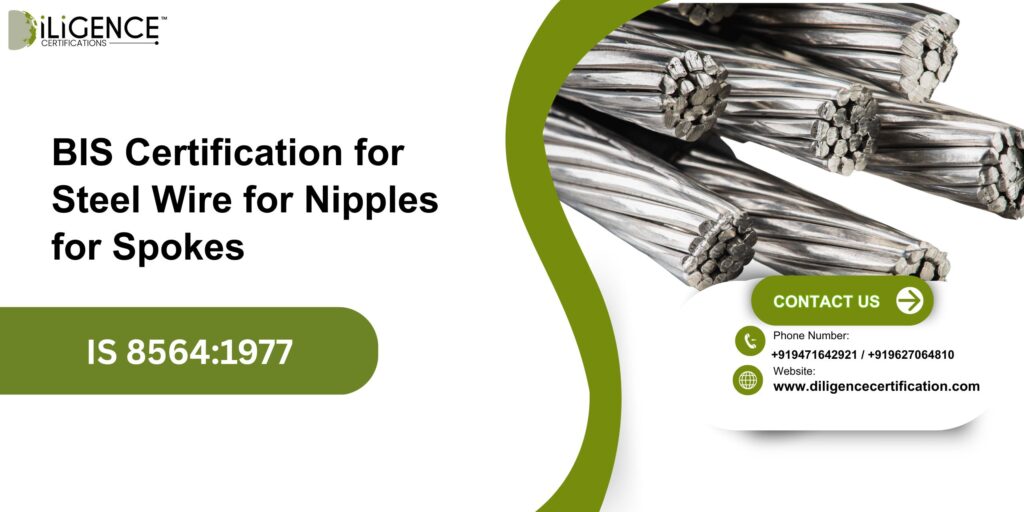
By - BIS certification is an assurance that steel wire which is used for Steel Wire for Nipples is conforming to the standard mechanical, chemical, and dimensional requirements.
- It makes sure that the occurrence of wire breakage, rust problems, and irregular performance of wheels is minimized or avoided.
- Material that is certified becomes a source of trust among bicycle manufacturers, automotive component suppliers, and OEMs.
- BIS certifies that the producer has enough manufacturing facilities, good quality control measures, and trustworthy testing arrangements.
- Acquiring a BIS licence is a way of improving the supplier’s reputation with both local and foreign buyers.
Introduction
Steel wire for spoke nipples is one of the most essential components in the wheels of bicycles, motorcycles, and even light vehicles where the three main characteristics of the wire must be strength, flexibility, and durability. Any deviation of the material can have an immediate effect on the safety of the wheel, its carrying capacity, and the stability of the product in a long period of time.
In order to keep up with quality and standardization, the Bureau of Indian Standards has come up with IS 8564:1977 that defines the requirements for the steel wire used in the production of the nipples of the spokes. BIS certification under this standard is a guarantee for the buyers that the product meets the specified mechanical properties, surface finish, and dimensional accuracy.
For the producers, BIS-approved steel wire is a proof of their conformity with the Indian standards, makes it easier for them to be accepted in the market, and assures them that they are in line with the regulations set by the BIS Act, 2016.Bureau of Indian Standars
What is IS 8564:1977?
IS 8564:1977 is the Indian Standard that defines the technical requirements of the steel wire that is used to make Steel Wire for Nipples for spoke assemblies.
The standards include:
- Chemical composition of steel
- Mechanical properties like tensile strength
- Diameter tolerances
- Surface finish and freedom from defects
- Testing and sampling procedures
Steel wire made according to IS 8564:1977 is mainly the steel wire in the bicycle wheels or in the applications that are similar where there is a requirement for threading, strength, and corrosion resistance to be done consistently.
ISI Mark Certification
According to the ISI Mark Certification Scheme, the steel wire for spokes wire nipples should conform to all the stipulations of IS 8564:1977.
Some of the key features are:
- Defined range of tensile strength
- Restrictions on impurities that affect ductility and strength
- Dimensions for the wire diameter
- The surface should be without cracks, rust, or any harmful defects
- Testing and inspection are obligatory
Only manufacturers have a valid BIS licence can put the ISI mark on the product.
Why is BIS Certification Necessary?
BIS certification is compulsory when products come under the range of notified standards or Quality Control Orders that are set up to regulate the safety and the general consistency of the most important parts. The metal wire which is going to be used for the nipples of the spokes is the factor that will determine the strength of the wheel and the safety of the person riding it.
Mandatory BIS certification:
- Helps to stop bad quality wire that is below standard from being used or sold in the market.
- Make sure that quality is the same for all manufacturers.
- Gives a guarantee to OEMs and end users that the product will not fail them quickly
- Helps to keep the competition level fair between manufacturers
- Means that the product
Importance and Benefits of BIS Certification
| Importance | Benefits |
| Ensures compliance with IS 8564:1977 | Reduces risk of wire breakage and defects |
| Maintains uniform mechanical properties | Improves wheel durability and safety |
| Builds trust among OEMs and buyers | Easier vendor approvals |
| Supports regulatory compliance | Avoids legal penalties and recalls |
| Enhances brand credibility | Competitive advantage in domestic & export markets |
Step-by-Step Process of BIS Certification
Step 1: Documentation
- Prepare documents for the company and the factory
- Gather product specifications
- Coordinate quality control records
- Make sure documents are in accordance with BIS guidelines
Step 2: Product Testing
- Provide wire steel samples for a laboratory recognized by BIS
- Perform mechanical and dimensional tests
- Get test reports confirming conformity
Step 3: Application Submission
- Submit BIS application through online portal
- Attach documents and test reports
- Carry out BIS fee payment, if applicable
Step 4: Scrutiny & Inspection
- BIS evaluates the documents sent
- An inspection of the factory can be scheduled
- The verification of manufacturing and quality control (QC) systems take place
Step 5: Grant of Licence
- BIS gives out the license number
- Producer is entitled to the use of the ISI mark
- The license is checked from time to time
Documents Required for BIS Certification
| Category | Documents Required |
| Business Documents | Local company registration, ISO certificates, organizational details |
| Manufacturer Details | Factory layout, process flow diagram, machinery details |
| Product Documents | Steel wire specifications, grades, diameter details |
| Testing Documents | Test reports from labs recognized by BIS |
| Legal & Compliance | Authorization letter, brand details |
| Foreign Manufacturer (if applicable) | AIR agreement and import-related documents |
Timelines, Costs, Validity & Renewal
- Timelines: 20-30 working days (testing may take 7-15 days)
- Costs: Are mainly determined by testing charges, BIS fees, and inspection expenses
- Validity: A BIS licence is typically valid for 1-2 years
- Renewal: Needs current documents and new compliance off the shelf before the deadline.
Why Choose Diligence Certifications
- Professional management of the BIS certification for steel and alloy products
- Complete records and testing coordination
- Speedy processing with lowered risk for objections
- Open communication throughout every phase
- Great success rate in obtaining approvals
Conclusion
Getting a BIS certification for steel wire for nipples for spokes as per IS 8564:1977 is more than just a necessary action imposed by government authorities; it proves a manufacturer’s pledge towards safety, a long service life of the product, and its uniformity. The standard specifies very strict requirements of both the mechanical and the dimensional characteristics which have a great impact on the performance of the wheel as well as its reliability over time.
As the trend is for more and more manufacturers and OEMs to prioritize quality and compliance, steel wire with a BIS certification becomes the most reliable solution for the production of spokes and nipples. By providing expert guidance and total compliance support, Diligence Certifications makes it possible for manufacturers to get their BIS certification in a quick and easy way, thus they can enjoy the benefits of fast approvals, correct documentation and long-lasting trust in the component manufacturing ecosystem in India.
Frequently Asked Questions
What is the BIS certification for steel wire for nipples for spokes?
A BIS certification is essentially a certification that acknowledges that the steel wire has been produced according to IS 8564:1977 quality and safety standards.
Is BIS certification mandatory for steel wire used in spoke nipples?
Yes, it is quite essential for those products, which are regulated by BIS standards and QCOs.
What does IS 8564:1977 mean?
This standard covers the chemical, mechanical, dimensional, and testing aspects of the steel wire for spoke nipples.
What is the importance of a BIS-certified steel wire?
Other than the abolition of the wire breaking issue, a BIS-certified steel wire can even be geared for the wheel to become stronger, safer, and more durable.
Are there any limitations on who can send a BIS certification application?
The factory which makes the steel wire in line with IS 8564:1977 standards can submit a BIS certification application.
Which experiments are necessary for securing a BIS certificate?
While tensile strength and dimensional precision are the main tests, the surface quality and chemical tests are also compulsory ones.
How much time is needed for a BIS certification?
The certification process usually takes 20 to 30 working days.
What is the period of a BIS license?
The average term of a BIS license is from 1 to 2 years.
Can foreign manufacturers obtain a BIS certification?
Yes, foreign manufacturers can file an application via an Authorized Indian Representative (AIR).
How can Diligence Certifications be of service?
Once you get in touch with them, they take care of everything for you right from giving you the proper documents, through taking the tests, to receiving the BIS approvals.


