BIS Certification
 CDSCO
CDSCO
 PESO
PESO
 CPCB
CPCB
 LMPC
LMPC
 WPC Approval
 Global Approvals
 TEC
TEC
 ARAI
ARAI
 BEE
BEE
 ISO Certification
 DGCA Certification
 NOC For Steel
 APEDA Registration























 Business Registration
 FSSAI Mark Certification












 (32).jpg)
 Legal Services
 Trademark Registration
 Copyright Registration
 Patent Registration
 By
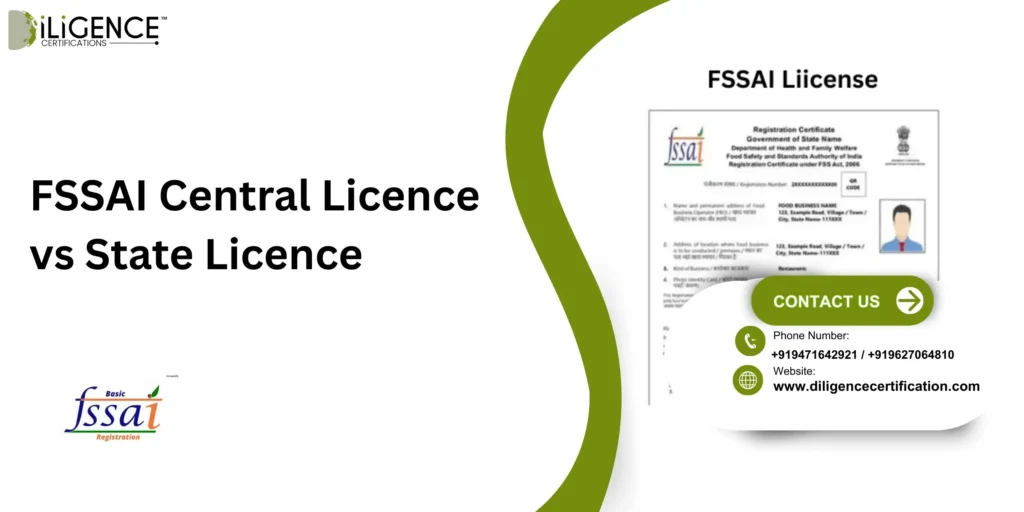
By - FSSAI Central Licence is meant for food businesses operating across multiple states or involved in import or export activities.
- FSSAI State License fits well with food businesses of medium size which are only local within a single state.
- The major difference between them is the size and the geographical reach of the business.
- In comparison with the State Licence, a Central Licence needs more comprehensive documentation and has tougher compliance requirements.
- By choosing the right licence you can have your business running without any problems and you will be safe from any punishments that may result from infringements of the law.
Introduction | FSSAI Licence
New food business owners, when they come to us at Diligence Certification, often put forward as their very first query a question which is simple but very important, “Do I require a Central Licence or a State Licence?” It is a question that gets mixed up with many others. Both licences are issued by the same authority-FSSAI, but the requirements, the scope of operations and the compliance obligations differ significantly. In the past, we have come across instances where a large number of businesses have chosen the wrong category for their application which has eventually resulted in their applications being rejected, thus causing them to incur a period of time when they cannot operate and even receive compliance notices. Knowing what sets the two licences apart is not only a matter of going through the regulatory procedures. It is what decides whether your food business will be able to run without any hiccups, if you will be able to freely expand and if you will still be in accordance with national food safety laws. This becomes especially evident when you are a manufacturer, distributor, transporter, or anyone who has plans of going beyond the local level . Food Safety and Standards Authority of India
What Is an FSSAI Licence?
An FSSAI Licence is a formal authorization given to a company dealing with food by the Food Safety and Standards Authority of India (FSSAI) which allows the company to do the manufacturing, storing, distributing, or selling of food products in India. It is an assurance that the business meets the food safety standards laid down at the national level and that it is clean in all its operations.
Key Points
- Compulsory for all food businesses to have one such as manufacturers, traders, transporters, e-commerce FBOs, home kitchens, and cloud kitchens.
- It is a license issued through the FoSCoS portal, the government’s online licensing and compliance system.
- Depending on the size and nature of the business, licences are classified into FSSAI Registration, State Licence, and Central Licence.
- It is an instrument that guarantees food quality, safety, hygiene, and even consumer trust.
- It is a must-have taking part in events of audits, retail approvals, exports, imports, and online marketplace onboarding.
Understanding the Two Main Types of Licences
1. What Is a State FSSAI Licence?
A State FSSAI Licence is compulsory for a food business of a medium scale that is working within one state only. The rule applies to those enterprises which are engaged in the manufacture, processing, trading, storage, transportation, or distribution on a moderate level of operations.The State Food Safety Department grants it and thus it is an assurance of an organization’s conformity to the food safety standards of the local area.
Key Points
- Applicable to food businesses that are only functioning within one state.
- Necessary for mid-level manufacturers, distributors, transporters, retailers, and storage units.
- Licensing authority: State Food Safety Commissioner of the respective state.
- Duration: 1-5 years depending on the applicant’s choice.
- It is necessary to renew the license before the expiration date if you want to avoid penalties.
- The number of documents involved in this transaction is moderate if we compare it to the Central Licence.
Real-World Example
A packaged snacks manufacturer Jaipur-based operates the production unit and distribution that is only within Rajasthan. As they do not supply outside the state or deal in import/export, they come under the State FSSAI Licence category.e the state or deal in import/export, they fall under the State FSSAI Licence category.
2. What Is a Central FSSAI Licence?
Central FSSAI Licence is the authority given by the Food Safety and Standards Authority of India to big food businesses, importers, exporters, and companies that are running in more than one state. Such a license becomes compulsory when a business has a more extensive operational area, higher output, or is engaged in activities regulated at the national level .
Key Points
- Required for food businesses operating in more than one state.
- Mandatory for importers, exporters, and e-commerce food operators.
- Also applies to large manufacturers, central government establishments, airports, seaports, railways, and big chains.
- Issued directly by the Central FSSAI Authority.
- Requires detailed documentation, strict compliance, and periodic inspections.
- Licence validity ranges from 1-5 years.
Real-World Example
A beverage company with manufacturing units in Delhi, distribution hubs in Haryana, and sales operations in UP and Punjab must obtain a Central FSSAI Licence.
Since it operates in multiple states and has a large production network, the Central licence is mandatory.
How to Know Which One you need
To choose between a State FSSAI Licence and a Central FSSAI Licence, you must evaluate your business based on where you operate, what scale you work at, and whether import/export or multi-state activity is involved.
The licence type is determined by scope, not by the product category.
How to Know Which One You Need :-
1. Business Location
- Operate in one state only → State Licence
- Operate in multiple states → Central Licence
2. Nature of Activity
- Importing or exporting food → Central Licence
- Supplying only within state boundaries → State Licence
3. Business Category
- E-commerce food operators, large manufacturers, central govt. facilities → Central Licence
- Medium-sized manufacturing units and distributors → State Licence
4. Regulatory Oversight
- State authority handles State Licence
- FSSAI headquarters issues Central Licence
Practical Example
If a cloud kitchen in Bangalore serves only within the city, it needs a State Licence.
If the same brand opens branches in Hyderabad, Pune, and Noida, it now falls under Central Licence because it operates across multiple states.
Documents Required for Each Licence
| Document | State Licence | Central Licence |
| Business Registration Proof | GST, PAN, Partnership/Proprietorship Certificate | Same as State Licence |
| Owner’s ID Proof | Aadhaar, Passport, Voter ID, Driving Licence | Same as State Licence |
| Business Address Proof | Rental Agreement, Electricity Bill, Municipal NOC | Same as State Licence |
| Food Safety Plan | HACCP/GMP (if applicable) | Detailed HACCP/GMP documents |
| Import/Export Registration | Not required | IEC code for exporters/importers |
Application Process (Step-by-Step)
- Decide Licence Type - A business may first decide whether it needs a state or central license. The determination is made by evaluating a business’s turnover, its size, and whether it operates within a single state, as a multi-state unit, or as exports.
- Get Ready with Documents - Prepare for the submission of the application by collecting all necessary documents like business registration, ID proof, address proof, food safety plan, and IEC code if you are an exporter.
- Apply Online - Filling out the forms that are available on the FSSAI FoSCoS portal, submitting the documents along with the fee for the applicable payment is the way to complete the application.
- Inspection of the Facility (if needed) - To check the hygiene, storage, and safety condition a local health inspector may come to your place for a State and Central Licences review.
- Licence Confirmation - The online license is issued to you after the verification and it is valid for 1-5 years depending on the category.
- Renewal & Compliance - Always renew your license before its expiration and continue to practice good hygiene as well as keep proper records of production and business changes.
Role of Compliance Consultants
Compliance consultants are the ones who deliberate the maze-like and extremely time-taking FSSAI licensing procedure that is mainly designed for the food enterprises and is, therefore, incomprehensible to them. Determining the most suitable type of licence (State or Central) is the point at which they provide support to you, in addition to preparing, verifying all documents, and making sure that there are no mistakes in the application. Also, they accompany you to the inspection process, help you with the compliance requirements maintenance, and advise you on the renewals so you can be free from the inconveniences and the illegal penalties.
Key Points:
- Inform about the correct type of licence depending on your business volume and activities.
- Handling the preparation, assembling, and reviewing of the necessary documents is in their power.
- Help local authorities to carry out inspections and coordinate with FSSAI officials for follow up.
- Remain compliant at all times so as not to be subjected to fines or forced closures.
- Support exporters to comply with additional FSSAI requirements for foreign markets.
Why Choose Diligence Certification FSSAI Licence
- guidance while selecting the appropriate license (State or Central)
- Preparation and verification of documents by a well-trained professional
- Inspections and follow-ups with FSSAI officials handled in a hassle-free way
- Assistance to exporters in satisfying global standard requirements
- Adherence to the principle of zero errors
Conclusion
In India, having the proper FSSAI licence (State or Central) is the key for a business to be legally compliant, maintain food safety standards, and gain business credibility. Diligence Certification assists food businesses in going through the procedure efficiently, thus they do not have to worry about which type of licence to pick, document preparation, inspection management, and getting the approvals in time. With Diligence Certification on their side, companies can concentrate on scaling up and exporting their products while enjoying peace of mind that they are in line with the FSSAI regulations.
Frequently asked questions
What is an FSSAI licence?
It is a certification that guarantees the safety and hygienic conditions of food businesses and is compulsory in India.
Who needs a State FSSAI licence?
Medium-sized food businesses that local their operations in one state.
Who requires a Central FSSAI licence?
Large businesses, importers/exporters, or a multi-state companies.
Can small businesses get a Central Licence?
No, small businesses usually have a Basic or State Licence depending on their turnover.
Which licence is required for exporting food?
Definitely, only a Central FSSAI licence with the authorization for export activity.
What documents are needed for a State Licence?
These are local NOC, business registration, identity/address proof, product list, and hygiene plan.
What documents are needed for a Central Licence?
The same as a State Licence, additionally with lab reports and approvals from the authorities.
How long does FSSAI approval take?
State Licence: from 7 up to 30 days; Central Licence: 30-60 days.
Can one upgrade from State to Central Licence?
Indeed, they can when a business is growing operations or exports.
How does Diligence Certification help?
Helps in deciding the licence, gathering documents, filing the application, handling inspections, and a quicker obtaining of the licence.