 BIS Certification
 CDSCO
CDSCO
 PESO
PESO
 CPCB
CPCB
 LMPC
LMPC
 WPC Approval
 Global Approvals
 TEC
TEC
 ARAI
ARAI
 BEE
BEE
 ISO Certification
 DGCA Certification
 NOC For Steel
 APEDA Registration















 Business Registration
 FSSAI Mark Certification



 (32).jpg)
 Legal Services
 Trademark Registration
 Copyright Registration
 Patent Registration
 By
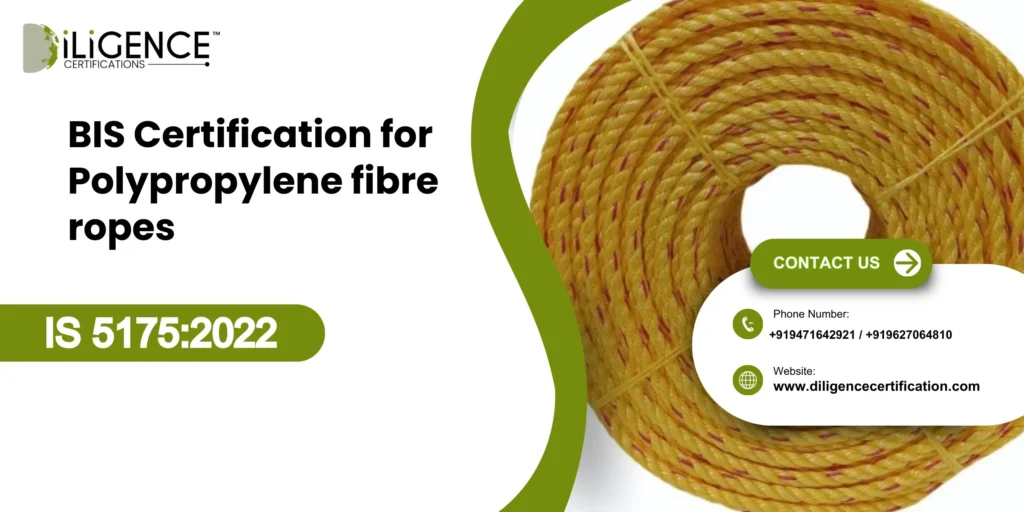
By - BIS Certification is an assurance that Polypropylene fibre ropes conform to safety, strength, and durability requirements as per IS 5175:2022.
- Such certified ropes become reliable in safety and performance, thus increasing the confidence of users in various industrial, marine, and construction applications.
- To be compliant, manufacturers need to undergo the testing, documentation, and factory inspection operations as per the BIS requirements.
- BIS-certified Polypropylene fibre ropes have a greater acceptance in the market and are a source of a long-term ROI for the business.
- Observance of standards is a safety net for the users, a must-legal requirement, and a quality indicator that separates good ropes from the inferior ones .
Introduction | Polypropylene fibre ropes
In 2023, a mid-sized marine supply company in Mumbai had to deal with the situation where their clients were sending them multiple complaints about breakage of ropes during heavy operations. Although they were using good quality materials, the issue kept going on until they found out that their ropes were not BIS-certified. This emphasized the point that their compliance and quality assurance were of the most important aspects that they had overlooked. Polypropylene fibre ropes that are easily available in the market and thus used in different industries such as shipping, construction, and industrial lifting to name a few, are the most dependable ones when they have a certification. Bureau of Indian Standards BIS certification in accordance with IS 5175:2022 Polypropylene fibre ropes guarantees that the ropes have passed stringent tests for strength, endurance, and safety thus both the manufacturers and consumers are kept safe. For any company that is using ropes in the performance of its core activities, knowing this certification is beyond being
What is IS 5175:2022 ?
IS 5175:2022 describes the Indian standard for Polypropylene fibre ropes that specify the material, construction, strength, and quality parameters of the ropes. The standard contains detailed directions that aim at safety, durability, and suitability of the ropes in industrial, marine, and construction applications as it is published by the Bureau of Indian Standards (BIS).
Key points
- Polypropylene rope kinds: Monofilament, multifilament and high-tenacity ropes.
- Stands configurations: 3-strand, 4-strand, 8-strand, and 12-strand ropes.
- Physical characteristics: Linear density, minimum breaking strength, and elongation limits.
- Identification and packaging: Proper identification for traceability and compliance.
It is of paramount importance that IS 5175:2022 should be adhered to in order to guarantee that Polypropylene fibre ropes are capable of withstanding the applied loads, resisting environmental factors such as UV and moisture, and meeting legal and industry standards. Manufacturers who conform to the requirements are allowed to affix the ISI mark, thus indicating high quality and winning the trust of industrial clients.
Why is BIS Certification Mandatory | Polypropylene fibre ropes ( IS 5175:2022 )
BIS Certification as per IS 5175:2022 is not merely a ceremonial gesture. Polypropylene fibre ropes manufacturers and sellers need to have it in India. The Ropes and Cordages (Quality Control) Order is the legal instrument that provisions this requisite and it is through it that the demand for safety, strength, and durability of the products put in the market is being met.
Key points
- Safety Compliance: BIS certification is proof that Polypropylene fibre ropes are structurally sound to hold the specified loads and as a result, accidents and legal liabilities are avoided.
- Quality Assurance: The certification is a token that every batch meets IS 5175:2022 standards in the aspects of tensile strength, density, and environmental resistance.
- Legal Requirement: Selling non-BIS-certified ropes in India is against the law and may lead to penalties, recalls, or restrictions of the business.
- Market Credibility: Certified ropes turn out to be more appealing to the purchasers, especially those from the industrial and marine sectors, where a great level of trust is necessary.
- Traceability & Accountability: Ropes bearing a BIS mark denote proper labeling, traceability in the supply chain, and accountability at every stage.
Importance and Benefits of BIS Certification ( IS 5175:2022 )
| Importance of BIS Certification | Benefits of BIS Certification |
| Ensures compliance with Indian legal standards for rope quality | Builds market credibility and trust among buyers |
| Confirms ropes meet IS 5175:2022 specifications for strength, durability, and safety | Reduces rope failure incidents in critical applications like marine and construction |
| Protects end-users from accidents and operational risks | Enables manufacturers to command premium pricing for certified products |
| Provides a standardized benchmark for rope performance | Guarantees consistent quality across production batches |
| Mandates proper marking and traceability | Simplifies regulatory audits and compliance checks |
| Minimizes legal liabilities for manufacturers | Enhances brand reputation and client confidence |
| Promotes safety in industrial, marine, and construction use | Facilitates easier acceptance in government and institutional tenders |
Step-by-Step Process of BIS Certification
Step1:Documentation
- Collect required technical documents
- Prepare product specifications
- Gather company registration details
- Ensure documents follow BIS format
Step2:Product Testing
- Send samples to a BIS-approved lab
- Conduct safety and quality tests
- Receive test reports
- Confirm compliance with BIS standards
Step3:Application Submission
- Fill out the BIS application form
- Upload all required documents
- Attach valid test reports
- Pay the necessary BIS fees
Step4:Scrutiny and Inspection
- BIS reviews submitted documents
- Authority verifies test results
- Factory/product inspection may occur
- Clarifications requested if needed
Step5:Grant of License
- BIS approves the application
- License number is issued
- Product can carry BIS mark
- Renewal required before expiry
Documents Required for BIS Certification
| Category | Documents Required |
| Business Documents | Business license/registration, ISO certificate, organizational details |
| Manufacturer Details | Factory layout, process flow chart, machinery list, production details |
| Product Documents | Product specifications, component list, user manual, model details |
| Testing Documents | Test report from BIS-recognized lab, sample details, test request form |
| Legal & Compliance | Authorization letter, brand ownership proof, trademark certificate (if any) |
| Import/Foreign Manufacturer (If applicable) | AIR (Authorized Indian Representative) details, contract agreement, overseas manufacturer documents |
Timelines, Costs, Validity & Renewal
- Timelines: Usually from 20 to 30 days, with only 7-15 days for the testing.
- Costs: The cost of the government and the test varies depending on the product. There can be some additional charges though.
- Validity: The validity period is 2 years in most situations.
- Renewal: The renewal is done before the expiration; there should be updated documents/tests; the renewal
Why Choose Diligence Certifications
- Expertise in IS 5175:2022: Diligence Certifications is very familiar with the BIS standards for Polypropylene fibre ropes, thus ensuring accurate compliance.
- End-to-End Certification Support: We are there with you through the whole BIS certification journey from documentation, testing, to factory inspections and thus, we need less time and effort.
- Access to Accredited Labs: We work with India-wide laboratories that are BIS-recognized and hence the testing of Polypropylene fibre ropes is reliable and is done by a recognized entity.
- Proven Industry Track Record: Numerous manufacturers in marine, industrial, and construction sectors have gone through the process of obtaining BIS certification successfully with the help of Diligence Certifications.
- Strategic Guidance Beyond Compliance: In addition to compliance, we offer you quality control, production best practices, and market readiness advice so that your ropes can be of high performance.
Conclusion
Obtaining BIS certification for Polypropylene fibre ropes according to IS 5175:2022 is a must for safety, strength, and durability of such ropes. Certified ropes are the best safety measures for the ultimate users, open up new market opportunities for the manufacturers, and make it easier to comply with legal requirements. Thus, they become an indispensable instrument in the hands of producers, dealers, and industrial clients. It is very important to select the right partner for the certification. Diligence Certifications is a perfect choice due to its expert advising, availability of BIS-accredited labs and complete support throughout the process. Companies can be sure that their Polypropylene fibre ropes are not only fitting the requirements and certified but also marketable with less risk of failure and thus, uplifting their brand image by teaming up with Diligence Certifications.
Frequently asked questions
What are polypropylene fibre ropes used for?
There was a vast adoption of the polypropylene fiber ropes in different areas and ecosystems such as ocean/ marine operations, the construction industry, industrial lifting, agriculture, and cargo handling. These are the industries that rely on the ropes for their strength and water resistance.
What is IS 5175:2022?
IS 5175:2022 refers to an Indian Standard which governs the qualitative, quantitative, structural, and feature aspects for identification of polypropylene fiber ropes.
Is BIS certification compulsory for Polypropylene fibre ropes in India?
Yes, the BIS certification is a must along with the compliance to IS 5175:2022 as stated by the quality control regulations of the government.
What kind of tests are done for BIS certification?
Among the tests that the ropes are subject to are tensile strength, linear density, elongation, and the area of the resistance to quite a few environmental factors like moisture, and the UV.
How long is BIS certification valid for Polypropylene fibre ropes?
The talked about time between 30 and 90 days is the whole time if all is in order and it largely depends on the availability of the documents and the testing schedule.
Are BIS certificates available for import Polypropylene fibre ropes?
Definitely, imported ropes should conform to IS 5175:2022 and have a BIS certificate if they are to be marketed in India.
What if uncertified ropes are sold in India?
Non-BIS certified rope sales may lead to imposition of monetary penalties, product seizure, recall, or restriction of business volume.
How can manufacturers get BIS certification easily?
Manufacturers can engage expert consultants such as Diligence Certifications who would manage their documentation, testing, and BIS approvals smoothly and efficiently.
Who is providing the BIS certification for Polypropylene fibre ropes?
BIS (The Bureau of Indian Standards) is the body that issues the certification after it has done the testing, the inspection, and the verification of the conformity.
What kinds of Polypropylene fibre ropes are mentioned in the IS 5175:2022?
The document covers the monofilament, multifilament, and high-tenacity Polypropylene fibers ropes of different strand constructions.


