 BIS Certification
 CDSCO
CDSCO
 PESO
PESO
 CPCB
CPCB
 LMPC
LMPC
 WPC Approval
 Global Approvals
 TEC
TEC
 ARAI
ARAI
 BEE
BEE
 ISO Certification
 DGCA Certification
 NOC For Steel
 APEDA Registration























 Business Registration
 FSSAI Mark Certification












 (32).jpg)
 Legal Services
 Trademark Registration
 Copyright Registration
 Patent Registration
 By
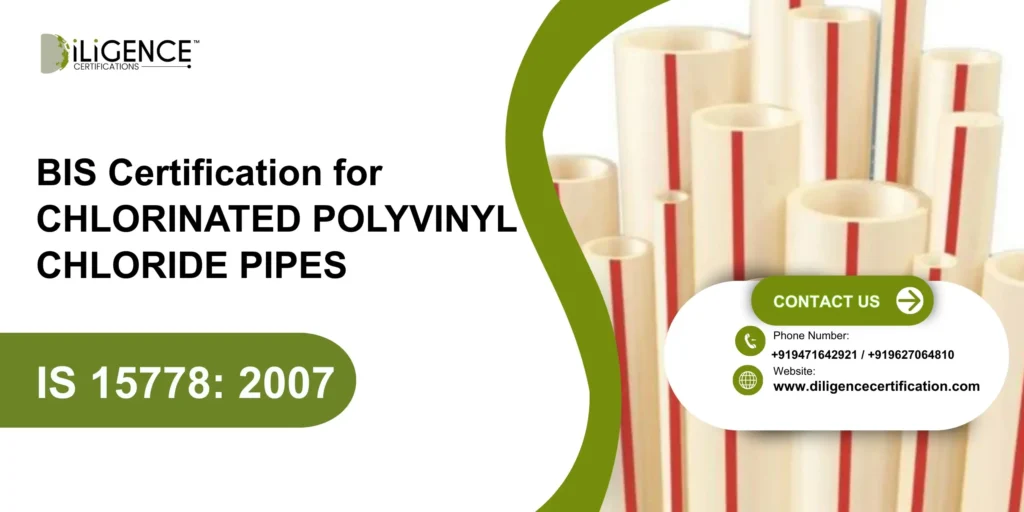
By - CHLORINATED POLYVINYL CHLORIDE PIPES are the most preferred and used in hot and cold water plumbing systems as they are able to resist high temperatures and pressures.
- Compared to regular PVC pipes, these pipes can withstand better and have a longer life span, especially in Indian climatic conditions.
- As the pipes are corrosion-resistant, they can be used in the water supply systems of the residential, commercial, and industrial sectors.
- Standardization with Indian standards assures safety, quality that is consistent, and acceptance by government and big infrastructure projects.
- It is very important that these pipes are made and controlled in terms of quality so that cracking, deformation, and failure of long-term performance can be avoided.
Introduction | CHLORINATED POLYVINYL CHLORIDE PIPE
In India’s plumbing and water distribution sector, BIS Certification for CHLORINATED POLYVINYL CHLORIDE PIPES (IS 15778:2007) is considered a mandatory requirement rather than a mere formality of the procedure. CPVC pipes are the most common choice for the transport of hot and cold water in residential buildings, hospitals, hotels, and huge projects of the infrastructure, where safety and durability over the period are of utmost importance. To avoid situations where the failure is the result of the use of substandard materials, the Bureau of Indian Standards has introduced area IS 15778:2007, which not only defines the quality, strength, and thermal resistance standards but also sets them clearly. This specification is confirmed through the certification that CPVC pipes made or traded in India are required to consistently meet the set standards in terms of such features as pressure resistance, temperature stability, and material composition. For manufacturers and importers, acquiring BIS certification is more than just fulfilling regulations - it is a key to gaining acceptance in the market, being eligible for government tenders, and increasing brand trust. In the absence of a valid BIS licence and ISI marking, production, distribution, or sale of CPVC pipes will be illegal in the Indian market.
What is CHLORINATED POLYVINYL CHLORIDE PIPE (IS 15778: 2007)
CHLORINATED POLYVINYL CHLORIDE PIPES (IS 15778:2007) is an Indian standard that defines the quality, performance, and testing requirements of CPVC pipes made for water supply systems both hot and cold. It certifies that CPVC pipes must be able to securely resist high temperatures, internal pressure, and long-term usage that are typical of Indian residential, commercial, and institutional plumbing applications.
Key Points
- IS 15778:2007 is a standard set up by the Bureau of Indian Standards (BIS) that applies to CPVC pipes used for hot and cold potable water distribution.
- The norm sets out the requirements for material composition, dimensions, pressure rating, and thermal stability of CPVC pipes.
- The pipes as per this standard shall undergo tests such as hydrostatic pressure, temperature resistance, and durability before they are permitted.
- Production, selling, or importing CPVC pipes in India mandates BIS certification and ISI marking.
- Conformance to IS 15778:2007 is an instrument to prevent pipe failure by leakages and deformation due to high-temperature conditions.
Why is BIS Certification Mandatory | IS 15778: 2007
BIS Certification is required by law in the case of CPVC pipes (IS 15778:2007) in order to maintain safety, good quality, and dependability of hot and cold water plumbing systems. By doing so, it also safeguards against the usage of substandard CPVC pipes and guarantees that Indian regulatory and performance standards are being followed.
Key Points
- BIS certification is a legal prerequisite for the production, sale, or import of CPVC pipes in India.
- It makes sure that CPVC pipes comply with the standards for temperature resistance, pressure resistance, and wear resistance.
- The only CPVC pipes that have received BIS certification are those that are permitted for use in government projects and large-scale infrastructure works.
- In the case of non-certified CPVC pipes, the owners face the risk of fines, seizure of products, and lawsuits under the BIS Act.
- An ISI mark is a guarantee of quality and long-term performance to the buyers and the end users.
Importance and Benefits of BIS Certification ( IS 5778: 2007 )
| Importance | Benefits |
| Ensures compliance with Indian quality and safety standards | Guarantees consistent product quality and performance |
| Prevents the sale of substandard and unsafe CPVC pipes | Reduces risk of leakage, bursting, and premature pipe failure |
| Mandatory for legal manufacturing and sale in India | Avoids penalties, product seizure, and legal action |
| Required for government tenders and large infrastructure projects | Improves eligibility for public and private contracts |
| Confirms suitability for hot and cold water applications | Enhances customer confidence and brand credibility |
| Enables regular testing and factory surveillance by BIS | Maintains long-term reliability and market trust |
| Supports uniform manufacturing and quality control practices | Minimises complaints, returns, and after-sales issues |
Step-by-Step Process of BIS Certification
Step1:Documentation
- Collect required technical documents
- Prepare product specifications
- Gather company registration details
- Ensure documents follow BIS format
Step2:Product Testing
- Send samples to a BIS-approved lab
- Conduct safety and quality tests
- Receive test reports
- Confirm compliance with BIS standards
Step3:Application Submission
- Fill out the BIS application form
- Upload all required documents
- Attach valid test reports
- Pay the necessary BIS fees
Step4:Scrutiny and Inspection
- BIS reviews submitted documents
- Authority verifies test results
- Factory/product inspection may occur
- Clarifications requested if needed
Step5:Grant of License
- BIS approves the application
- License number is issued
- Product can carry BIS mark
- Renewal required before expiry
Documents Required for BIS Certification
| Category | Documents Required |
| Business Documents | Business license/registration, ISO certificate, organizational details |
| Manufacturer Details | Factory layout, process flow chart, machinery list, production details |
| Product Documents | Product specifications, component list, user manual, model details |
| Testing Documents | Test report from BIS-recognized lab, sample details, test request form |
| Legal & Compliance | Authorization letter, brand ownership proof, trademark certificate (if any) |
| Import/Foreign Manufacturer (If applicable) | AIR (Authorized Indian Representative) details, contract agreement, overseas manufacturer documents |
Timelines, Costs, Validity & Renewal
- Timelines: Usually from 20 to 30 days, with only 7-15 days for the testing.
- Costs: The cost of the government and the test varies depending on the product. There can be some additional charges though.
- Validity: The validity period is 2 years in most situations.
- Renewal: The renewal is done before the expiration; there should be updated documents/tests; the renewal
Why Choose Diligence Certifications
- Expert regulatory guidance that assures adherence to BIS norms in detail without causing any unwarranted delays or rework.
- Complete support to the certification process from the documentation phase, testing coordination, factory inspection, to licence approval.
- The Diligence Certifications team has substantial industry knowledge and experience when it comes to BIS certification for CPVC pipes and other plastic piping products.
- Diligence Certifications provides you with open communication, achievable timeframes, and practical, inspection-ready solutions.
- Support for compliance in the long run including renewals, surveillance audits, and scope expansion assistance.
Conclusion
BIS Certification for Chlorinated Polyvinyl Chloride Pipes (IS 15778:2007) is a must-have product for manufacturers and importers in the Indian market. It is a measure to make sure that CPVC pipes are safe, durable, and perform well when used in hot and cold water supply systems. In addition to meeting the legal requirements, BIS certification is a trust mark which fosters the brand name, opens a window to projects by the government and large enterprises, and safeguards the business against legal and financial risks. By being familiar with the standards of IS 15778:2007 and taking the certification path in an ordered manner, producers will be able to escape situations of postponements, refusals, and retesting. In fact, with the right technical readiness and conformity assistance, obtaining BIS certification can be a company’s strategic weapon rather than a stumbling block, thus ensuring continuous acceptance and confidence in the competitive plumbing industry.
Frequently asked questions
Is a BIS Certificate Necessary to be in Possession for CPVC Pipe Use in India?
Yes, any person willing to manufacture, market, warehouse, or import CPVC Pipes in India needs to obtain a BIS Certificate.
What is the Indian Standard for CPVC Pipe?
The Bureau of Indian Standards has specified its standard for CPVC Pipes in the Indian Standard IS 15778:2007.
For What Purpose are the CPVC Pipes Used According to IS 15778:2007?
IS 15778:2007 is a standard that defines the materials' behavior, construction, and performance characteristics of CPVC Pipes used only in domestic hot and cold water supply systems.
Who can approach the Bureau of Indian Standards for BIS Certification of CPVC Pipes?
Any Manufacturer of CPVC Pipes can apply for BIS certification. Furthermore, Importers of CPVC Pipes, through an Indian Authorised Representative, can also apply for BIS certification by submitting the application to the relevant Bureau of Indian Standards.
IsI marking required on CPVC pipes?
Definitely, BIS-certified CPVC pipes are a must to carry the ISI mark and licence number.
What tests are conducted for CPVC pipes?
The tests involve hydrostatic pressure, thermal stability, dimensional accuracy, and material quality tests.
How long does BIS certification take?
The certification procedure is generally 6-8 weeks depending upon compliance in the factory.
What is the validity of a BIS licence?
Often, a BIS license is valid for 1-2 years and it has to be renewed before expiry.
What happens if CPVC pipes are sold without BIS certification?
Failure to comply with regulations can result in impoundment of goods, monetary penalties, and legal proceedings under the BIS Act.
Can BIS certification be expanded to additional pipe sizes later?
Certainly, manufacturers can ask for scope extension to cover more sizes or variants.


