 BIS Certification
 CDSCO
CDSCO
 PESO
PESO
 CPCB
CPCB
 LMPC
LMPC
 WPC Approval
 Global Approvals
 TEC
TEC
 ARAI
ARAI
 BEE
BEE
 ISO Certification
 DGCA Certification
 NOC For Steel
 APEDA Registration
















 Business Registration
 FSSAI Mark Certification











 (32).jpg)
 Legal Services
 Trademark Registration
 Copyright Registration
 Patent Registration
 By
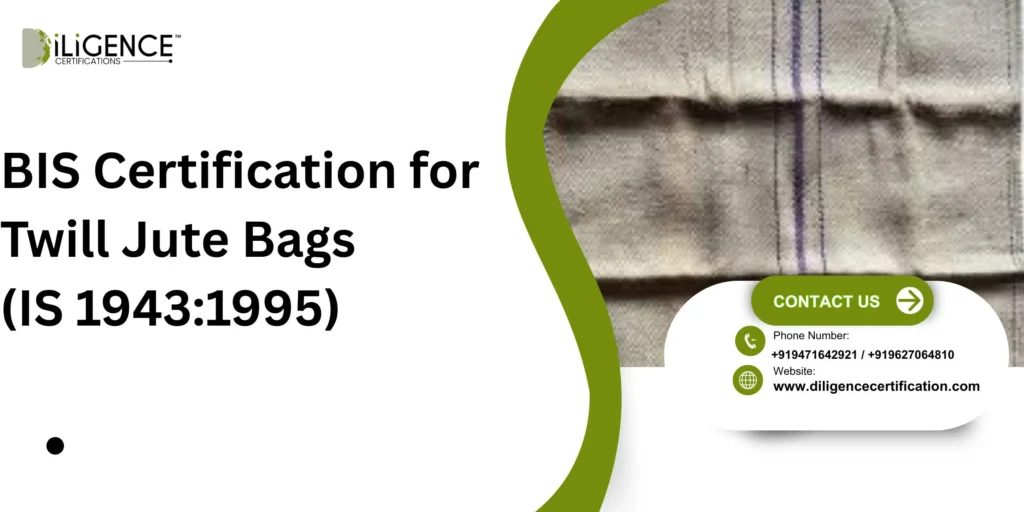
By - Mandatory Compliance: BIS certification, necessary for Twill Jute Bags, according to IS: 1943:1995, before use and subsequent sales, in India.
- Quality Standard: Fabric weave, weight, strength, and stitching quality are defined by the quality standards.
- Application Use: Jute bags made of twill jute material are used primarily for packing and storing agricultural and foodgrain products.
- Product Testing: Bags are tested for tensile strength, fabric quality, and workmanship in BIS recognized laboratories.
- ISI Mark Authorization:
- Authorized manufacturers are allowed to put “ISI” marks on their products to ensure quality assurance and marketability.
Introduction
BIS Certification for Twill Jute Bags according to Twill Jute Bags IS 1943:1995 is an assurance that the jute bags used for packing meet certain standards of quality as required in India. These bags are typically used to pack food grains and other agricultural products, which have to be strong and resilient. There are specific requirements of fabric, weight, stitching, and workmanship as laid down by IS 1943:1995, which is controlled by the Bureau of Indian Standards, to be compulsorily followed by all manufacturers to industrially produce and supply Twill Jute Bags in the country.
What is IS 1943:1995?
IS 1943:1995 is an Indian Standard document that defines standards of quality of twill jute bags. This standard prescribes various factors like construction of fabrics, weaving type, weights, strength, stitching, and workmanship that should be maintained in order to achieve reliability of the bags used for packing food grains or agricultural products. Adherence to IS 1943:1995 enables maintenance of quality and safe handling of bags during transportation.
Key Points:
- Indian Standard: - The Bureau of Indian Standards has created a standard for twill jute bags called IS 1943:1995.
- Product Scope: This standard delineates characteristics of fabrics made by twill weaving of jute for the bags packing of foodgrains and agri-products.
- Quality Requirements: The standard gives the quality requirements on fabric construction, fabric weave, weight, stitching and workmanship.
- Performance Assurance: This function guarantees that there will be enough strength and resistance against damage during packing and transporting.
- Government Regulation Compliance: IS 1943:1995 is the standard that the manufacturers supplying twill jute bags in India must adhere to.
Why is BIS Certification Mandatory
BIS certification is a requirement to guarantee that products comply with the Indian quality, safety, and performance standards set before their sale in the market. It protects consumers, encourages the adoption of similar manufacturing practices, and makes sure that only nonconforming goods are produced and supplied in India through the Bureau of Indian Standards regulation.
Key Reasons:
- Consumer Safety: Ascertains that all products for consumption are safe, reliable, and suitable for a specific purpose.
- Quality Assurance: It is carried out to ensure conformation to Indian Standards.
- Legal Requirement: Certification is mandatory for the manufacture, importation, or promotion of the notified products in the Indian market.
- Market Trust: Consumer acceptance and trust are greater for products marked with ISI.
- Fair Trade Practices: Preventing low-quality and copies from the market.
Importance and Benefits of BIS Certification
| Importance | Benefits |
| Mandatory Quality Compliance: This guarantees that the twill jute bag must unavoidably meet the IS 1943:1995 quality standard, i.e. the highest quality. | Product Quality Assurance: BIS certification ensures that jute bags double woven are complying with IS 1943:1995 in strength, weave, and stitching. |
| Protecting the Foodgrains: Helps to maintain the bags’ strength and fabric in order to avoid damage or loss. | Higher Market Acceptance: ISI-marked jute bags have a wide recognition by government departments and large food grain purchasers. |
| Regulatory Acceptance: The BIS certification is mandatory, hence it is legally permitted to produce and sell the product in India without any fear of getting punished. | Legal Market Access: It will be possible for manufacturers to make and sell jute bags all over India without the hassle of adhering to compliance. |
| Control of Substandard Products: This measure is related to the prevention of low-quality jute bags reaching the market and subsequently the supply chain. | Reduced Rejections & Losses: Consistency in quality reduces the risks of damage, rejection, and wastage in handling and transportation. |
| Enhanced Market Trust: The ISI certification of products is a factor that aids in the building of market trust and easier acceptance by the government and large-scale purchases. | It creates a reliable relationship and makes one’s reputation better, thus, the competitive power in the market is further increased. |
Step-by-Step Process of BIS Certification
Step1:Documentation
- Collect required technical documents
- Prepare product specifications
- Gather company registration details
- Ensure documents follow BIS format
Step2:Product Testing
- Send samples to a BIS-approved lab
- Conduct safety and quality tests
- Receive test reports
- Confirm compliance with BIS standards
Step3:Application Submission
- Fill out the BIS application form
- Upload all required documents
- Attach valid test reports
- Pay the necessary BIS fees
Step4:Scrutiny and Inspection
- BIS reviews submitted documents
- Authority verifies test results
- Factory/product inspection may occur
- Clarifications requested if needed
Step5:Grant of License
- BIS approves the application
- License number is issued
- Product can carry BIS mark
- Renewal required before expiry
Documents Required for BIS Certification
| Category | Documents Required |
| Business Documents | Business license/registration, ISO certificate, organizational details |
| Manufacturer Details | Factory layout, process flow chart, machinery list, production details |
| Product Documents | Product specifications, component list, user manual, model details |
| Testing Documents | Test report from BIS-recognized lab, sample details, test request form |
| Legal & Compliance | Authorization letter, brand ownership proof, trademark certificate (if any) |
| Import/Foreign Manufacturer (If applicable) | AIR (Authorized Indian Representative) details, contract agreement, overseas manufacturer documents |
Timelines, Costs, Validity & Renewal
- Timelines: Usually from 20 to 30 days, with only 7-15 days for the testing.
- Costs: The cost of the government and the test varies depending on the product. There can be some additional charges though.
- Validity: The validity period is 2 years in most situations.
- Renewal: The renewal is done before the expiration; there should be updated documents/tests; the renewal
Why Choose Diligence Certifications
Diligence Certifications is an experienced BIS certification consultant and is associated with Diligence Certifications. Diligence Certifications is an experienced BIS certification consultant and is associated with providing manufacturers and exporters with easy and confident ways of complying with BIS certifications. With thorough knowledge of Indian Standards and BIS norms, Diligence Certifications is an associated and trustworthy partner of manufacturers and exporters who desire ISO certifications and BIS certifications.
Conclusion
The Indian Bureau of Standards (BIS) Certification is a significant factor when it comes to marking products as good, safe, and complying with Indian Standards. It suffocates poor quality goods at the start, provides protection to the end-users, and fosters similar manufacturing practices among various sectors. Besides, when manufacturers comply with the BIS standards, they obtain legal recognition, trust of the market, and the opportunity for a growth in the long-term business horizon as they are guaranteed that their products are reliable, durable, and accepted widely in the Indian market.
Frequently Asked Questions (FAQs)
BIS (Bureau of Indian Standards) certification for Twill Jute bags ?
BIS Certification ensures that Twill Jute Bags are as per IS 1943:1995 set by Bureau of Indian Standards for quality.
Is BIS Certification compulsory for Twill Jute Bags in the Indian market?
Yes, the BIS certification is required for manufacturing and selling twill jute bags in India as per the ‘IS 1943:1995’ standard.
In fact, twill jute bags are largely utilized as carrier bags.?
Twill jute bags are basically used for packing as well as storing agricultural products like grains.
What all aspects is covered in IS 1943:1995?
The standard involves fabric weaving, fabric construction, weight, tensile strength, stitching, and workmanship.
Where is the testing of the product for certification by BIS conducted?
The testing is done at some laboratories that have been approved by BIS. They conduct the required testing on the goods to ensure compliance with IS 1943:1995.
Who has to make an application for BIS certification for twill jute bags?
The BIS certification is awarded to the manufacturers of twill jute bags in the country as per their request.
What is the validity of BIS Certification?
BIS certification is generally valid for two years and must be renewed before expiry.
Can manufacturers use the ISI mark after certification?
Yes, once certified, manufacturers are authorized to use the ISI mark on their products.
What happens if BIS certification is not obtained?
Manufacturing or selling uncertified twill jute bags can lead to penalties, product seizure, or legal action.
How long does the BIS certification process take?
The process typically takes 20-30 days, depending on documentation, testing, and inspection timelines.


