 BIS Certification
 CDSCO
CDSCO
 PESO
PESO
 CPCB
CPCB
 LMPC
LMPC
 WPC Approval
 Global Approvals
 TEC
TEC
 ARAI
ARAI
 BEE
BEE
 ISO Certification
 DGCA Certification
 NOC For Steel
 APEDA Registration























 Business Registration
 FSSAI Mark Certification












 (32).jpg)
 Legal Services
 Trademark Registration
 Copyright Registration
 Patent Registration
 By
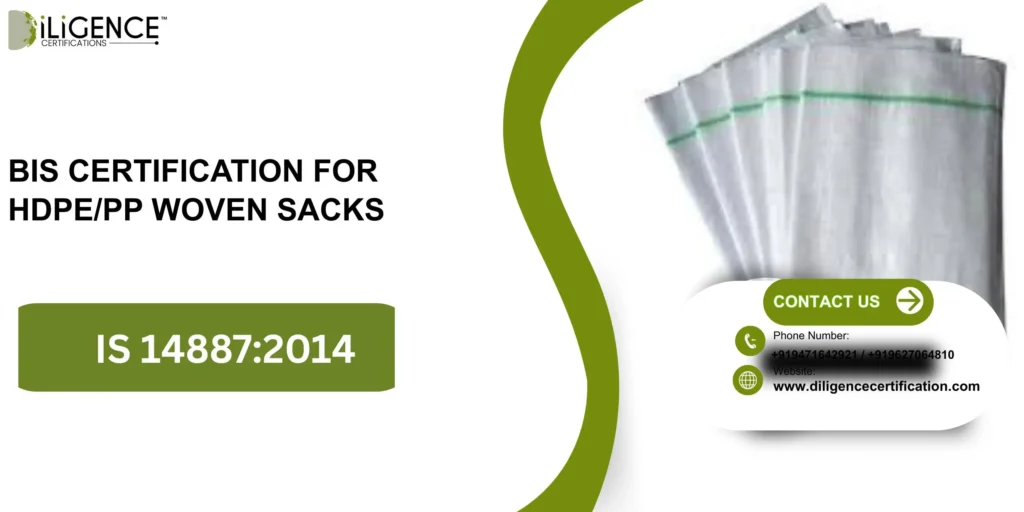
By - Mandatory Compliance: HDPE/PP woven sacks that are manufactured or sold in India need to comply with IS 14887:2014 as per the Bureau of Indian Standards (BIS) requirement.
- Material & Construction Standards: The standard details the specification of the requirements of raw material quality, fabric construction, tape width, weaving, and stitching.
- Strength & Performance: The standard is a guarantee that the product has enough tensile strength, load, bearing capacity, durability, and is resistant to tearing, especially during handling and transport.
- Product Testing: Sacks are tested for their dimensions, mass, breaking strength, elongation, and workmanship quality in labs that are certified by BIS.
- ISI Mark Authorization: It is the quality mark that a manufacturer with a valid BIS license is authorized to put on his product. It signifies the product quality, safety, and consumer acceptance in the market.
Introduction | HDPE/PP Woven Sacks
BIS Certification for HDPE/PP Woven Sacks as per IS 14887:2014 indicates that the woven sacks utilized for packaging and transportation conform to the set Indian standards of quality, strength, and durability. This certificate from the Bureau of Indian Standards weighs material quality, construction, load, bearing performance, and workmanship aspects to guarantee safety in handling, reliability of use, and consumer trust in industrial and commercial sectors.
What is IS14887:2014?
IS 14887:2014 represents an Indian Standard established by the Bureau of Indian Standards, aimed at regulating HDPE/PP woven sacks. The standard delimits the necessary parameters for these products in terms of material quality, construction, strength, durability, and testing. Observance of this standard thus becomes a prerequisite for inherently safe packaging, trouble, free performance during storage and transport, and the right to put the ISI mark in the Indian market.
Key Points:
- It is a quality control standard for HDPE/PP woven sacks issued by the Bureau of Indian Standards.
- The standard specifies requirements for raw materials, weaving, stitching, and overall construction stages.
- The standard regulates adequate strength, durability, and load, bearing performance during usage.
- It specifies the testing methods for dimensions, mass, tensile strength, and workmanship.
- By conforming to this standard, manufacturers are allowed to use the ISI mark, which is a mark of quality and trust in the market.
Why is BIS Certification Mandatory
BIS Certification is a must for any product that is to be sold in India. This is to ensure that such products meet the prescribed safety, quality, and performance standards that are specified by the Bureau of Indian Standards. It is a certification that helps in protecting consumers from poor quality goods, encouraging standard manufacturing practices, ensuring that businesses comply with regulations and only certified products are allowed to use the ISI mark, thus creating trust, safety, and market credibility.
Key Reasons:
- Ensures that the products meet the safety, quality, and performance standards as per the Bureau of Indian Standards.
- Stops substandard, unsafe, or non, compliant products from entering the market thus protecting the consumer.
- Encourages uniform manufacturing practices and maintains product quality at a consistent level.
- Implements regulatory compliance as a must for the legal sale of products in the Indian market.
- Permits the use of the ISI mark which helps in gaining consumer confidence and easier acceptance in the market.
Importance and Benefits of BIS Certification
| Importance | Benefits |
| Ensures products meet the quality and safety standards established by the Bureau of Indian Standards.. | Assures consistent product quality as per standards defined by the Bureau of Indian Standards. |
| Helps consumers to be safe from low, quality and unsafe products. | Enhances consumer safety by preventing substandard and unsafe products. |
| Is a must for manufacturing and selling products legally that have been notified in India. | Builds strong market trust through the authorized use of the ISI mark. |
| Enables the use of the ISI mark, thus providing the product with more credibility and making it more trusted. | Enables legal sale and regulatory compliance in the Indian market. |
| Contributes to business getting more customers and being more competitive in the market. | Improves business credibility and competitiveness across industries.. |
Step-by-Step Process of BIS Certification
Step1:Documentation
- Collect required technical documents
- Prepare product specifications
- Gather company registration details
- Ensure documents follow BIS format
Step2:Product Testing
- Send samples to a BIS-approved lab
- Conduct safety and quality tests
- Receive test reports
- Confirm compliance with BIS standards
Step3:Application Submission
- Fill out the BIS application form
- Upload all required documents
- Attach valid test reports
- Pay the necessary BIS fees
Step4:Scrutiny and Inspection
- BIS reviews submitted documents
- Authority verifies test results
- Factory/product inspection may occur
- Clarifications requested if needed
Step5:Grant of License
- BIS approves the application
- License number is issued
- Product can carry BIS mark
- Renewal required before expiry
Documents Required for BIS Certification
| Category | Documents Required |
| Business Documents | Business license/registration, ISO certificate, organizational details |
| Manufacturer Details | Factory layout, process flow chart, machinery list, production details |
| Product Documents | Product specifications, component list, user manual, model details |
| Testing Documents | Test report from BIS-recognized lab, sample details, test request form |
| Legal & Compliance | Authorization letter, brand ownership proof, trademark certificate (if any) |
| Import/Foreign Manufacturer (If applicable) | AIR (Authorized Indian Representative) details, contract agreement, overseas manufacturer documents |
Timelines, Costs, Validity & Renewal
- Timelines: Usually from 20 to 30 days, with only 7-15 days for the testing.
- Costs: The cost of the government and the test varies depending on the product. There can be some additional charges though.
- Validity: The validity period is 2 years in most situations.
- Renewal: The renewal is done before the expiration; there should be updated documents/tests; the renewal
Why Choose Diligence Certifications
Choosing Diligence Certifications signifies a collaboration with a reliable compliance expert who is committed to making the BIS certification process straightforward. Diligence Certifications, with its thorough understanding of the regulations, comprehensive support, open guidance, and a client oriented approach, enables companies to obtain the necessary approvals on time, lower the risks associated with compliance, and establish a sustainable reputation in the market for confidence.
Conclusion
BIS certification is an important factor that helps keep the quality of the products, their safety and also ensure that they are in compliance with the regulations in the Indian market. Following the standards laid down in the regulations safeguards consumers and, at the same time, increases the credibility of the manufacturer, trust of the market and ultimately the business will have a long life. The attainment of the certification is a manifestation of the manufacturer’s commitment to standards, dependability, and the practice of socially responsible manufacturing.
Frequently Asked Questions (FAQs)
BIS Certification of HDPE/PP woven sacks: What does it mean?
It’s a certificate issued by the Bureau of Indian Standards that ensures HDPE/PP woven sacks have fulfilled the standards of the quality and safety standard specified under the code designation of IS 14887:2014.
Is BIS Certification Mandatory For HDPE/PP Woven Sacks Sold In India?
The answer is that it is compulsory to accompany BIS Certification to HDPE/PP Woven Sacks in circumstances where such products are produced, sold, and/or imported in India.
How wide is the scope for standard IS 14887:2014?
The standard offers general specifications and criteria for the usage of HDPE and PP woven sacks in the packaging of different commodities.
What are the important elements of IS 14887:2014?
The standards deal with requirements related to material, manufacturing, strength, durability, workmanship, and tests.
Which are the tests conducted for BIS certification?
Tests include dimensions, mass, tensile strength, breaking strength, elongation and workmanship evaluation.
Where does product testing take place?
The testing has to be done in laboratories recognized or approved by BIS.
How long is BIS certification valid?
The BIS certification is typically valid for a period of two years, after which it needs to be renewed.
Can manufacturers use ISI mark without BIS certification?
In fact, the use of ISI certification marks requires a valid license from the BIS.
How long does it take to obtain BIS certification?
The entire process is generally done within 20, 30 days; however, it largely depends on how ready the documents are, how long the testing takes and if the inspection department needs to be there.
What happens if a manufacturer sells uncertified HDPE/PP woven sacks?
The sale of unlicensed products can bring about financial punishments, legal procedures, forfeiture of goods, and the dropping of the manufacturer's trust level in the market.


