 BIS Certification
 CDSCO
CDSCO
 PESO
PESO
 CPCB
CPCB
 LMPC
LMPC
 WPC Approval
 Global Approvals
 TEC
TEC
 ARAI
ARAI
 BEE
BEE
 ISO Certification
 DGCA Certification
 NOC For Steel
 APEDA Registration























 Business Registration
 FSSAI Mark Certification












 (32).jpg)
 Legal Services
 Trademark Registration
 Copyright Registration
 Patent Registration
 By
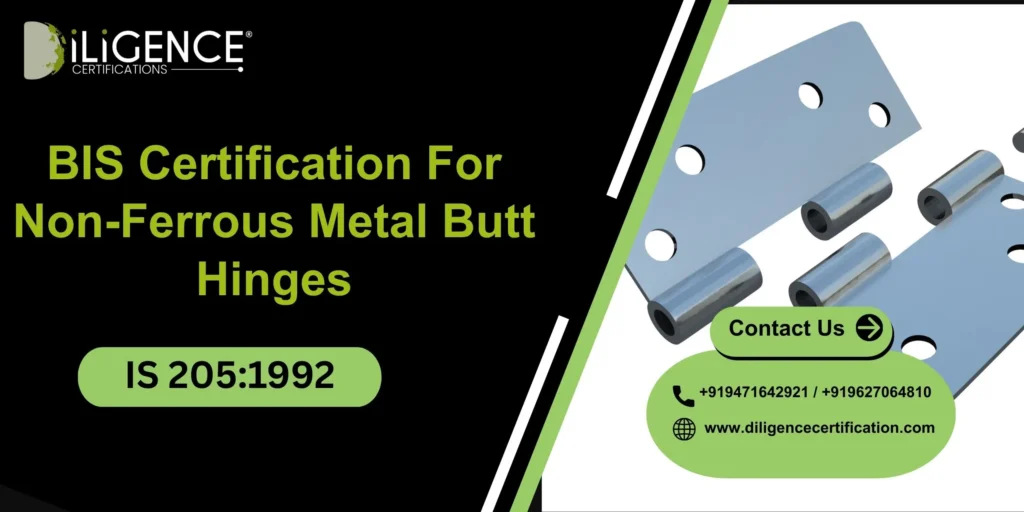
By - The IS 205:1992 indicates the materials, specifications, finish, and performance characteristics of non-ferrous metal butt hinges to be used in door and window functions.
- But hinges shall be made from approved non-ferrous materials such as Brass, Aluminum, or Bronze in view of corrosion resistance and endurance.
- The load-bearing capacity of the products for smoother functioning and resistance to wear is tested by BIS-accredited laboratories.
- The companies also have to adhere to a tight quality control procedure followed by BIS factory inspection.
- BIS certified butt hinges have ISI markings, which indicate they adhere to safety and quality standards in India.
Introduction
The BIS Certification of Non-Ferrous Metal Butt Hinges as per IS 205:1992 ensures that the hinges being used in doors, windows, and furniture are of specified Bureau of Indian Standards for quality, strength, and endurance. These butt hinges are generally made of non-ferrous metals such as brass, aluminum, and bronze, which have incredible resistance to corrosion and smooth functioning. As butt hinges are of prime importance to sustain the panels of doors, using them has become directly related to safety and functionality. The Indian Standard IS 205:1992 specifies requirements regarding composition, sizes, workmanship, and testing procedures of butt hinges.
What is IS 205:1992?
IS 205:1992 covers the Indian Standard for non-ferrous metal butt hinges in doors, windows, cupboards, and other similar articles. The Bureau of Indian Standards publishes Indian Standard and is responsible for maintaining standards on hinges made from metals such as brass, aluminum, and bronze. The specification deals with requirements from quality and dimensions to finish, strength, load-carrying capability, and easy action of Butt Hinges. When manufactured accordingly to IS 205:1992, it is ensured that the hinges have durability and resistance to corrosion apart from satisfactory performance for a long time. The ISI mark has been proof of conformity to the safety and quality standards as laid down in the country.
Key Points:
- “IS 205:1992 - Non-ferrous metal butt hinges” is the name given to the
- It has specific demands in metals such as brass, aluminum, and bronze for uses like corrosion resistance.
- The standard sizes, tolerances, and workmanship are specified in such a way that consistency is ensured.
- It consists of performance testing for carrying capacity, free motion, and abrasion resistance.
- Products meeting the specifications of IS 205:1992 can use the BIS ISI mark, thus assuring the consumer about the quality and safety of the product.
Why is BIS Certification Mandatory
BIS Certification of Non-Ferrous Metal Butt Hinges conforming to IS 205:1992 specifies the requirements of the hinges made of materials such as Brass and Aluminum in respect of their strength, durability, finish, and performance, and the BIS Certification of the Non-Ferrous Metal Butt Hinge attains the reliability, safety, and quality of the product when it bears the ISI Mark.
Key Reasons:
- IS 205: 1992: Specifies the quality and performance requirements for nonferrous metal butt hinges.
- Hinges shall be manufactured from approved metals such as brass, aluminium and bronze.
- Products undergo strength, durability, and smooth-operation tests.
- BIS undertakes factory inspection and quality audits before certification.
- ISI-marked hinges ensure safety, reliability, and adherence to Indian standards.
Importance and Benefits of BIS Certification
| Importance | Benefits |
| Make sure that hinges conform to Indian standards for safety and quality. | Enables use of ISI mark by manufacturers, hence increasing acceptance of products. |
| It also prevents low-quality and low-strength materials. | Improves product durability and corrosion resistance. |
| Guarantees proper loading and functioning. | Boosts customer confidence & brand reputation. |
| It maintains a uniform production standard. | Prevents product failures and consumer complaints. |
| Establishes trust and credibility within the Indian market. | It facilitates easy market access and legal compliance in India. |
Step-by-Step Process of BIS Certification
Step1:Documentation
- Collect required technical documents
- Prepare product specifications
- Gather company registration details
- Ensure documents follow BIS format
Step2:Product Testing
- Send samples to a BIS-approved lab
- Conduct safety and quality tests
- Receive test reports
- Confirm compliance with BIS standards
Step3:Application Submission
- Fill out the BIS application form
- Upload all required documents
- Attach valid test reports
- Pay the necessary BIS fees
Step4:Scrutiny and Inspection
- BIS reviews submitted documents
- Authority verifies test results
- Factory/product inspection may occur
- Clarifications requested if needed
Step5:Grant of License
- BIS approves the application
- License number is issued
- Product can carry BIS mark
- Renewal required before expiry
Documents Required for BIS Certification
| Category | Documents Required |
| Business Documents | Business license/registration, ISO certificate, organizational details |
| Manufacturer Details | Factory layout, process flow chart, machinery list, production details |
| Product Documents | Product specifications, component list, user manual, model details |
| Testing Documents | Test report from BIS-recognized lab, sample details, test request form |
| Legal & Compliance | Authorization letter, brand ownership proof, trademark certificate (if any) |
| Import/Foreign Manufacturer (If applicable) | AIR (Authorized Indian Representative) details, contract agreement, overseas manufacturer documents |
Timelines, Costs, Validity & Renewal
- Timelines: Usually from 20 to 30 days, with only 7-15 days for the testing.
- Costs: The cost of the government and the test varies depending on the product. There can be some additional charges though.
- Validity: The validity period is 2 years in most situations.
- Renewal: The renewal is done before the expiration; there should be updated documents/tests; the renewal
Why Choose Diligence Certifications
Diligence Certifications is a reliable compliance consultant providing expert assistance in acquiring BIS certification on IS 205:1992 standards. With in-depth knowledge of compliance processes, start to finish assistance, and a client-centric approach, Diligence Certifications provides a smooth, quick, and completely hassle-free certification process to businesses to attain overall Indian standards compliance.
Conclusion
BIS Certification of Non-Ferrous Metal Butt Hinges as per IS 205:1992 is a crucial element for maintaining the quality of these products. As per this standard, if the manufacturers follow it properly, they will be able to provide consumers with highly durable and corrosion-resistant hinges.
Frequently Asked Questions (FAQs)
What is IS 205:1992 ?
It is the Indian Standard for non-ferrous metal butt hinges for doors & windows.
What materials are included under IS 205:1992?
The list of non-ferrous metals includes brass, aluminium, and bronze.
Do butt hinges have mandatory certification by BIS?
Yes, it is necessary to sell certified hinges in the Indian market.
“What does the ISI mark indicate?”
It indicates that the product complies with the quality requirements in India.
WHOM DOES BIS ?
The certification is issued by the Bureau of Indian Standards (BIS).
Where are hinges tested?
In BIS-certified test labs.
What tests are done?
Load-carrying capacity, smooth operation, and wear resistance tests.
For how long is a BIS license valid?
Generally, it is valid for two years.
Are hinges allowed to be sold in India that are not certified?
No, un-certified hinges are not legally allowed in regulated markets.
Why is BIS certification important?
Ensures product safety, quality, and durability.


