 BIS Certification
 CDSCO
CDSCO
 PESO
PESO
 CPCB
CPCB
 LMPC
LMPC
 WPC Approval
 Global Approvals
 TEC
TEC
 ARAI
ARAI
 BEE
BEE
 ISO Certification
 DGCA Certification
 NOC For Steel
 APEDA Registration























 Business Registration
 FSSAI Mark Certification












 (32).jpg)
 Legal Services
 Trademark Registration
 Copyright Registration
 Patent Registration
 By
By - Compulsory BIS compliance: All personal e-transporters (e-scooters, hoverboards, self-balancing boards, and others) sold in India are required to be IS 302 (Part 1):2024 safety norm compliant and BIS certified.
- Applies safety standards: IS 302 (Part 1):2024 is the general safety standard (harmonized with IEC 60335-1:2020) that applies to electrical safety, insulation, protection against electric shock, and other similar risks.
- ISI Mark mandatory: The BIS Standard Mark (ISI mark) is mandatory on the product and its packaging before
- Testing mandatory: The following tests are mandatory: earth continuity test, electric strength test, functional safety test, protection against electric shock test, leakage current test, and others.
- Legal implications: Failure to comply may result in seizure of goods, suspension/cancellation of license, fines, or imprisonment under the BIS Act, 2016.
Introduction
The BIS Certification for Personal E-Transporters under IS 302 (Part 1): 2024 makes sure that electrically operated personal mobility devices like e-scooters, hoverboards, and self-balancing boards are equipped with basic safety standards before being marketed in India. The standard has been published by the Bureau of Indian Standards (BIS) as per the BIS Act, 2016, and deals with electrical safety, protection against electric shock, fire risks, insulation, and mechanical safety.
What is IS 302:2024?
IS 302 (Part 1): 2024 is an Indian safety standard published by the Bureau of Indian Standards (BIS) for domestic, commercial, and similar electrical appliances. This standard defines the general safety requirements that electrical appliances should comply with to provide safety against hazards.
Key Points:
- Indian Safety Standard, published by the Bureau of Indian Standards (BIS).
- Applies to general safety requirements for electrical appliances.
- Protects against electric shock, fire, and overheating hazards.
- Complies with international safety standards (IEC 60335-1).
- Essential for BIS certification and ISI marking in India.
Why is BIS Certification Mandatory
BIS Certification is a requirement to ensure that electrical goods conform to the safety and quality requirements set by the Bureau of Indian Standards (BIS) as per the BIS Act, 2016. BIS Certification safeguards consumers against the sale of unsafe, substandard, or hazardous goods in the Indian market.In the case of products like personal e-transporters, as specified in IS 302 (Part 1): 2024, BIS Certification ensures that the product satisfies the basic safety requirements, such as protection against electric shock, fire risk, insulation breakdown, and mechanical hazards.
Key Reasons:
- Ensures Consumer Safety: It ensures that the products are safe for use, as they are designed in accordance with the set safety standards, thereby eliminating dangers like electric shock, fire, and mechanical breakdowns.
- Legal Requirement: As per the BIS Act, 2016, some products are notified for compulsory certification, thereby making BIS certification mandatory for sale in the Indian market.
- Quality Assurance: It ensures that the products are designed as per the Indian Standards, thereby ensuring their performance, durability, and reliability.
- Market Authorization: It is mandatory for manufacturers and importers to obtain BIS certification and use the ISI Mark to sell notified products in the Indian market.
- Prevents Legal Consequences: Failure to comply with the regulations may result in legal action like fines, confiscation of goods, revocation of licenses, and prosecution by the concerned authorities.
Importance and Benefits of BIS Certification
| Importance | Benefits |
| Safety Standards Compliance: Verifies that the products comply with Indian safety standards and minimize electrical and fire risks. | Enhanced Brand Reputation: Certified products enjoy better credibility in the market. |
| Establishes Consumer Trust: The ISI Mark certifies consumers that the product is reliable and of good quality. | Competitive Advantage: BIS-approved products are preferred over non-certified products. |
| Compliance for Legal Market Access: Required for the sale of notified products in India as per the BIS Act, 2016. | Less Risk of Penalties: Saves manufacturers from legal penalties and confiscation of products. |
| Compliance with Quality Standards: Verifies that the manufacturing process is consistent and the product performs well. | Improved Product Quality: Promotes adherence to quality control and testing standards. |
| Government Safety Standards Compliance: Indicates that the product complies with government safety standards. | Opportunities for Market Expansion: Eases acceptance in local as well as international markets. |
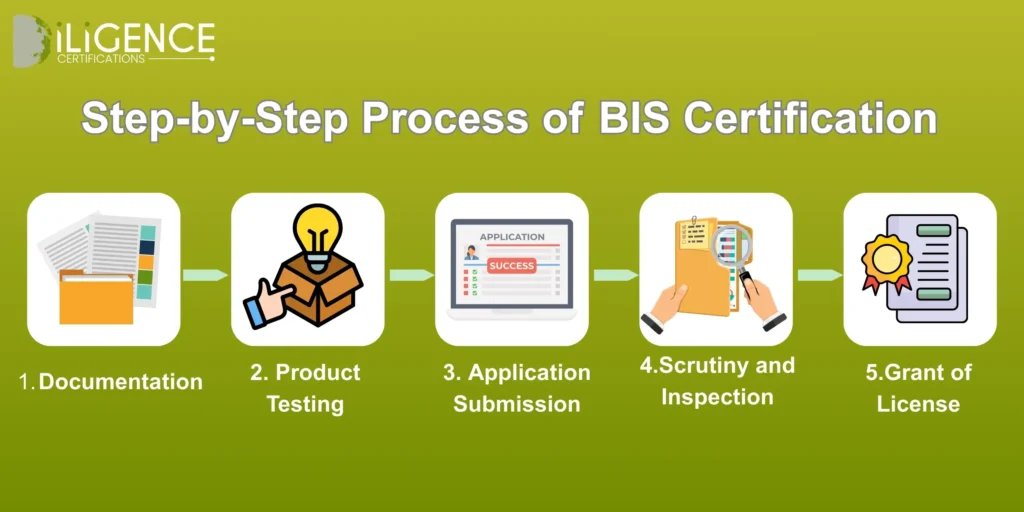
Step-by-Step Process of BIS Certification
Step1:Documentation
- Collect required technical documents
- Prepare product specifications
- Gather company registration details
- Ensure documents follow BIS format
Step2:Product Testing
- Send samples to a BIS-approved lab
- Conduct safety and quality tests
- Receive test reports
- Confirm compliance with BIS standards
Step3:Application Submission
- Fill out the BIS application form
- Upload all required documents
- Attach valid test reports
- Pay the necessary BIS fees
Step4:Scrutiny and Inspection
- BIS reviews submitted documents
- Authority verifies test results
- Factory/product inspection may occur
- Clarifications requested if needed
Step5:Grant of License
- BIS approves the application
- License number is issued
- Product can carry BIS mark
- Renewal required before expiry
Documents Required for BIS Certification
| Category | Documents Required |
| Business Documents | Business license/registration, ISO certificate, organizational details |
| Manufacturer Details | Factory layout, process flow chart, machinery list, production details |
| Product Documents | Product specifications, component list, user manual, model details |
| Testing Documents | Test report from BIS-recognized lab, sample details, test request form |
| Legal & Compliance | Authorization letter, brand ownership proof, trademark certificate (if any) |
| Import/Foreign Manufacturer (If applicable) | AIR (Authorized Indian Representative) details, contract agreement, overseas manufacturer documents |
Timelines, Costs, Validity & Renewal
- Timelines: Usually from 20 to 30 days, with only 7-15 days for the testing.
- Costs: The cost of the government and the test varies depending on the product. There can be some additional charges though.
- Validity: The validity period is 2 years in most situations.
- Renewal: The renewal is done before the expiration; there should be updated documents/tests; the renewal
Why Choose Diligence Certifications
Diligence Certifications is an organization that offers professional consultancy services for BIS Certification and other approvals in India. They have in-depth knowledge of the procedures for compliance and Indian Standards, which helps them assist manufacturers and importers in getting certification efficiently.They provide end-to-end services, such as preparation of documents, submission of applications, coordination with BIS-approved labs, testing of products, and so on. Their team of experts makes sure that the application is correct, error-free, and submitted on time to prevent delays or rejection.
Conclusion
BIS Certification for Personal E-Transporters under IS 302 (Part 1): 2024 is an important factor that helps in maintaining the electrical safety, reliability, and standards of the product in the Indian market. It also safeguards the consumer from possible dangers such as electric shock, fire, and mechanical failure.Acquiring BIS certification and the ISI mark is not only mandatory for notified products, but it also gives a sense of authenticity and trustworthiness to the manufacturers and importers. By adhering to the BIS standards, one can easily enter the Indian market without any legal complications and enhance their brand reputation in the Indian market.
Frequently Asked Questions (FAQs)
What is BIS?
BIS is an abbreviation for the Bureau of Indian Standards. It is the national organization that defines the safety standards for products in India.
What is IS 302 (Part 1): 2024?
It is an Indian safety standard for electrical appliances, which defines general safety standards.
Is BIS certification mandatory for personal e-transporters?
Yes, if it is a notified product by the government, then it is mandatory to have certification before sale in India.
Which products are covered?
E-scooters, hoverboards, self-balancing boards, and other electric mobility devices.
What safety standards are tested?
Electric shock protection, insulation, overheating, fire hazard, and mechanical safety.
What is the mark that is given out after certification?
The product gets the ISI Mark.
Who needs to apply for BIS certification?
Manufacturers and importers who sell in the Indian market.
What will happen if a product is sold without BIS certification?
The product can be fined, seized, or even taken to court.
How long is BIS certification valid for?
It is valid for a certain period of time and needs to be renewed as and when required.
Why is BIS certification important?
It is important for the safety and trust of consumers.


