BIS Certification
 CDSCO
CDSCO
 PESO
PESO
 CPCB
CPCB
 LMPC
LMPC
 WPC Approval
 Global Approvals
 TEC
TEC
 ARAI
ARAI
 BEE
BEE
 ISO Certification
 DGCA Certification
 NOC For Steel
 APEDA Registration























 Business Registration
 FSSAI Mark Certification












 (32).jpg)
 Legal Services
 Trademark Registration
 Copyright Registration
 Patent Registration
 By
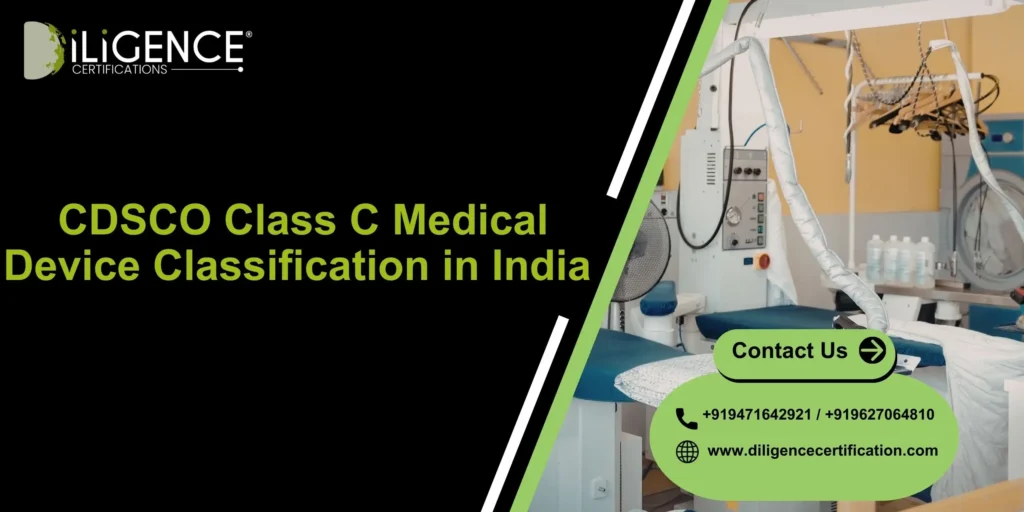
By - CDSCO Class C Medical Device are categorized as moderate to high-risk devices under the Medical Devices Rules, 2017 in India.
- These devices require strict regulatory approval from the Central Drugs Standard Control Organization (CDSCO) before they can be manufactured, imported, or sold.
- The Central Licensing Authority (CLA) under CDSCO grants licenses for Class C medical devices.
- Manufacturers must follow quality standards such as ISO 13485 and technical documentation requirements for compliance.
- Proper certification ensures patient safety, product reliability, and legal market access in India.
Introduction | CDSCO Class C Medical Device
India’s medical device industry is rapidly growing, driven by technological innovation, increased healthcare demand, and stronger regulatory frameworks. To ensure the safety and effectiveness of medical devices, the Government of India regulates them under the Medical Devices Rules (MDR), 2017 administered by the Central Drugs Standard Control Organization (CDSCO).
Medical devices are categorized into four risk-based classes: Class A, Class B, Class C, and Class D. Among these, Class C medical devices fall under the moderate to high-risk category, which means they require stricter evaluation and regulatory oversight before they can enter the market.
For manufacturers, importers, and distributors dealing with CDSCO Class C Medical Device carrying CDSCO blessing is obligatory. Without proper licensing, businesses can not fairly manufacture, import, or sell these products in India.
This blog provides a complete companion to CDSCO Class C Medical Device bracket, including eligibility, nonsupervisory conditions, benefits, blessing process, challenges, and expert backing for smooth instruments.
What is CDSCO Class C Medical Device Classification?
CDSCO Class C Medical Device grounded on the position of threat they pose to cases and druggies. Class C Devices are considered moderate to high- threat medical Devices, meaning that indecorous use or malfunction could potentially beget serious health consequences.
Because of this advanced threat position, these Devices bear strict quality control, clinical evaluation, and nonsupervisory blessing before being retailed in India.
Examples of Class C Medical Devices
Some commonly known Class C devices include:
- Ventilators
- Bone fixation plates
- Dialysis machines
- Orthopedic implants
- Infusion pumps
- Blood bags
- Anesthesia machines
These Devices play a critical part in healthcare treatment, which is why they must meet strict safety, performance, and quality norms.
The bracket ensures that devices suffer the applicable position of nonsupervisory scrutiny before they reach hospitals, conventions, and cases.
Why CDSCO Class C Medical Device is Required
Obtaining CDSCO Class C Medical Device is not just a regulatory requirement but also a crucial step for ensuring safety and credibility in the healthcare sector.
Key Reasons for CDSCO Class C Medical Device
- Legal Compliance The Medical bias Rules dictate that Class C bias must gain a license before being retailed in India.
- Case Safety The instrument process ensures that the device meets strict safety and performance norms.
- Quality Assurance Manufacturers must misbehave with transnational quality norms similar as ISO 13485.
- Request Authorization CDSCO blessing allows companies to fairly manufacture, import, and distribute their products.
- Trust and Credibility Regulatory instruments increase trust among healthcare providers and consumers.
- Global Recognition Compliance with CDSCO regulations can support entry into transnational requests.
Importance and Benefits of CDSCO Class C Certification
| Importance | Benefits |
| Ensures compliance with Medical Devices Rules, 2017 | Legal approval to sell medical devices in India |
| Protects patient safety through strict evaluation | Builds credibility in the healthcare industry |
| Maintains high manufacturing and quality standards | Improves brand reputation and trust |
| Reduces risks associated with defective medical devices | Enhances product reliability |
| Supports regulatory monitoring and control | Expands business opportunities in regulated markets |
| Encourages standardized medical device production | Facilitates easier market acceptance |
Process for CDSCO Class C Medical Device
The certification process for CDSCO Class C Medical Device involves multiple regulatory steps. Businesses must carefully follow the procedure to obtain approval from CDSCO.
Step 1: Device Classification
The first step is to determine whether the medical device falls under Class C risk category according to CDSCO guidelines.
Step 2: Appoint an Authorized Indian Agent (for Importers)
Foreign manufacturers must appoint an authorized Indian representative to communicate with CDSCO and handle regulatory procedures.
Step 3: Preparation of Technical Documentation
Manufacturers must prepare essential documents, including:
- Device master file (DMF)
- Plant master file (PMF)
- Risk analysis reports
- Clinical evaluation data
- ISO 13485 certification
Step 4: Application Submission
The application must be submitted through the CDSCO online portal (Sugam Portal) with all required documents and application forms.
Step 5: Review by CDSCO
Regulatory experts review the submitted documents to evaluate safety, performance, and compliance with regulatory requirements.
Step 6: Inspection and Verification
CDSCO may conduct facility inspections or request additional information to ensure compliance with quality standards.
Step 7: Grant of License
If the device meets all requirements, CDSCO grants the manufacturing or import license for the Class C medical device.
Once approved, the manufacturer can legally market and distribute the device in India.
Challenges of Getting CDSCO Certification Without a Consultant
Although the process may seem straightforward, obtaining CDSCO certification without professional guidance can be difficult for many companies.
Common Challenges
1. Complex Documentation Conditions Preparing specialized lines similar to DMF and PMF requires moxie and detailed nonsupervisory knowledge.
2. Understanding Regulatory Guidelines CDSCO regulations constantly change, making it delicate for businesses to stay streamlined.
3. Operation crimes or Rejections Deficient or incorrect Documentation may lead to detainments or rejection of the operation.
4. Time- Consuming Process Without expert support, the blessing process can take significantly longer.
5. Communication with Regulatory Authorities Handling queries and interpretations from CDSCO requires proper nonsupervisory understanding.
These challenges make it delicate for numerous businesses to navigate the process efficiently without professional support.
Why Choose Diligence Certification for CDSCO Class C Medical Device Approval
When it comes to regulatory compliance, choosing the right consultant can significantly simplify the process.
Diligence Certification provides expert assistance for obtaining CDSCO medical device approvals with complete compliance and efficiency.
Reasons to Choose Diligence Certification
1. Expert Regulatory Knowledge Our platoon understands the rearmost CDSCO guidelines and nonsupervisory conditions.
2. End- to- End Support We help prepare all necessary Documentation including specialized lines, threat analysis reports, and compliance records.
3. Faster blessing Process With our experience and methodical approach, we help reduce detainments in the blessing process.
4. Transparent Consultation We maintain clear communication and give regular updates throughout the instrument process.
5. Complete Compliance backing From device bracket to final blessing, we insure full nonsupervisory compliance.
6. Customer Support Our experts accompany businesses at every stage of the CDSCO instrument trip.
With professional guidance, businesses can save time, avoid crimes, and gain nonsupervisory blessing easily.
Conclusion
The CDSCO Class C medical device bracket plays a pivotal part in regulating moderate to high- threat medical bias in India. By administering strict quality norms and nonsupervisory blessings, CDSCO ensures that medical bias used in healthcare settings are safe, dependable, and effective.
For manufacturers and importers, carrying CDSCO blessing is essential for legal request entry, nonsupervisory compliance, and consumer trust. still, the instrument process involves complex Documentation and nonsupervisory conditions that can be challenging without expert support.
Partnering with educated advisers like industriousness instrument can help businesses streamline the blessing process, insure full compliance, and successfully bring their medical bias to the Indian request. As India’s healthcare sector continues to grow, proper nonsupervisory compliance will remain essential for icing patient safety, product quality, and sustainable assiduity development.
Frequently Asked Questions (FAQs)
What is a Class C medical device under CDSCO?
Class C devices are moderate to high-risk medical devices requiring strict regulatory approval.
Which authority approves Class C medical devices in India?
The Central Licensing Authority under CDSCO grants approval.
Is CDSCO certification mandatory for Class C devices?
Yes, it is mandatory before manufacturing or importing the device in India.
What documents are required for CDSCO Class C approval?
Documents include Device Master File, Plant Master File, ISO certification, and technical data.
How long does CDSCO Class C approval take?
The timeline varies but generally takes several months depending on documentation and review.
Can foreign manufacturers apply for CDSCO approval?
Yes, but they must appoint an authorized Indian agent.
What standards are required for Class C medical devices?
Manufacturers typically need ISO 13485 and compliance with Medical Devices Rules.
What happens if a device is sold without CDSCO approval?
Selling without approval can lead to legal penalties and product bans.
Are inspections required for Class C device approval?
Yes, CDSCO may conduct inspections to verify compliance.
Can a consultant help in obtaining CDSCO certification?
Yes, regulatory consultants can simplify the process and ensure proper documentation.