 BIS Certification
 CDSCO
CDSCO
 PESO
PESO
 CPCB
CPCB
 LMPC
LMPC
 WPC Approval
 Global Approvals
 TEC
TEC
 ARAI
ARAI
 BEE
BEE
 ISO Certification
 DGCA Certification
 NOC For Steel
 APEDA Registration












 Business Registration
 FSSAI Mark Certification











 (32).jpg)
 Legal Services
 Trademark Registration
 Copyright Registration
 Patent Registration
 By
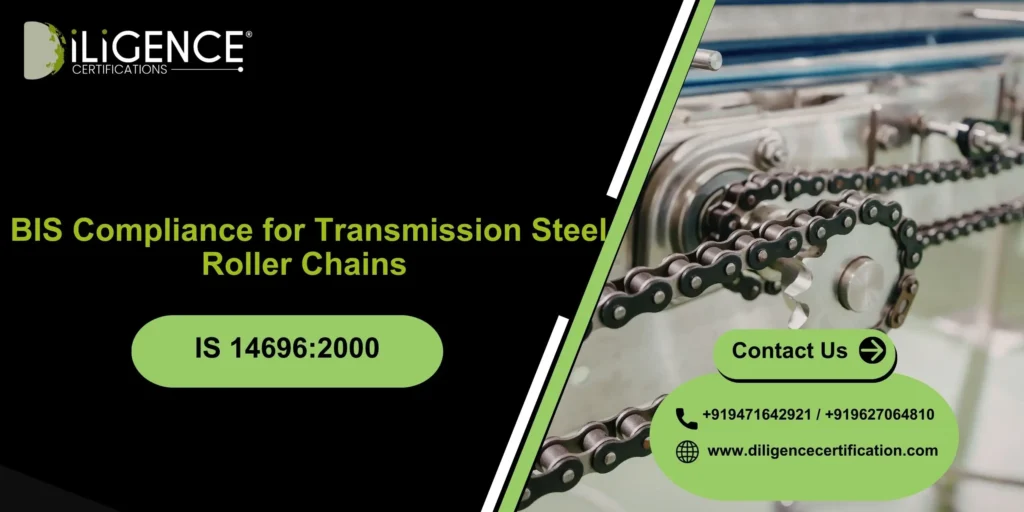
By - BIS for Steel Roller Chains IS 14696:2000 defines quality, safety, and performance standards for transmission steel roller chains and chain wheels used in oil field applications.
- BIS compliance ensures durability, load-bearing capacity, and resistance to harsh operating conditions.
- Mandatory certification improves product reliability and builds trust among industrial buyers.
- The certification process involves testing, documentation, factory inspection, and license approval.
- Non-compliance can lead to product rejection, legal penalties, and loss of market credibility.
Introduction | BIS for Steel Roller Chains
In the oil and gas industry, equipment reliability is not just important-it is critical. Components like transmission steel roller chains and chain wheels play a vital role in ensuring smooth operations in drilling, extraction, and transportation systems. Any failure in these components can lead to costly downtime and safety hazards.
To maintain quality and safety, the Bureau of Indian Standards (BIS) has established IS 14696:2000, a standard that defines the specifications for transmission steel roller chains and chain wheels used in oil field applications. Compliance with this standard is essential for manufacturers who want to supply high-quality products in the Indian market.
This blog provides a complete, easy-to-understand guide on BIS for Steel Roller Chains under IS 14696:2000, including its importance, process, benefits, and challenges.
What is BIS for Steel Roller Chains IS 14696:2000?
BIS for Steel Roller Chains IS 14696:2000 is an Indian Standard that specifies the requirements for transmission steel roller chains and chain wheels used in oil field operations. These products are designed to operate under extreme conditions, including high loads, abrasive environments, and continuous usage.
The standard covers:
- Material specifications
- Dimensions and tolerances
- Mechanical properties
- Performance requirements
- Testing methods
- Marking and labeling
By following this standard, manufacturers ensure that their products meet industry expectations for safety, durability, and efficiency.
Why BIS for Steel Roller Chains for IS 14696:2000 is Required
BIS for Steel Roller Chains is essential for manufacturers dealing with industrial products, especially those used in critical sectors like oil fields. Here’s why it is important:
Key Reasons
- Ensures Product Quality
Compliance guarantees that the chains and chain wheels meet strict quality benchmarks. - Enhances Safety
Reduces the risk of equipment failure, protecting workers and operations. - Legal Requirement
In many cases, BIS certification is mandatory for market entry. - Improves Market Acceptance
Certified products are more trusted by buyers and contractors. - Boosts Brand Reputation
Demonstrates commitment to quality and compliance. - Facilitates Tender Participation
Many government and large-scale tenders require BIS-certified products.
Importance and Benefits of BIS for Steel Roller Chains
| Importance | Benefits |
| Ensures adherence to national standards | Builds customer trust and credibility |
| Maintains product consistency | Reduces rejection rates |
| Enhances operational safety | Minimizes risk of accidents |
| Meets regulatory requirements | Enables smooth market entry |
| Supports industrial reliability | Improves long-term performance |
| Aligns with global quality practices | Strengthens brand positioning |
Step-by-Step Process of BIS for Steel Roller Chains
Step1:Documentation
- Collect required technical documents
- Prepare product specifications
- Gather company registration details
- Ensure documents follow BIS format
Step2:Product Testing
- Send samples to a BIS-approved lab
- Conduct safety and quality tests
- Receive test reports
- Confirm compliance with BIS standards
Step3:Application Submission
- Fill out the BIS application form
- Upload all required documents
- Attach valid test reports
- Pay the necessary BIS fees
Step4:Scrutiny and Inspection
- BIS reviews submitted documents
- Authority verifies test results
- Factory/product inspection may occur
- Clarifications requested if needed
Step5:Grant of License
- BIS approves the application
- License number is issued
- Product can carry BIS mark
- Renewal required before expiry
Documents Required for BIS Certification
| Category | Documents Required |
| Business Documents | Business license/registration, ISO certificate, organizational details |
| Manufacturer Details | Factory layout, process flow chart, machinery list, production details |
| Product Documents | Product specifications, component list, user manual, model details |
| Testing Documents | Test report from BIS-recognized lab, sample details, test request form |
| Legal & Compliance | Authorization letter, brand ownership proof, trademark certificate (if any) |
| Import/Foreign Manufacturer (If applicable) | AIR (Authorized Indian Representative) details, contract agreement, overseas manufacturer documents |
Timelines, Costs, Validity & Renewal
- Timelines: Usually from 20 to 30 days, with only 7-15 days for the testing.
- Costs: The cost of the government and the test varies depending on the product. There can be some additional charges though.
- Validity: The validity period is 2 years in most situations.
- Renewal: The renewal is done before the expiration; there should be updated documents/tests; the renewal
Challenges of Getting This Certification Without a Consultant
While the process may seem straightforward, manufacturers often face several challenges:
- Complex Documentation
Understanding and preparing technical documents can be difficult. - Lack of Technical Knowledge
Interpreting IS 14696:2000 requirements requires expertise. - Testing Delays
Incorrect samples or incomplete documentation can delay testing. - Factory Compliance Issues
Manufacturing units may not meet BIS inspection standards initially. - Application Rejections
Minor errors can lead to rejection or resubmission. - Time-Consuming Process
Without proper guidance, the process can take much longer.
These challenges can increase costs and delay market entry.
Why Choose Diligence Certification for BIS Compliance
Choosing the right consultant can make a significant difference in the certification process. Diligence Certification offers expert support to simplify and accelerate BIS for Steel Roller Chains
Key Advantages
- Expert Guidance
Professionals with in-depth knowledge of BIS standards. - End-to-End Support
From documentation to final approval. - Faster Processing
Minimizes delays and ensures smooth application handling. - Accurate Documentation
Reduces chances of rejection. - Testing Assistance
Helps coordinate with BIS-approved laboratories. - Inspection Preparation
Ensures your factory meets all compliance requirements. - Cost-Effective Solutions
Saves time and resources in the long run.
With Diligence Certification, manufacturers can focus on production while experts handle compliance.
Conclusion
BIS compliance under IS 14696:2000 is crucial for manufacturers of transmission steel roller chains and chain wheels used in oil field applications. It ensures product quality, safety, and reliability while enhancing market credibility.
Although the certification process can be complex, proper planning and expert assistance can make it smooth and efficient. By obtaining BIS certification, manufacturers not only meet regulatory requirements but also gain a competitive edge in the market.
Partnering with a professional consultancy like Diligence Certification can help you achieve compliance faster and without unnecessary complications.
Frequently Asked Questions (FAQs)
What is IS 14696:2000?
It is an Indian Standard for transmission steel roller chains and chain wheels used in oil field applications.
Is BIS certification mandatory for these products?
It depends on regulatory requirements, but certification is highly recommended for market acceptance.
Who can apply for BIS certification?
Manufacturers of transmission steel roller chains and chain wheels.
How long does the certification process take?
It typically takes a few weeks to a few months depending on compliance readiness.
What documents are required?
Company details, product specifications, and test reports are required.
What is the role of product testing?
Testing ensures the product meets IS 14696:2000 standards.
Can foreign manufacturers apply?
Yes, through the appropriate BIS certification scheme.
What happens if the product fails testing?
The manufacturer must rectify issues and reapply.
Is factory inspection mandatory?
Yes, BIS conducts inspections before granting certification.
Why should I hire a consultant?
A consultant simplifies the process, reduces errors, and speeds up approval.


