BIS Certification
 CDSCO
CDSCO
 PESO
PESO
 CPCB
CPCB
 LMPC
LMPC
 WPC Approval
 Global Approvals
 TEC
TEC
 ARAI
ARAI
 BEE
BEE
 ISO Certification
 DGCA Certification
 NOC For Steel
 APEDA Registration























 Business Registration
 FSSAI Mark Certification












 (32).jpg)
 Legal Services
 Trademark Registration
 Copyright Registration
 Patent Registration
 By
By - Mandatory Quality Compliance:BIS certification ensures the quality and safety of the aluminium alloy milk cans as per the standards mentioned in the IS 1825:1983 specification.
- Ensures Food Safety:BIS-certified milk cans are made of food-grade aluminium alloys, thus ensuring the milk does not get contaminated during storage or transportation.
- Durability and Strength:IS 1825:1983 specifies the mechanical properties of the milk cans, thus ensuring the cans are corrosion-resistant, and durable.
- Standardized Design and Capacity:IS 1825:1983 specifies the standards for the design, capacity, and construction of the milk cans, thus ensuring uniformity among all the manufacturers.
- Market Trust and Legal Compliance:BIS certification ensures the credibility of the product, thus helping the manufacturer comply with the regulations set by the Indian government.
Introduction
Aluminum alloy milk cans have been playing a vital role in the dairy industry to ensure safe storage and transportation of milk from collection centers to processing units. To ensure quality, hygiene, and strength of milk cans, it is important that they comply with regulatory requirements. The Bureau of Indian Standards (BIS) has formulated IS 1825:1983 that defines the specifications for aluminum alloy milk cans to be used in the dairy industry.If BIS certification is obtained for milk cans according to this standard, it ensures that the milk cans are made of food-grade materials and have the necessary strength and design requirements.
What is IS 1825:1983?
IS 1825:1983 is an Indian Standard that has been published by the Bureau of Indian Standards (BIS). The standard specifies the requirements that need to be met by aluminium alloy milk cans. The standard specifies guidelines that need to be met by aluminium alloy milk cans to ensure that they are safe and suitable for use in the dairy industry. The standard specifies important factors that need to be met by aluminium alloy milk cans. The factors that have been specified in this standard include food-grade aluminium alloy, corrosion resistance, finishing, leak-proof design, and ease of cleaning.
Key Points:
- Defines Standard Specifications:It provides specifications for the aluminium alloy milk cans, including the design, dimensions, and capacity of the cans.
- Ensures Food-Grade Material:The standard specifies the safe, non-toxic, and edible aluminium alloy used for the milk cans.
- Focus on Durability:The standard provides durability specifications.
- Hygiene and Safety Requirements:It ensures the cans have a smooth finish, are leak-proof, and can be easily cleaned.
- Uniformity Across Products:It ensures the milk cans are uniform, thus making them reliable.
Products Covered Under IS 1825 : 1983
The IS standard for milk cans made from aluminium alloys, specifically for storing, handling, and transporting milk in the dairy industry, is IS 1825:1983. The standard includes seamless or fabricated milk cans made from food-grade aluminium alloys, ensuring safety for direct contact with milk.The milk cans are usually available in standard sizes, such as 10 liters, 20 liters, 30 liters, and 40 liters, or as specified, with basic features such as covers that fit tightly, handling facilities in the form of handles, and locking arrangements to prevent spillage and contamination. The milk cans are designed to be durable, corrosion-resistant, and suitable for repeated use in various environmental conditions.
Key Reasons:
- Aluminium Alloy Milk Cans:This includes milk cans made of food-grade aluminium alloy, which can be used for the safe storage of milk.
- Standard Capacity Cans:This includes cans of standard capacities, such as 10L, 20L, 30L, and 40L.
- Seamless and Fabricated Cans:This includes both seamless as well as fabricated milk cans.
- Cans with Lids and Handles:This includes the entire unit, including the lids, handles, and locking mechanisms.
- Components of Milk Cans:This includes the specifications of the individual components of the milk cans, including the body, bottom, lids, handles, etc.
Importance and Benefits of BIS Certification
| Importance | Benefits |
| Compliance with IS 1825:1983:Manufacturers have to comply with all the specifications related to materials, design, and performance. | Assured Product Quality:Guarantees quality in terms of durability, strength, and performance. |
| Use of Food-Grade Aluminium:Ensures that the milk cans are safe for storing and transporting milk without any kind of contamination. | Enhanced Food Safety:Prevents contamination and maintains milk hygiene during storage and transportation. |
| BIS Certification Process:Includes product testing, factory inspection, and quality control evaluation. | Increased Market Credibility:Helps build trust with buyers, dairy business owners, and government agencies. |
| Marking and Labeling Requirements:Certified products must bear the BIS Standard Mark (ISI Mark) to ensure authenticity. | Legal Compliance:Aids the dairy manufacturer to comply with legal requirements in India. |
| Quality Control Measures:Regular surveillance and testing are required to maintain certification validity. | Competitive Advantage:Helps dairy manufacturers to secure tenders and large-scale dairy business. |
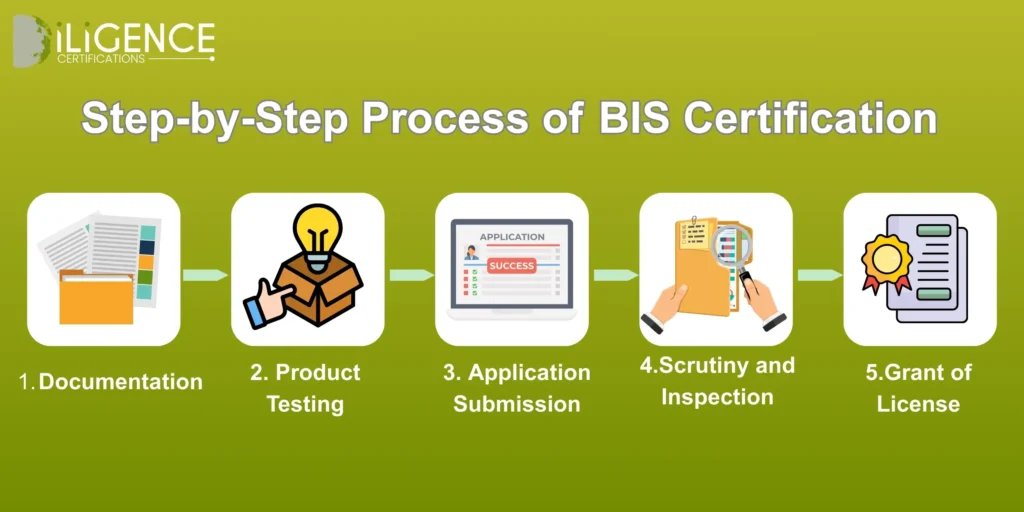
Step-by-Step Process of BIS Certification
Step1:Documentation
- Collect required technical documents
- Prepare product specifications
- Gather company registration details
- Ensure documents follow BIS format
Step2:Product Testing
- Send samples to a BIS-approved lab
- Conduct safety and quality tests
- Receive test reports
- Confirm compliance with BIS standards
Step3:Application Submission
- Fill out the BIS application form
- Upload all required documents
- Attach valid test reports
- Pay the necessary BIS fees
Step4:Scrutiny and Inspection
- BIS reviews submitted documents
- Authority verifies test results
- Factory/product inspection may occur
- Clarifications requested if needed
Step5:Grant of License
- BIS approves the application
- License number is issued
- Product can carry BIS mark
- Renewal required before expiry
Documents Required for BIS Certification
| Category | Documents Required |
| Business Documents | Business license/registration, ISO certificate, organizational details |
| Manufacturer Details | Factory layout, process flow chart, machinery list, production details |
| Product Documents | Product specifications, component list, user manual, model details |
| Testing Documents | Test report from BIS-recognized lab, sample details, test request form |
| Legal & Compliance | Authorization letter, brand ownership proof, trademark certificate (if any) |
| Import/Foreign Manufacturer (If applicable) | AIR (Authorized Indian Representative) details, contract agreement, overseas manufacturer documents |
Timelines, Costs, Validity & Renewal
- Timelines: Usually from 20 to 30 days, with only 7-15 days for the testing.
- Costs: The cost of the government and the test varies depending on the product. There can be some additional charges though.
- Validity: The validity period is 2 years in most situations.
- Renewal: The renewal is done before the expiration; there should be updated documents/tests; the renewal
Why Choose Diligence Certifications
Diligence Certifications is a renowned consultancy that offers comprehensive support for procuring BIS certification for aluminium alloy milk cans as per IS: 1825:1983. The company’s team of experienced professionals helps ensure that the process is hassle-free for companies. Diligence Certifications offers end-to-end support for procuring BIS certification for aluminium alloy milk cans as per IS: 1825:1983. The company’s in-depth understanding of BIS standards helps companies avoid delays and errors in the process, thereby speeding up the procedure.
Conclusion
BIS Certification for Aluminium Alloy Milk Cans as per IS:1825:1983 plays an important role in ensuring product quality, safety, and reliability in the dairy sector. This standard can be followed to ensure that milk cans are manufactured with basic parameters in mind for hygiene, durability, etc.Besides ensuring compliance with regulatory requirements in India, BIS certification can be beneficial in building brand reputation and trust among consumers. This is because the milk will be stored in safe and clean conditions during transportation, which is critical for public health.
Frequently Asked Questions (FAQs)
What is IS 1825:1983?
It is a standard for aluminium alloy milk cans in the dairy industry, set by the Bureau of Indian Standards.
Is BIS certification for milk cans compulsory?
It may be compulsory in accordance with regulatory orders and requirements from buyers.
What material is used for these milk cans?
Food-grade aluminium alloys are used for milk cans for safety and hygienic purposes.
What are the capacities available for this standard?
The available capacities for these milk cans are 10L, 20L, 30L, and 40L milk cans.
What is ISI Mark?
It is a certification mark for products that conform to Indian standards and is provided by the Bureau of Indian Standards.
Who can apply for BIS certification?
Manufacturers of aluminium alloy milk cans can apply for BIS certification.
What is the main purpose of certification?
The main purpose of certification is to ensure product quality, safety, and standardization.
Does BIS certification improve product quality?
Yes, BIS certification ensures that the product meets strict quality and performance criteria.
Is testing required for BIS certification?
Yes, testing is required for BIS certification, and testing has to be done in BIS recognized laboratories.
How long does it take to get BIS certification?
It takes a few weeks to months to obtain BIS certification.