BIS Certification
 CDSCO
CDSCO
 PESO
PESO
 CPCB
CPCB
 LMPC
LMPC
 WPC Approval
 Global Approvals
 TEC
TEC
 ARAI
ARAI
 BEE
BEE
 ISO Certification
 DGCA Certification
 NOC For Steel
 APEDA Registration























 Business Registration
 FSSAI Mark Certification












 (32).jpg)
 Legal Services
 Trademark Registration
 Copyright Registration
 Patent Registration
 By
By - Mandatory Quality Compliance:The BIS certification ensures that the quality and chemical composition of the Aluminium Alloy Hardeners conform to the set standards as per the IS 2047:1992 standard.
- Ensures Purity and Composition:This standard specifies the composition of alloying elements; hence, the consistency of metallurgical properties is ensured.
- Applicable to Master Alloys:This certification is applicable to Aluminium Alloy Hardeners, which is also called Master Alloys. Master Alloys are used to enhance the strength and grain structure of Aluminium materials.
- Use of ISI Mark:The manufacturer is allowed to use the ISI mark on the product. The use of the ISI mark ensures that the product is compliant with the standards and is safe for use in industries.
- Third Party Inspection and Testing:BIS certification includes factory inspection and testing to ensure that the Aluminium Alloy Hardeners conform to the IS 2047:1992 standard.

Introduction
Aluminum alloy hardeners, also called master alloys, have been recognized as important materials to improve the mechanical properties of aluminum products. The materials have been widely applied in many industries to increase the strength and grain structure of aluminum products. To ensure the quality and consistency of the materials, it is important to comply with the standards and regulations of the Bureau of Indian Standards (BIS).According to the Bureau of Indian Standards (BIS), IS 2047:1992 has been specified as the standard for the quality and composition of aluminum alloy hardeners. The BIS certification ensures that the manufacturers of aluminum alloy hardeners adhere to the guidelines and regulations of the standard.
What is IS 2047:1992?
IS 2047:1992 is an Indian Standard, and it is developed by the Bureau of Indian Standards. The necessary requirements for aluminum alloy hardeners, also known as master alloys, are provided in this standard. These hardeners are used to change the properties of aluminum alloys and enhance their quality by adding alloying materials.This standard gives guidelines for aluminum alloy hardeners to operate effectively and efficiently. The aluminum alloy hardeners manufactured will be able to enhance the quality of aluminum alloys.
Key Points:
- Indian Standard by BIS:IS 2047:1992 is an Indian Standard for controlling and regulating aluminium alloy hardeners in the form of master alloys, and it is issued by the Bureau of Indian Standards (BIS).
- Covers Master Alloys:The standard applies to aluminium alloy hardeners used for adding alloying components such as copper, manganese, silicon, etc.
- Specifies Chemical Composition:The standard specifies exact chemical composition requirements for quality and performance assurance.
- Defines Testing & Inspection:The standard includes requirements for sampling, testing, and inspection for conformity verification.
- Ensures Quality & Uniformity:By adhering to IS 2047:1992, users are assured of quality and uniformity for applications in industries such as automobiles and aerospace.
Products Covered Under IS 2047 : 1992
Aluminum alloy hardeners, also called master alloys, used for the addition of specific alloying components to molten aluminum with the aim of improving the mechanical and metallurgical properties of the alloy, are covered under the standard. These products play a vital role in the achievement of specific properties such as strength, hardness, corrosion resistance, and grain structure. The standard specifies the types of master alloys used, including Aluminum Copper Master Alloys, Aluminum Manganese Master Alloys, Aluminum Silicon Master Alloys, Aluminum Chromium Master Alloys, and Aluminum Iron Master Alloys. The products may be supplied in ingots, rods, waffle, or shot forms.
Key Reasons:
- Aluminium-Based Master Alloys:This section deals with aluminium alloys used for hardening and for adding certain elements to aluminium in its molten form.
- Different Alloy Combinations:These are Aluminium Copper, Aluminium Manganese, Aluminium Silicon, Aluminium Chromium, and Aluminium Iron alloys.
- Various Product Forms:These master alloys are available in ingot, rod, waffle, and shot forms for ease of handling in industries.
- Used in Metal Enhancement: These master alloys are used for metal enhancement in aluminium alloys for better strength, hardness, and grain structure.
- Industrial Applications:These master alloys are used in industries such as automobiles, aviation, construction, and electrical.
Importance and Benefits of BIS Certification
| Importance | Benefits |
| Compliance with Indian Standards:It ensures products conform to BIS Standards under IS 2047:1992 for quality and safety. | Assured Product Quality:Guarantees the quality of the product for the intended use. |
| Chemical Composition Control:It ensures accurate control over alloying elements. | Enhanced Market Credibility:Establishes credibility for the buyers, sellers, and stakeholders. |
| Mandatory Testing Procedures:Products go through rigorous testing and inspection in the laboratory. | Regulatory Compliance:Helps the manufacturers comply with the government and legal requirements. |
| ISI Mark Authorization:It allows manufacturers to use the ISI Mark, signifying compliance with standards. | Competitive Advantage:Helps the product achieve a competitive edge in the markets. |
| Surveillance by BIS:It ensures constant compliance with quality norms. | Reduced Risk of Rejection:Minimizes the risk of rejection of the products. |
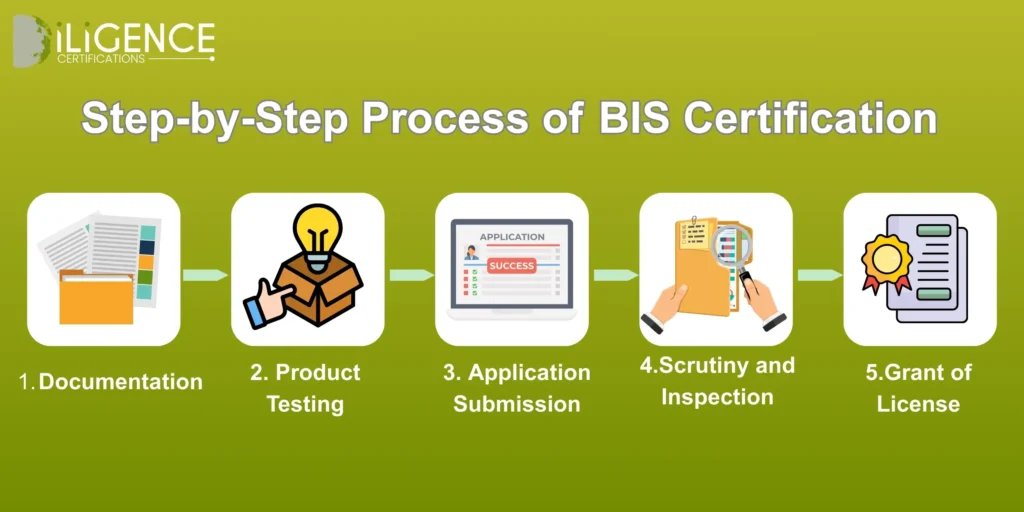
Step-by-Step Process of BIS Certification
Step1:Documentation
- Collect required technical documents
- Prepare product specifications
- Gather company registration details
- Ensure documents follow BIS format
Step2:Product Testing
- Send samples to a BIS-approved lab
- Conduct safety and quality tests
- Receive test reports
- Confirm compliance with BIS standards
Step3:Application Submission
- Fill out the BIS application form
- Upload all required documents
- Attach valid test reports
- Pay the necessary BIS fees
Step4:Scrutiny and Inspection
- BIS reviews submitted documents
- Authority verifies test results
- Factory/product inspection may occur
- Clarifications requested if needed
Step5:Grant of License
- BIS approves the application
- License number is issued
- Product can carry BIS mark
- Renewal required before expiry
Documents Required for BIS Certification
| Category | Documents Required |
| Business Documents | Business license/registration, ISO certificate, organizational details |
| Manufacturer Details | Factory layout, process flow chart, machinery list, production details |
| Product Documents | Product specifications, component list, user manual, model details |
| Testing Documents | Test report from BIS-recognized lab, sample details, test request form |
| Legal & Compliance | Authorization letter, brand ownership proof, trademark certificate (if any) |
| Import/Foreign Manufacturer (If applicable) | AIR (Authorized Indian Representative) details, contract agreement, overseas manufacturer documents |
Timelines, Costs, Validity & Renewal
- Timelines: Usually from 20 to 30 days, with only 7-15 days for the testing.
- Costs: The cost of the government and the test varies depending on the product. There can be some additional charges though.
- Validity: The validity period is 2 years in most situations.
- Renewal: The renewal is done before the expiration; there should be updated documents/tests; the renewal
Why Choose Diligence Certifications
Diligence Certifications is a reliable consultancy service that helps companies obtain BIS certification in a smooth and hassle-free manner. The team at Diligence Certifications is aware of the regulatory requirements in India and helps companies obtain BIS certification in a hassle-free manner. The professional approach of the team at Diligence Certifications helps companies obtain timely approvals, accurate compliance with IS 2047:1992, and completely eliminate the possibility of rejection.
Conclusion
Similarly, BIS certification for Aluminium Alloy Hardeners according to IS 2047:1992 is vital for ensuring product quality, consistency, and safety. It provides a framework for standardized guidelines for chemical analysis, tests, and performance, thus ensuring that reliable and high-quality products are produced.By obtaining BIS certification for aluminium alloy hardeners, organizations not only demonstrate their adherence to Indian government regulations and directives but also provide a competitive advantage to themselves in a very competitive and quality-oriented business environment. It is a vital certification for organizations engaged in the business of aluminium alloy hardeners.
Frequently Asked Questions (FAQs)
What is IS 2047:1992?
It is a BIS standard for aluminium alloy hardeners (master alloys).
Is BIS certification mandatory?
It depends on government quality control orders. You can check the latest notifications.
What are aluminium alloy hardeners?
Aluminium alloy hardeners are master alloys.
Who can apply for BIS certification?
Manufacturers of aluminium alloy hardeners can apply for BIS certification.
What is the ISI mark?
It is a mark given for compliance with BIS standards.
What tests are required?
Chemical composition and quality tests as per the standard.
How long does certification take?
It takes weeks to months depending upon compliance.
Is factory inspection required?
Yes, factory inspection is required by BIS for granting certification.
Can foreign manufacturers apply?
Yes, foreign manufacturers can apply through BIS FMCS (Foreign Manufacturer’s Certification Scheme).
What is the validity of BIS certification?
It is generally for a certain period and requires renewal.