BIS Certification
 CDSCO
CDSCO
 PESO
PESO
 CPCB
CPCB
 LMPC
LMPC
 WPC Approval
 Global Approvals
 TEC
TEC
 ARAI
ARAI
 BEE
BEE
 ISO Certification
 DGCA Certification
 NOC For Steel
 APEDA Registration























 Business Registration
 FSSAI Mark Certification












 (32).jpg)
 Legal Services
 Trademark Registration
 Copyright Registration
 Patent Registration
 By
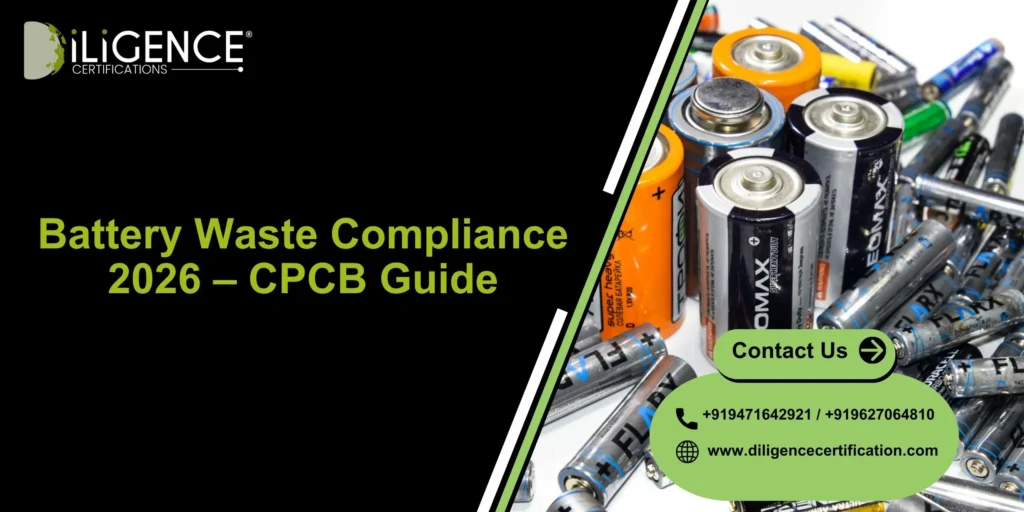
By - Extended Producer Responsibility (EPR):Producers, importers, and manufacturers need to collect used batteries and recycle them in accordance with the targets set by the Central Pollution Control Board (CPCB).
- Mandatory Registration on CPCB Portal:All stakeholders need to register on the CPCB online portal prior to the commencement of operations.
- Recycling Targets & Documentation: Businesses need to meet the Battery Waste Compliance targets set by the Central Pollution Control Board (CPCB), along with the required documentation.
- Environmentally Safe Disposal:Batteries need to be handled, stored, and recycled only through authorized recyclers in order to avoid environmental pollution.
- Compliance Reporting & Audits: Businesses need to file their Battery Waste Compliance returns regularly in order to maintain transparency and comply with the CPCB Battery Waste Management Rules 2022 (updated for 2026 compliance).
Introduction
Battery waste management has emerged as a significant environmental issue owing to the increased rate of usage of electronic gadgets, electric vehicles, and power storage devices. Battery waste management is important as improper management may cause severe pollution and health risks due to toxic chemicals used in batteries such as lead, lithium, and cadmium. In order to control battery waste management, the Central Pollution Control Board (CPCB) has formulated stringent norms for battery waste management under Battery Waste Management Rules. In 2026, these rules are still focused on ensuring that all stakeholders, such as manufacturers, importers, dealers, and recyclers, are responsible for battery waste management.
What are Battery Waste Management Rules?
The Battery Waste Management Rules are regulations set up by the Ministry of Environment, Forest, and Climate Change, which are then implemented by the Central Pollution Control Board. The regulations are meant to ensure proper handling, recycling, and disposal of batteries that are no longer in use. The regulations were set up to combat environmental pollution through the promotion of a circular economy, where waste battery recycling is ensured through the Extended Producer Responsibility (EPR) approach. The regulations apply to all types of batteries, such as lithium-ion, lead-acid, and electric vehicle batteries.
Key Points:
- Extended Producer Responsibility (EPR):Producers, importers, and manufacturers are responsible for collecting and recycling waste batteries according to targets set by authorities.
- Mandatory Registration & Compliance:All parties are required to register themselves with the Central Pollution Control Board before starting operations.
- Coverage of All Battery Types:The scheme covers all types of batteries, including lithium-ion batteries, lead acid batteries, and electric vehicle batteries.
- Environmentally Sound Recycling Practices:Used or waste batteries are required to be recycled only through authorized recyclers.
- Monitoring, Reporting & Accountability:Filing of returns and compliance are required as per rules framed by the Ministry of Environment, Forest & Climate Change.
Who Needs to Comply with Battery Waste Rules?
The Battery Waste Management Rules cover all entities involved in the manufacturing, distribution, usage, and recycling of batteries. The Battery Waste Management Rules were introduced by the Ministry of Environment, Forest and Climate Change and implemented by the Central Pollution Control Board. The Battery Waste Management Rules ensure that all stakeholders in battery management are responsible for the safe handling of battery waste.
Key Reasons:
- Producers (Manufacturers & Importers):Manufacturers or importers of batteries are required to comply with EPR requirements.
- Dealers & Distributors:Entities dealing in battery sales are required to collect used batteries from consumers and hand them over to recyclers for proper processing.
- Consumers & Bulk Users:Consumers and users of batteries are required to dispose of used batteries properly and not discard them as general waste.
- Recyclers & Refurbishers:Recyclers or refurbishers are required to properly dispose of used batteries in an eco-friendly manner and adhere to guidelines provided by CPCB.
- E-commerce Entities:Entities dealing in battery sales on e-commerce platforms are required to comply with EPR requirements.
Importance and Benefits of Battery Waste Compliance
| Importance | Benefits |
| Environmental Protection:The chemicals will not pollute the soil and water. | Improved Brand Reputation:Businesses earn the trust of the public by exhibiting their responsibility towards the environment. |
| Legal Compliance:The rules and regulations set by the Central Pollution Control Board will be followed, and there will be no legal issues. | Regulatory Approval & Smooth Operations:By complying with the Ministry of Environment, Forest and Climate Change norms, business operations run smoothly. |
| Resource Conservation:The recycling of the battery will help in the conservation of valuable resources like lithium, cobalt, and lead. | Cost Efficiency in the Long Run:Recycling saves on the cost of raw materials and waste disposal. |
| Public Health Safety:The safety of public health will be ensured by disposing of the used battery. | Market Advantage:Businesses that comply with eco-regulations tend to attract more business. |
| Sustainable Business Practices:The business will ensure a clean and green environment. | Contribution to Circular Economy:Encourages the reuse and recycling of products, thus reducing the need to use new resources. |
Step-by-Step Process of CPCB E-Waste Rules
Step 1: Identify Your Category
- Determine whether you are a producer, manufacturer, recycler, refurbisher, or bulk consumer.
Step 2: Register on CPCB Portal
- Create an account and apply for E-Waste Registration/EPR Authorization online.
Step 3: Prepare & Upload Documents
- Submit required documents like PAN, GST, company details, and business licenses.
Step 4: Submit EPR Plan (For Producers)
- Provide a detailed plan for collection, recycling, and disposal of e-waste.
Step 5: Approval from CPCB
- CPCB reviews the application and grants authorization if all requirements are met.
Step 6: Implement E-Waste Management System
- Set up proper channels for collection, storage, recycling, and disposal.
Step 7: Maintain Records & File Returns
- Keep records of e-waste handled and submit regular compliance reports.
Documents Required for CPCB E-Waste Rules
| Category | Documents Required |
| Company PAN & GST Certificate | Proof of business identity and tax registration |
| IEC (Import Export Code) | Mandatory for importers of electronic goods |
| Business Registration Proof | Certificate of incorporation, partnership deed, or MSME registration |
| Product Details | Information about the type of electronic products handled |
| EPR Plan | A detailed plan for collection, recycling, and disposal of e-waste |
| Authorization Documents | Agreements with authorized recyclers, collection centers, or PROs |
Timelines, Costs, Validity & Renewal
- Timelines:The registration process usually takes a few weeks, depending on document verification and application accuracy.
- Costs:Costs vary based on business type, scale, and compliance requirements.
- Validity:CPCB E-Waste Registration is generally valid for a specific period as per approval terms and must be maintained through compliance.
- Renewal:Renewal should be applied before expiry with updated documents and compliance reports to ensure continuous authorization.
Why Choose Diligence Certifications
Diligence Certifications offers expert guidance for hassle-free regulatory compliance. With a professional approach and end-to-end support, businesses can easily achieve compliance quickly. This will save time and effort for businesses.
Conclusion
Battery Waste Compliance is significant in the protection of the environment, adherence to the law, and the promotion of sustainable business practices. Adhering to the guidelines provided by the Central Pollution Control Board and the Ministry of Environment, Forest and Climate Change ensures the efficient handling of Battery Waste without incurring sanctions in the quest for a clean future.
Frequently Asked Questions (FAQs)
What is Battery Waste Compliance?
Battery Waste Compliance is defined as the implementation of rules for the safe handling, recycling, and disposal of batteries.
Who regulates the battery waste rules in India?
The Central Pollution Control Board regulates the rules.
Is registration mandatory?
Yes, it is mandatory for all stakeholders to register on the CPCB portal.
What is EPR in battery rules?
EPR in battery rules stands for Extended Producer Responsibility.
Which types of batteries are included in the rules?
All types of batteries, including lithium-ion, lead acid, and electric vehicle batteries.
Can the batteries be disposed of in general waste?
No, they have to be handed over to the recyclers.
Who has to comply?
Producers, importers, dealers, recyclers, and bulk users.
What will happen if the rules are not followed?
Non-compliance will result in action against the violators.
Do records and reports have to be kept?
Yes, filing and reporting are a regular requirement.
Which ministry has introduced the rules?
The Ministry of Environment, Forest and Climate Change.