BIS Certification
 CDSCO
CDSCO
 PESO
PESO
 CPCB
CPCB
 LMPC
LMPC
 WPC Approval
 Global Approvals
 TEC
TEC
 ARAI
ARAI
 BEE
BEE
 ISO Certification
 DGCA Certification
 NOC For Steel
 APEDA Registration























 Business Registration
 FSSAI Mark Certification












 (32).jpg)
 Legal Services
 Trademark Registration
 Copyright Registration
 Patent Registration
 By
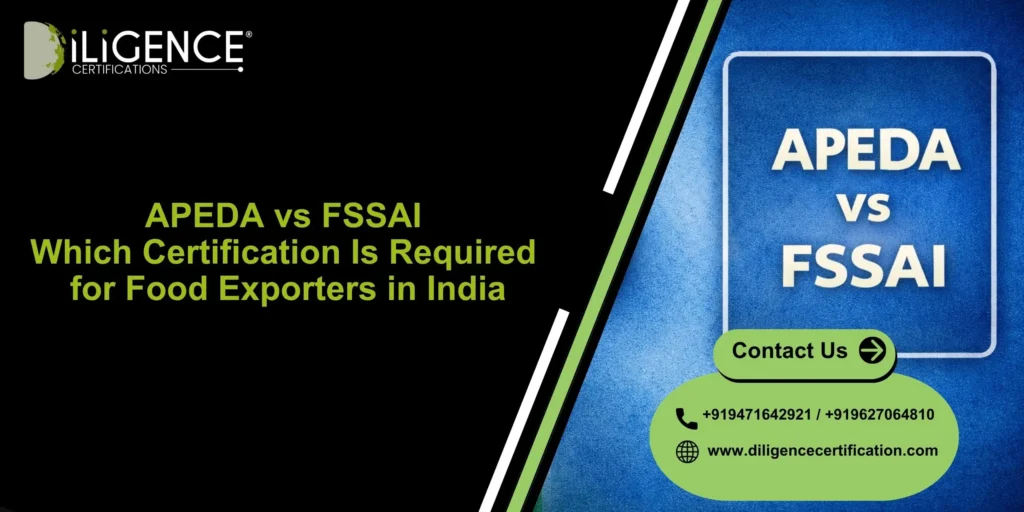
By - Both APEDA vs FSSAI are mandatory-but for different purposes.
- FSSAI is required for food safety compliance within India, including manufacturing and processing.
- APEDA is mandatory for exporting specific agricultural and processed food products.
- Exporters usually need both certifications to operate legally and efficiently.
- Missing either certification can lead to shipment delays, penalties, or rejection in international markets.
Introduction | APEDA vs FSSAI
Food exporters in India often get confused between APEDA vs FSSAI certifications. This confusion leads to compliance issues, shipment delays, and even business losses.
The core issue is simple: both certifications serve different regulatory functions, but they overlap in the export process. If you misunderstand this, your export business will face operational blocks.
This guide breaks down the exact difference, requirement, and process so you know what is actually needed-not assumptions.
What is APEDA vs FSSAI?
APEDA (Agricultural Export Authority)
APEDA is responsible for promoting and regulating the export of agricultural and processed food products.
Covers:
- Fruits and vegetables
- Meat and poultry products
- Dairy products
- Processed foods
- Organic products
It issues RCMC (Registration-Cum-Membership Certificate), which is mandatory for exporters dealing in listed products.
FSSAI regulates food safety and hygiene within India.
Covers:
- Food manufacturing
- Processing units
- Packaging and labeling
- Storage and distribution
It ensures your food products are safe for consumption before they are sold domestically or exported.
Why Food Exporters Need APEDA vs FSSAI
APEDA vs FSSAI Food exporters in India cannot operate with a single certification because export compliance is split into two different regulatory systems. One controls food safety, and the other controls export authorization for agricultural and processed food products.
Both are required depending on your business activity, and in most export setups, both work together.
1. Legal Compliance
- FSSAI ensures your food business is legally allowed to operate in India
- APEDA allows you to export specific products internationally
2. Export Approval
- Without APEDA, export shipments may not be cleared
- Without FSSAI, your production is illegal
3. Quality Assurance
- FSSAI ensures hygiene and safety standards
- APEDA ensures export quality compliance
4. Market Access
- APEDA helps access global markets and schemes
- FSSAI builds trust with buyers and regulators
5. Documentation Requirements
- Export documentation often requires both licenses
- Missing one leads to rejection or delays
Importance and Benefits for APEDA vs FSSAI
| Factor | APEDA | FSSAI |
| Purpose | Export promotion and regulation | Food safety and hygiene |
| Applicability | Exporters of agricultural/processed foods | All food businesses |
| Mandatory For | Export of listed products | Manufacturing, processing, selling |
| Certification Type | RCMC | FSSAI License |
| Market Impact | Enables international trade | Ensures domestic compliance |
| Benefits | Export subsidies, market access | Legal operation, consumer trust |
| Authority Role | Export development | Food safety regulation |
Difference Between APEDA vs FSSAI
| Basis | APEDA | FSSAI |
| Full Form | Agricultural and Processed Food Products Export Development Authority | Food Safety and Standards Authority of India |
| Governing Purpose | Export promotion and regulation of agricultural & processed food products | Food safety regulation in India |
| Regulatory Scope | Export-oriented compliance | Domestic food safety compliance (manufacturing to sale) |
| Applicability | Only specific export food categories | All food businesses in India |
| Mandatory For | Exporters of notified agricultural/processed food items | Every food manufacturer, processor, distributor, retailer |
| Type of Certification | RCMC (Registration-Cum-Membership Certificate) | Food License (Basic/State/Central) |
| Main Objective | Facilitate international trade and exports | Ensure food safety and hygiene standards |
| Issuing Authority | APEDA | FSSAI |
| Product Coverage | Fruits, vegetables, meat, dairy, processed foods, organic products | All food categories in India |
| Role in Export | Enables export eligibility and registration | Ensures food is safe for export processing |
| Inspection Requirement | Limited, based on export category | Regular inspections possible depending on license type |
| Validity | Typically 5 years (renewable) | 1-5 years depending on license |
| Benefit Area | Export incentives, global market access | Legal compliance and consumer trust |
| Consequence of Non-Compliance | Export restrictions, shipment rejection | Legal penalties, business shutdown risk |
Process to Obtain APEDA vs FSSAI Certification
Step-by-Step Process for FSSAI License
- Identify license type (Basic, State, Central)
- Prepare documents (ID, business proof, food category)
- Submit application on FSSAI portal
- Inspection (if required)
- Approval and license issuance
Step-by-Step Process for APEDA Registration
- Obtain Import Export Code (IEC)
- Register on APEDA portal
- Submit business details and documents
- Pay registration fee
- Receive RCMC certificate
Challenges of Getting This Certification Without a Consultant
1. Wrong License Selection
Many businesses apply for incorrect FSSAI license types, leading to rejection.
2. Documentation Errors
Incomplete or incorrect documents delay approvals.
3. Portal Complexity
Government portals are not user-friendly, especially for first-time applicants.
4. Compliance Confusion
Businesses don’t clearly understand when both APEDA and FSSAI are required.
5. Delays in Approval
Small errors can cause weeks of delay due to rework.
6. Lack of Export Knowledge
Export-specific compliance (like labeling, standards) is often misunderstood.
Why Choose Diligence Certification for This Certification
Diligence Certification exporting and compliance process in India is highly rule-based, documentation-focused, and approval-based. Delays do not occur due to lack of eligibility but due to improper application and mismatching with the requirements of the authority.
In case of obtaining certifications such as APEDA vs FSSAI, accuracy in execution is more critical than merely submitting the application.
1. Proper Requirement Mapping Get clear about which certifications you should have depending upon your business strategy.
2. Comprehensive Documentation Preparation Eliminate any uncertainties by preparing accurate documentation.
3. Efficient Approval Process Ensure that errors are reduced to prevent delays and rejection.
4. Professional Assistance Be assured that you will not make compliance mistakes, thus saving money and time.
5. Export-oriented Strategy Certification is important, but exporting is key.
Conclusion
APEDA vs FSSAI are not competing certifications; they serve different regulatory layers in the food business ecosystem.
FSSAI is essential for ensuring food safety, hygiene, and legal operation within India. Without it, no food business can legally manufacture, process, or distribute products.
APEDA is required for exporters dealing in notified agricultural and processed food products, enabling them to access international markets and complete export compliance.
For food exporters, both certifications often work together: FSSAI establishes product safety compliance, while APEDA enables export eligibility and market access.Ignoring either creates practical risks such as shipment delays, documentation rejection, or loss of export opportunities. The correct approach is to evaluate product category, ensure FSSAI compliance first, and then proceed with APEDA registration where applicable.
In short, FSSAI builds legal foundation, and APEDA enables global expansion.
Frequently Asked Questions (FAQs)
Is FSSAI mandatory for food exporters?
Yes, it is required to legally manufacture and process food in India.
Is APEDA required for all food exports?
No, only for products listed under APEDA categories.
Can I export food without APEDA registration?
Not for APEDA-covered products; export may be restricted.
Do I need both APEDA and FSSAI?
Yes, in most cases where you manufacture and export food.
What is RCMC in APEDA?
It is the registration certificate required for exporters.
Is IEC required before APEDA registration?
Yes, IEC is mandatory.
Does FSSAI cover exports?
Indirectly, by ensuring food safety compliance.
How long does APEDA registration take?
Usually a few working days if documents are correct.
Can traders apply for APEDA?
Yes, if they export listed products.
What happens if I don’t have these certifications?
You may face legal penalties and export restrictions.