BIS Certification
 CDSCO
CDSCO
 PESO
PESO
 CPCB
CPCB
 LMPC
LMPC
 WPC Approval
 Global Approvals
 TEC
TEC
 ARAI
ARAI
 BEE
BEE
 ISO Certification
 DGCA Certification
 NOC For Steel
 APEDA Registration























 Business Registration
 FSSAI Mark Certification












 (32).jpg)
 Legal Services
 Trademark Registration
 Copyright Registration
 Patent Registration
 By
By - Corrosive gases can damage people, equipment, pipelines, cylinders, and storage areas if they are not handled with proper safety systems.
- PESO certification and PESO licence may be required for businesses involved in import, filling, storage, transport, or use of gas cylinders and pressure systems.
- A corrosive gases PESO certificate helps prove safety compliance and supports legal handling of hazardous gas-related business activities.
- Proper documentation, approved cylinders, safety layout, gas detection, ventilation, and emergency planning are important for approval.
- PESO verification, inspection, and licence approval can become difficult without correct technical documents and expert compliance support.
Introduction
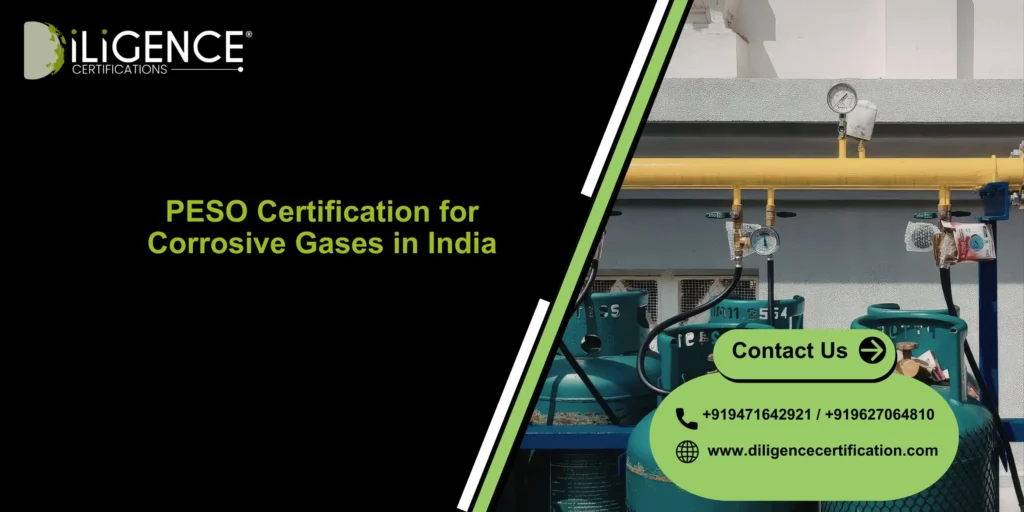
Gases like corrosive ones have applications in various fields such as chemicals, oil, pharmaceuticals, water purification, and manufacturing companies. These gases are helpful yet hazardous because, in case there is a leak, it will result in burning, suffocation, equipment corrosion, pollution, fines, and even closure. As far as India is concerned, one needs to be certified by PESO for importing, storing, refilling, transporting, or using corrosive gases. Moreover, the rules regarding cylinders, laid down by PESO’s Gas Cylinders Rules, 2016, call for safety measures including neutralizing systems.
What Is PESO Certification for Corrosive Gases?
The PESO certification for corrosive gases is a safety authorization process for companies involved in the storage, filling, import, transportation, or use of corrosive gases in cylinder or pressurized containers. It ensures that the gas cylinders, valves, storage place, arrangement, ventilation, scrubber installation, emergency response, and documentation satisfy specified safety requirements.
In India, the application of corrosive gases can be licensed by the PESO license or corrosive gases PESO certificate, depending on the type of gas, volume, pressure, and activity of the company. The Gas Cylinders Rules, 2016 mandates safety measures, such as neutralization or scrubber installations in filling and storage locations for toxic and corrosive gases.
Common corrosive gases include:
- Chlorine
- Hydrogen chloride
- Ammonia
- Sulphur dioxide
- Hydrogen fluoride
- Nitrogen dioxide
- Bromine vapour
- Other acidic or alkaline industrial gases
A corrosive gases PESO certificate may be required when the business activity involves regulated gas cylinders, pressure vessels, import of cylinders, storage facilities, filling stations, or industrial use of compressed or liquefied gases. The exact requirement depends on the gas type, quantity, pressure, storage method, and nature of operation.
Key Points
- PESO certification confirms that gas-related operations meet safety requirements.
- PESO licence may be required for storage, filling, possession, import, or transport of gas cylinders.
- Corrosive gases need special materials, approved valves, and safe storage systems.
- PESO verification may include document checking, technical review, and site inspection.
- Businesses must maintain safety systems even after licence approval.
Why PESO Certification and Corrosive Gas Compliance Are Important
PESO certification and corrosive gas compliance are important because corrosive gases can cause serious injury, leakage, equipment corrosion, environmental damage, and legal action if handled without proper safety systems. In India, the Gas Cylinders Rules, 2016 require safety arrangements such as neutralisation or scrubbing systems for toxic and corrosive gas filling and storage areas.
Proper PESO licence, PESO verification, and corrosive gases PESO certificate help businesses operate legally, reduce accident risks, protect workers, pass inspections, avoid penalties, and maintain safe storage, filling, import, transport, or industrial use of corrosive gases.
Key Points
- It protects workers from burns, poisoning, and breathing problems.
- It prevents leakage, corrosion, cylinder damage, and equipment failure.
- It helps businesses meet Indian safety and licensing requirements.
- It improves trust with clients, auditors, buyers, and authorities.
- It reduces the risk of penalties, rejection, or business shutdown.
- It supports safe import, storage, filling, and industrial use of gases.
- It helps businesses maintain long-term compliance and smooth operations.
Important Requirements and Benefits
| Important Requirement | Business Benefit |
| Correct gas identification | Helps decide the right PESO licence and safety requirement |
| PESO certification or licence check | Ensures legal operation for regulated gas activities |
| Approved gas cylinders | Reduces leakage, failure, and safety risk |
| Suitable cylinder valves and fittings | Prevents corrosion and gas release |
| Proper site layout | Supports safe storage and authority approval |
| Ventilation system | Prevents gas accumulation in storage areas |
| Gas detection system | Gives early warning during leakage |
| Scrubber or neutralisation system | Controls harmful gas release |
| Safety Data Sheet | Provides hazard, handling, storage, and emergency details |
| Fire and emergency system | Helps control accidents quickly |
| PPE for workers | Protects employees during handling and emergency response |
| Trained manpower | Reduces human error and unsafe handling |
| Testing and inspection records | Supports PESO verification and renewal |
| Correct documentation | Avoids rejection and approval delay |
| Licence renewal tracking | Maintains continuous legal compliance |
Common Business Activities That May Need PESO Licence
A PESO licence or approval may be required depending on the type of activity. Not every business will need the same licence. The requirement changes based on the gas, quantity, pressure, premises, cylinder type, and usage.
Common activities include:
- Import of gas cylinders
- Import of valves
- Storage of compressed gas cylinders
- Filling of gas cylinders
- Possession of gas cylinders
- Transport of filled cylinders
- Storage of liquefied gases
- Use of static or mobile pressure vessels
- Operation of gas handling premises
- Testing of gas cylinders
- Industrial use of hazardous gases
For example, PESO’s licensing guidance under the Gas Cylinders Rules mentions procedures for import of gas cylinders and valves through the PESO portal. It also explains that applicants need to submit documents such as application details, covering letter, specifications, drawings, and other technical documents depending on the activity.
Step-by-Step Process for PESO Certification for Corrosive Gases
- Check gas details
Identify the corrosive gas type, quantity, cylinder capacity, pressure, and business activity. - Confirm PESO licence requirement
Check whether the activity needs a PESO licence for import, storage, filling, transport, or use. - Prepare safety layout
Make a proper site plan with storage area, ventilation, safety distance, emergency exit, and gas control system. - Install safety systems
Arrange gas detectors, PPE, emergency kit, alarm, ventilation, and neutralisation or scrubbing system for toxic and corrosive gases. - Collect documents
Prepare SDS, business proof, layout drawing, cylinder details, valve details, test certificates, and emergency plan. - Submit PESO application
Apply through the PESO process with correct form, documents, drawings, and required details. - Complete PESO verification
Handle document review, inspection, and authority queries properly. - Get approval and maintain compliance
After approval, follow licence conditions, renew on time, maintain records, and inspect safety systems regularly.
Challenges of Getting This Certification Without a Consultant
Getting PESO certification for corrosive gases without a consultant can be difficult because the process involves technical rules, safety standards, drawings, documents, and authority review. Many businesses understand the gas usage but do not understand the licensing category, PESO verification process, or documentation format.
Common Challenges
- Wrong PESO licence selection
- Confusion between PESO certification and PESO licence
- Incomplete application documents
- Incorrect site layout or storage plan
- Missing gas safety data
- Use of unsuitable cylinders, valves, or fittings
- Lack of scrubber or gas detection system
- Poor emergency planning
- Delay in replying to PESO queries
- Inspection failure due to unsafe storage
- Renewal delay due to missing records
- Risk of rejection, penalty, or shutdown
A small documentation mistake can create a long delay. A small safety mistake can create a serious accident. That is why expert support is useful for businesses dealing with corrosive gases.
Why Choose Diligence Certification for Corrosive Gas PESO Compliance?
Diligence Certification helps businesses complete PESO licence, and corrosive gases requirements with proper documentation, correct licence guidance, and smooth PESO verification support. Since the Gas Cylinders Rules, 2016 require proper safety arrangements such as neutralisation or scrubbing systems for toxic and corrosive gas areas, expert support helps avoid technical mistakes, delays, and inspection issues.
Why Businesses Choose Diligence Certification
- Expert support for PESO certification and PESO licence
- Guidance for corrosive gases PESO certificate requirements
- Correct licence category selection
- Proper documentation and application filing
- Support for site layout and safety document preparation
- Assistance with PESO verification and authority queries
- Help for importers, manufacturers, and storage units
- Faster and smoother approval process
- Reduced chances of rejection and delay
- End-to-end compliance support from start to approval
Conclusion
PESO certification for corrosive gases is important for safe and legal handling of hazardous gas activities in India. Corrosive gases can cause serious injury, leakage, equipment corrosion, environmental damage, and business shutdown if safety systems are weak. The Gas Cylinders Rules, 2016 require proper safety arrangements, including neutralisation or scrubbing systems for toxic and corrosive gas filling and storage areas.
Businesses dealing with import, storage, filling, transport, or industrial use of corrosive gases should maintain the correct PESO licence, complete documentation, approved cylinders, safety layout, emergency systems, and timely PESO verification. With expert support from Diligence Certification, the approval process becomes more systematic, compliant, and less risky.
Frequently Asked Questions
What is PESO certification for corrosive gases?
PESO certification for corrosive gases is a compliance approval related to safe storage, import, filling, transport, or handling of corrosive gas cylinders and pressure systems in India.
Is PESO licence required for corrosive gases in India?
Yes, a PESO licence may be required depending on the gas type, quantity, cylinder storage, filling activity, import, transport, and industrial use.
What is a corrosive gases PESO certificate?
A corrosive gases PESO certificate is a compliance approval that helps prove that the gas-related activity, cylinder, storage area, or equipment meets safety requirements.
What are examples of corrosive gases?
Common examples include chlorine, hydrogen chloride, ammonia, sulphur dioxide, hydrogen fluoride, nitrogen dioxide, and other acidic or alkaline industrial gases.
Why is PESO verification important?
PESO verification is important because it checks whether the documents, safety systems, storage layout, equipment, and business activity meet required safety standards.
Which businesses need PESO certification for corrosive gases?
Importers, manufacturers, gas filling stations, storage units, chemical plants, laboratories, industrial users, and transporters may need PESO certification depending on their activity.
What documents are required for PESO licence?
Common documents include business proof, site layout, gas details, Safety Data Sheet, equipment details, cylinder specifications, test certificates, emergency plan, and authority forms.
Can I store corrosive gas cylinders without PESO licence?
It depends on the gas type, quantity, and activity. If the activity falls under regulated storage or possession rules, operating without a PESO licence can create legal problems.
What happens if corrosive gases are handled without compliance?
The business may face leakage risk, worker injury, equipment damage, inspection failure, penalties, licence cancellation, seizure, or shutdown.
How can Diligence Certification help?
Diligence Certification helps with PESO licence selection, documentation, application filing, PESO verification support, query handling, and approval guidance for corrosive gas compliance.