BIS Certification
 CDSCO
CDSCO
 PESO
PESO
 CPCB
CPCB
 LMPC
LMPC
 WPC Approval
 Global Approvals
 TEC
TEC
 ARAI
ARAI
 BEE
BEE
 ISO Certification
 DGCA Certification
 NOC For Steel
 APEDA Registration























 Business Registration
 FSSAI Mark Certification












 (32).jpg)
 Legal Services
 Trademark Registration
 Copyright Registration
 Patent Registration
 By
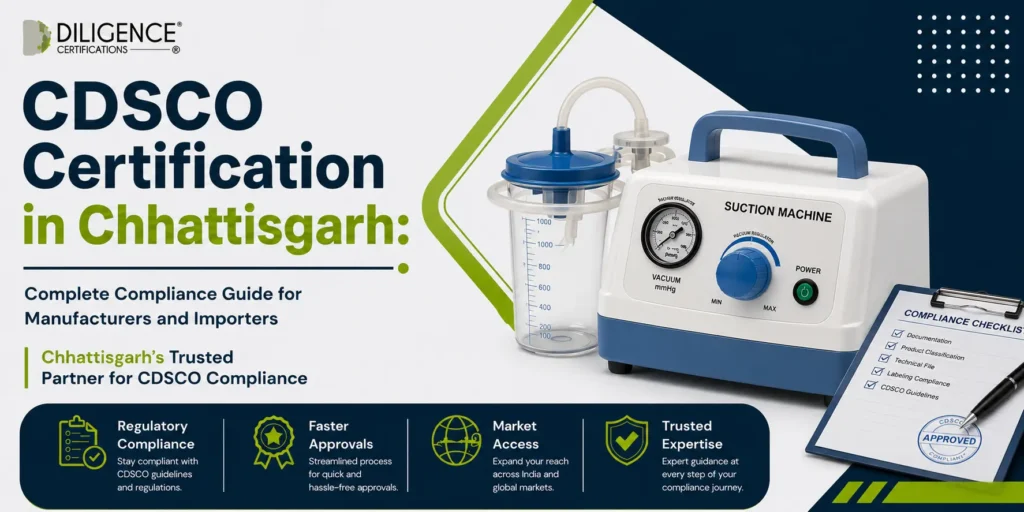
By - The CDSCO certification in Chattisgarh is required if a business is to trade regulated medical devices, drugs, cosmetics, and diagnostic products in the state.
- With a CDSCO certificate/license, the manufacturer, importer or supplier of these health products may successfully adhere to the norms and rules prescribed by India prior to their introduction into the Indian marketplace.
- The key requirements include comprehensive documentation, accurate product categorization, and submission of all particulars via the SUGAM portal, for straightforward CDSCO approval.
Introduction
On occasion a medical device supplier in Raipur approached us for help after experiencing demand from hospitals for their diagnostic equipment. The business had the right product at the right price, the buyers were interested in making purchase, and they had already committed finances to their marketing and packaging. Later, they hit a roadblock: CDSCO approval had not been checked before selling.
This is an event quite common to all the businesses in the health sector. There may be a manufacturer who is an expert at production, a retailer at managing customers, an importer at negotiating prices but CDSCO clearance is always the next legal step. Without appropriate license, certificate or approval, any of the business might encounter problems like: delay, rejection of product, seizing of product, loss of business, etc.
The CDSCO certification in Chattisgarh may be needed for the following product classes, depending on how it is to be sold in the Indian markets: medical devices, drugs, cosmetics, in-vitro diagnostic products, diagnostic equipment, etc. Whether you are located in Bilaspur, Raipur, Durg, Bilaspur, Korba or any other city in Chattisgarh the regulatory requirement will always vary depending on the type of the product and its classification and how you are to use the product in terms of business strategy.
The certification of the product cannot just be thought of as submitting some documents and forms; it is also proof that the product has legally come into the market.
What is CDSCO Certification?
CDSCO is the acronym for the Central Drugs Standard Control Organisation. This organisation is the national regulatory authority of India and is responsible for granting licenses, approving medical devices, drugs, cosmetics, conducting clinical trials of these products, and others. The CDSCO is under the Directorate General of Health Services, which falls under the Ministry of Health & Family Welfare, India.
In basic terms, the CDSCO certificate or approval acts as an indication that the said product has undergone a detailed review as per Indian laws and regulations and can be used for manufacturing, selling, importing or exporting. For most businesses dealing with regulated healthcare products such as medical devices, implants, drug preparations, diagnostics products, etc., CDSCO clearance is required prior to entry in the Indian markets.
Why does CDSCO Certification in Chattisgarh Matter?
Chhattisgarh is a state that boasts a rapidly expanding health sector. The development of hospitals, diagnostic centers, clinics, pharmacies, government funded health programs, etc., has brought about a considerable increase in the requirement for medical devices and other healthcare products across states like Chhattisgarh, especially in cities like Raipur, Bhilai, Bilaspur, Korba, Durg, etc. But the demand comes with a rising awareness on part of buyers such as hospitals that are demanding approvals for each product they purchase. Government tenders increasingly list regulations and compliance requirements. The distributors of medical equipment are careful, as one delay in a consignment could create an enormous bottleneck in their entire distribution network.
Here it can be of advantage to consider the CDSCO certification in Chattisgarh. It simply adds weight to your products and your business by establishing that they have legally entered the markets, not by a trial and error method. For example, a normal consumable commodity will obviously not have the same implications for health as say an oxygen concentrator, a pregnancy kit, or an implant or a surgical item. This is where the medical product will need a serious regulatory consideration.
Who is the Need for CDSCO Certification in Chattisgarh?
Depending on their business and the nature of their products, several categories of businesses might require CDSCO approval:
Medical Device manufacturers: A manufacturer is required to review the regulations that apply to their product and take the required licenses from CDSCO prior to their commercial sale.
Medical Device Importers: A company exporting medical devices, surgical instruments, and healthcare equipment to India will likely require an import license.
Pharmaceutical companies: Drug manufacturers and importers need various licenses, approvals or permissions to sell their products.
Cosmetic manufacturers and importers: Cosmetics also require approvals and registration from the CDSCO prior to their sale in India.
Diagnostic Product Suppliers: Suppliers that offer IVD kits, lab tests, reagents etc. Will be required to acquire CDSCO approval, if the product fits into a specific class as per its intended use.
Suppliers of hospital equipment: All companies supplying items such as monitors, imaging machines, etc., to hospitals should check their respective requirements with the CDSCO.
Products Covered by CDSCO Certification
Each product is treated under a specific class and rule as defined by Indian regulations. A supplier generally seeks the CDSCO approval for following product groups:
- Medical devices
- In-vitro diagnostic devices
- Surgical instruments
- Diagnostic equipment
- Implants
- Drug formulations
- Cosmetics
- Hospital equipment
- Patient monitoring devices
- Laboratory diagnostic kits
- Import of medical devices
- Test licenses for products to test or examine before sale or export
It is important to note that a normal thermometer and an implant will not have same regulatory and risk classification. A correct product categorization is therefore essential.
CDSCO Medical Device Classification
For medical devices, products have been segmented into four risk classes that dictate their evaluation process, approval pathway, relevant authority, and time of approval.
Class-level classification is based on:
- Intended use of the device
- Design and manufacturing technology
- Potential harm to patient or user if the device malfunctions
Risk Levels of Medical Devices:
| Medical Device Class | Risk Level | Description | Examples |
| Class A | Low Risk | Devices with the lowest level of risk and minimal impact on patient health. | Simple measuring devices, non-invasive medical tools |
| Class B | Low to Moderate Risk | Devices posing a lower to moderate risk, often designed for a specific medical purpose. | Sterile medical devices, hypodermic needles |
| Class C | Moderate to High Risk | Devices that pose a moderate to higher risk and may interact directly with the patient’s body or circulatory system. | Dialysis machines, ventilators, infusion pumps |
| Class D | High Risk | Devices that support or sustain life, or are implanted in the human body. | Pacemakers, heart valves, hip replacements, implantable defibrillators |
One frequent error while dealing with CDSCO certification in Chattisgarh is beginning to fill out the forms immediately without prior classification of the product.
Advantages of CDSCO Certification in Chattisgarh
The key advantages of getting CDSCO certification in Chattisgarh are:
- Legal access to the markets in India, which prevents all legal problems and negative business implications.
- Higher confidence with doctors and buyers who prefer purchasing only with proper certifications.
- Government tenders often specify mandatory requirements for obtaining the approvals that you will not miss.
- Prevention of delays and seizure of your products.
- Improved brand credibility.
- Scaling beyond Chhattisgarh across other Indian states.
The paperwork needed for CDSCO certification in Chhattisgarh varies depending on the type of product, business plan, and licence category, but a mix of company, technical, product and quality documentation is typically needed.
Company Documents
Certificate of incorporation
• PAN card
• GST certificate
• Address proof
• Details of authorized signatory
• Board resolution or authorization letter
• Details of manufacturing or business premises
Product Documents
• Product name and intended use
• Product specification
• Product label and artwork
• Instructions for use
• Device description
• Material details
• Shelf life, if applicable
• Safety and performance data
Technical Documents
• Device Master File
• Plant Master File
• Test reports
• Risk analysis report
• Clinical evaluation data, if applicable
• Performance evaluation report, if required
• Essential principles checklist
Quality Documents
• ISO 13485 certification, if applicable
• Quality management system documents
• Manufacturing process flow
• Quality control procedures
• Sterilisation details, if applicable
• Batch testing procedure
Import Documents
• Free Sale Certificate
• Details of the foreign manufacturer
• Details of the authorized Indian Agent
• Details of the importer
• Documents showing approval of product from country of origin, if applicable
Documents need to be consistent. An application may be rejected if the label states one intended use while the technical file states another.
Step-by-step process for CDSCO certification in Chattisgarh:
Step 1: Preparation of documents
The process begins with compilation of paperwork, many businesses commit the mistake of filing the papers at first instance with correction later which will usually end up causing a lot of delay.
Documents pertaining to company, product specifications, technical file, quality certificate, test reports and authorisation are collected at this point of time.
Step 2: Product Classification
The product will be categorized on the basis of: risk level, intended use, technology employed, patient contact (skin, body cavities or implanted in the body), duration of use, and regulatory category. Based on this, a medical device will be classified as Class A, B, C, or D.
Step 3: Selection of Regulatory Route
The relevant regulatory route for your application should be determined based on classification. This might include; a manufacturing license, import license, a registration, test license or an equivalent permission required for the use/marketing of the product.
This is applicable when deciding if the product is for testing, used for commercial purpose, manufactured in India or being imported from a foreign nation.
Step 4: SUGAM Portal Registration
All applications are to be submitted through the SUGAM portal, which requires the applicant to register, obtain credentials and submit the selected application form with relevant documentation.
Step 5: Filing the application
An application form should be completed and submitted together with the other required supporting documents. It is advisable to provide all the accurate details to avoid a request for query or rejection later on, because the form should not have mismatched details with the attached documents.
Step 6: Review of application by authority
All applications and documents will be evaluated. If a clarification is necessary, then the concerned authority will pose queries for a response from the applicant. A properly structured response for such queries is imperative.
Step 7: Inspection/ audit (if applicable)
Depending on the kind of application or product (higher class medical devices), a manufacturing unit or business facility might need to be inspected. During inspection, regulatory guidelines like the quality system of the company will be assessed.
Step 8: Grant of license or approval
Upon satisfaction, a license/registration/approval will be provided for your product. The product may be manufactured/imported/sold only based on the terms and conditions mentioned in the given permission.
Timeline, Cost and Validity of CDSCO Certification:
| Particulars | Details |
| Timeline | 3-9 months typically, depending on the device category, documentation, risk class, testing requirements, and regulatory evaluation. |
| Cost | Varies based on the type and class of product, number of products, government fees, testing charges, documentation requirements, and professional fees. |
| Validity | Varies depending on the license category and applicable regulatory requirements. |
| Renewal | Renewal or retention must be completed before the license expiry date or as prescribed under the relevant regulations. |
The indicated timeline is not precise and fixed. A Class A product with correct documents might complete the verification in shorter duration compared to Class C or D, when technical review becomes an imperative requirement. For CDSCO certification in Chhattisgarh, cost is also determined by if one is an importer, manufacturer, agent, cosmetic business, drug company or supplier of diagnostics product.
Common Mistakes During CDSCO Registration:
1. Incorrect Product Classification. This is the most commonly seen problem. An incorrect classification would result in wrong application route.
2. Inadequate technical file. Technical file is not a brochure but the evidence of product safety and efficacy for the claimed purpose and use.
3. Documents not matching. Documents should be consistent with each other with regard to the name of company and product, its address, on the labels and the authorizations.
4. Poor handling of queries. Most applications get queries. The issue is not having queries but a vague or casual answer that may result in extra delays.
5. Ignorance of labelling requirements. Product labels are to meet stringent standards, claims on a product may pose an issue with regulatory authorities.
6. Initiating sales prior to obtaining approval. A regulated medical, cosmetic or drug business can market its products after receiving the mandatory license/approval from CDSCO.
Why Local Businesses in Chattisgarh should care about CDSCO Compliance.
Chhattisgarh does not just exist as a local market; it is connected by an extensive network of supply chains to neighboring states. A business supplying in Raipur may even market and distribute to hospitals in other states like Orissa, Maharashtra, Madhya Pradesh, Jharkhand or even Telangana. With the product in the B2B distribution market, theregulatory documentation comes into play as part of commercial negotiations. A business house, which receives orders from a potential buyer such as distributor/hospital, may be required to produce approvals/licenses as part of tendering procedure. This establishes that CDSCO compliance for products being supplied in Chhattisgarh is not just an issue of being legal but is also crucial for business growth. If an uncertified business is allowed to operate in a limited market, when they begin to trade in larger markets, such issues of compliance with a responsible buyer can become significant hurdles.
CDSCO Certification versus Drug License: Are they the same?
CDSCO certification, approval, and registration depend on product category and the designated regulatory path. A drug license may be applicable to manufacturing, sale or distribution of drugs, whereas the business dealing in medical devices and diagnostics will have separate set of rules. For instance, if a business intends to manufacture and sell pharmaceutical formulations, then it would need to obtain the respective permits for drugs. If the intention is to import medical instruments then one will need the import license for medical devices, and a cosmetic importer will have different requirements altogether. The relevant regulation is to be determined based on the product and business.
Why choose Diligence Certification?
Diligence Certification assist businesses with CDSCO application process such as preparing proper documentation, supporting with classification of products and submitting the application with appropriate attachments and query responses. Diligence Certification ensures that before submission the entire paperwork is scrutinized to support you in obtaining all essential documents required for filing of application and to successfully acquire all licenses and permissions with ease. Owning a business in healthcare product related domain requires taking all possible steps to obtain a clear understanding of the requirements before initiating the entire process to ensure that the application for the grant of licenses and permissions to market the product is smooth and error free.
Conclusion
CDSCO Certification in Chattisgarh is crucial for any company aiming to manufacture, import, sell, or distribute regulated healthcare products within India. This approval will bring legal clarity, increase the trust of buyers, and protect your company from non-essential regulatory problems.
The process can appear difficult initially due to its variability for every product. However, obtaining approval becomes significantly more straightforward when the right approach is followed in terms of classification, documentation, technical files, and application filing.
For any medical devices, drugs, cosmetics, diagnostic products, or hospital equipment, regulatory compliance should not be viewed as an eleventh-hour project. It needs to be a pre-planned step before the launch of the products.
Get expert guidance for Documentation, SUGAM filling, tracking of application, and regulatory approval on your CDSCO Certification in Chattisgarh with the experts at Diligence Certification.
Frequently Asked Questions
1.Is CDSCO Certification mandatory in Chattisgarh?
Yes, it is mandatory for regulated healthcare products, including medical devices, drugs, cosmetics, diagnostic kits, and some hospital supplies. The actual requirement varies from the activity of the product.
2. How much time does it take for CDSCO Certification?
The process generally takes between 3 to 9 months. It depends on the type of product, required documentation, testing of the products, authority’s review and response of queries.
3. Who can apply for CDSCO Approval?
Depending on the type of product, an applicant may be the manufacturer, importer, or authorized Indian agent for medical devices; cosmetic company or drug company or diagnostic product supplier etc.
4.What is the initial process for CDSCO registration?
The first phase is documentation and then comes classification of the product and selection of the correct application route.
5. Is it necessary to register on SUGAM Portal?
Most of the applications made to CDSCO can be filed using the SUGAM portal. The portal is used for registration, application filing, uploading documents, and tracking of the application.
6. What are the consequences of selling products without CDSCO approval?
Selling any regulated healthcare product without approval could pose legal, commercial, and supply chain risks. The product can be stopped at the custom or may even be rejected by buyers and regulatory agencies.
7. Are the documents same for all medical devices?
No, documents for medical devices differ depending on the device classification (Risk class), intended purpose of use, manufacturing process, import status, and device category.
8. Can Diligence Certification help with CDSCO queries?
Yes, it can help you provide with responses to query, prepare documentation to fill up the gaps and provide full assistance to the applicant throughout the approval process.
9. Can startups apply for CDSCO Certification in Chattisgarh?
Yes, startups can apply if their product falls under CDSCO-regulated categories. They must have proper company documents, product details, technical files, and the correct application route before filing.
10. Is CDSCO approval required before importing medical devices into Chhattisgarh?
Yes, if the medical device is regulated, import approval or licence is required before bringing it into India and supplying it in Chhattisgarh.
Frequently Asked Questions
Is CDSCO certification compulsory in Meghalaya?
Yes, CDSCO certification is compulsory for medical devices, drugs, cosmetics, diagnostic and healthcare products prior to manufacturing/importing/selling them in India.
Who requires CDSCO certification in Meghalaya?
CDSCO certification may be required by manufacturers, importers, authorised Indian agent(s), distributors and healthcare ventures based on product category and business operations.
Which products require CDSCO clearance?
Medical devices, diagnostic kits, drugs, cosmetics, implants, surgical equipment and a range of other healthcare products may require CDSCO clearance.
What is Form MD-14?
MD-14 is generally used to apply for an import license for medical devices under CDSCO.
What is Form MD-15?
Form MD-15 is the Import License for medical devices that has been approved by CDSCO.
How long does CDSCO certification take?
The timeline depends on product category, risk class, document readiness and query resolution. A properly prepared file can reduce avoidable delays.
Can a distributor sell medical devices without CDSCO approval?
A distributor should ensure that regulated medical devices have valid approval before sale. Selling unapproved regulated products can create legal and commercial risk.
Is ISO 13485 required for CDSCO approval?
ISO 13485 may be required or strongly relevant for many medical device applications, depending on product type and regulatory pathway.
Can Diligence Certification help with CDSCO queries?
Yes, Diligence Certification assists with query handling, document correction, application review and regulatory coordination.
Does CDSCO certification apply to imported cosmetics?
Imported cosmetics may require registration or approval under applicable cosmetic regulations before sale in India.