BIS Certification
 CDSCO
CDSCO
 PESO
PESO
 CPCB
CPCB
 LMPC
LMPC
 WPC Approval
 Global Approvals
 TEC
TEC
 ARAI
ARAI
 BEE
BEE
 ISO Certification
 DGCA Certification
 NOC For Steel
 APEDA Registration























 Business Registration
 FSSAI Mark Certification












 (32).jpg)
 Legal Services
 Trademark Registration
 Copyright Registration
 Patent Registration
 By
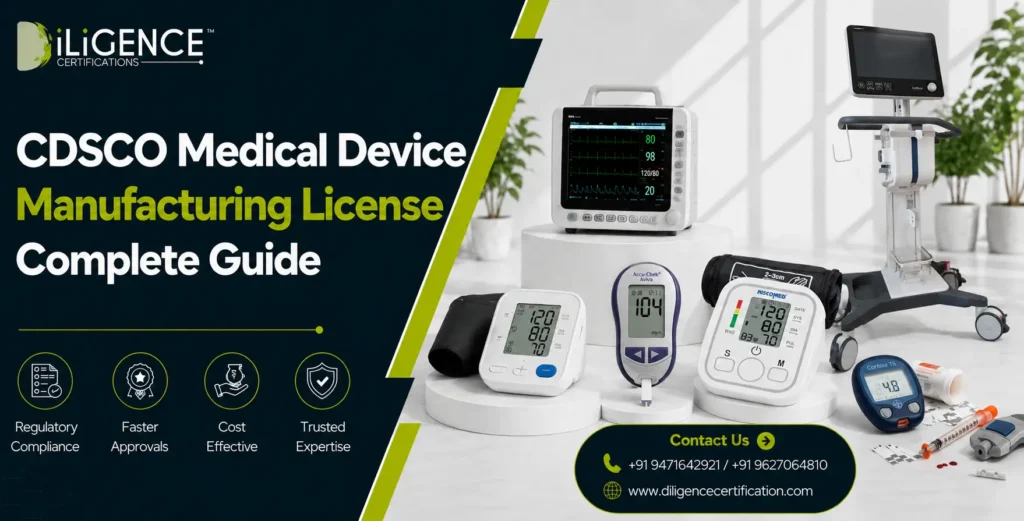
By - CDSCO Medical Device Manufacturing License is essential for production of notified medical devices in India.
- Licensing procedure comes under the purview of the Medical Device Rules, 2017 and is controlled by CDSCO.
- Classification, documentation, quality systems, and regulatory compliance ensure successful approval.
Introduction
A CDSCO Medical Device Manufacturing License is an authorization which is granted by the Central Drugs Standard Control Organization (CDSCO) for the manufacturing of notified medical devices in India.
It is an indication that the manufacturer adheres to all the quality, safety, and performance requirements that are relevant in terms of the Medical Device Rules (MDR), 2017.
A CDSCO Medical Device Manufacturing License is necessary for the manufacture of notified medical devices in India. The certificate indicates that the Medical Device Rules, 2017 have been complied with.
Why Is the CDSCO Medical Device Manufacturing License Important?
In the absence of this license, manufacturers risk:
- Product confiscation
- Penalties from regulators
- Market barriers
- Rejected distributors
- Disqualified tenders
- Import/Export restrictions
Hospitals and procurement agencies have increasingly begun to check regulatory approval before making purchases for medical equipment.
From syringe manufacture to sophisticated diagnostic systems, compliance has become a must.
Which Authority Issues the CDSCO Medical Device Manufacturing License?
Authority responsible for the issuance of CDSCO Medical Device Manufacturing License is dependent upon the risk classification of the medical device based on Medical Device Rules, 2017.
Low risk and low to moderate-risk medical devices will have the license issued by State Licensing Authority (SLA) of the state in which the manufacturing facility exists.
Moderate-high risk and high-risk medical devices will have their licenses issued by Central Licensing Authority (CLA) of CDSCO because of the additional risk factors involved in these medical devices.
It is pertinent to note that classification of the device is an important consideration for the process of licensing, document submission, inspection, and the approval time frame.
Understanding Medical Device Classification in India
For obtaining CDSCO Medical Device Manufacturing License, first step is to correctly classify the risk category of the medical device. According to Medical Device Rules, 2017, devices can be divided into four groups depending upon the purpose and the risk posed by the device to the patient.
Low Risk
Such devices carry low risks and do not require much regulatory control.
Examples: Surgical dressings, examination gloves, tongue depressors.
Low to Moderate Risk
Devices carry some risk and need more regulatory control compared to low risk devices.
Examples: Hypodermic needles, suction apparatus, infusion sets.
Moderate to High Risk
Such devices are used in crucial medical procedures and therefore need strict regulation.
Examples: Dialysis apparatus, bone fixation devices, ventilators.
High Risk
Devices that either sustain or support life are included in high risk devices.
Examples: Heart valves, implantable defibrillators, critical life supporting systems.
It is very important for correct classification of medical devices as it plays a key role in determining licensing authority, documentation process, approval procedure etc.
Eligibility Criteria for CDSCO Medical Device Manufacturing License
Requirements need to be fulfilled in order to get the CDSCO license for manufacturing medical device products. Requirements make sure that the medical devices are manufactured in a controlled, quality, and safe environment.
Legal Business Entity
The applicant must be a legally registered business capable of manufacturing and marketing medical devices in India. The entity can operate as a:
- Private Limited Company
- Limited Liability Partnership (LLP)
- Partnership Firm
- Sole Proprietorship
- Public Limited Company
The business needs proper registration documentation, GST registration, PAN numbers, etc., as per statutory requirement to carry out business activities.
Manufacturing Unit
The manufacturing unit should be fit for manufacturing medical devices as per the Medical Device Rules 2017. This should have:
Production space that is adequate for manufacturing activities
Separate areas for storing, packaging, and quality control
Testing facility for quality assurance and performance testing of the products
Environmental controls when necessary like temperature and humidity controls
Installation, calibration, and validation of proper equipment
It is possible that regulatory authorities can inspect the facility to ensure the compliance of standards in manufacturing activities.
Technical Personnel
Manufacturers should designate qualified technical personnel who would take care of production and quality activities. The technical personnel should have appropriate educational background and professional experience in fields related to medical devices, engineering, pharmacy, biotechnology, etc.
They are responsible for:
- Supervising manufacturing operations
- Maintaining product quality standards
- Implementing quality control procedures
- Ensuring compliance with regulatory requirements
- Managing documentation and records
Quality Management System (QMS)
A solid Quality Management System forms an essential component for any organization producing medical devices. Despite different requirements depending on the class of the medical device, ISO 13485 certification is always considered the best practice approach and increases regulatory preparedness.
The following are among the benefits of an efficient QMS:
Achieving consistency in product quality
Controlling the manufacturing process
Managing risks effectively
Dealing with complaints and corrective actions
Product and material traceability
Compliance in case of an audit or inspection
By fulfilling the eligibility criteria prior to submitting the application, organizations will avoid any regulatory objection and increase the likelihood of getting a CDSCO Medical Device Manufacturing License.
Documents Required for CDSCO Medical Device Manufacturing License
The fate of an application for a CDSCO Medical Device Manufacturing License is largely determined by the quality and thoroughness of the documents used in the submission process. Through the analysis of the documents provided, the regulatory agencies are able to evaluate the legality, compliance of the facilities, safety, and quality of the manufacturing process.
1. Company Documents
Company documents determine the legal standing and business operations of the firm making the submission.
Incorporation Certificate
The Incorporation Certificate is proof that the business is legally established according to Indian laws.
PAN Card
The Permanent Account Number (PAN) is required for tax identification and verification of the applicant entity.
GST Registration Certificate
The GST registration process indicates the approval of the company to carry out business and abide by tax laws in India.
Proof of Address
Utility bills or other documents are submitted in order to prove the address of the registered office as well as the manufacturing location.
2. Facility Documents
These documents provide detailed information about the manufacturing facility and its capability to produce medical devices in a controlled environment.
Site Master File (SMF)
The Site Master File is one of the most important documents in the licensing process. It provides a comprehensive overview of the manufacturing facility, including:
- Organizational structure
- Manufacturing operations
- Quality management systems
- Personnel details
- Facility layout
- Production processes
- Storage and distribution practices
Layout Plan
A detailed layout plan helps regulators understand the flow of materials, personnel, and products within the facility. The layout should clearly identify:
- Manufacturing areas
- Quality control laboratories
- Storage sections
- Packaging areas
- Finished goods warehouse
Equipment List
Manufacturers must provide a list of all machinery and equipment used during production and testing. The list should include equipment specifications, capacity, and calibration status.
Utilities Details
Information related to utilities such as water systems, compressed air, HVAC systems, power backup, and environmental control systems must be submitted to demonstrate operational adequacy.
3. Technical Documents
Technical documentation enables regulatory authorities to evaluate the safety, performance, and intended use of the medical device.
Device Master File (DMF)
The Device Master File is a comprehensive technical document containing detailed information about the medical device, including:
- Product description
- Intended use
- Design specifications
- Manufacturing process
- Materials used
- Performance characteristics
- Safety features
The DMF is often considered the core technical document in the licensing application.
Product Specifications
Specifications for Manufacturers,Specifications regarding the device should be provided by manufacturers in regard to the size, materials used, technical characteristics and working conditions of the medical device.
Risk Analysis Report
A risk analysis report contains information about possible hazards that may arise when using the medical device and how these risks were minimized.
Labeling Information
Labels, IFUs, packaging art, and inserts have to meet the requirements of Medical Device Rules, 2017.
Labeling Documentation (To Establish Safety and Usage Information of Users)
Clinical Evaluation Data (If Required)
Certain medical devices may need to provide clinical evidence of safety and performance. Such evidence can consist of clinical investigations, publications, or any other clinical data.
4. Quality Documents
Documents related to quality prove that the manufacturer has set up the processes required to manufacture consistently reliable and safe medical devices.
ISO 13485 Certificate
An ISO 13485 certificate means that the manufacturer has set up the international Quality Management System tailored for the production of medical devices.
Standard Operating Procedures (SOPs)
These documents describe the procedures carried out in the course of manufacturing, quality control, tests, maintenance, complaint handling, and other important processes.
Validation Reports
Validation reports provide evidence that manufacturing processes, equipment, software, and testing methods perform as intended and produce reliable results.
Examples include:
- Process validation
- Equipment qualification
- Cleaning validation
- Software validation
- Test method validation
Quality Manual
Quality Manual is the bedrock of an organization’s quality management system. The Quality Manual outlines the quality policy, objectives, organizational responsibility, and procedures adopted for maintaining regulatory compliance and product quality.
Step-by-Step CDSCO Medical Device Manufacturing License Process
Step 1: Product classification
Find out which class does the product belong to (A, B, C, D).
Step 2: Deficiency assessment
Check the current infrastructure and documentation for compliance with regulation.
Step 3: Preparation of technical documentation
Device Master File and other documentation.
Step 4: Registration on CDSCO Portal
Generate the necessary account and get the login details.
Step 5: Apply
Submit the application and upload all prescribed documents.
Step 6: Regulatory Assessment
Evaluation of technical and quality documents by the regulators.
Step 7: Site Inspection
Inspection may be conducted depending on device classification and regulatory assessment.
Step 8: License Approval
After successful review, the CDSCO Medical Device Manufacturing License is issued.
Common Reasons for Application Rejection
Over the years, certain issues repeatedly cause delays.
Incorrect Device Classification
A wrong risk classification can invalidate the entire application.
Weak Technical Documentation
Incomplete Device Master Files often trigger objections.
Infrastructure Gaps
Facility layouts and manufacturing controls may fail regulatory expectations.
Labeling Non-Compliance
Labels must align with MDR 2017 requirements.
Inadequate Quality Systems
Poor documentation and weak quality processes frequently delay approvals.
Why ISO 13485 Matters for Medical Device Manufacturers
Imagine building a hospital without a blueprint.
That is how regulators often view manufacturing operations lacking structured quality systems.
ISO 13485 establishes:
- Process consistency
- Traceability
- Risk management
- Corrective actions
- Regulatory compliance
Many successful manufacturers implement ISO 13485 before initiating the CDSCO Medical Device Manufacturing License process.
CDSCO Medical Device Manufacturing License for Startups
Startup companies are always under the impression that regulatory clearances are applicable to big corporations only.
Actually, this can be an important competitive advantage.
Most of the hospitals would prefer vendors who have all the regulatory clearances since there will not be any procurement risk.
A startup that has licensing will definitely win the distributor’s confidence before others.
Challenges Faced by Manufacturers
Manufacturers commonly struggle with:
Regulatory Interpretation
Understanding Medical Device Rules can be complex.
Technical Documentation
Preparing Device Master Files requires expertise.
Facility Compliance
Production environments often require upgrades.
Inspection Readiness
Many companies lack documented procedures required during audits.
Working with experienced regulatory consultants often shortens approval timelines and reduces compliance risks.
How Diligence Certifications Helps Manufacturers
The process of getting CDSCO Medical Device Manufacturing License could be complicated due to various requirements that may include regulatory issues, technical documentation, quality management system, among other aspects. Diligence Certifications offers end-to-end services to help manufacturers to comply with these requirements and minimize the time of approval.
Device Classification
Classification of the device is the base for the success of the licensing application. Diligence Certifications will assist manufacturers in deciding on which class the device belongs according to its purpose (Class A, B, C or D). Classification will facilitate a correct application to the licensing body and avoid any regulatory objections related to incorrect classification.
Documentation Preparation
Regulatory authorities strictly assess the documents.
Conclusion
CDSCO Medical Device Manufacturing License is not just another regulatory requirement; it is actually a requirement that is necessary to manufacture and market medical devices within India. With increasing regulatory scrutiny, manufacturers cannot afford to approach compliance with laxity anymore. Product classification, technical documents, quality systems, and compliance to Medical Device Rules, 2017 are key requirements for getting this approval.
For startups which manufacture their first medical devices as well as for established manufacturers who are looking at diversification of their product offerings, securing the appropriate license is vital for smooth market entry, higher customer confidence, and lower regulatory risks. Companies that take compliance seriously from the beginning save time and effort.
However, the CDSCO Medical Device Manufacturing License is not simply a requirement but a requirement that needs to be met to produce and sell medical devices in India. Due to greater regulatory oversight, manufacturers must ensure that there are no loose compliances when it comes to manufacturing the products. The above requirements are some of the major things to consider when trying to get the license.
As far as new startups that have made their initial foray into the field of medical device manufacturing or already-established organizations wanting to diversify their product lines are concerned, getting the required license is crucial
frequently asked question
What is a CDSCO Medical Device Manufacturing License?
A CDSCO Medical Device Manufacturing License is a regulatory approval issued under the Medical Device Rules, 2017, allowing manufacturers to legally produce and market notified medical devices in India.
Is a CDSCO Medical Device Manufacturing License mandatory in India?
Yes. Any company manufacturing notified medical devices in India must obtain the appropriate license before commercial production and sale.
Which authority issues the CDSCO Medical Device Manufacturing License?
For Class A and Class B devices, the license is generally issued by the State Licensing Authority (SLA). For Class C and Class D devices, the Central Licensing Authority (CDSCO) issues the approval
How are medical devices classified in India?
Medical devices are classified into four categories based on risk:
Class A - Low Risk
Class B - Low Moderate Risk
Class C - Moderate High Risk
Class D - High Risk
What documents are required for a CDSCO Medical Device Manufacturing License?
Key documents include:
Company incorporation documents
Site Master File
Device Master File
ISO 13485 Certificate
Manufacturing facility details
Equipment list
Quality management documents
Product specifications and labeling information
What is the time duration taken to get CDSCO Medical Device Manufacturing License?
Time taken depends upon the class of the medical device and the application. It may take anywhere between 30 days in case of certain Class A devices to more than 180 days in the case of certain Class D devices.
Is ISO 13485 certification compulsory to obtain a manufacturing license?
ISO 13485 certification may not be mandatory as it will depend upon the requirement of each category of devices. However, it is advisable to have it.
Can start-ups apply for a CDSCO Medical Device Manufacturing License?
Yes, start-ups, MSMEs, or any manufacturer can apply for the manufacturing license as long as they fulfill the other criteria also.
Mention the usual grounds for the rejection of CDSCO license.
Common reasons for delay/rejection of applications include:
Inappropriate device classification
Incomplete documentation
Facility not in line with the regulatory requirements
Quality management systems not meeting the requirements
Labeling issues
Technical data missing
Can a consultant help with the CDSCO Medical Device Manufacturing License process?
Yes. Regulatory consultants can assist with device classification, documentation, application filing, audit preparation, compliance reviews, and communication with regulatory authorities, helping reduce approval delays.