BIS Certification
 CDSCO
CDSCO
 PESO
PESO
 CPCB
CPCB
 LMPC
LMPC
 WPC Approval
 Global Approvals
 TEC
TEC
 ARAI
ARAI
 BEE
BEE
 ISO Certification
 DGCA Certification
 NOC For Steel
 APEDA Registration























 Business Registration
 FSSAI Mark Certification












 (32).jpg)
 Legal Services
 Trademark Registration
 Copyright Registration
 Patent Registration
 By
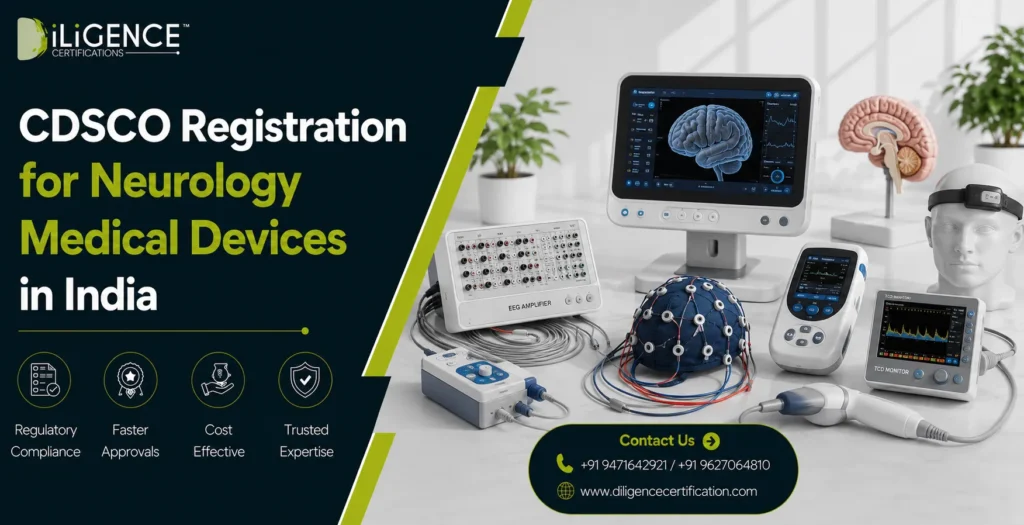
By - CDSCO Registration for Neurology Medical Devices in india To import, manufacture and market medical devices with therapeutic applications for use in neurology, it is important to comply with the CDSCO regulations of India.
- It is managed under the Medical Device Rules, 2017, which class based on a 4 class system - A, B, C and D. Based on risk classifications, Medical devices for Neurology could also come under Class A to D.
- Compliance relies upon the right classifications, adequate documentation, timely submissions, and accurate filing with the regulatory body.
Introduction
Recently, a Medical Importer from Mumbai narrated a prevalent compliance hurdle faced by the medical device industry in India. A consignment of highly technical EEG and Neuro Monitoring Systems were shipped from Europe with proper CE Mark and associated certifications, and the importer anticipated hassle-free customs clearance followed by immediate deployment to hospitals. On the contrary, the shipment landed up detained at port due to “NON AVAILABILITY OF CDSCO REGISTRATION Neurology medical devices” as per Medical Device Rules 2017.
The importer assumed that an international certification like CE or FDA approval shall render entry to the Indian markets seamless but he wasn’t aware that Indian laws are self-sufficient and that approval by Indian Regulatory authorities is independent of any foreign approval.
Neurology Medical Devices are not similar to General diagnostic equipment, because they interfere directly with human’s Central Nervous System or periphery’s Nervous system; which puts them in the highly sensitive product category; a small dispute in the matter of product classification and documentation may cause huge troubles. Neurology medical devices have unique considerations since they directly interact with human nervous systems.
Due to the growing number of cases for neurological diseases such as Stroke, Epilepsy, Parkinson,traumatic brain injury and spinal injury, the demand for specialized Neurology medical devices have grown enormously but the only hurdle before the foreign and domestic players is regulatory approval of these high end Neurology Medical Devices by CDSCO(Central Drugs Standard Control Board). Hence for a brand new or existing player in the Healthcare device industry and to make an entry into this burgeoning Healthcare sector, one needs to acquire prior approval of these products via CDSCO Registration For Neurology Medical devices, in India.
What Are Neurology Medical Devices?
Neurology medical devices cover any type of medical device utilized to identify, watch, or treat nervous system issues. Neurological gadgets, as in all neural-technology items, come under highly advanced and clinic-level-sensitive clinical instruments which can also assist in the calculation or also treatment or management.
Several of the commonly used neurology devices consist of:
- Deep Brain Stimulation (DBS) gadgets utilized to assist Parkinson’s disorder
- EEG equipment for the mind, as well as a set of neurologic-based machines to display screen neurological tasks as well as control nerve and muscular task like, the ECG devices
- Spinal cord Stimulation, tools used to manage constant pain
- Spine surgical treatment - the help of neuro-navigation gadgets
- ICU neuro-monitoring equipment
- AI-driven or Software program as Medical gadgets (SaMD) for neurologic analyses
- Neurologic-imaging gadgets
- among others
Such equipment are generally used by clinicians working in critical situations such as neurology operation theatres, diagnostic centers and Neurology critical care systems.
Considering that they have a substantial clinical effect, the regulations of such items are extremely severe contrasting to other standard health devices.
Regulatory Framework for Medical Devices in India
All medical devices in India are regulated under the:
Medical Device Rules, 2017 (MDR 2017)
Enforced by CDSCO (Central Drugs Standard Control Organization)
The framework is based on a risk classification model, which determines the approval complexity.
Risk Classification
- Class A: Low risk devices
- Class B: Low to moderate risk devices
- Class C: Moderate to high risk devices
- Class D: High risk devices
Neurology Medical Devices Classification
Neurology medical devices generally fall under Class B, C, or D depending on their function, invasiveness, and clinical impact.
Examples
- Basic EEG monitoring systems → Class B or C
- ICU neuro-monitoring systems → Class C
- Implantable brain stimulators → Class D
- Neuro prosthetics → Class D
Regulatory Impact
The classification determines everything-from documentation depth to approval timelines and inspection requirements.
Why CDSCO Registration for Neurology Medical Devices Is Mandatory
Regulatory Importance of Neurology Medical Devices
Neurology medical devices are high-impact medical devices as they directly deal with neurologic function.
Important Regulatory Concerns in This Device Class
- Interaction with CNS signals
- Misinterpretation of neurologic activity
- Potential long-term effects in implanted devices
- Requirement of clinical evidence and performance justification
- High degree of accuracy and calibration requirements
Indian Legal Context
- No neurology medical devices are permitted to be imported, distributed, or sold in India without CDSCO approval, even if they are approved in a foreign country.
- All hospitals, dealers, and importers must verify CDSCO approval before purchasing neurology medical devices.
Classification of Neurology Medical Devices in India
Correct classification is the foundation of CDSCO compliance strategy.
| Risk Class | Risk Level | Types of Neurology Medical Devices | Examples |
| Class A | Low Risk Medical Device | Neurological simple devices | Brain stimulation accessories, neurological electrodes as external conductors, brain monitors |
| Class B | Low to Moderate Risk Medical Device | Basic diagnostic neurology devices | EEG caps for electroencephalograph machines, neuromonitors, EMG apparatus |
| Class C | Moderate to High Risk Medical Device | Advanced diagnostic and monitoring systems | ICU neuro-monitoring arrangement, complicated analytical neuroscience appliances, CNS-related diagnostic systems |
| Class D | High Risk Medical Device | Implantable and highly complex neurology devices | Deep brain stimulation system, implanted neuromonitors, complex neuromotoric appliances |
Misclassification is one of the most common causes of rejection or long delays in CDSCO Registration for Neurology Medical Devices.
Eligibility Criteria for CDSCO Registration
To apply for CDSCO Registration for Neurology Medical Devices, applicants must meet the following requirements:
- ISO 13485 certification for quality management systems
- Appointment of Indian Authorised Agent (IAA) for foreign manufacturers
- Compliance with IEC 60601 electrical safety standards
- Free Sale Certificate from the country of origin
- Clinical evaluation report for Class C and D devices
- Risk management file as per ISO 14971
Without these, applications are usually returned or queried multiple times.
Documents Required for CDSCO Registration for Neurology Medical Devices
Documentation is the most critical and time-consuming stage.
Mandatory documents:
- Device Master File (DMF)
- Plant Master File (PMF)
- ISO 13485 certificate
- Free Sale Certificate
- Clinical Evaluation Report (CER)
- Risk Management File
- Electrical safety test reports
- Software validation documents (for SaMD devices)
- Device labeling and packaging details
- Technical specifications and intended use documentation
A large percentage of application delays occur due to inconsistencies in these documents rather than regulatory rejection.
Step-by-Step CDSCO Registration Process
Step 1: Device Classification
Identify correct class under MDR 2017.
Step 2: SUGAM Portal Registration
Create application on CDSCO online portal.
Step 3: Application Submission
File MD-14 (import) or MD-15 (manufacturing).
Step 4: Technical Document Review
CDSCO evaluates submitted files.
Step 5: Query Handling
Authority may request clarification or additional evidence.
Step 6: Inspection (if required)
Manufacturing facilities may be audited.
Step 7: Final Approval
License is issued after compliance verification.
Import vs Manufacturing License
- MD-14: Import license for foreign devices
- MD-15: Manufacturing license for domestic production
Most neurology device companies entering India require MD-14 initially.
Timeline for CDSCO Approval
- Class A & B: 30-90 days
- Class C: 90-180 days
- Class D: 120-240 days
Higher-risk neurology devices require longer evaluation due to clinical and safety complexity.
Common Challenges in CDSCO Registration
- Incorrect device classification
- Missing clinical evaluation data
- Weak risk management documentation
- Delayed response to CDSCO queries
- Lack of IEC 60601 compliance reports
- Inconsistent technical specifications
Industry Reality: Why Applications Get Delayed
Most delays are not due to CDSCO inefficiency but due to:
- Incomplete technical dossiers
- Overreliance on CE/FDA approvals
- Lack of India-specific regulatory mapping
- Poor document structuring
- Missing software validation for digital devices
Importance of CDSCO Compliance for Neurology Devices
CDSCO Registration for Neurology Medical Devices ensures:
- Patient safety validation
- Legal authorization for market entry
- Hospital procurement eligibility
- Reduced regulatory risk exposure
- Structured entry into Indian healthcare system
Why Should You Go For Diligence Certifications for CDSCO Registration of Neurology Medical Devices?
Diligence Certifications can help you get CDSCO Registration for Neurology Medical Devices in India by providing you with expert advice on how to comply with the regulatory requirements according to the Medical Device Rules 2017.
We will provide you with the services related to device classification, development of technical documentation, ISO 13485, clinical evaluation report, risk management file, and full-fledged CDSCO SUGAM portal registration.
If you are an overseas manufacturer then we can help you register yourself as an Indian Authorized Agent (IAA) and apply for your import license. With emphasis on compliance, transparency and quickness, Diligence Certifications can make your work much easier in getting CDSCO Registration for neurology medical devices in India.
Conclusion
CDSCO Registration for Neurology Medical Devices ensures that only devices that are found to be safe, effective and clinically acceptable in India are granted market approval. The success and speed of CDSCO approval for neurology medical devices primarily depends on three factors: the way a device is classified, the compliance of application documentation with the requirements, and how quickly the regulatory authority responds to the submitted files. Organizations that invest in timely planning of regulatory compliance for their neurology medical devices see greatly accelerated time to market and accelerated sales in the rapidly expanding neurology device market of India.
Frequently Asked Questions
Can I register my neurology medical device in India through CDSCO registration?
Absolutely! Whether your neurology medical device is an implant or an aid, whether it has been previously approved or has passed in other countries, you'll need CDSCO registration to manufacture, import, or sell it in India.
Do I need an import license to import Neurology Medical Devices into India?
Yes. To import Neurology Medical Devices to India, you’ll require an MD-14 import license issued by the CDSCO that meets all the Indian Quality Standards for your neurology product.
Are clinical trials required for implantable neurology medical devices?
Yes. A clinical evaluation report is mandatory for all neurology medical devices in the Class C and Class D category to demonstrate its safety and effectiveness.
How long does it take for CDSCO approval for neurology medical devices?
Depending on your classification, here’s what to expect: Class A & B devices: 30-90 days Class C medical devices: 90-180 days Class D medical devices: 120-240 days As you know, the higher the risk associated with a medical device, the longer the time taken to get approval.
Does having a CE Mark or US FDA approval exempt my neurology medical device from CDSCO registration?
Unfortunately, no. If you intend to market your neurology medical device in India, a CE Mark or US FDA approval doesn't grant you exemption from the rigorous CDSCO registration process in India.
Can software used for Neurology be registered as a CDSCO medical device?
Certainly! Any medical-oriented software for Neurology can be registered under CDSCO as a Medical Device Software-as-a- Medical Device (SaMD).
Who can fill out the CDSCO Registration Application form?
You can either do it by yourself if you are the foreign manufacturer or go with the commonly practiced approach where you fill out the form using the services of an Indian Authorized Agent (IAA).
What causes delays in the CDSCO registration process?
Several reasons could slow down your application process, including missing documentation, incomplete applications, incorrect classification of your neurology device, lack of required clinical/technical data, and slow response time to requests from CDSCO.
Will my neurology medical device undergo an inspection?
Not all devices require an inspection to get the CDSCO approval.
It is typically reserved for the higher-risk neurology medical devices like Class C and Class D.
What happens if I don’t have CDSCO Approval for my Neurology Device?
You might face issues like your devices getting stuck at customs, being rejected on arrival, facing seizure orders, and getting fined heavily for violating Indian medical device regulations.