BIS Certification
 CDSCO
CDSCO
 PESO
PESO
 CPCB
CPCB
 LMPC
LMPC
 WPC Approval
 Global Approvals
 TEC
TEC
 ARAI
ARAI
 BEE
BEE
 ISO Certification
 DGCA Certification
 NOC For Steel
 APEDA Registration























 Business Registration
 FSSAI Mark Certification












 (32).jpg)
 Legal Services
 Trademark Registration
 Copyright Registration
 Patent Registration
 By
By - CDSCO Registration for Operation Theatre Medical Devices Before you can import, manufacturer or sell most OT equipment in India, you have to obtain an approval from the CDSCO.
- Depending upon the medical equipment classification, there would be requirement for technical documentation as well as the manufacturing licensing requirements with CDSCO.
- By obtaining regulatory guidance it is possible to mitigate the compliance risk and ensure timely approval to your hospital/import/manufacturing venture.
Introduction
Some months ago, a distributor of hospital equipment approached us because their shipment of operation theatre equipment faced some delay due to failure to comply with regulations. A lot of money had been spent on sourcing and logistics. But just because of a simple oversight - that is CDSCO registration - their entire project was stalled.
Cases such as these happen frequently in India’s medtech industry. Companies have a tendency to concentrate on sourcing good quality surgical lights, operating tables, anesthesia workstation, and patient monitoring system.
These days, the requirement is such that not only should the equipment be technologically advanced, but at the same time, they must meet the legal requirements too. This is where CDSCO Registration for Operation Theatre Medical Devices comes into play.
The Central Drugs Standard Control Organization (CDSCO) is the organization in India that controls the use of medical devices in India according to the Medical Device Rules of 2017.
What Are Operation Theatre Medical Devices?
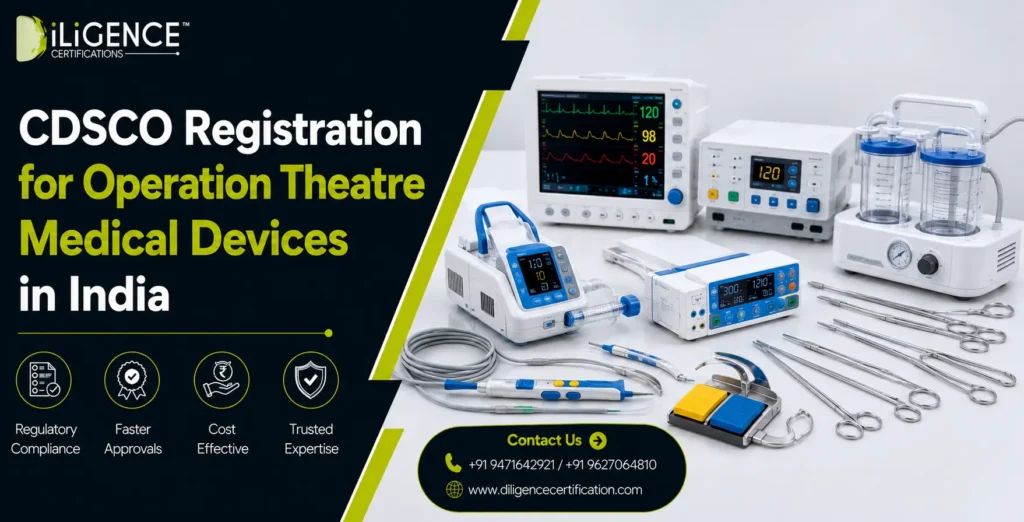
Operation theatre medical devices are equipment and systems specifically designed to support surgical procedures, patient monitoring, anaesthesia delivery, and clinical safety inside an operating room.
Common examples include:
- Operating Tables
- Surgical Lights
- Electrosurgical Units
- Anaesthesia Machines
- Ventilators
- Patient Monitors
- Surgical Suction Devices
- Infusion Pumps
- Defibrillators
- Surgical Navigation Systems
These devices directly impact patient safety and surgical outcomes. Consequently, regulators impose stringent quality, safety, and performance requirements before they can be marketed.
Why Is CDSCO Registration Required for Operation Theatre Medical Devices?
CDSCO registration will ensure that the operation theatre medical equipment comply with the Indian safety and quality standards prior to their import, manufacture and sale.
It is crucial for the healthcare industry that the equipment is not prone to failures during operations as a failure of an operating table or an anesthesia work station can have serious repercussions on patient health.
CDSCO registration helps ensure:
- Patient safety
- Product quality assurance
- Legal market access
- Regulatory compliance
- Product traceability
- Post-market surveillance
Without approval, manufacturers and importers may face penalties, shipment detention, product recalls, and restrictions on market access.
Regulatory Framework Governing Operation Theatre Medical Devices
Medical devices in India are regulated primarily under:
Medical Device Rules, 2017
The Medical Device Rules (MDR), 2017 established a structured framework for classification, licensing, manufacturing, import, distribution, and post-market surveillance.
Role of CDSCO
CDSCO acts as India’s central regulatory authority responsible for:
- Granting import licenses
- Reviewing technical documentation
- Monitoring adverse events
- Ensuring compliance with medical device regulations
- Conducting inspections where required
Regulatory Authorities Involved
Depending on device classification, approvals may involve:
- CDSCO Headquarters
- State Licensing Authorities
- Notified Bodies
- Accredited Testing Laboratories
Classification of Operation Theatre Medical Devices
One of the most important aspects of CDSCO Registration for Operation Theatre Medical Devices is determining the correct risk classification.
| Medical Device Class | Examples | Key Features |
| Class A - Low Risk | Basic accessories used in surgical operations | • Low risk for patients• Simpler approval procedure• Lower regulatory requirements |
| Class B - Low to Moderate Risk | • Some infusion system accessories• Monitoring accessories | • Moderate documentation requirements• Third-party assessment may be required |
| Class C - Moderate to High Risk | • Anaesthesia workstations• Ventilators• Advanced patient monitoring accessories | • Higher level technical assessment• More clinical evidence required |
| Class D - High Risk | • Life-supporting surgical accessories• Critical monitoring accessories | • Highest regulatory scrutiny• Comprehensive safety assessment required |
Incorrect classification remains one of the leading reasons for application delays.
Who Needs CDSCO Registration?
Manufacturing Companies in India
Indian manufacturing companies need to have the necessary manufacturing license in place before any distribution.
Importer
Any company importing medical devices for operating theatres needs CDSCO authorization for importation before customs clearance.
Foreign Medical Device Companies
These companies need to assign an Authorized Indian Representative to handle all regulatory submissions.
Distribution/Brand Owners
Legal implications even when you outsource the manufacturing process.
Step-by-Step CDSCO Registration Process for Operation Theatre Medical Devices
| Registration Step | Process Details |
| Step 1: Classification of Device | Determine whether the device falls under Class A, Class B, Class C, or Class D. The classification affects:• Documentation requirements• Review timelines• Licensing procedure• Regulatory fees |
| Step 2: Preparation of Technical Documentation | Prepare a complete technical file containing:• Device Master File (DMF)• Plant Master File (PMF)• Risk Management Report• Clinical Evaluation Report• Product Specifications• Labeling Information |
| Step 3: ISO 13485 Quality Management System | Ensure compliance with ISO 13485 quality management requirements. Regulatory authorities review:• Production Controls• Quality Management Systems• Complaint Handling Procedures• Corrective and Preventive Actions (CAPA) |
| Step 4: Online Submission of Application | Submit the application through the CDSCO online portal with:• Device Information• Manufacturer Information• Regulatory Certificates• Technical Documentation |
Essential Documents Required for CDSCO Registration
| Document | Purpose / Contents |
| Device Master File (DMF) | Includes:• Device Description• Intended Use and Indications• Design Information• Manufacturing Process• Safety Data |
| Plant Master File (PMF) | Includes:• Manufacturing Plant Details• Quality Systems Information• Facility Details• Process Control Procedures |
| ISO 13485 Certificate | Demonstrates compliance with international medical device quality management standards. |
| Free Sale Certificate (FSC) | Mandatory for many imported medical devices and confirms that the product is legally sold in its country of origin. |
| Clinical Evaluation Documents | Required particularly for high-risk operation theatre equipment to demonstrate safety and performance. |
| Risk Management Document | Provides details of risk identification, evaluation, control measures, and mitigation strategies. |
| Labels and Instructions for Use (IFU) | Must comply with Indian regulatory requirements and contain all mandatory product information, warnings, and usage instructions. |
Import License for Operation Theatre Medical Devices
Most of the operation theatres devices available in the Indian market are imported from other countries like Germany, USA, Japan, South Korea, and China. It is imperative for importers to ensure CDSCO approval of the equipment before they sell their products.
Importers have the wrong notion that if they possess international certifications like CE marking, FDA clearance etc., it is enough for them to start marketing their products. This is untrue since the said certifications will help them get their application approved faster, but it doesn’t suffice as the CDSCO approval.
MD-14 Application
Importer/Authorized Indian Representative submits Form MD-14 with relevant technical data.
The application usually includes the following documents:
- Device particulars
- Details of manufacturing facility
- Approvals from other countries
- Device Master File
- Plant Master File
- Quality certifications
- MD-15 Import License
After reviewing the application, CDSCO gives MD-15 Import License to authorize import and distribution in India.
Manufacturing License for Operation Theatre Medical Devices
Indian manufacturers must obtain the applicable manufacturing license before launching products in the market.
The exact licensing route depends on device classification.
Manufacturing License Process
The process typically includes:
- Device classification assessment
- Quality Management System implementation
- Technical documentation preparation
- Application filing
- Audit or inspection (if applicable)
- License issuance
Manufacturers often underestimate the preparation stage. In practice, documentation gaps cause more delays than regulatory review itself.
For example, a surgical equipment manufacturer may have an excellent production facility but lack adequate risk management records. In such cases, approval timelines can extend significantly.
Clinical Evaluation and Performance Requirements
Operating theater devices are used in procedures critical for saving lives. Therefore, there should be very clear evidence for safety and efficacy.
Clinical Evaluation
Clinical evaluation may include:
- Published literature
- Clinical investigations
- Post-market surveillance data
- Comparable device assessments
Performance Testing
Testing requirements often cover:
- Electrical safety
- Electromagnetic compatibility
- Mechanical performance
- Software validation
- Biocompatibility
In case of anesthesiology machines or patient monitors, there should be a lot of performance verification.
How Long Does CDSCO Registration Take?
One of the most frequently asked questions from manufacturers and importers concerns approval timelines.
Estimated Timeline for CDSCO Registration of Operation Theatre Medical Devices
| Activity | Estimated Timeline |
| Classification of Device | • 1-3 Days |
| Documentation Collection | • 2-6 Weeks |
| Preparation of Technical File | • 2-8 Weeks |
| Submission of Application | • 1-3 Days |
| CDSCO Evaluation | • 30-180 Days |
| Response to Regulatory Queries | • Depends on query complexity and response time |
| Grant of License | • Issued after successful approval |
Factors Affecting the Timeline
- Device Classification - Higher-risk devices generally require more detailed review.
- Quality of Documentation - Complete and accurate documents help avoid delays.
- Regulatory Queries - Additional questions from CDSCO can extend the review period.
- Complexity of the Device - Advanced or innovative devices may require deeper technical assessment.
Well-prepared applications typically move faster than submissions requiring repeated clarifications.
Common Challenges in CDSCO Registration of Operation Theatre Medical Devices
| Challenge | Impact on Registration Process |
| Device Misclassification | Selecting the wrong device class can affect the entire registration process, including documentation requirements, review timelines, and licensing procedures. |
| Inadequate Documentation | Missing certificates, technical documents, or quality-related records often result in regulatory queries and approval delays. |
| Insufficient Technical Data in DMF | Applications may face rejection or extended review periods when the Device Master File lacks adequate technical information. |
| Labeling Non-Compliance | Product labels must comply with Indian regulatory requirements, including manufacturing details, intended use, warnings, and other mandatory information. |
| Delayed Response to Regulatory Queries | Failure to respond promptly to CDSCO questions can significantly delay the approval and licensing process. |
Real-World Compliance Insight
A healthcare equipment manufacturer approached us for assistance after importing several operation theatre systems from Europe.
The devices were certified with CE marking, and they thought that getting into the market should have been smooth sailing. But upon regulatory scrutiny, some gaps were found in technical documentations and compliance aspects.
This led to a delay in product launch and higher warehousing costs.
After redesigning the Device Master File, gathering the necessary regulatory data, and fulfilling the CDSCO observations, the client got their clearance.
The bottom line was - International approvals matter, but Indian regulations cannot be overlooked.
Benefits of Obtaining CDSCO Registration
For organizations, registration is seen as a regulation issue. However, there are business benefits involved.
Market Access through Regulation
Registration facilitates legal sales and distributions throughout India.
Higher Acceptance in Hospitals
Registered items have higher acceptance in large hospitals and procurement centers.
Good Reputation for Product
Regulation means the organization has a good reputation in terms of safety and quality.
Minimizing Risks Involved
The company avoids being in a situation where its product could be recalled.
Access to Tenders
Government tenders are based on registration.
Post-Approval Compliance Requirements
| Compliance Requirement | Details |
| Adverse Event Reporting | Any serious adverse event associated with the medical device must be reported to the relevant regulatory authorities within the prescribed timelines. |
| Change Management | Regulatory notification or approval may be required for changes related to:• Manufacturing Facilities• Product Design• Intended Use• Labelling Information |
| Record Keeping | Manufacturers and importers must maintain:• Complaint Records• Distributor Records• Quality Records• Corrective and Preventive Action (CAPA) Reports |
| Market Surveillance | Regulatory authorities may conduct inspections, audits, and compliance reviews even after product approval to ensure ongoing regulatory compliance. |
Why Choose Diligence Certifications for CDSCO Registration for Operation Theatre Medical Devices?
Regulatory approval involves more than just uploading files. It necessitates comprehension of classification principles, technical standards, quality systems, and regulatory expectations.
Diligence Certifications helps manufactures, importers, and foreign medical device firms with comprehensive regulatory services.
Our services include:
- Device classification assessment
- CDSCO registration strategy
- Documentation preparation
- Device Master File review
- Plant Master File preparation
- Import license assistance
- Manufacturing license support
- Regulatory query management
- Post-approval compliance guidance
Early identification of areas for improvement will help prevent unnecessary delays.
Conclusion
CDSCO Registration for Operation Theatre Medical Devices is a critical requirement for manufacturers, importers, and healthcare equipment suppliers seeking access to the Indian market. From device classification and technical documentation to import licensing and post-market compliance, every stage requires careful planning and regulatory expertise.
Businesses that treat compliance as a strategic investment rather than a regulatory formality often achieve faster approvals, stronger market credibility, and smoother commercial operations. Whether you are launching surgical lights, operating tables, anaesthesia workstations, patient monitors, or advanced OT equipment, obtaining the correct approval pathway is essential.
If you require expert assistance with CDSCO Registration for Operation Theatre Medical Devices, Diligence Certifications can help streamline the process, reduce compliance risks, and support successful market entry.
Frequently Asked Questions
Is CDSCO Registration for Operation Theatre Medical Devices mandatory?
Yes. Most operation theatre medical devices require CDSCO registration or licensing before they can be legally imported, manufactured, or marketed in India.
Which license is required for importing operation theatre medical devices?
Importers generally require an MD-15 Import License obtained through the MD-14 application process.
Does CE certification eliminate the need for CDSCO approval?
No. CE certification may support the application, but CDSCO approval remains mandatory for regulated medical devices in India.
How long does CDSCO registration take?
Depending on device classification and application quality, timelines generally range from 30 to 180 days.
What is the most common reason for application delays?
Incomplete documentation, incorrect classification, and poor-quality technical files are among the most common causes of delays.
Can foreign manufacturers apply directly to CDSCO?
Foreign manufacturers must appoint an Authorized Indian Representative (AIR) to manage regulatory submissions in India.
How long will the approval procedure from CDSCO for a medical device take?
Generally, the approval procedure takes anywhere between 30 to 180 days depending upon the type of device, nature of documentations available, and the questions raised.
Is ISO 13485 necessary for CDSCO approval of medical devices?
Yes, because the presence of ISO 13485 indicates the presence of an ISO-compliant Quality Management System in the manufacturer's facility.
What will happen if CDSCO's queries remain unanswered?
It would result in a lot of delay and in some cases might lead to rejection of the approval request.
Can modifications be done after getting CDSCO approval for medical devices?
Yes, but all changes related to design, manufacturing process, intended use or labeling need to be reported.