BIS Certification
 CDSCO
CDSCO
 PESO
PESO
 CPCB
CPCB
 LMPC
LMPC
 WPC Approval
 Global Approvals
 TEC
TEC
 ARAI
ARAI
 BEE
BEE
 ISO Certification
 DGCA Certification
 NOC For Steel
 APEDA Registration























 Business Registration
 FSSAI Mark Certification












 (32).jpg)
 Legal Services
 Trademark Registration
 Copyright Registration
 Patent Registration
 By
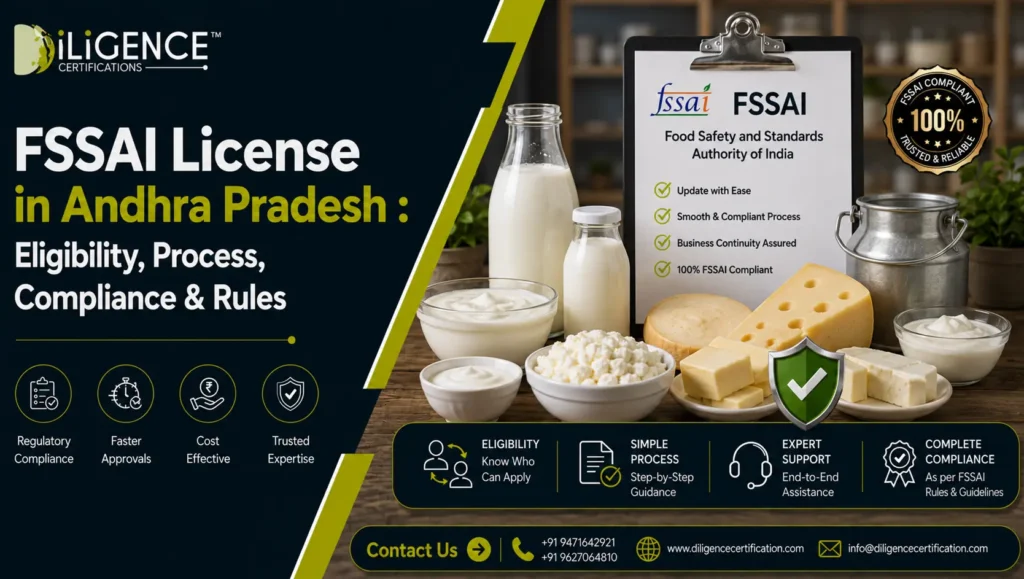
By - FSSAI License in Andhra Pradesh is Required for Food Business in Andhra Pradesh State According to Food Safety and Standards Act, 2006
- This license is applicable to all kinds of food businesses like manufacturing food business, catering food business, cloud kitchen food business, trading food business, e-food business in the state of Andhra Pradesh.
- It involves FoSCoS registration, document submission, inspection (if required), and finally approval by FSSAI authorities.
INTRODUCTION
Once a cloud kitchen owner from Guntur city presumed that PAN and GST registration will suffice for operating a delivery-based food business. Orders were being received, the customer base was growing, and all seemed well.
The challenge emerged while applying to a nationwide food delivery app. The application got rejected for lack of a FSSAI License in Andhra Pradesh. Business operations came to a standstill for almost three weeks in the high season period.
Such instances are quite common in Andhra Pradesh, especially in the cities like Vijayawada and Visakhapatnam. A lot of food entrepreneurs start their ventures casually but later understand that FSSAI registration is not an option - it is mandatory.
The FSSAI license in Andhra Pradesh is essentially the legal identity for all kinds of food related enterprises. It means that food processing, handling, packaging, and distribution comply with the norms mentioned under the Food Safety and Standards Act, 2006.
Below is presented the FSSAI licensing procedure in Andhra Pradesh, prepared by our team in a consultative style format.
WHAT IS FSSAI LICENSE IN ANDHRA PRADESH
License Under FSSAI In Andhra Pradesh
It is an official license which has been issued under FSSAI ( Food Safety and Standards Authority of India)using FoSCoS portal.
It assures that there is sufficient safety, hygiene, labeling and quality in food industry.
Objective:
Food safety and prevention of food adulteration, contamination and labeling.
Legal basis
- Food Safety and Standards Act, 2006
- Food Safety and Standards Rules, 2011
- Implementation of act in state under Food Safety Department of Andhra Pradesh.
It indicates that you have authorization for conducting your food business in India.
WHY FSSAI LICENSE IN ANDHRA PRADESH IS IMPORTANT
Many businesses treat licensing as paperwork, but in reality, it directly impacts revenue and survival.
Here is the expanded version with minimum 2 lines per heading, as requested:
1. Compliance With The Law
In case there is no FSSAI license in Andhra Pradesh, then your food business will be regarded as non-compliant with the Food Safety and Standards Act of 2006.
There can be situations where your business will face legal notices, penalties or even shutdown at the time of inspection because of the absence of such a license.
Your FSSAI license is a legal document that shows compliance of your food business with the law.
2. Entering the Market
To get on-boarded with food aggregators such as Swiggy, Zomato, Amazon Fresh, and Blinkit, you will require an FSSAI license in Andhra Pradesh.
Regardless of your food being of high quality and high demand, the absence of an FSSAI license will stop you from getting on-boarded on such platforms.
Supermarkets and retail stores will also require an FSSAI license for their functioning.
3. Customer Trust
Modern consumers tend to verify FSSAI licenses prior to making an order, especially when shopping on the Internet or in packaged foods.
The possession of a valid FSSAI license serves as a trust marker to make sure that the food you serve is safe and hygienic.
It adds value to your brand and attracts repeat customers.
In highly competitive markets, customers trust brands that they can believe.
4. Future Prospects
Possessing a valid FSSAI license in Andhra Pradesh helps in expanding your business in other markets.
Otherwise, expansion through retail channels, exports, or franchises will be impossible.
Major buyers and distributors collaborate with compliant suppliers only.
Thus, obtaining a FSSAI license plays a crucial role in future development of your business.
5. Financial Strength
Banks, NBFCs, and investors favor those enterprises which have obtained all necessary approvals, including FSSAI.
This means that your enterprise complies with the law and hygiene standards regarding the operation with food products.
Therefore, possessing an FSSAI license will positively affect the prospects of getting financing.
TYPES OF FSSAI LICENSE IN ANDHRA PRADESH
Understanding the correct category is critical. Most rejections happen due to wrong selection.
1. BASIC FSSAI REGISTRATION
For small-scale food businesses.
Applicable for:
- Home kitchens
- Small traders
- Petty retailers
- Small food vendors
Turnover limit:
Up to ₹12 lakh annually
2. STATE FSSAI LICENSE
For mid-sized businesses operating within Andhra Pradesh.
Applicable for:
- Restaurants
- Medium-scale manufacturers
- Storage units
- Distribution businesses
Turnover range:
₹12 lakh to ₹20 crore
3. CENTRAL FSSAI LICENSE
For large-scale operations.
Applicable for:
- Multi-state food businesses
- Export/import units
- Large manufacturing plants
- E-commerce food aggregators
WHO NEEDS FSSAI LICENSE IN ANDHRA PRADESH
The scope is wider than most people assume.
Mandatory for:
- Restaurants and cafés
- Cloud kitchens
- Home-based food businesses
- Food packaging units
- Wholesale distributors
- Import/export companies
- Online food sellers
- Caterers and event food providers
Even small-scale pickle or snack sellers operating from home are legally required to register.
DOCUMENTS REQUIRED FOR FSSAI LICENSE IN ANDHRA PRADESH
Documentation is the most sensitive part of the process.
PERSONAL DOCUMENTS
- Aadhaar card
- PAN card
- Passport-size photograph
BUSINESS DOCUMENTS
- GST certificate (if applicable)
- Incorporation certificate
- Partnership deed (if applicable)
- Trade license
TECHNICAL DOCUMENTS
- Food product list
- Manufacturing process details
- Layout of premises
- Water test report (for manufacturing units)
- Food safety management plan
STEP-BY-STEP PROCESS FOR FSSAI LICENSE IN ANDHRA PRADESH
The application process is fully online through FoSCoS.
STEP 1: CREATION OF ACCOUNT
Sign up on the official portal of FoSCoS by using your business name, business contacts, and category of your food business.
It is a step where you will get a unique user ID for applying for all the FSSAI applications.
Make sure that all the information provided by you should be consistent with the business documentation.
Otherwise, there could be problems at later stages of the verification/approval process.
STEP 2: SELECTION OF APPLICATION FORM
The choice of correct application depends upon the size and turnover of the business.
Application form A is to be chosen for Basic Registration, whereas Application Form B needs to be selected for State/Central License.
Selection of incorrect application form is the most frequent reason for rejection of applications.
A proper classification would help your application from any unnecessary delays and queries.
STEP 3: UPLOAD OF DOCUMENTS
Upload all necessary documents including your identification proof, proof of business and address proof etc.
Depending upon your business other documents such as list of products, layout or water report may also be needed.
Step 4: Payment of Fees
Pay the respective government fees, taking into account the chosen license category and period.
The amount of fee depends on whether it is Basic, State, or Central license, and also on the turnover and business nature.
After making the payment, remember to retain the receipt.
It acts as evidence that you have paid and might be needed for future checks.
Step 5: Inspection (If Needed)
Sometimes, the Food Safety Officer inspects your business premises.
This includes inspection of hygiene levels, storage facilities, and compliance framework in general.
Inspection is not always a necessary step; it mostly depends on the risks associated with your business.
COMMON REJECTION REASONS
Most applicants face delays due to avoidable mistakes.
- Incorrect license category selection
- Missing or unclear documents
- Wrong business activity classification
- Mismatch in address proof
- Non-compliance with hygiene layout
COST OF FSSAI LICENSE IN ANDHRA PRADESH
Cost varies depending on business type.
BASIC REGISTRATION
Lowest government fee category
STATE LICENSE
Moderate fee depending on turnover and category
CENTRAL LICENSE
Higher fee due to national-level compliance
Additional consultancy charges may apply for documentation and filing assistance.
VALIDITY AND RENEWAL
The license is valid for 1 to 5 years.
Important rule:
Renewal must be applied before expiry. Delay leads to penalties and business disruption.
COMPLIANCE RULES FOR FOOD BUSINESSES
FSSAI compliance is ongoing, not one-time.
Key requirements:
- Hygienic kitchen environment
- Proper food storage systems
- Correct labeling and packaging
- Employee hygiene training
- Regular record maintenance
BENEFITS OF FSSAI LICENSE IN ANDHRA PRADESH
- Legal permission to operate food business
- Access to online delivery platforms
- Increased brand credibility
- Better customer retention
- Eligibility for retail partnerships
- Reduced legal risk
- Business expansion opportunities
WHY BUSINESSES STRUGGLE WITHOUT EXPERT HELP
A major misconception is that FSSAI registration is simple filing. In practice:
- Category selection errors cause rejection
- Document mismatch leads to queries
- Premises inspection issues delay approval
- Labeling errors affect compliance approval
This is where professional compliance support becomes critical.
WHY DILIGENCE FOR FSSAI LICENSE IN ANDHRA PRADESH
Diligence Certification comes to help those companies which want professional help for their work rather than getting themselves entangled in the complex process of compliance under FSSAI in which any minor error in the documentation or categorization could result in the rejection of the application. The first thing among several benefits is the correct category mapping, in which the appropriate license category will be chosen according to the business activities and turnover of the company itself and thereby avoiding the rejection of the application in the initial stage.
Apart from this, end-to-end documentation services will be offered by the professionals where all necessary documents are prepared, checked, and organized as per the FSSAI guidelines. Another significant benefit is faster processing because properly filled-in applications raise less queries from food officials.
REAL BUSINESS INSIGHT
A Bakery unit in Visakhapatnam had originally filed for Basic Registration even though it had an intermediate level production facility. The application was denied on two occasions.
However, upon reclassification under the State License scheme, it was cleared within 10 days or less.
It was not a problem of qualification but one of classification.
CONCLUSION
The FSSAI License for Andhra Pradesh is not just a procedural matter; it is the legal bedrock of any food business in the state. Whether at a domestic kitchen level or an industrial manufacturing level, compliance ensures not only survival but also scalability and market entry.
Those who handle their licenses strategically do not face any legal hassles and get themselves registered in the organized food supply chain.
The FSSAI process can become very systematic and effective when handled properly.
Frequently Asked Questions
Is FSSAI Registration compulsory in Andhra Pradesh?
Yes, all food companies need to be registered with the FSSAI or get a license.
This applies to producers, wholesalers, restaurants, cloud kitchens, and even those operating out of homes.
It is an offense to run a food business without FSSAI registration under Indian food safety laws.
Can I open a food business without FSSAI License?
No, you will be violating the Food Safety and Standards Act, 2006.
Penalties or notice for closure may be issued by inspection authorities.
Online platforms will not allow onboarding without FSSAI registration.
How much time will it take to get FSSAI Approval?
Usually 7 to 30 days working days depending upon the category.
Simple registrations will take less time than licenses at the State and Central level.
This is due to lack of documentation and filing errors.
Is inspection compulsory for all business houses?
No, not in every case. It depends on risk category and nature of the business.
Inspection of small-scale food businesses is generally not necessary for obtaining clearance.
But manufacturing premises and risky food business will surely be inspected.
Can I register home kitchen with FSSAI?
Certainly, FSSAI basic registration is obligatory for home-based food business.
Any kind of cooking and selling food from home is covered by FSSAI.
This process provides reliability and makes the sale of food possible legally.
What will happen if my FSSAI license is not renewed?
Licenses can get penalty, suspension, or even cancellation.
Doing business operation with an expired FSSAI license can invite trouble.
Is GST necessary for FSSAI License?
Not necessary, but necessary in many commercial instances.
Many businesses seeking licenses from the State and Central Governments require GST registration.
It also makes the process of taxation easier.
Can one license work for multiple locations?
Generally, no.
Each food business must adhere to FSSAI regulations individually.
An exception may arise if it is a concentrated business operation.
Is FSSAI license transferable?
No, not transferable.
FSSAI license is assigned to a specific business organization at a particular location.
Any change in ownership requires a fresh license application.
Can I sell food items online without FSSAI license?
No, online sale requires FSSAI license.
Without it, one will not be able to put up one’s business on Swiggy, Zomato, etc.
It is a necessary compliance requirement for all online food sellers.