 BIS Certification
 CDSCO
CDSCO
 PESO
PESO
 CPCB
CPCB
 LMPC
LMPC
 WPC Approval
 Global Approvals
 TEC
TEC
 ARAI
ARAI
 BEE
BEE
 ISO Certification
 DGCA Certification
 NOC For Steel
 APEDA Registration















 Business Registration
 FSSAI Mark Certification











 (32).jpg)
 Legal Services
 Trademark Registration
 Copyright Registration
 Patent Registration
 By
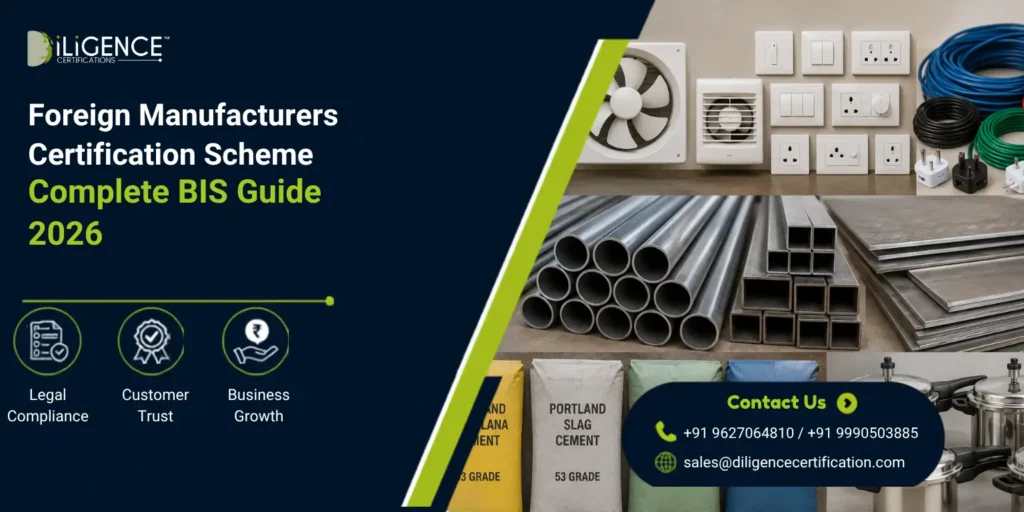
By - Foreign Manufacturers Certification Scheme (FMCS) is the compulsory BIS certification scheme enabling eligible foreign manufacturers to put the ISI Mark on their products that are covered by Indian Quality Control Orders (QCOs).
- Foreign manufacturers wishing to sell their regulated products in India need to first get FMCS approval.
- Knowledge of the entire procedure and requirements for the FMCS will save businesses time and money, avoiding possible problems while importing to India.
Introduction
A few months back, a European manufacturer of electrical appliances contacted our team for compliance services following an enquiry from Indian distributors regarding their products that have got approvals in various other international markets such as Europe and Southeast Asia.
However, they failed to realize that one critical requirement is missing-the Foreign Manufacturers Certification Scheme (FMCS) of the Bureau of Indian Standards (BIS).
It became necessary for them to obtain FMCS certification to be able to bring their products into India as without it, the products cannot even clear customs. It has delayed their production process, delayed purchase orders and incurred additional costs due to lack of compliance with Indian regulations simply because they did not begin the process of certification beforehand.
There are many more similar cases emerging. There has been tremendous development in the area of quality regulation in India via Quality Control Orders (QCOs). BIS certification is now mandatory for a number of products under QCOs.
If you manufacture electrical appliances, steel products, chemicals, cement, consumer goods, auto parts or machinery, you should be aware of the Foreign Manufacturers Certification Scheme.
What is the Foreign Manufacturers Certification Scheme
The Foreign Manufacturer’s Certification Scheme (FMCS) is a certification scheme run by the Bureau of Indian Standards behalf of manufacturers situated abroad.
This scheme allows the foreign manufacturing units to get a BIS license which gives the right to affix ISI standard mark on those goods which meet Indian Standards.
It is important to note that foreign manufacturers cannot apply through BIS domestic certification scheme as done by Indian manufacturers. They need to undergo the FMCS scheme, which involves factory inspection by BIS inspectors, product testing, technical documentation checking and monitoring.
On completion of the procedure successfully, the manufacturer gets a BIS license for exporting their goods to India.
Why is the Foreign Manufacturers Certification Scheme Important
India has gradually toughened its product quality regulations to enhance consumer safety, environmental protection, and production standards.
With more and more products being governed by QCOs, foreign manufacturers need to prove their compliance before selling their products in India.
Foreign Manufacturers Certification Scheme is the guarantee that the imported products have passed the same tests as those produced by Indian companies.
Failure to obtain FMCS certification can result in:
- Import restrictions
- Customs clearance issues
- Product seizure
- Financial penalties
- Cancellation of import contracts
- Loss of distributor confidence
- Regulatory action by Indian authorities
For global brands, FMCS is no longer just a regulatory requirement it has become an essential market entry strategy.
Objectives of the Foreign Manufacturers Certification Scheme
The program has several vital objectives.
Protect Consumers’ Safety
Goods imported into India should meet Indian Standards to ensure safety.
Maintain Product Quality
The manufacturer needs to be able to show a reliable process of production to ensure product quality.
Prevent Inferior Goods
The certification program deters inferior goods from meeting the Indian technical standards.
Provide Equal Opportunities for Competition
Both domestic and foreign manufacturers can compete equally on the basis of quality.
Build Consumers’ Trust
ISI marked products are normally perceived as meeting Indian quality standards.
Products Covered Under the Foreign Manufacturers Certification Scheme
The scope of FMCS continues to expand as India introduces additional mandatory Quality Control Orders.
Common product categories include:
| Product Category | Examples |
| Electrical Appliances | Fans, switches, cables, plugs |
| Steel Products | Steel bars, pipes, sheets |
| Cement | Various grades of cement |
| Household Products | Pressure cookers, kitchen appliances |
| Chemicals | Industrial chemicals under QCOs |
| Automotive Components | Certain regulated vehicle parts |
| Industrial Equipment | Machinery covered by Indian Standards |
| Consumer Goods | Products notified under mandatory BIS certification |
Manufacturers should always verify whether their products fall under mandatory BIS certification before exporting.
Key Benefits of the Foreign Manufacturers Certification Scheme
Being FMCS certified presents some benefits other than compliance with regulations.
Access to the Indian Market
The Indian market is among the fastest growing markets in the world. Being FMCS-certified allows entry into the regulated market.
Greater Business Integrity
Distributors, government buyers, and institutional buyers favor certified products because of recognized quality assurance.
Less Risk When Importing
There is usually less difficulty when importing certified products.
Competitive Edge
It shows dedication to quality and regulations, thus improving relations with the importer or channel partners.
Enhances Brand Image
The ISI mark increases consumer trust and provides a great branding strategy in India.
Facilitates Business Growth
A lot of multinational companies regard the process of getting certified by the FMCS as an investment for the future of expanding into India.
Who is an Authorised Indian Representative
One of the most important requirements under the Foreign Manufacturers Certification Scheme is the appointment of an Authorised Indian Representative (AIR).
The AIR acts as the official point of contact between BIS and the foreign manufacturer throughout the certification lifecycle.
An AIR may be:
- The Indian subsidiary of the manufacturer
- An Indian branch office
- An importer
- A distributor
- A legally authorised representative based in India
The AIR is responsible for:
- Coordinating with BIS
- Submitting documents
- Receiving official communications
- Supporting inspections
- Handling compliance matters
- Assisting during licence renewal
- Responding to regulatory notices
For manufacturers without an Indian office, selecting a knowledgeable AIR is essential to avoid communication delays and compliance issues.
Step-by-Step Foreign Manufacturers Certification Scheme Process
The Foreign Manufacturers Certification Scheme follows a structured process designed to verify both product quality and manufacturing capability.
Step 1 - Product Identification
The first step is identifying whether the product falls under mandatory BIS certification.
Many manufacturers incorrectly assume that all products require FMCS approval. In reality, only products covered under the relevant Quality Control Orders (QCOs) are subject to mandatory certification.
A detailed product classification helps determine:
- Applicable Indian Standard (IS)
- Certification requirements
- Product scope
- Testing parameters
Step 2 - Appointment of Authorised Indian Representative
If required, the manufacturer appoints an AIR to communicate with BIS and coordinate the certification process.
Choosing an experienced representative often helps reduce delays arising from documentation or regulatory queries.
Step 3 - Preparation of Documentation
At this stage, all technical and legal documents are compiled.
This typically includes:
- Manufacturing details
- Product specifications
- Factory information
- Laboratory capabilities
- Quality procedures
- Test reports
Incomplete documentation is one of the most common reasons for application delays.
Step 4 - Submission of Application
The manufacturer submits the application to BIS along with the prescribed fee and supporting documents.
BIS reviews the application to ensure:
- Completeness
- Product applicability
- Technical compliance
- Availability of required records
If clarifications are required, BIS may request additional information before scheduling the inspection.
Step 5 - Factory Inspection by BIS
Factory inspection is one of the most important stages under the Foreign Manufacturers Certification Scheme.
Unlike desk-based approvals, BIS officials visit the overseas manufacturing facility.
During the inspection, they evaluate:
- Production process
- Manufacturing capability
- Quality control systems
- Testing laboratory
- Calibration records
- Production consistency
- Staff competency
- Raw material controls
- Packaging procedures
- Product traceability
The inspection helps verify that the factory consistently produces products meeting Indian Standards rather than merely passing a one-time laboratory test.
Common Challenges Faced by Foreign Manufacturers
Many first-time applicants encounter avoidable issues during the FMCS process.
Some of the most common challenges include:
Incomplete Technical Documentation
Missing drawings, specifications, or quality records often lead to repeated BIS queries.
Incorrect Product Classification
Applying under the wrong Indian Standard can significantly delay approval.
Testing Equipment Deficiencies
Factories may lack calibrated equipment required for demonstrating compliance.
Delayed Laboratory Reports
Testing timelines can vary depending on product complexity and laboratory workload.
Communication Gaps
Manufacturers without an experienced AIR often face delays in responding to BIS requirements.
Factory Non-Conformities
Inspection findings such as inadequate quality controls or missing records may require corrective actions before approval.
Why Choose Diligence Certification for FMCS
The process of navigating the Foreign Manufacturer’s Certification Scheme may prove difficult for those who are new to it or new to the Indian market.
At Diligence Certification, we help our clients navigate through the entire process by enabling them to:
- Determine product applicability
- Identify the relevant Indian Standard
- Prepare documentation
- Coordinate with the Authorised Indian Representative (AIR)
- Review technical files before submission
- Support BIS application filing
- Assist during factory inspections
- Coordinate product testing
- Respond to BIS queries
- Support licence renewal and ongoing compliance
Our objective is to help businesses complete the certification process efficiently while reducing avoidable delays and compliance risks.
Conclusion
India is also enhancing their product quality regulation standards, meaning that the Foreign Manufacturers Certification Scheme (FMCS) has become an important consideration for foreign manufacturers wishing to export regulated products into India.
In order to see beyond just another regulatory burden imposed upon the business, organizations must understand that FMCS can help them invest in certification and secure market access to the fastest-growing consumer market.
Manufacturers that have made appropriate preparation, established good quality management systems, and met BIS standards will be more likely to succeed.
When exporting regulated products to India, receiving approval through the Foreign Manufacturer’s Certification Scheme must be considered a priority.
Frequently Asked Questions
What is Foreign Manufacturer’s Certification Scheme ?
Foreign Manufacturer’s Certification Scheme (FMCS) is the BIS Certification Scheme wherein foreign manufacturers having their manufacturing facilities outside India can seek permission to use the ISI Mark on the relevant products
Is Foreign Manufacturer’s Certification Scheme mandatory?
Yes. Foreign Manufacturer’s Certification Scheme is a mandatory scheme for foreign manufacturers who have their products under Quality Control Orders
Who gives Foreign Manufacturer’s Certification Scheme License?
The Foreign Manufacturer’s Certification Scheme license is issued by the Bureau of Indian Standards (BIS) after passing documents examination, factory inspection, product testing, and compliance evaluation.
Who can apply under the Foreign Manufacturer’s Certification Scheme?
In this scheme, only foreign manufacturers having their facilities outside India can apply. Importer/Trader cannot apply on behalf of manufacturers unless authorised as Authorised Indian Representative (AIR).
Is it compulsory to appoint Authorised Indian Representative (AIR)?
In most cases, yes. Foreign manufacturers need to appoint an Authorised Indian Representative (AIR).
How much time is required for FMCS certification?
The time period for certification depends on various factors including document processing, inspection schedule, product testing, etc. An entire application usually takes a number of weeks to a few months.
Does BIS conduct inspection of manufacturing facility abroad?
Yes. Under the Foreign Manufacturers Certification Scheme, BIS performs an inspection of the manufacturing facility located abroad.
In case the manufacturer in a foreign country exports his/her goods without FMCS license?
It will depend upon the necessity of the license and the fact that it has not been obtained.
Is one FMCS license enough for all sorts of products?
This depends on the Indian Standard in question
What are the advantages of Diligence Certification in regard to Foreign Manufacturer Certification Scheme?
Diligence Certification assists at all levels including eligibility assessment, application submission, coordination with BIS, inspection, testing, renewal of license and more.