


 BIS Certification
 CDSCO
CDSCO
 PESO
PESO
 CPCB
CPCB
 LMPC
LMPC
 WPC Approval
 Global Approvals
 TEC
TEC
 ARAI
ARAI
 BEE
BEE
 ISO Certification
 DGCA Certification
 NOC For Steel
 APEDA Registration





















 Business Registration
 FSSAI Mark Certification












 (32).jpg)
 Legal Services
 Trademark Registration
 Copyright Registration
 Patent Registration
 By
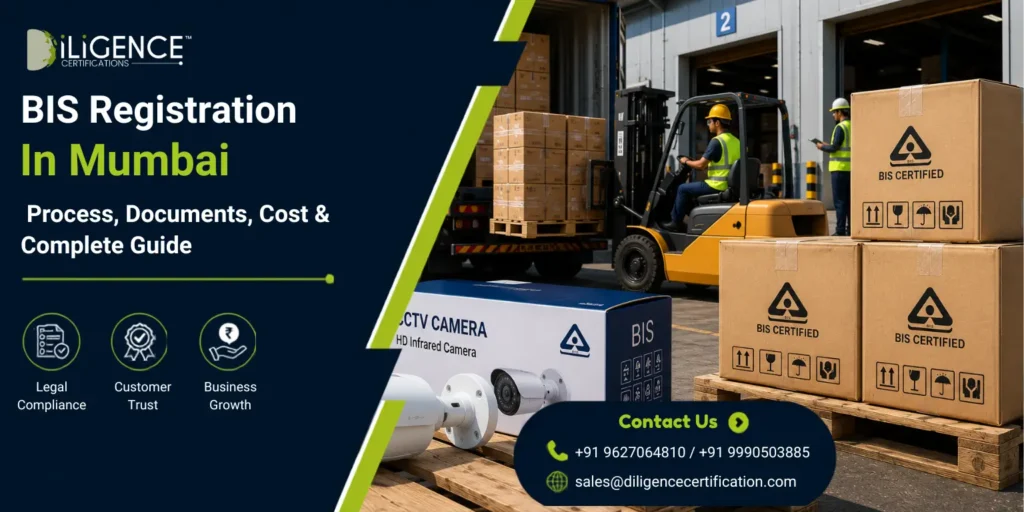
By - Registration of products with BIS in Mumbai is compulsory prior to manufacturing, importing, or selling such products in India.
- It entails testing of the product, documentation, application for the registration, and finally obtaining approval from the Bureau of Indian Standards (BIS).
- BIS registration assists organizations in meeting the legal requirements and increases their credibility in the market.
Introduction
An electronics products importing firm from Mumbai had made agreements with retail stores all over Maharashtra and was all set to introduce a new range of electronic devices in the market. However, at the time of clearance, they realized that there was a need for BIS Registration in Mumbai before their products could be introduced in India.
This compliance certification delay resulted in delayed imports, additional warehousing charges, and postponement of the product launch. There are instances where such things happen because companies tend to ignore the BIS compliance requirement during the product planning process.
Since Mumbai is one of the biggest business hubs of India and houses many businesses dealing in electronics, electrical appliances, engineering products, chemicals, construction materials, and consumer goods, there are many products that are part of mandatory QCOs and thus need BIS registration.
Whether you are a manufacturer, importer, startup, or even a foreign brand looking forward to introducing their products in the Indian market, it is important for you to know about the BIS Registration in Mumbai process. At Diligence Certification, we help our clients in product classification, documentation, and BIS registration.
What is BIS Registration?
BIS Registration is a certification scheme run by the Bureau of Indian Standards (BIS), which guarantees that products subject to regulation meet Indian quality and safety standards prior to their production, importation, or distribution in India.
The main BIS certification schemes are:
- Compulsory Registration Scheme (CRS)
- ISI Mark Certification
- Foreign Manufacturers Certification Scheme (FMCS)
- Scheme X Certification
- BIS Hallmark Registration
Choosing the correct scheme is essential for legal compliance and smooth product approval.
Why is BIS Registration Important?
Without the required BIS approval, many regulated products cannot be:
- Manufactured or sold legally
- Imported into India
- Listed on e-commerce platforms
- Supplied to government departments
- Distributed through authorised channels
Apart from legal compliance, BIS registration strengthens customer confidence and demonstrates that the product meets recognised Indian quality standards.
Types of BIS Registration in Mumbai
The Bureau of Indian Standards offers different certification schemes based on the product category and applicable regulations.
1. Compulsory Registration Scheme (CRS)
Applicable to notified electronic and IT products.
Common products include:
- Mobile phones
- Laptops
- LED lights
- Power banks
- Smart watches
- Television sets
2. ISI Mark Certification
Applicable to products affecting public safety and quality.
Common products include:
- Cement
- Steel products
- Electrical cables
- Pressure cookers
- LPG cylinders
- Household appliances
3. Foreign Manufacturers Certification Scheme (FMCS)
Applicable to overseas manufacturers exporting regulated products to India through an Authorised Indian Representative (AIR).
4. Scheme X Certification
Applicable to selected products covered under specific Quality Control Orders and involves product testing, technical review, and factory assessment.
5. BIS Hallmark Registration
Mandatory for jewellers dealing in notified gold and silver jewellery.
Products Covered Under BIS Registration in Mumbai
Products notified under the Government of India’s Quality Control Orders (QCOs) need registration with BIS at Mumbai. Some important product groups are:
- Electronics & IT Products: Mobile phones, laptops, LED lights, TVs, power banks, and computer screens.
- Electrical Appliances: Water heaters, ceiling fans, switches, sockets, cables, and electrical appliances.
- Steel & Construction Materials: Steel rods, cement, structural steel, pipes, and construction material.
- Industrial & Domestic Appliances: Industrial machinery, pressure cookers, helmets, packaged drinking water, and toys.
- Firms are advised to check first whether their products require BIS registration.
Who Needs BIS Registration in Mumbai?
BIS registration is required for businesses manufacturing, importing, or selling products covered under mandatory BIS certification schemes.
Eligible applicants include:
- Indian manufacturers
- Importers
- Foreign manufacturers
- MSMEs and startups
- OEMs and brand owners
- Contract manufacturers
Obtaining the appropriate BIS approval before launching regulated products helps businesses avoid compliance issues and market delays.
Industries That Require BIS Registration in Mumbai
Mumbai is one of India’s largest industrial and commercial hubs, with several sectors requiring BIS compliance.
Major industries include:
- Electronics and IT
- Electrical equipment
- Steel and construction
- Engineering and manufacturing
- Consumer goods
- Chemical and industrial products
Many businesses operating in MIDC industrial areas and nearby manufacturing clusters require BIS registration before commercial distribution.
Documents Required for BIS Registration in Mumbai
The documents required vary depending on the certification scheme, but generally include:
Business Documents
- GST Registration
- PAN Card
- Company Incorporation Certificate
- MSME Certificate (if applicable)
Technical Documents
- Product specifications
- Product drawings
- Test reports (if available)
Manufacturing Documents
- Factory layout
- Machinery details
- Quality control process
Additional Documents
- Trademark certificate (if applicable)
- Authorisation letter
- Utility bill
Accurate documentation reduces processing delays and improves approval timelines.
BIS Registration Process in Mumbai
Steps involved in BIS Registration in Mumbai to make sure that the products meet the Indian Standards.
Step 1: Identification of the Applicable BIS Scheme
Identify the applicable BIS Scheme like CRS, ISI, FMCS, or Scheme X according to the product.
Step 2: Identification of the Applicable Indian Standard
Ensure the applicable Indian Standard (IS) of the product before carrying out any tests.
Step 3: Product Testing
Make sure the product is tested in an accredited lab of BIS.
Step 4: Documentation
Ensure all the necessary business, technical, manufacturing and testing documentation are gathered.
Step 5: Submitting the Application
BIS application must be filed online with all the necessary documentation and government charges.
Step 6: Factory inspection (if applicable)
If BIS schemes are ISI, FMCS, and Scheme X, the factory will have to undergo inspection by BIS before grant of registration.
Step 7: BIS Registration
After the completion of successful verification, BIS provides the registration or license to manufacture, import and sell in India.
Processing Time for BIS Registration in Mumbai
The processing time for BIS Registration in Mumbai depends on various factors, including the type of product, applicable BIS certification scheme, testing requirements, and completeness of submitted documents.
There is no fixed timeline for every application because different products follow different conformity assessment procedures. For example, CRS Registration for electronic products may be completed faster compared to ISI Mark Certification or FMCS, which generally involve detailed evaluation, testing, and inspection procedures.
The major factors affecting the BIS registration timeline include:
Applicable BIS Certification Scheme
The approval duration depends on whether the product falls under CRS, ISI Mark Certification, FMCS, or Scheme X. Each scheme has different testing and verification requirements.
Product Testing Process
Products must be tested at a BIS-recognised laboratory. The time required may vary depending on product complexity, testing parameters, and laboratory availability.
Accuracy of Documentation
Incomplete or incorrect documents can lead to clarification requests from BIS, increasing the overall processing time. Proper preparation of technical and business documents helps avoid unnecessary delays.
Factory Inspection Requirements
For certifications such as ISI, FMCS, and Scheme X, BIS may conduct a factory inspection. The availability of inspection schedules and readiness of the manufacturing unit can influence the approval timeline.
Cost of BIS Registration in Mumbai
There is no fixed cost for BIS Registration in Mumbai. The overall expense depends on several factors, including:
- Product category
- Applicable BIS scheme
- Government fees
- Laboratory testing charges
- Factory inspection costs (if applicable)
- Consultancy and documentation support
Generally, CRS Registration has a lower compliance cost, while ISI and FMCS certifications may involve additional testing and inspection expenses.
Common Errors to Be Avoided While Availing BIS Registration in Mumbai
There are many businesses that experience difficulties getting their BIS Registration in Mumbai not owing to their inability to make their products conform to standards, but owing to their inability to comply with mandatory conditions while filing for the registration.
Avoiding these common errors will help the business save time, cost and effort in making further submissions.
Selecting an Incorrect BIS Certification Scheme
Selecting an incorrect BIS certification scheme, like CRS, ISI, FMCS and Scheme X leads to rejection of application or extra testing cost. The business needs to know about the correct scheme required for its product.
Selecting Incorrect Indian Standard (IS)
Each product has a corresponding Indian Standard, failure to know the Indian Standard will lead to wrong testing of the product.
Incomplete Documentation Submission
Failure to include relevant technical documentation, business details, manufacturing information and test reports will lead to BIS clarification.
Testing Products in Non-Accepted Laboratory
The testing of the products should be done using BIS accepted laboratory wherever applicable.
Inappropriate Product Labelling
Incorrect labelling of products can be a problem even after testing. preparation helps minimise delays and improves approval chances.
Delayed Responses to BIS Queries
Slow responses to BIS clarification requests can delay application processing. Providing accurate information within the required timeframe helps maintain approval progress.
Penalties for Non-Compliance
Selling regulated products without mandatory BIS certification may result in:
- Financial penalties
- Product seizure or recall
- Customs clearance delays
- Legal action
- Restrictions on manufacturing or sales
- Loss of customer confidence
For businesses operating in Mumbai’s manufacturing and import sectors, non-compliance can significantly affect operations and market reputation.
BIS Registration Renewal Process
Depending on the applicable certification scheme, BIS registration must be renewed within the prescribed validity period.
The renewal process generally includes:
- Updating business documents
- Filing the renewal application
- Payment of applicable fees
- Compliance review
- Inspection or testing (where required)
Timely renewal ensures uninterrupted manufacturing, importing, and product sales.
Latest BIS Updates and Quality Control Orders (QCOs)
The Government of India regularly notifies new Quality Control Orders (QCOs) to improve product quality and consumer safety. Businesses should monitor these updates to ensure continued compliance.
Recent developments include:
- Expansion of mandatory certification to new product categories
- Stricter testing and conformity assessment requirements
- Increased compliance checks on imported products
- Stronger enforcement against non-compliant manufacturers and importers
Checking the latest BIS notifications before launching a product helps avoid regulatory issues.
Why Choose Diligence Certification?
Getting BIS Registration in Mumbai demands technical knowledge, proper documentation, and liaison with the testing laboratory as well as BIS. It is time-consuming to handle all this internally.
Diligence Certification assists in every aspect of BIS Registration, which includes:
- Product classification support
- Documentation preparation
- Coordination with BIS-recognised laboratories
- BIS application filing
- Factory inspection assistance
- Query management and compliance support
- Renewal and post-certification guidance
Our experienced team helps manufacturers, importers, startups, and multinational companies complete the BIS registration process efficiently and in compliance with applicable regulations.
Conclusion
Mandatory BIS Registration in Mumbai is a must for manufacturers/importers of regulated products. Be it your electronics, electricals, engineering products, construction material, or consumer goods, a BIS clearance will be a guarantee of your legal compliance and smooth market entry.
BIS planning in advance while developing/importing products may save you time and money. The right consultation will make your BIS registration procedure easier and more effective.
With Diligence Certification, your BIS Registration in Mumbai will be taken care of in an easy way through product classification, documentation, testing, and final clearance.
Get in touch with Diligence Certification now to make BIS registration hassle-free.
Frequently Asked Questions
What is BIS Registration in Mumbai?
BIS Registration in Mumbai is the approval issued by the Bureau of Indian Standards (BIS) for regulated products before they are manufactured, imported, or sold in India.
Is BIS Registration mandatory for all products?
No. It is mandatory only for products covered under applicable Quality Control Orders (QCOs) and notified BIS certification schemes.
Who can apply for BIS Registration?
Indian manufacturers, importers, foreign manufacturers, OEMs, startups, and MSMEs dealing with regulated products can apply.
Which products require BIS Registration?
Products such as electronics, electrical equipment, steel, cement, household appliances, toys, and pressure cookers commonly require BIS Registration.
What documents are required for BIS Registration?
Common documents include GST, PAN, company registration, product specifications, factory details, and BIS-recognised laboratory test reports
Can foreign manufacturers obtain BIS Registration?
Yes. Foreign manufacturers can apply through the Foreign Manufacturers Certification Scheme (FMCS) with an Authorised Indian Representative (AIR).
What happens if products are sold without BIS Registration?
Businesses may face penalties, product seizure, customs delays, legal action, and restrictions on manufacturing or sales.
How can I check my BIS Registration status?
You can verify the status through the official BIS online portal using your application or licence details.
How can I check my BIS Registration status?
You can verify the status through the official BIS online portal using your application or licence details.
Why choose Diligence Certification for BIS Registration in Mumbai?
Diligence Certification provides end-to-end assistance for documentation, testing, application filing, inspection support, and ongoing BIS compliance.