BIS Certification
 CDSCO
CDSCO
 PESO
PESO
 CPCB
CPCB
 LMPC
LMPC
 WPC Approval
 Global Approvals
 TEC
TEC
 ARAI
ARAI
 BEE
BEE
 ISO Certification
 DGCA Certification
 NOC For Steel
 APEDA Registration























 Business Registration
 FSSAI Mark Certification












 (32).jpg)
 Legal Services
 Trademark Registration
 Copyright Registration
 Patent Registration
 By
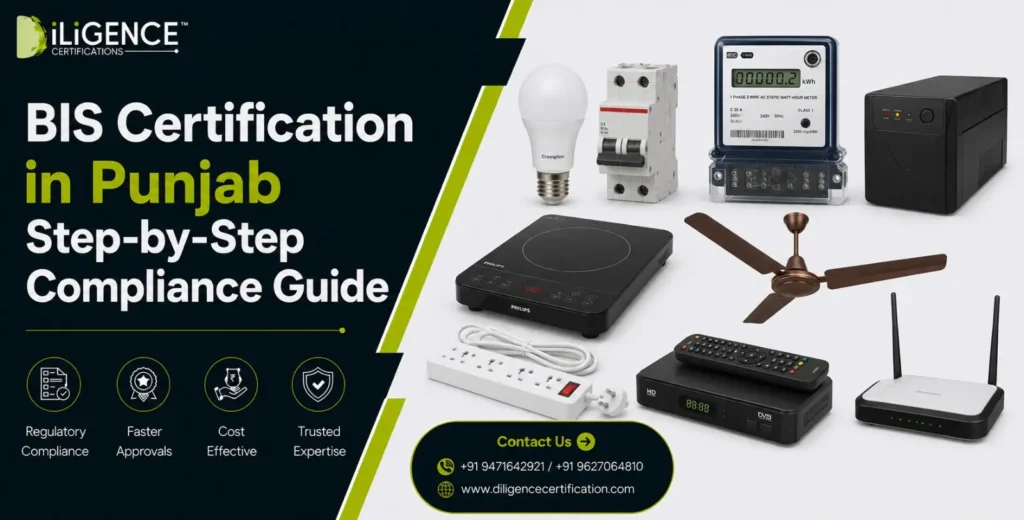
By - BIS Certification in Punjab is compulsory for certain goods in order to make sure that the Indian safety and quality standards are met as per BIS laws.
- The procedure to be followed by manufacturers and importers involves a proper structure of documentation, testing, and verification by BIS.
- Proper compliance planning will minimize delays and increase chances of approval.
Introduction
A medium-sized manufacturer of electronic devices from Ludhiana contacted a compliance expert since their goods were detained at a distribution point due to lack of approval in accordance with the Indian standards. It is quite a common situation in Punjab, where companies grow much faster than their ability to comply with the legislation.
In this case, BIS Certification in Punjab not only means complying with the standards but also represents a business necessity. Regardless of whether your company is located in Jalandhar, Amritsar, or Mohali, it must comply with the requirements set forth by the Bureau of Indian Standards to operate on the Indian market.
The certification confirms that your products comply with certain safety and quality criteria approved by the Bureau of Indian Standards.
What is BIS Certification in Punjab
BIS Certification in Punjab pertains to the process wherein products that are either manufactured or marketed in Punjab adhere to the standards set by the Bureau of Indian Standards in India.
The state of Punjab has an excellent foundation in areas such as textiles, electrical items, agricultural machinery, and food processing. All these industries are subject to BIS regulations.
Simply put:
BIS certification means that the product is safe, tested, and authorized for marketing within the country.
This is particularly relevant to:
- Electrical appliances
- Steel and construction materials
- Packaging materials
- Consumer goods
- Industrial equipment
Without BIS approval, products may be restricted from sale or distribution.
Why BIS Certification in Punjab is Important for Businesses
Punjab’s industrial hubs like Ludhiana, Mohali, and Amritsar are export-oriented and highly competitive. In such markets, compliance directly affects business credibility.
Key reasons why BIS Certification in Punjab matters:
1. Legal Market Access
Products covered under mandatory BIS schemes cannot be sold without certification.
2. Improved Buyer Trust
Retailers and institutional buyers prefer BIS-certified products as it reduces risk.
3. Reduced Market Rejection
Non-certified goods are often rejected during quality audits or inspections.
4. Export and Expansion Benefits
Many international buyers consider BIS compliance as a baseline requirement.
A compliance gap in Punjab’s manufacturing sector often leads to financial loss more than regulatory penalties.
Products Covered Under BIS Certification
1. Electrical & Electronics Products
These are among the most strictly regulated categories.
- LED lights, lamps, and lighting systems
- Switches, sockets, and electrical wiring accessories
- Electric motors and pumps
- Household appliances (fans, irons, heaters, mixers)
- Cables and power cords
- Batteries (lithium-ion, lead-acid)
2. Steel & Construction Materials
Widely applicable to Punjab’s industrial and infrastructure sector.
- Steel rods and structural steel
- Cement and cement products
- Aluminum products
- Pipes and tubes (GI, PVC, steel)
- Structural building materials
3. Automotive Components
Critical for manufacturers in Ludhiana and Jalandhar clusters.
- Tyres and tubes
- Automotive batteries
- Safety glass (windshields)
- Helmets (IS 4151)
- Brake components
- Electrical automotive parts
4. Consumer Goods
Common household and retail products.
- Pressure cookers
- Kitchen appliances
- Water bottles (metal/plastic regulated types)
- Toys (mandatory BIS certification under safety standards)
- Footwear (selected categories)
5. Food-Related Packaging Materials
Packaging safety is also regulated under BIS standards.
- Food containers
- Plastic packaging materials
- Bottles and jars used for consumables
- Aluminium foils and wraps
Step-by-Step Process for BIS Certification in Punjab
The process of BIS Certification in Punjab follows a structured compliance workflow. Each stage requires precision and documentation accuracy.
Step 1: Product Classification
Identify whether your product falls under mandatory or voluntary BIS certification categories.
Step 2: Standard Mapping
Match your product with the applicable Indian Standard (IS code).
Step 3: Documentation Preparation
Common documents include:
- Company registration certificate
- Manufacturing details
- Product specifications
- Factory layout
- Test reports (if applicable)
Step 4: Product Testing
Samples must be tested in BIS-recognized laboratories.
Step 5: Application Submission
Submit application through BIS portal with required documents.
Step 6: Factory Inspection
BIS officials may conduct on-site inspection of manufacturing units.
Step 7: Final Approval
Once verified, BIS issues certification allowing legal product sale.
Documents Required for BIS Certification in Punjab
Documentation is an essential component of BIS Certification in Punjab. Products that are technically well made can be delayed or rejected because of their lack of proper documentation. Every piece of documentation has its own regulatory role, which assists BIS in verifying the manufacturer and its products.
1. Business Incorporation Certificate
This document confirms that the applicant company is legally registered in India. It establishes the legal identity of the manufacturer or importer applying for BIS Certification in Punjab.
2. GST Registration Certificate
GST registration validates the tax identity of the business. It is used by BIS to confirm that the applicant is an active commercial entity engaged in legitimate business operations.
3. Manufacturing License
This is required to prove that the applicant has authorized permission to manufacture the product in India. It helps BIS verify that production is carried out in a regulated and approved facility.
4. Details of the Authorised Signatory
The authorised signatory is the individual who signs and submits the application on behalf of the organization. His name needs to be mentioned here in order to maintain transparency and ensure communication ease.
5. Product Test Report
Product test report of BIS-recognized laboratory is very important because it shows the compliance of the product with the IS code of the particular Indian Standard.
6. Technical Specifications Sheet
This sheet holds the technical data of the product such as its designing, material used, electrical properties, etc. It will help in assessing whether the product meets the requirements of the regulations or not.
7. Quality Control Methods
This outlines how the manufacturer ensures consistent product quality during production. It includes inspection methods, testing frequency, and internal compliance systems.
Common Challenges Faced by Punjab Businesses
Even established manufacturers face issues during BIS compliance.
1. Incorrect Product Classification
Many companies misidentify applicable standards.
2. Testing Delays
Lab approvals and sample testing often take longer than expected.
3. Documentation Gaps
Missing technical files lead to repeated queries.
4. Inspection Non-Compliance
Factory inspection readiness is often underestimated.
These challenges highlight why structured handling of BIS Certification in Punjab is necessary rather than ad-hoc application filing.
Why Choose Diligence Certifications for BIS Certification in Punjab
Selecting the right compliance partner may actually dictate how quickly your BIS application gets through the process of being submitted and getting approved. In Punjab, where the manufacturing time is very tight and there are no long distribution cycles, delays in certification can impact income and market entry.
Diligence Certifications concentrates on regulation management and not document filing. This process is aimed at avoiding rejection, decreasing clarification cycles, and ensuring that all applications comply with BIS requirements from the start.
1. End-to-End Application Handling
From product classification to final approval tracking, the process is managed in a controlled workflow. This avoids gaps between documentation, testing, and submission stages.
2. Accurate Product Standard Mapping
Another one of the most common reasons for BIS delays is choosing wrong IS code.
3. Document Pre-audit System
Documents are pre-audited prior to submission with regard to technical consistency and correctness.
4. Coordination With BIS-Accredited Test Lab
Coordination with test lab helps avoid sample submission problems.
5. Preparation of the Factory for Inspection
Manufacturers located in Punjab have problems with their factory inspections due to lack of SOPs and quality documents.
6. Faster Approval Process
Eliminating common mistakes from your filing process will speed up the approval process.
7. Industry Specific Experience
Experience in different industries such as electrical appliances, automotive parts and industrial manufacturing will help us foresee potential problems with certain category of products.
8. Clarity of Process Stages
Applicant receives information about all stages of the certification process.
Conclusion
The IS certification in Punjab is a mandatory compliance requirement for various regulated products and an important factor in accessing the legal market of India. The IS certification verifies that the products conform to Indian safety, quality, and performance standards laid down by the Bureau of Indian Standards.
There are certain crucial steps involved in the process of IS certification, including product classification, selection of IS standards, testing in laboratories, verification of documents, and inspection in factories. Every step should be carried out properly because any mistake can cause delay, rejection, or non-compliance problems.
For companies manufacturing, importing, and distributing products in Punjab, the BIS certification is not only a regulatory requirement but an absolute business need.
Following a systematic approach, you will be able to get your certifications approved without any compliance problems.
Frequently Asked Question
What is BIS Certification in Punjab?
This is a regulatory license which confirms that products produced or marketed in Punjab adhere to Indian safety and quality standards laid down by the BIS.
What kind of products need BIS Certification in Punjab?
Electrical appliances, steel products, automobile parts, toys, pressure cookers, and some industrial goods among others need BIS approval compulsorily.
How long does it take to get BIS certification?
It takes between 3 to 6 weeks for this.
Is factory inspection required for BIS Approval?
Yes, in many cases BIS conducts an inspection of the factory
Can importers get BIS certification?
Yes, importers must have BIS certificate for certain products to sell them in India.
What will happen to the products that are not sold with BIS Certification?
These products may have some restrictions on market entry or be confiscated by the authorities.
What kinds of documents are needed for BIS Certification?
Generally, these include company registration certificate, specification of the product, test report, factory data, and documentation about quality control.
Does the BIS Certification apply to all Indian states?
Yes, BIS Certification is applied to all states of India, including Punjab.
Can BIS Certification be renewed?
In general, BIS Certification should be renewed periodically or be in compliance with the scheme.
Why is BIS Certification necessary for Punjab industries?
It helps in ensuring legal compliance and gaining buyer confidence.