BIS Certification
 CDSCO
CDSCO
 PESO
PESO
 CPCB
CPCB
 LMPC
LMPC
 WPC Approval
 Global Approvals
 TEC
TEC
 ARAI
ARAI
 BEE
BEE
 ISO Certification
 DGCA Certification
 NOC For Steel
 APEDA Registration























 Business Registration
 FSSAI Mark Certification












 (32).jpg)
 Legal Services
 Trademark Registration
 Copyright Registration
 Patent Registration
 By
By - BIS certification in Meghalaya essential for specified products in the country that come under the Indian quality and safety standards.
- BIS certification must be obtained for the electronic and electrical items, the materials used in construction, along with various controlled consumer items entering India.
- BIS compliance helps your goods enter legally, avert any fine, and adds to the business standing on an all-India level.
Introduction
A purchase order was placed on a small electrical assembly business operating from Shillong by a Guwahati-based distributor. The sale seemed straight-forward - it was a repeat purchase of a batch of LEDs drivers; the demand for the product was steady, and repeated sales were a regular occurrence. That appeared to be until the interstate logistics and movement facility where it got stopped while going through routine compliance procedures.
The cause for being pulled up for verification and eventually being withheld was not a quality defect or poor performance of the product; the shipment was stopped because the products lacked BIS certification.
This issue is not confined to this one manufacturer and is being encountered with a growing number of manufacturing businesses in Meghalaya, primarily engaged in electronics, electrical equipment and light manufacturing. It is a mistaken impression by most to believe that compliance rules in northeastern states might be a tad more lenient, and the reality of that being far from the truth.
The entire regulatory system is one for the entire nation, and irrespective of where the factory unit (large scale or even an industrial shed) is - be it Ri-Bhoi or any other area on the outskirts of Shillong - the necessity to obtain BIS( Bureau of Indian Standards)certification is identical for the specified product categories. This article deals with BIS Certification in Meghalaya, how the system works, common points of failure for companies, estimated costs of obtaining certification, and how businesses can preempt a disruption due to non-compliance.
What is BIS Certification in Meghalaya?
BIS Certification in Meghalaya signifies a recognized product quality certificate of conformity by BIS that meets the established Indian Standards (IS codes). If you are engaged in manufacturing, import or even distribution of products that come under regulation for their selling or marketing in India, you will need this Certification. The rules and guidelines are also applicable to manufacturers with relatively smaller scale businesses.
Even a tiny or a moderately-sized firm, having their manufactured products notified by the relevant government authority must abide by the necessary BIS regulations.
The BIS comes in three kinds of certified quality assurance system:
1. ISI Mark Scheme
The certification procedure for Indian manufacturers. This system holds in high esteem for goods used industrially and also for the products consumers carry around us. In this process, the factory will be thoroughly inspected and then the product thoroughly examined.
2. CRS (Compulsory Registration Scheme)
Primarily it caters to gadgets and electronics goods. This kind of product assessment is based on the principle of self-declaratory forms as well as comprehensive lab tests.
This scheme doesn’t usually deal with the ISI certification of the products; on the contrary, they will receive registration numbers.
3. FMCS (Foreign Manufacturers Certification Scheme)
This procedure caters to the concerns of overseas manufacturers exporting their products to India. In this system, the manufacturer has to have a qualified and authorized person in India for getting all the regulatory requirements met through their certified BIS representation.
Why BIS Certification in Meghalaya Matters
What to know about BIS Certification in Meghalaya Industrial Landscape in Meghalaya Developing Electrical assembly units Packaging & consumer goods Small-scale manufacturing clusters Distribution & cross border trade centers The current challenges that have been faced by numerous companies are due to a lack of awareness regarding regulations despite recent commercial growth in Meghalaya’s industrial ecosystem.
The need of getting the relevant certification like BIS Certification in Meghalaya for such products are to ensure that goods manufactured in Meghalaya are eligible to be sold in India’s consumer market as well as to avail various other benefits such as :
- To be eligible to enter in government contracts or for government tenders.
- To gain admissibility to supply their products to government organizations.
- To avoid the chances of impoundment or seizure of any consignment in any state to another state.
- To enhance the acceptance of your brand in today’s competitive market.
For instance, a distributor in Byrnihat had to suffer a complete consignment of imported chargers since the supplier was unaware of the CRS applicability.
This not only caused a loss of business for the distributor, but it also caused a termination of contract and irreparable damage to reputation. This further reiterates that compliance doesn’t mean doing just a mere documentation task; rather this decision can make or break the revenue of a firm and can help build and secure future opportunities of a company in all respects.
Products Covered Under BIS Certification in Meghalaya
Not every product requires certification, but the list of regulated categories is wide and expanding.
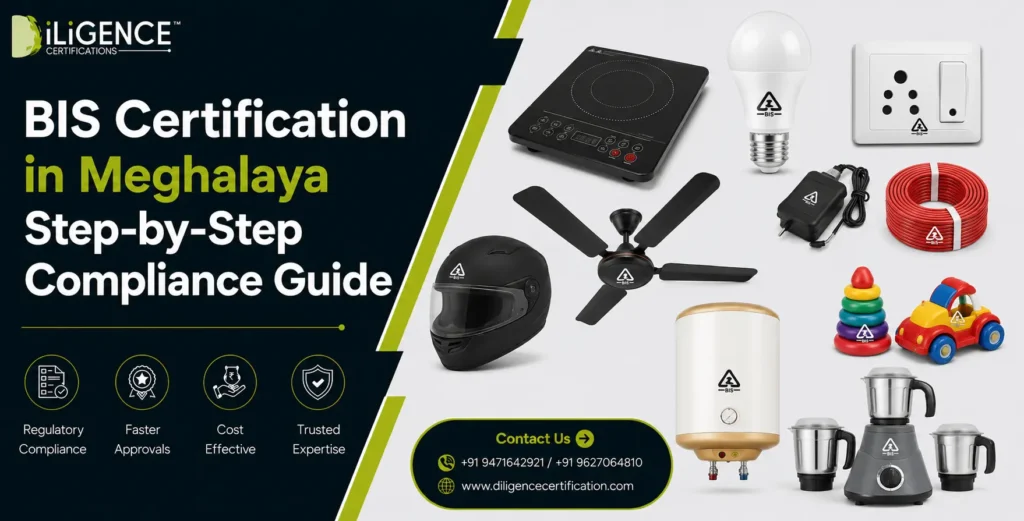
Common regulated product categories:
- Electrical appliances (fans, heaters, switches)
- LED lighting products and drivers
- Mobile chargers and adapters
- IT and electronics equipment
- Steel and construction materials
- Cement and structural products
- Packaged drinking water
- Batteries and power storage devices
For Meghalaya-based businesses, electronics and electrical goods remain the most sensitive category due to frequent regulatory updates.
Step-by-Step BIS Certification Process in Meghalaya
BIS Certification Process in Meghalaya
The BIS Certification process in Meghalaya follows a prescribed and structured course of action. Like other regions, the procedures used in BIS certification must be strictly followed during product inspection and certification.
Following the correct process helps avoid:
- Wastage of time and funds
- Submission of incorrect, irrelevant, or duplicated documentation
- Application rejection or refusal
A large number of certification applications fail due to poor understanding of the procedure or lack of preparedness in documentation. This ultimately leads to unnecessary delays in the overall certification timeline.
Step-by-Step BIS Certification Process in Meghalaya
Step 1: Determine Your IS Standards
Identification of the appropriate Indian Standard (IS code) for your product is the first and most critical step.
Each product is categorized under specific IS standards that define the quality, safety, and performance requirements. Only after meeting these defined standards can a product qualify for BIS Certification in Meghalaya.
Step 2: BIS-Approved Laboratory Testing
In this stage, product samples must be submitted to a BIS-approved laboratory for testing.
After identifying the relevant IS standards, the product is tested for:
- Performance parameters
- Safety compliance
- Quality benchmarks
- Other applicable technical requirements
Once the product passes these tests, a product-specific test report is issued. This report becomes a key document for further certification processing.
Step 3: Application Preparation
This stage involves preparing all essential legal and technical documentation required for BIS certification.
Many applicants make errors during this stage due to incomplete or incorrect paperwork.
Documentation may include:
- Company registration details
- Factory or plant information
- Quality assurance system details
- Manufacturing process documentation
- Product technical specifications
The test report from the BIS-approved laboratory serves as a primary supporting document for ISI or CRS certification applications.
Step 4: Online Application Submission
After completing product testing and documentation, the application must be submitted through the official BIS portal.
At this stage:
- Product specifications must be accurately filled in
- Required documents must be uploaded
- Verified test reports must be attached
Once submitted, an application reference number is generated for tracking the status of the certification process.
Step 5: Inspection of Manufacturing Unit
BIS conducts an inspection of the manufacturing facility to verify compliance with required standards.
During the inspection (audit), officials assess:
- Quality control systems
- Manufacturing consistency
- Testing capabilities within the plant
- Overall production process adherence to standards
If the inspection is satisfactory, the application proceeds further. This audit is a crucial step before final approval is granted.
Step 6: Grant of Certification
Once all stages-testing, documentation review, application verification, and inspection-are successfully completed, BIS issues the certification.
After approval:
- The manufacturer is authorized to use the ISI mark or BIS registration mark
- The certification becomes valid for the approved product range
- Compliance obligations must be maintained for continued validity
This marks the final stage of the BIS Certification process in Meghalaya.
Documents Required for BIS Certification in Meghalaya
Documentation plays a decisive role in approval timelines.
Typical requirements include:
- Company incorporation certificate
- GST registration and PAN
- Factory ownership or lease documents
- Product technical specifications
- Test reports from BIS-approved labs
- Manufacturing flowchart
- Quality control procedures
- Authorized signatory details
Incomplete or inconsistent documentation leads to repeated queries and delays.
Cost of BIS Certification in Meghalaya
There is no fixed cost for BIS Certification in Meghalaya. The total cost depends on multiple factors:
Key cost components:
- BIS application fees
- Laboratory testing charges
- Factory inspection expenses (if applicable)
- Consultancy and documentation support fees
- Product category complexity
For example, electronics with multiple variants require more extensive testing, increasing overall compliance cost.
In most MSME cases, testing and documentation preparation contribute more to total cost than government fees.
Timeline for BIS Certification in Meghalaya
The average timeline ranges between:
- 15 days (simple CRS applications)
- 30-60 days (standard cases)
- Up to 90 days (complex ISI certification)
Delays typically occur due to:
- Incorrect product classification
- Incomplete documentation
- Lab testing backlog
- Inspection scheduling gaps
Proper pre-assessment reduces approval time significantly.
Key Benefits of BIS Certification in Meghalaya
The impact of BIS Certification in Meghalaya goes beyond basic regulatory compliance. For manufacturers, importers, and distributors, it functions as a structured market access requirement that directly influences business growth, supply chain acceptance, and long-term brand credibility.
1. Legal Market Access
One of the most fundamental benefits of BIS Certification in Meghalaya is legal authorization to sell regulated products in the Indian market.
Once certified, products can:
- Be manufactured and distributed legally across all Indian states
- Enter organized retail and distribution networks without compliance barriers
- Avoid restrictions at interstate checkpoints and regulatory inspections
In practical terms, without BIS certification, even a technically sound product may face distribution blocks. Certification ensures that market entry is not interrupted by regulatory enforcement.
2. Stronger Buyer Trust and Market Acceptance
Retailers, wholesalers, and institutional buyers increasingly evaluate compliance status before onboarding new suppliers.
BIS-certified products:
- Carry higher trust value in procurement decisions
- Reduce perceived risk for distributors and retailers
- Improve acceptance in competitive product categories
In Meghalaya and surrounding northeastern markets, where distribution networks are relatively consolidated, certification often becomes a deciding factor in supplier selection. Buyers prefer certified goods because they reduce product liability concerns and post-sale issues.
3. Government Tender and Institutional Eligibility
Many government procurement systems and institutional buyers require BIS compliance as a mandatory eligibility criterion.
With BIS Certification in Meghalaya, businesses can:
- Participate in government tenders
- Supply products to public sector projects
- Access institutional procurement opportunities in education, infrastructure, and utilities
Without certification, companies are automatically disqualified from several structured procurement channels, regardless of pricing or product quality.
4. Reduced Regulatory and Operational Risk
Non-compliance with BIS requirements can lead to serious operational disruptions, including product seizure and shipment delays.
BIS Certification helps in:
- Avoiding product detention at checkpoints
- Preventing regulatory penalties or enforcement action
- Ensuring smooth interstate transportation of goods
- Reducing compliance-related business uncertainty
For businesses operating in logistics-sensitive sectors like electronics or electrical goods, this risk reduction is commercially significant. It ensures uninterrupted supply chain movement.
5. Competitive Advantage in Organized Markets
Certified products are more easily accepted in organized retail and structured distribution systems.
BIS Certification in Meghalaya provides:
- Better shelf positioning in retail environments
- Easier onboarding with large distributors and aggregators
- Stronger brand differentiation in crowded product categories
In competitive markets, certification acts as a trust marker. Even when pricing is similar, BIS-certified products are often preferred due to perceived reliability and compliance assurance.
6. Improved Brand Credibility and Long-Term Positioning
Beyond immediate sales benefits, BIS certification contributes to long-term brand building.
It signals that the manufacturer:
- Follows standardized production practices
- Meets national quality benchmarks
- Maintains consistent product quality control
This becomes especially important for businesses aiming to expand beyond regional markets into national-level distribution networks.
7. Easier Expansion into Other States and Channels
Once certified, scaling operations becomes more straightforward.
Businesses benefit from:
- Faster onboarding in new geographic markets
- Reduced compliance checks during expansion
- Better acceptance in e-commerce and retail platforms
For Meghalaya-based manufacturers, this is particularly relevant when expanding into larger commercial hubs like Guwahati, Kolkata, or Delhi NCR.
Common Challenges in Meghalaya
Despite increasing awareness, businesses face practical challenges:
- Limited in-house compliance expertise
- Dependence on external testing labs outside the state
- Misinterpretation of BIS applicability
- Documentation inconsistencies in MSMEs
- Delays in inspection scheduling
These issues are procedural, not structural, but they significantly affect timelines.
BIS Certification for MSMEs in Meghalaya
MSMEs form a large part of Meghalaya’s industrial base. However, compliance readiness remains uneven.
Common MSME gaps include:
- Lack of dedicated compliance personnel
- Limited awareness of IS codes
- Reactive approach to certification
A structured compliance approach helps MSMEs:
- Reduce rejection rates
- Improve supply chain acceptance
- Expand into national markets
Businesses that integrate BIS requirements during product design face fewer delays compared to those treating compliance as an afterthought.
Why Diligence Certification
Diligence Certification is a compliance consulting company helping manufacturers, importers, MSME achieve various regulatory certifications like BIS Certification, ISI Mark & CRS Registration in India. We aim to simplify the approval processes, ensuring that our clients meet the essential standards required for entry into the Indian market without unwanted delays and rejections. From Product Classification, Documentation Preparation, Test Report Assistance to Application filing and Follow-up with the relevant Authorities, we guide our clients through each step of the journey.
Our process helps minimize the chances of rejections arising out of incorrect IS Code/Standards, faulty documents, missing Test Reports, etc., thus, saving valuable time and resources for the clients. Diligence certification treats each product classification separately whether they are electronics or electrical products or industrial materials,ensuring compliance is done from scratch.
With proper documentation and a systematic approach, Diligence Certification aids its clients to not just save their time in the testing andapproval phase butalso ensure clarity throughout the process so that they are well aware of the requirements and the timelines at every stage.
Conclusion
For any individual and business who’s participating in the markets, getting BIS certification on appropriate products has became the need of hour - especially those into manufacturing and exporting, whether in consumer electronics or in other varied industrial items in Meghalaya.
Firms that didn’t consider BIS certification in Meghalaya have seen itself getting into supply disruptions, sales loss and distribution glitches. In fact, brands those has synchronized strategy with BIS compliance had faced relatively smooth approvals and more impactful market penetration.
Regulator in Indian product certification and quality, BIS does not act only as the certification body but, honestly, stands as the vigilant watchdog of the market.
Frequently Asked Questions
What is BIS Certification in Meghalaya?
A BIS certification in Meghalaya is an official certification issued by the Bureau of Indian Standards, the certification of which is required when your product meets with all safety standards and quality.
What is the need for BIS Certification in Meghalaya?
Yes, there are many items which have mandatory for certification with the BIS in Indian country.
What is BIS Certification for Meghalaya products?
Items such as an electronic gadget, electrical appliance, cement, steel, packed water bottle, batteries, and products of LED are those that are most likely to need BIS certification.
How much is BISCertification take time?
TheBIS Certification takes about 15 days to 90 days to complete, based on many factors.
What is the cost for BIS Certification?
It is no clear price to the BIS Certification; the costs of certifications are product based.
Are BIS Certifications available to MSMEs in Meghalaya?
Yes, MSMEs can apply for BIS certifications themselves or consult consultants to help with documentation and other related aspects.
What would be the consequences of not obtaining a BIS certification?
There could be repercussions including seizure, restrictions on sale or even legal penalties.
Is factory inspection mandatory for obtaining BIS certification?
Yes, as far as ISI marks are concerned, factory inspections might be carried out by BIS officials.
What is the validity period for BIS Certification?
The BIS certification is normally valid for 1 year to 2 years.
Which organization provides BIS Certification in India?
The Bureau of Indian Standards provides such certifications.