BIS Certification
 CDSCO
CDSCO
 PESO
PESO
 CPCB
CPCB
 LMPC
LMPC
 WPC Approval
 Global Approvals
 TEC
TEC
 ARAI
ARAI
 BEE
BEE
 ISO Certification
 DGCA Certification
 NOC For Steel
 APEDA Registration























 Business Registration
 FSSAI Mark Certification












 (32).jpg)
 Legal Services
 Trademark Registration
 Copyright Registration
 Patent Registration
 By
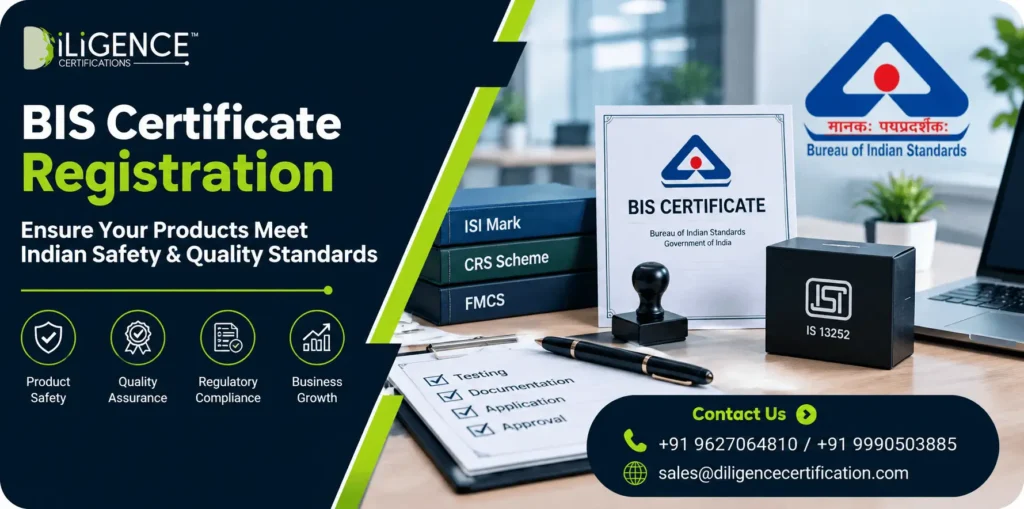
By - BIS certificate registration helps businesses ensure their products meet applicable Indian safety and quality standards.
- The BIS registration process depends on the product and may involve CRS, ISI Mark, or FMCS certification schemes.
- The process generally includes checking requirements, selecting the right scheme, product testing, preparing documents, and submitting the BIS application.
- Businesses should avoid common BIS registration mistakes, such as using the wrong Indian Standard, laboratory, outdated test report, or mismatched company details.
- Since BIS rules and product requirements can change, businesses should check the latest BIS requirements before applying and maintain their approval details after registration.
Intorduction
BIS certificate registration helps businesses comply with safety and quality rules.
Before you apply check if your product needs BIS approval and which scheme is relevant.
This guide covers the BIS registration process, documents, testing, application steps and common mistakes, in language.
What Is BIS Certificate Registration?
BIS certificate registration is the process of getting approval from the Bureau of Indian Standards. This approval is for products that must meet Indian Standards. It ensures that the products are safe and reliable for use, in India. The registration shows that a product has been tested and follows the rules set by the Bureau of Indian Standards..You might wonder why BIS certificate registration matters.
BIS certificate registration process changes based on the type of product.
For example
- Electronics and IT products might fall under the Compulsory Registration Scheme or (CRS).
- Many other regulated products come under the ISI Mark scheme.
- I believe foreign manufacturers might need to use the Foreign Manufacturers Certification Scheme or FMCS for their products. This could be important depending on the kind of product they are selling. The scheme is meant to ensure that products meet safety and quality standards. It’s something foreign companies should look into if they want to sell in this market. I think it’s worth checking the rules.
Depending on the plan you might need product testing, paperwork, an online form and permission, from BIS.
BIS Certificate, Registration and Licence: What Is the Difference?
You may hear the words BIS certificate, BIS registration, and BIS licence used for the same thing. Technically, they can refer to different types of BIS approval.
| Term | Generally Used For |
| BIS Registration | Electronics and IT products under CRS |
| BIS Licence | Products covered under the ISI Mark scheme |
| BIS Certificate | A general term people use for BIS approval |
The exact approval depends on your product and the applicable BIS scheme.
Do You Need BIS Certificate Registration?
Not every product needs mandatory BIS certification.BIS approval becomes necessary when the government has listed a product under a Quality Control Order or a Compulsory Registration Order.
If your product is not part of a required rule BIS certification can be optional.
How to Check If Your Product Needs BIS Certification
Before starting the application check these points:
- Find out the name of the product.
- Learn how the product will be used and where it will be used.
- Check the applicable Indian Standard.
- Check whether your product is covered by a QCO or CRO.
- Confirm the latest requirements on the official BIS website.
This last step is important because BIS requirements can change. New products can be added, deadlines can change, and some requirements can be withdrawn or delayed.
Which BIS Scheme Applies to Your Product?
There are different BIS certification routes. The right one depends mainly on your product.
| Scheme | Mainly Used For | Basic Process |
| CRS (Scheme-II) | Notified electronics and IT products | Testing, application and BIS registration |
| ISI Mark (Scheme-I) | Many regulated products | Testing, factory inspection and BIS licence |
| FMCS | Foreign manufacturers of applicable products | Testing, factory assessment and certification |
If you manufacture or import electronics or IT products, you should check whether your product is covered under BIS CRS registration.
Who Can Apply for BIS Certification?
The applicant depends on the product and the applicable scheme.
Indian Manufacturers
Indian manufacturers can apply for BIS approval for their manufacturing unit when the product is covered by the relevant BIS requirement.
Foreign Manufacturers
Foreign manufacturers may need to appoint an Authorised Indian Representative (AIR) before applying.
Importers and Brand Owners
Importers and brand owners should make sure that the products they sell have the required BIS approval.
If you are only a trader or retailer, you generally do not apply for BIS certification yourself. The exact requirement depends on the product and scheme.
Documents Required for BIS Certificate Registration
The documents required for BIS registration can vary from one product to another.
However, you may commonly need:
- Company registration documents
- GST details
- Factory address and details
- Product specifications
- Model details
- Circuit diagram, where applicable
- Test report from a BIS-recognised laboratory
- Brand authorisation letter, if applicable
- AIR documents for foreign manufacturers
- BIS application forms and declarations
Keep Your Documents Consistent
One simple mistake can create unnecessary questions during the application.
Make sure the following information is the same across your documents:
- Company name
- Factory name
- Factory address
- Brand name
- Product name
- Model number
Even a small spelling difference can cause problems.
BIS Certificate Registration Process: 7 Steps
Step 1: Check Whether Your Product Needs BIS Approval
Start by checking whether your product is covered by a mandatory BIS requirement.
Find the relevant:
- Indian Standard
- Quality Control Order
- Compulsory Registration Order
- Product category
Do not start testing before confirming the correct standard. Testing against the wrong standard can waste both time and money.
Step 2: Select the Right BIS Scheme
Once you know that BIS approval is required, find out which scheme applies.
It could be:
- CRS
- ISI Mark
- FMCS
If you are a foreign manufacturer, check whether you need an Authorised Indian Representative.
Step 3: Choose a BIS-Recognised Laboratory
Testing is an important part of the BIS certification process.
Choose a laboratory that is recognised for the relevant product and Indian Standard.
Before sending your product sample, confirm that the laboratory can perform the required testing for your exact standard.
Step 4: Get Your Product Tested
Send your product samples to the selected laboratory.
The lab will test the product according to the applicable Indian Standard.
If the product passes, you can use the test report for the next stage of the application.
If it fails, you may need to fix the issue and test the product again.
For CRS applications, always check the current BIS rules regarding the acceptable age and validity of the test report before submitting your application.
Step 5: Submit Your BIS Application
Once your testing and documents are ready, you can submit the application through the BIS portal.
The basic process is:
- Create or access your BIS account.
- Select the relevant application.
- Enter your company and product details.
- Upload the required documents.
- Submit the test report.
- Pay the applicable fees.
Before submitting, check all details carefully. Correcting mistakes later can take additional time.
Step 6: Respond to BIS Queries
Sometimes BIS may ask for information or clarification.
If you receive a query respond soon as possible.
Check the question carefully. Provide the requested information or documents.
Clear and complete responses can help avoid delays, in the application process.
Step 7: Receive Your BIS Registration or Licence
After the application is approved the BIS approval will be sent to you.
Depending on the scheme this could be:
- A BIS registration number or R-number or
- A BIS licence
After approval, make sure you use the BIS mark and registration or licence details according to the applicable BIS requirements.
What Changed in BIS Rules in 2026?
BIS rules and procedures can change from time to time.
In 2026, BIS made updates in areas such as licence validity, renewal, annual fees, production information, and suspension-related provisions.
There have also been changes to product standards and certain Quality Control Orders.
Because these requirements can change, it is better not to depend on an old blog or outdated product list.
Always check the latest BIS notification and requirements for your specific product before applying.
Common BIS Registration Mistakes to Avoid
A large number of application problems can be avoided by checking the basics before filing.
Here are some common mistakes:
Using CE or FCC Instead of BIS Approval
CE or FCC certification does not automatically replace a BIS requirement in India.
Choosing the Wrong Indian Standard
Your product needs to be assessed against the correct applicable standard.
Using the Wrong Laboratory
Make sure the testing laboratory is recognised for your product and standard.
Submitting an Old Test Report
Check the current BIS requirements before using an existing test report.
Mismatched Information
Company names, addresses, brand details, and model numbers should be consistent across your documents.
Ignoring Product Changes
If you introduce a new model, change the design, or move production to another factory, check whether you need a new registration or an update.
What Happens After BIS Registration?
Getting your BIS registration or licence is an important step, but your responsibilities do not necessarily end there.
Use the BIS Mark Correctly
Follow the applicable rules for displaying the BIS mark and registration or licence number.
Keep Your Information Updated
If your product, model, manufacturing location, or other important details change, check whether BIS approval needs to be updated.
Track Renewal and Fees
Keep track of your approval validity, renewal requirements, and applicable fees.
Keep Your Records
Store important documents such as test reports, production records, and approval documents safely.
Verify Your BIS Number
BIS registration and licence details can be checked through the official BIS system.
This can also help buyers and importers confirm that a product has the required approval.
Why Choose Diligence Certifications for BIS Certificate Registration?
BIS applications can become difficult when the product, documents, testing requirements or applicable standard are not clear.
At Diligence Certifications we help businesses understand the requirements before they submit their application.
Our support includes:
- Checking the applicable BIS scheme
- Identifying the relevant Indian Standard
- Preparing and reviewing documents
- Coordinating with BIS-recognised laboratories
- Helping with the BIS application
- Assisting with BIS queries
- Explaining the next steps after approval
We believe in giving clear information about the process and timelines. Since the final decision is made by BIS, we do not promise guaranteed approval or fixed approval dates.
Conclusion
BIS certificate registration does not have to be confusing when you follow the process step by step.
First check whether your product needs BIS approval. Then identify the Indian Standard and BIS scheme. After that choose the laboratory, complete product testing prepare your documents and submit the application.
Importantly do not rely on outdated information. BIS requirements can change, so always check the rules for your product.
If you are planning to manufacture, import or sell a product in India and need help, with BIS certificate registration you can contact Diligence Certifications to understand the requirements and next steps.
Frequently Asked Questions
What is BIS certificate registration?
BIS certificate registration is the process of getting approval from the Bureau of Indian Standards for products that must meet applicable Indian Standards.
Is BIS certificate registration mandatory in India?
It is mandatory for products covered by applicable Quality Control Orders or Compulsory Registration Orders.
Which products require BIS certification?
Products covered by mandatory BIS requirements may need certification. The exact requirement depends on the product and applicable Indian Standard.
What is the difference between BIS registration and BIS licence?
BIS registration is commonly associated with products under CRS, while a BIS licence is generally issued for products covered under the ISI Mark scheme.
What documents are required for BIS registration?
Common documents include company details, factory information, product specifications, test reports, brand documents, and applicable BIS forms.
How does the BIS certificate registration process work?
The process generally involves checking the applicable standard, selecting the correct scheme, product testing, preparing documents, submitting the application, responding to queries, and receiving approval.
Can foreign manufacturers apply for BIS certification?
Yes. Foreign manufacturers can apply under the applicable BIS scheme and may need to appoint an Authorised Indian Representative (AIR).
Is product testing required for BIS registration?
Yes, product testing is generally required under the applicable BIS scheme and must follow the relevant Indian Standard and testing requirements.
Can I sell a product in India without BIS certification?
If BIS approval is mandatory for that product, the required approval must be obtained before selling it in India. Requirements vary by product.
How can I check a BIS registration or licence number?
BIS registration and licence details can be verified through the official BIS system.