 BIS Certification
 CDSCO
CDSCO
 PESO
PESO
 CPCB
CPCB
 LMPC
LMPC
 WPC Approval
 Global Approvals
 TEC
TEC
 ARAI
ARAI
 BEE
BEE
 ISO Certification
 DGCA Certification
 NOC For Steel
 APEDA Registration























 Business Registration
 FSSAI Mark Certification












 (32).jpg)
 Legal Services
 Trademark Registration
 Copyright Registration
 Patent Registration
 By
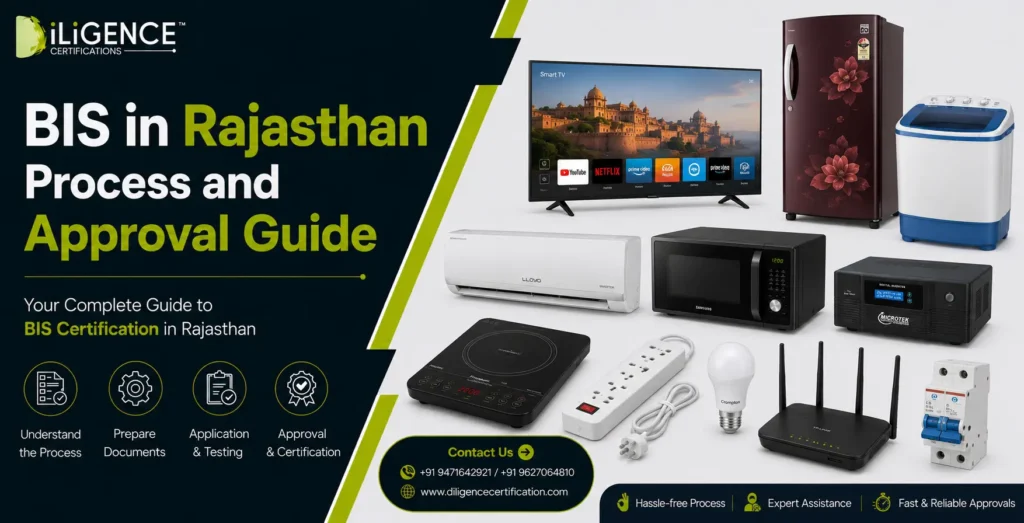
By - BIS certification in Rajasthan is compulsory for the regulated products according to the quality laws of India administered by Bureau of Indian Standards.
- It helps in ensuring that the product is safe, eligible for the market, and complies with the law.
- Documentation, testing, and conformance to IS standards play a vital role in getting the product approved.
Introduction: BIS Certification in Rajasthan
An electronics firm located in Jaipur contacted a compliance consultant after his consignment of LED products got stuck at the border of Delhi because of lack of BIS certification, not for product quality issues, which almost cost him about ₹18 lakhs in logistics and other expenses.
This is not an exceptional case. There have been many instances where manufacturers in Rajasthan, especially in Jaipur, Alwar, Jodhpur, and Bhiwadi industrial clusters, face similar issues on account of lack of awareness regarding BIS Certification in Rajasthan.
BIS Certification is not just a formality; it is the only route for entry into the market as it directly impacts the product legality and reputation, along with the supply chain.
What is BIS Certification in Rajasthan
Rajasthan BIS Certification is defined as an authorization given byBureau of Indian Standards ensuring that the products conform to the Indian Standards.
Manufacturers or importers based in Rajasthan are required to get their products certified before selling them in the Indian markets.
Objectives:
- To ensure safety of products
- Standardization of industrial quality in India
- Protection of Indian markets from substandard products
In the ever-evolving industrial landscape of Rajasthan, BIS Certification plays the role of a regulatory body for MSMEs and big firms.
Why BIS Certification is Important for Rajasthan Industries
Rajasthan has a strong manufacturing base in:
- Electrical appliances in Jaipur
- Cement and minerals in Udaipur and Chittorgarh
- Hand tools and engineering goods in Jodhpur and Alwar
Without BIS approval, these sectors face:
- Market restrictions in India
- Import/export clearance issues
- Loss of retailer and distributor trust
- Legal penalties under Indian compliance law
For regulated goods, BIS Certification in Rajasthan is not optional-it is a legal requirement.
Products Requiring BIS Certification in Rajasthan
While not all items found in Rajasthan need certification, some specific categories must be certified by BIS according to the Bureau of Indian Standards policy. The reason why this needs to be done is that such items affect the safety of consumers and infrastructure. The following are the types of items and the implications of the compliance:
1. Electrical appliances (Switches, wires, LED lights)
- This type of item is very strictly controlled since any malfunction may result in fire accidents, short circuits, and even fatal results.
- What does this include:
- Electricity switches and plugs
- Insulated wires
- LED lights and illumination systems
- Power extensions and adapters
2. Cement and Construction Materials
Construction materials are directly linked to infrastructure safety, making BIS certification critical for public and private projects.
Includes:
- Portland cement (OPC, PPC, PSC)
- Ready-mix concrete (RMC)
- Fly ash-based cement products
- Wall putty and bonding materials
3. Steel Products
Steel is widely used in construction, automotive, and manufacturing sectors in Rajasthan.
Covered products:
- TMT bars
- Structural steel sections
- Stainless steel sheets
- Wire rods and coils
4. Electronics and IT Hardware
This category is expanding rapidly with industrial growth and digital adoption.
Includes:
- Mobile chargers and adapters
- Laptops and computing accessories
- Printed circuit boards (PCBs)
- Smart devices and IoT equipment
5. Household Appliances (Pressure Cookers, Geysers)
This category directly affects daily consumer safety and is heavily monitored.
Products include:
- Pressure cookers and induction cooktops
- Electric geysers and water heaters
- Gas stoves and burners
- Kitchen electrical appliances
Step-by-Step BIS Certification Process in Rajasthan
The procedure for BIS certification in Rajasthan is systematic, document-intensive, and technologically evaluated by Bureau of Indian Standards. The delay in many applications is not because of any problems with quality of the product, but because of lack of knowledge about the procedure.
Here are the stages of the process explained below.
1. Product Classification
This is the foundation of the entire process. The first task is to determine whether your product is covered under mandatory BIS certification.
At this stage:
- The product is mapped against applicable Indian Standards (IS codes)
- Category is identified (electrical, mechanical, construction, etc.)
- Compliance requirement is confirmed as mandatory or voluntary
2. Application Submission
Once classification is clear, the formal application is submitted to BIS.
This includes:
- Company and factory details
- Product technical specifications
- Manufacturing process description
- Authorized signatory information
3. Product Testing
Product samples are sent to BIS-approved laboratories for technical evaluation.
What is tested:
- Safety parameters (electrical/mechanical)
- Material quality and composition
- Performance under defined conditions
- Compliance with applicable IS standards
4. Factory Inspection
After successful testing, BIS officers conduct a physical inspection of the manufacturing unit in Rajasthan.
What inspectors evaluate:
- Production process consistency
- Quality control systems
- Calibration of testing equipment
- Raw material traceability
- Worker training and compliance awareness
5. Grant of License
If all stages are cleared successfully, BIS issues a license number to the manufacturer.
What this means:
- The product can legally be sold in the Indian market
- The BIS/ISI mark can be used on packaging
- The manufacturer is officially listed under certified producers
Documents Required for BIS Certification in Rajasthan
The success of a BIS application in Rajasthan hinges significantly on the accuracy and technical details provided in the documents. The Bureau of Indian Standards checks not only the quality of the product but also the production system and traceability measures before giving the certificate.
Any discrepancy in the document results in either questions, delays in inspection, or even the rejection of the document. Below is the detail of each document needed for the BIS along with its meaning.
1. Company Registration Certificate
- This is the identity of the company.
- Acceptable Documents:
- Certificate of Incorporation (Private Limited / LLP / Public Limited)
- MSME/Udyam Registration (If any)
- Partnership deed (for partnership firm)
2. Factory Address Proof
This establishes the physical manufacturing location where inspection will be conducted.
Accepted documents:
- Electricity bill of factory premises
- Rent agreement or lease deed
- Property ownership documents
3. Manufacturing Process Flowchart
This document explains how the product is made step by step.
What it includes:
- Raw material sourcing
- Production stages
- Quality checkpoints
- Final packaging process
4. Product Technical Specifications
This is one of the most critical documents in the entire application.
Includes:
- Material composition
- Dimensions and tolerances
- Electrical or mechanical properties
- Performance parameters
5. ISO Certificates (If Available)
Although not mandatory for all categories, ISO certification strengthens the application.
Common standards:
- ISO 9001 (Quality Management System)
- ISO 14001 (Environmental Management)
- ISO 45001 (Safety Management System)
6. Test Reports from BIS-Approved Labs
This is a mandatory technical validation step.
What it includes:
- Product performance testing
- Safety compliance results
- Material quality verification
- Standard conformity results as per IS codes.
7. Authorized Signatory Documents
This confirms who is legally allowed to represent the company in BIS matters.
Required documents:
- Board resolution (for companies)
- Power of Attorney (if applicable)
- Identity proof of authorized person (PAN, Aadhaar, Passport)
Common Challenges Faced by Rajasthan Businesses
- Incorrect product classification leading to rejection or rework of BIS application
- Delays in BIS-approved laboratory testing due to backlog or failed test samples
- Incomplete or incorrect documentation such as missing technical files or mismatch in details
- Lack of understanding of applicable IS standards causing non-compliant product design
- Shipment and export delays, especially in the Bhiwadi industrial belt, due to incomplete BIS compliance checks
- Inspection-related issues like poor record-keeping and inadequate factory readiness
- Re-submission cycles increasing overall approval time and operational costs
All these challenges are governed under the compliance framework of Bureau of Indian Standards, where accuracy in documentation and technical alignment is critical for approval.
Why Choose Diligence Certifications
Choosing the compliance partner for BIS Certification in Rajasthan does not only mean dealing with paperwork. The choice has an effect on how quickly you get approved, how ready your company is for the audit and what kind of stability will it guarantee from regulatory side Diligence Certifications.
Technical capabilities of many companies allow them to pass certification; however, some of them lack the systematic approach when it comes to documentation, testing and interaction with BIS.
There are several benefits of structured consultancy service for BIS Certification, including the following:
- Decrease the chances of getting your application rejected due to the pre-verification of documents;
- Faster coordination with BIS Approved laboratories for testing products;
- Mapping of the applicable IS standards prior to the submission;
- Preparation for factory inspection audits;
- End-to-end monitoring until license issuance.
For those enterprises which are increasing their production capacity or adding new product lines, such structured approach becomes especially important in order to avoid disruptions in operations. It is not only convenient but also allows maintaining continuity of sales and distribution channels.
Conclusion
The BIS Certification in Rajasthan is a compliance requirement that comes with Bureau of Indian Standards for several regulated product categories and impacts their market entry and approval process. It is not simply about obtaining the certificate but determines the way many industries in India, including electrical products, steel and building materials function in the market.
Certification becomes a crucial element in the business of Rajasthan industrial sector that affects the whole production process, procurement, logistics and brand positioning. Any failure or delay in certification process may interrupt the whole supply chain and result in additional costs and contractual obligations in case the BIS certificate is required for distribution.
The best solution here would be incorporating BIS regulations from the initial stage of product development and making sure your product meets IS standards even before the production process starts
Frequently Asked Question
What is the meaning of BIS Certification in Rajasthan?
It is a kind of certificate provided by Bureau of Indian Standards regarding conformity of the products as per Indian safety and quality standards.
Is BIS Certification compulsory for all kinds of products in Rajasthan?
No, only such products that fall under the notifications of compulsory BIS certification need to have BIS Certification.
What is the time taken for BIS Certification in Rajasthan?
In general, BIS Certification takes 15 to 90 days.
What documents do I need to get BIS Certification?
Documents needed for BIS Certification include company registration, product information, process of manufacturing the products, test results, and factory information.
Is factory inspection compulsory?
Yes, factory inspection is compulsory for getting BIS Certification.
Are MSMEs also allowed to apply for BIS Certification in Rajasthan?
Yes, MSMEs are allowed for BIS Certification process in India.
What are the consequences of selling a product without BIS Certification?
It may lead to penalties, seizure of goods, and market restrictions
Do exporters need BIS Certification?
Yes, in many categories BIS compliance is required for both domestic and export markets.
Can BIS Certification be transferred between states?
Yes, but it is linked to the manufacturing unit, not the state location.
Why do BIS applications get rejected?
Common reasons include incorrect documentation, wrong IS code selection, and failed product testing.


