BIS Certification
 CDSCO
CDSCO
 PESO
PESO
 CPCB
CPCB
 LMPC
LMPC
 WPC Approval
 Global Approvals
 TEC
TEC
 ARAI
ARAI
 BEE
BEE
 ISO Certification
 DGCA Certification
 NOC For Steel
 APEDA Registration























 Business Registration
 FSSAI Mark Certification












 (32).jpg)
 Legal Services
 Trademark Registration
 Copyright Registration
 Patent Registration
 By
By - BIS CRS is a mandatory registration for notified electronics and IT products sold or imported into India.
- Since 25 February 2026, a BIS CRS licence can run for up to five years, but fees must be paid every year in advance.
- Your product must be tested at a BIS-recognised lab before you apply, and each model must be covered by your registration.
- Foreign manufacturers need an Authorised Indian Representative (AIR) to apply.
- There’s no factory inspection, but BIS can check products in the market and suspend your licence if you break the rules.
Introduction
An importer in Delhi brings in a container of power banks from China. His supplier has told him the products are “BIS approved”. But at customs, the shipment is held.
The problem? The registration number on the boxes covers a different model. The model he ordered was never tested or added to the registration. He loses weeks waiting, and pays storage charges on top.
This kind of mistake is very common with BIS CRS. The scheme looks simple from the outside: test the product, register it, print the mark. But small details, like which models are covered or whether annual fees are paid, decide whether your goods clear customs and stay on the shelves.
What Is BIS CRS?
BIS CRS (Compulsory Registration Scheme) is a mandatory registration for notified electronics and IT products in India, such as power banks, chargers, LED lights, laptops and televisions. It runs under Scheme-II of the BIS (Conformity Assessment) Regulations, 2018. The product must be tested at a BIS-recognised lab against the relevant Indian Standard. The manufacturer then applies for registration and prints the Standard Mark with the registration number on the product. Since February 2026, registrations can be valid for up to five years, with fees paid every year in advance.
Who Needs BIS CRS Registration?
You need BIS CRS registration if you manufacture, import, sell or distribute a product that the government has notified under the scheme. This applies to:
- Indian manufacturers
- foreign manufacturers selling in India
- brand owners, even if another factory makes the product for them
The rule applies to both locally made and imported products. If your product is on the list, it cannot be legally sold or imported without registration.
Which Products Come Under BIS CRS?
The list is decided by the government, mainly through the Ministry of Electronics and Information Technology (MeitY). Some solar products are covered through the Ministry of New and Renewable Energy (MNRE).
Common examples include:
- power banks, chargers and power adaptors
- LED lamps and LED lights
- laptops, tablets and monitors
- televisions and set-top boxes
- mobile phones and smart watches
- printers, scanners and keyboards
- certain batteries
The list keeps growing and changing. Always check the latest official list on the BIS website before deciding whether your product needs registration.
BIS CRS New Rules 2026: What Has Changed?
On 25 February 2026, BIS notified the BIS (Conformity Assessment) Amendment Regulations, 2026. The main changes for BIS CRS are:
| Area | Before | After February 2026 |
| Validity | Usually 2 years | Up to 5 years on first grant |
| Renewal | Shorter renewal periods | Up to 5 more years |
| Fees | Paid for the licence period | Paid every year, in advance |
| How it works | Registration based on assessment | Based on self-declaration of conformity (SDoC), supported by lab test reports |
| Ongoing duties | Fewer annual obligations | Production statements and clearer suspension rules |
What this means for you:
- Fewer renewals, but yearly payments. Your licence lasts longer, but you must pay the annual fee on time every year.
- Missed payments can mean suspension. If the annual fee or required statements aren’t submitted on time, your licence can be suspended.
- You take more responsibility. Under self-declaration, you formally confirm that your product meets the standard, so your test reports and records must be solid.
Many websites still describe the old two-year rule. Go by the latest BIS notification, not old articles.
BIS CRS vs ISI Mark: What’s the Difference?
People often confuse BIS CRS with the ISI mark. They are different schemes.
| BIS CRS (Scheme-II) | ISI Mark (Scheme-I) | |
| Products | Notified electronics and IT goods | Many industrial and consumer products |
| Factory inspection | Not required | Required |
| Main basis | Lab test report and self-declaration | Factory inspection and testing |
| Mark | Standard Mark with registration number (R-number) | ISI mark with licence number |
In simple terms: CRS depends mainly on product testing and paperwork, while ISI also requires BIS to inspect your factory.
Documents Required for BIS CRS Registration
The exact list can vary, but you will usually need:
- test report from a BIS-recognised lab
- manufacturer’s business registration or licence
- factory address proof
- trademark or brand ownership documents (or brand authorisation if you’re not the brand owner)
- product details: model numbers, technical specifications and labels
- AIR documents, if you are a foreign manufacturer
- affidavits and undertakings in the forms BIS prescribes
Tip: make sure the manufacturer’s name and address are exactly the same on every document. Small mismatches are a common reason for BIS queries.
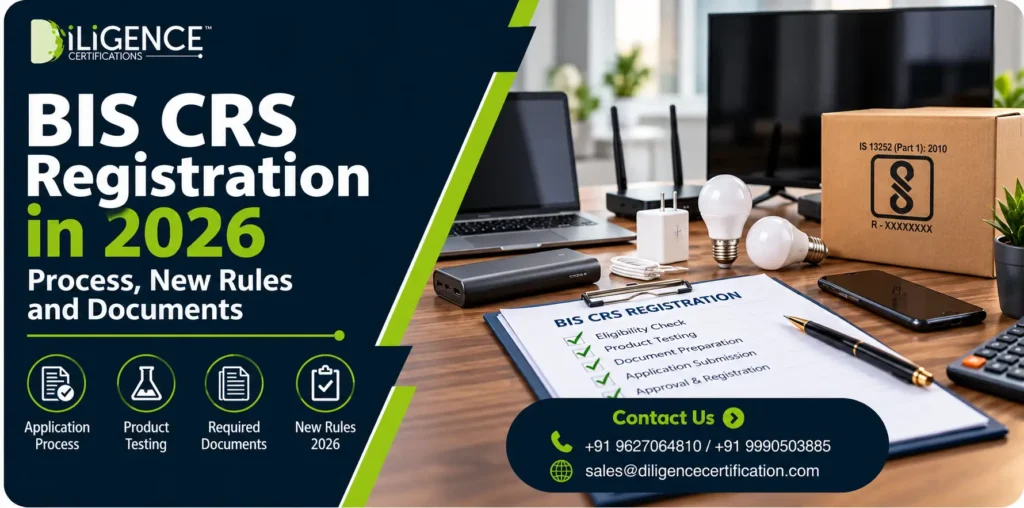
BIS CRS Registration Process: Step-by-Step
Step 1: Check if your product is covered
Look for your product in the latest notified list and find the Indian Standard (IS) that applies to it.
Step 2: Appoint an AIR (foreign manufacturers only)
A foreign manufacturer must appoint an Authorised Indian Representative (AIR): a person or company in India who represents you before BIS and takes responsibility for compliance.
Step 3: Register on the BIS portal
Create an account on the BIS online portal as a manufacturer.
Step 4: Test the product at a BIS-recognised lab
Send samples to a lab recognised by BIS for your product and standard. Only reports from recognised labs are accepted.
Step 5: Submit the application
Upload the test report, documents, forms and undertakings, and pay the required fee.
Step 6: Reply to BIS queries
BIS reviews your application and may ask questions. Clear, quick replies keep the process moving.
Step 7: Get your registration and print the mark
Once approved, you get a registration number. Print the Standard Mark with this number, and the Indian Standard where required, on the product and packaging as per BIS marking rules.
How Long Does BIS CRS Registration Take?
There’s no fixed timeline. It depends on:
- how busy the testing lab is
- whether your documents are complete
- how quickly you answer BIS queries
- how many models you are registering
A clean application with a ready test report moves much faster than one that keeps getting queries. Plan for testing time and a possible query round before your launch date.
Adding New Models to Your BIS CRS Registration
A registration covers only the models listed in it. This catches many importers out.
If you launch a new model, or your supplier changes one, you need to get that model covered. That usually means testing and applying to include it. Don’t assume a new model is covered just because it looks similar.
This was exactly the problem in the Delhi power bank case above.
Common BIS CRS Mistakes to Avoid
- Trusting a supplier’s word. Always check the registration and its model list yourself.
- Selling models that aren’t covered. Every model needs to be included in the registration.
- Missing annual fee dates. Under the 2026 rules, this can lead to suspension.
- Wrong or incomplete marking. The mark, registration number and details must follow BIS rules.
- Mismatched documents. Different names or addresses across documents cause delays.
- Using a lab that isn’t recognised. Reports from non-recognised labs are rejected.
Why Choose Diligence Certifications for BIS CRS?
With BIS CRS, most problems come from small details: a missing model, a mismatched address, a late fee. We focus on getting those right from the start.
At Diligence Certifications, we help you with:
- Product check: confirming whether your product needs CRS and which Indian Standard applies.
- Lab coordination: arranging testing at a BIS-recognised lab.
- Documents and forms: preparing your application, affidavits and undertakings.
- AIR support: guiding foreign manufacturers on appointing an Authorised Indian Representative.
- Filing and follow-up: submitting your application and replying to BIS queries.
- After registration: adding new models, tracking annual fees, and checking marking and labels.
You can read more about our BIS CRS Certification services. For official notifications and product lists, visit the Bureau of Indian Standards website.
conclusion
BIS CRS isn’t hard, but it rewards care. Test at a recognised lab, make sure every model is covered, print the mark correctly, and under the 2026 rules, never miss your annual fee.
If you want your registration done right the first time, book a free consultation with Diligence Certifications. We’ll check your product, plan your testing, and handle your BIS CRS registration from start to finish.
Frequently Asked Questions
What exactly is BIS CRS?
It's a registration that certain electronics must have before they can be sold in India. Think power banks, chargers, LED bulbs and laptops. No registration, no sale.
Does it apply to me if I only import, not manufacture?
Yes. If the product is on the notified list, it needs to be registered, whether it's made in India or shipped in from abroad.
How long does the registration last now?
Up to five years, under the rules that changed in February 2026. The catch is that you pay the fee every year, in advance.
Will BIS come and inspect my factory?
No, CRS doesn't involve a factory visit. BIS can still pick up your products from the market and test them.
Can any lab test my product?
No, only a lab recognised by BIS. A report from any other lab will be rejected, however good it looks.
We're a foreign company. Can we still apply?
Yes, but you'll need an Authorised Indian Representative (AIR), someone based in India who handles BIS matters on your behalf.
I got one model registered. Are my other models covered too?
Only if they're listed in the registration. A new or changed model has to be added separately. This is where a lot of importers get stuck at customs.
What if I forget to pay the annual fee?
Your licence can be suspended. Until it's fixed, you can't legally sell those products, so set a reminder.
Is CRS just another name for the ISI mark?
No, they're different schemes. CRS is for notified electronics and relies on lab testing. The ISI mark covers other products and includes a factory inspection.
What do I print on the product once it's registered?
The BIS Standard Mark with your registration number, on both the product and the packaging. BIS has specific rules on size and placement, so check them before printing.