BIS Certification
 CDSCO
CDSCO
 PESO
PESO
 CPCB
CPCB
 LMPC
LMPC
 WPC Approval
 Global Approvals
 TEC
TEC
 ARAI
ARAI
 BEE
BEE
 ISO Certification
 DGCA Certification
 NOC For Steel
 APEDA Registration























 Business Registration
 FSSAI Mark Certification












 (32).jpg)
 Legal Services
 Trademark Registration
 Copyright Registration
 Patent Registration
 By
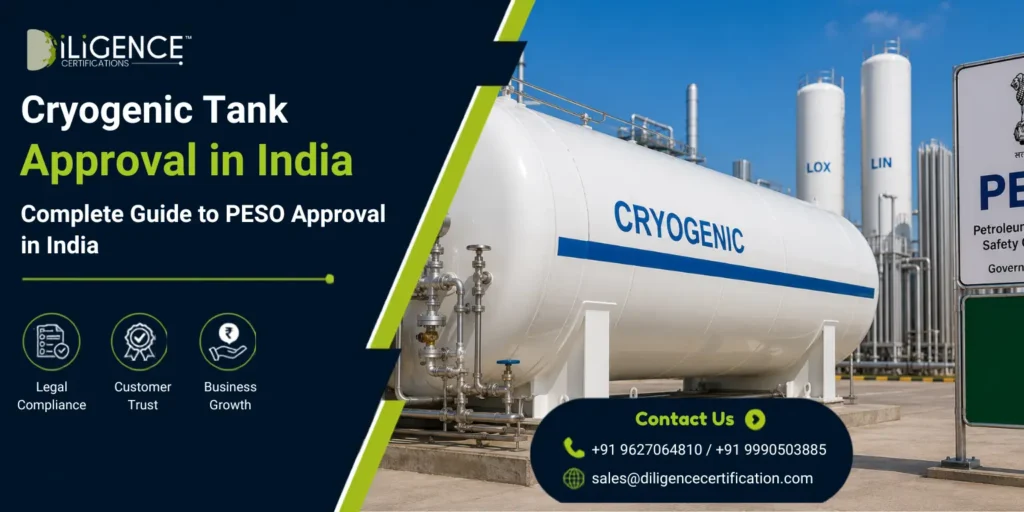
By - Cryogenic Tank Approval is essential for the safe storage and handling of liquefied gases like Liquid Oxygen (LOX), Liquid Nitrogen (LIN), LNG, Liquid Argon, and more in accordance with the PESO regulations in India.
- This is to ensure that the cryogenic tank is compliant with the specified standards for design, fabrication, testing, inspection, and safety prior to its operational commissioning.
- Diligence Certifications offers end-to-end help for Cryogenic Tank Approval.
Introduction
A company planning to establish a medical oxygen filling facility recently imported a cryogenic storage tank from an overseas manufacturer. Although the tank met international engineering standards and came with all the necessary factory test certificates, the project faced an unexpected hurdle. Before the tank could be commissioned in India, it had to comply with the regulatory requirements of the Petroleum and Explosives Safety Organisation (PESO). As a result, the installation was delayed until the required documentation, inspections, and technical approvals were completed.
This is a common challenge for businesses handling liquefied gases such as Liquid Oxygen, LNG, and Liquid Nitrogen. Many companies focus on purchasing and installing the equipment but overlook the mandatory approval process. Cryogenic Tank Approval ensures that the storage system meets the required safety and engineering standards, allowing businesses to operate legally and safely. Understanding the approval process in advance helps avoid costly delays, compliance issues, and operational risks.
What is Cryogenic Tank Approval?
Cryogenic Tank Approval refers to the approval issued by the Petroleum and Explosives Safety Organisation (PESO) in respect of cryogenic storage tanks meant for storing liquefied gases like Liquid Oxygen (LOX), Liquid Nitrogen (LIN), Liquid Argon (LAR), Liquefied Natural Gas (LNG), and other cryogenic liquids. It means that the tank has been checked against all the necessary safety, engineering, fabrication, testing and installation requirements and is ready for being put into commercial or industrial service.
PESO of the Department for Promotion of Industry and Internal Trade (DPIIT), Ministry of Commerce & Industry, Government of India is responsible for regulation of cryogenic storage systems to facilitate safe handling of dangerous and cryogenic substances. The PESO assesses the design, material specification, quality of welding, vacuum insulation system, pressure safety devices, instruments, inspection certificates and installation of the tank to ensure its compliance with the Static and Mobile Pressure Vessels (Unfired) Rules, 2016 (SMPV Rules) and other recognized codes of practice.
Why is Cryogenic Tank Approval Important?
Cryogenic Tank Approval is required as the cryogenic liquids are kept at extremely low temperatures below -150°C. Hence, even the slightest malfunction of the equipment causes the problems such as leakage, pressure build-up, disruption in operations, and safety threats to arise. The process of cryogenic tank approval means that the tank has been tested and checked for design, manufacturing, inspection, and testing before the tank operation.
This means that the tank is constructed in compliance with all engineering and regulatory specifications and standards. This enables companies to work legally and safely while adhering to the requirements. Moreover, an approved cryogenic tank has a set of safety devices such as pressure relief valve, pressure gauge, and safety system ensuring the safety of people and buildings near the tank.
The approval process includes testing of the pressure vessel, insulation, pipes, and safety systems for any manufacturing defects before the start of the operation. In the end, compliant cryogenic tanks provide reliable operations with minimum disturbances.
Who Needs Cryogenic Tank Approval?
There are various industry sectors where cryogenic storage units play an important role. Companies involved with the handling of liquefied gases are required to have cryogenic tanks that meet certain compliance standards prior to initiating any activities.
Medical Oxygen Plants
The hospitals and medical gas supply companies need cryogenic tanks to store Liquid Oxygen for continuous flow of oxygen.
Industries Manufacturing Industrial Gases
Companies that manufacture or distribute oxygen, nitrogen, argon, helium, hydrogen and carbon dioxide gas rely on cryogenic storage units.
LNG Plants
Liquefied Natural Gas plants and distributors require cryogenic tanks that can safely store liquefied natural gas.
Pharmaceutical Sector
The manufacturing processes of many pharmaceutical products use cryogenic liquids.
Food Processing Sectors
Many food processing units use cryogenic cooling and freezing units.
Chemical Manufacturing Units
The chemical sector usually requires cryogenic tanks for the storage of special gases for continuous manufacturing.
Research Institutes
Research organizations, universities, and laboratories commonly use liquid nitrogen and other cryogenic materials for their research purposes.
Aerospace and Defence Sectors
Cryogenic liquids are extensively used in the aerospace testing, propulsion systems and engineering purposes.
Types of Cryogenic Tanks Covered
Cryogenic Tank Approval applies to various storage systems depending on the type of liquefied gas being stored, storage capacity, and intended industrial application.
Common categories include:
- Liquid Oxygen (LOX) Storage Tanks
- Liquid Nitrogen (LIN) Storage Tanks
- Liquid Argon (LAR) Storage Tanks
- Liquefied Natural Gas (LNG) Storage Tanks
- Liquid Carbon Dioxide Storage Tanks
- Liquid Hydrogen Storage Tanks
- Vertical Cryogenic Storage Tanks
- Horizontal Cryogenic Storage Tanks
- Vacuum Insulated Cryogenic Tanks
- Double-Walled Cryogenic Storage Tanks
- Stationary Cryogenic Storage Vessels
- Cryogenic Bulk Storage Systems
Each category has unique design considerations relating to insulation performance, operating pressure, product characteristics, and safety devices.
Eligibility Criteria for Cryogenic Tank Approval
Prior to granting Cryogenic Tank Approval, the competent authority will make sure that the applicability conditions of the applicant and the storage system are fulfilled. Fulfilling these eligibility criteria will help to ensure a streamlined approval process.
The applicant should be a registered company, LLP, partnership firm, proprietorship, government body, or any other entity which is authorized to own or operate the cryogenic tank. It should be noted that the cryogenic tank is designed in accordance with recognized engineering codes and the design calculation, material and technical drawing. Its fabrication shall be done by a certified manufacturer using qualified welding procedures and certified material.
Moreover, there should be adequate safety distance from the site, stable foundation and good accessibility to the installation site of the tank. Moreover, the cryogenic tank shall be provided with the necessary safety equipment such as pressure relief valve, level indicator, pressure gauge, and emergency shut-off system.
Documents Required for Cryogenic Tank Approval
Submitting complete and accurate documentation is one of the most important steps in the Cryogenic Tank Approval process. The competent authority reviews business records, engineering documents, installation drawings, inspection reports, and compliance certificates to verify that the cryogenic storage system meets the prescribed safety and technical standards. Incomplete or incorrect documentation is one of the most common reasons for approval delays.
Business Documents
The applicant should submit documents that establish the legal identity of the business.
- Certificate of Incorporation or Business Registration
- PAN Card
- GST Registration Certificate
- Factory Licence (where applicable)
- Authorisation Letter
- Identity and Address Proof of the Authorised Signatory
Technical Documents
These documents confirm that the cryogenic tank has been designed and fabricated according to recognised engineering standards.
- General Arrangement (GA) Drawing
- Design Drawings
- Engineering Design Calculations
- Pressure Vessel Design Details
- Material Specifications
- Bill of Materials (BOM)
- Welding Procedure Specification (WPS)
- Procedure Qualification Record (PQR)
- Welder Qualification Certificates
- Fabrication Records
Installation Documents
Installation documents verify that the cryogenic tank has been installed safely and in accordance with the approved design.
- Foundation Drawing
- Piping and Instrumentation Diagram (P&ID)
- Layout Plan
- Safety Distance Plan
- Earthing Arrangement Details
- Insulation System Details
Testing and Inspection Reports
These reports confirm that the cryogenic tank has successfully completed all mandatory quality and safety tests.
- Hydrostatic Test Report
- Pneumatic Test Report (where applicable)
- Vacuum Integrity Test Report
- Leak Test Report
- Radiographic Test (RT) Report
- Ultrasonic Test (UT) Report
- Non-Destructive Testing (NDT) Certificates
- Material Test Certificates
- Pressure Relief Valve Test Certificate
- Calibration Certificates
- Third-Party Inspection Report (if applicable)
Compliance Documents
Additional compliance records may also be required during the approval process.
- Quality Assurance Documents
- Operation and Maintenance Manual
- Manufacturer’s Declaration
- Safety Compliance Certificates
- Previous Approval Records (if applicable)
- Applicable Standard Compliance Certificates
Step-by-Step Cryogenic Tank Approval Process
Obtaining Cryogenic Tank Approval involves a series of technical and regulatory steps to ensure the storage system is safe, reliable, and compliant with applicable standards before commissioning.
Step 1: Project Planning
The process begins with identifying the type of cryogenic liquid, storage capacity, operating pressure, installation location, and intended industrial application.
Step 2: Engineering Design
Qualified engineers prepare the tank design, structural drawings, insulation details, piping layout, and safety system based on recognised engineering standards.
Step 3: Fabrication
The cryogenic tank is manufactured using approved materials, certified welding procedures, and strict quality control measures.
Step 4: Inspection and Testing
Mandatory tests such as hydrostatic, vacuum integrity, leak, radiographic (RT), ultrasonic (UT), dimensional inspection, and pressure relief valve testing are carried out before installation.
Step 5: Installation
The tank is installed with proper foundation, piping, insulation, instrumentation, and safety devices.
Step 6: Application Submission
The applicant submits engineering documents, drawings, inspection reports, and compliance certificates to the competent authority.
Step 7: Technical Review
Authorities verify design calculations, fabrication records, safety systems, and regulatory compliance.
Step 8: Site Inspection
The installed tank is physically inspected to confirm conformity with the approved design.
Step 9: Approval
After successful technical evaluation and inspection, Cryogenic Tank Approval is granted, allowing the storage system to commence operations.
Inspection and Testing Requirements
Cryogenic tanks operate under extremely low temperatures and high safety requirements, making comprehensive inspection and testing essential before commissioning. These evaluations verify the structural integrity, operational reliability, and safety of the storage system.
Hydrostatic Test: Confirms that the pressure vessel can safely withstand pressures above its normal operating limits without leakage or permanent deformation.
Vacuum Integrity Test: Verifies the effectiveness of the vacuum insulation system in minimising heat transfer.
Radiographic Testing (RT): Uses X-rays or gamma rays to detect hidden welding defects.
Ultrasonic Testing (UT): Identifies internal flaws such as cracks, inclusions, or lack of fusion.
Magnetic Particle Testing (MT): Detects surface and near-surface defects in ferromagnetic components.
Liquid Penetrant Testing (LPT): Reveals fine surface cracks in welds and fabricated parts.
Leak Testing: Ensures there is no leakage from the tank, piping, valves, or joints.
Pressure Relief Valve Testing: Confirms proper valve operation at the specified pressure.
Dimensional Inspection: Verifies shell thickness, nozzle locations, and overall dimensions against approved engineering drawings.
Applicable Rules and Regulations
The approval of cryogenic storage systems is governed by several Acts, Rules, standards, and technical guidelines intended to ensure the safe handling and storage of hazardous substances.
The applicable regulatory framework generally includes:
- Static and Mobile Pressure Vessels (Unfired) Rules, 2016 (SMPV Rules)
- Explosives Act, 1884
- Petroleum Act, 1934
- Petroleum Rules, 2002
- Applicable Indian Standards (IS)
- ASME Boiler and Pressure Vessel Code (where applicable)
- PESO Circulars and Technical Guidelines
- Notifications issued by the Department for Promotion of Industry and Internal Trade (DPIIT)
Compliance with these requirements helps ensure that cryogenic storage systems meet recognised engineering and safety practices.
Common Reasons for Application Rejection
Many approval delays occur because of avoidable documentation or technical deficiencies rather than major engineering issues. Careful preparation before submission significantly improves the chances of first-time approval.
Common reasons include:
- Incomplete application forms
- Incorrect engineering drawings
- Missing design calculations
- Inadequate material certificates
- Invalid or incomplete test reports
- Deficiencies in welding documentation
- Non-compliance with applicable safety standards
- Improper installation arrangements
- Missing safety devices
- Delayed response to regulatory observations
Reviewing all documentation before submission can reduce unnecessary delays and additional inspection requirements.
Processing Time for Cryogenic Tank Approval
The processing period for Cryogenic Tank Approval depends on several technical and administrative factors.
These commonly include:
- Type of cryogenic liquid
- Capacity of the storage tank
- Complexity of the engineering design
- Completeness of technical documentation
- Inspection schedules
- Response time for regulatory observations
- Availability of supporting test reports
Applications supported by complete engineering records and inspection certificates are generally processed more efficiently than applications requiring repeated clarifications.
Government Fees
There is no single government fee applicable to every Cryogenic Tank Approval application. The applicable charges vary depending on the scope of the project and regulatory requirements.
Factors that may influence the overall cost include:
- Type of cryogenic tank
- Storage capacity
- Product being stored
- Engineering complexity
- Inspection requirements
- Applicable statutory charges
- Third-party inspection costs
- Testing expenses
- Professional consultancy services
Businesses should consider the overall compliance budget during project planning to avoid unexpected delays during implementation.
Validity and Renewal of Cryogenic Tank Approval
The validity of Cryogenic Tank Approval depends on the approval category, inspection schedule, and the applicable provisions governing the installation. Businesses should monitor renewal timelines and comply with periodic inspection requirements to ensure uninterrupted operations.
To maintain compliance, organisations should:
- Conduct periodic inspections of the cryogenic tank and associated equipment.
- Test pressure relief valves, gauges, and safety devices at prescribed intervals.
- Maintain records of preventive maintenance and repairs.
- Report any major modifications or alterations to the competent authority before recommissioning.
- Complete renewal formalities before the approval expires.
Timely renewal not only supports regulatory compliance but also helps identify wear, corrosion, insulation issues, or equipment deterioration before they affect operational safety.
Benefits of Cryogenic Tank Approval
Cryogenic Tank Approval is not just an obligation but a demonstration that the cryogenic storage system has been constructed, assembled and installed with due consideration for all aspects of safety, reliability and compliance.
1. Helps Stay Compliant with Regulations
This means that the cryogenic tank complies with the appropriate technical and safety standards.
2. Increases Safety at Work
Approved cryogenic storage tanks have tested safety devices to minimize any leakage, overpressure, frosting and other risks.
3. Minimizes Operational Risks
It allows avoiding project delays, operational interruptions and corrective works.
4. Increases Client’s Confidence
Hospitals, EPC companies, industrial gas companies and manufacturing plants favor doing business with a facility that has its storage systems compliant.
5. Promotes Business Development
Regulatory compliance is one of the requirements for most industrial projects and government tenders.
6. Facilitates Insurance and Audit Processes
This process makes insurance and audit much easier.
Common Compliance Challenges
Despite clear procedures for obtaining Cryogenic Tank Approval, companies are facing delays because of non-compliance aspects that remain unnoticed during project implementation.
Inconsistent Technical Documentation
Inadequate engineering drawings, calculations, welding certificates, and inspection reports may cause regulatory observations.
Imported Equipment Not Reviewed for Compliance
Foreign cryogenic tanks will comply with all international standards but may need to be verified in terms of Indian regulatory requirements.
Differences between Installation and Approved Engineering Drawings
Any change in the installed equipment in comparison with the approved engineering drawings will complicate inspections and approval.
Inconsistency in Testing Reports
Absence of hydrostatic tests, vacuum tightness tests, leak test reports, and NDT reports may cause further delays.
Improper Installation of Safety Devices
Any mistake in the installation of safety devices such as pressure relief valve, gauges, instrumentation, and emergency systems may influence compliance.
Poor Understanding of Regulatory Requirements
Companies focus on purchasing and installation while ignoring documentation and regulatory aspects of compliance.
Why Choose Diligence Certifications?
Cryogenic Tank Approval Process is far more extensive than just filling an application form. Technical documentations, engineering compliance, inspection, and coordination with concerned authorities play a big role in this process. Diligence Certifications offers full service assistance for the entire process of getting approval for your business.
We offer services like eligibility check, document preparation, engineering compliance check, submission of application, coordination of inspection, answering queries, and compliance assistance. We assist manufacturers, industrial gases, health care companies, EPC contractors, chemical companies, and infrastructure development companies in getting their approvals easily and effectively. We assist you in getting approvals for installation of new tanks or expansion of old facilities.
Conclusion
Cryogenic storage tanks form an important component of various industries including healthcare, industrial gases, energy, pharmaceuticals, food processing and manufacturing. Because these tanks contain liquefied gases at very low temperatures, it becomes imperative to ensure safety and compliance of these tanks before the start of the operations.
Cryogenic Tank Approval ensures that the storage tank, engineering design, fabrication, installation and safety systems are in line with the applicable technical and regulatory requirements prior to the commissioning. Organizations that plan for compliance from the early stages of their projects are well prepared for any potential project delays, regulatory observations or risks and keep their workplace safe.
In case your organization is planning to install a cryogenic tank or needs help in the documentation process, inspection and other regulatory matters, you could seek professional assistance to make things easy for yourself. Diligence Certifications offers you complete help regarding Cryogenic Tank Approval.
Frequently Asked Questions
What is Cryogenic Tank Approval?
Cryogenic Tank Approval is regulatory approval confirming that a cryogenic storage tank meets required safety, design, testing, and installation standards.
Who issues Cryogenic Tank Approval in India?
In India, Cryogenic Tank Approval is issued by the Petroleum and Explosives Safety Organisation (PESO) as per applicable safety regulations.
Which cryogenic liquids require approved storage tanks?
Cryogenic tanks used for storing LOX, LIN, LAR, LNG, and other cryogenic liquids require compliance approval before operation.
What documents are required for Cryogenic Tank Approval?
Required documents include engineering drawings, design calculations, test reports, material certificates, fabrication records, and compliance documents.
What tests are required for Cryogenic Tank Approval?
Tests include hydrostatic testing, vacuum integrity testing, leak testing, NDT, pressure relief valve testing, and dimensional inspection.
How long does Cryogenic Tank Approval take?
The approval timeline depends on documentation accuracy, technical review, inspections, and compliance with regulatory requirements.
Is Cryogenic Tank Approval mandatory in India?
Yes, approval is required before commissioning cryogenic storage systems to ensure safe and compliant operations.
Why choose Diligence Certifications for Cryogenic Tank Approval?
Diligence Certifications provides complete support with documentation, compliance review, inspections, and PESO approval assistance.
What are the benefits of Cryogenic Tank Approval?
Cryogenic Tank Approval ensures safe operation, regulatory compliance, reduced risks, and improved confidence among customers and authorities.
Can imported cryogenic tanks get approval in India?
Yes, imported cryogenic tanks can obtain approval after verification of design, technical documents, testing reports, and compliance with Indian requirements.