 BIS Certification
 CDSCO
CDSCO
 PESO
PESO
 CPCB
CPCB
 LMPC
LMPC
 WPC Approval
 Global Approvals
 TEC
TEC
 ARAI
ARAI
 BEE
BEE
 ISO Certification
 DGCA Certification
 NOC For Steel
 APEDA Registration














 Business Registration
 FSSAI Mark Certification










 (32).jpg)
 Legal Services
 Trademark Registration
 Copyright Registration
 Patent Registration
 By
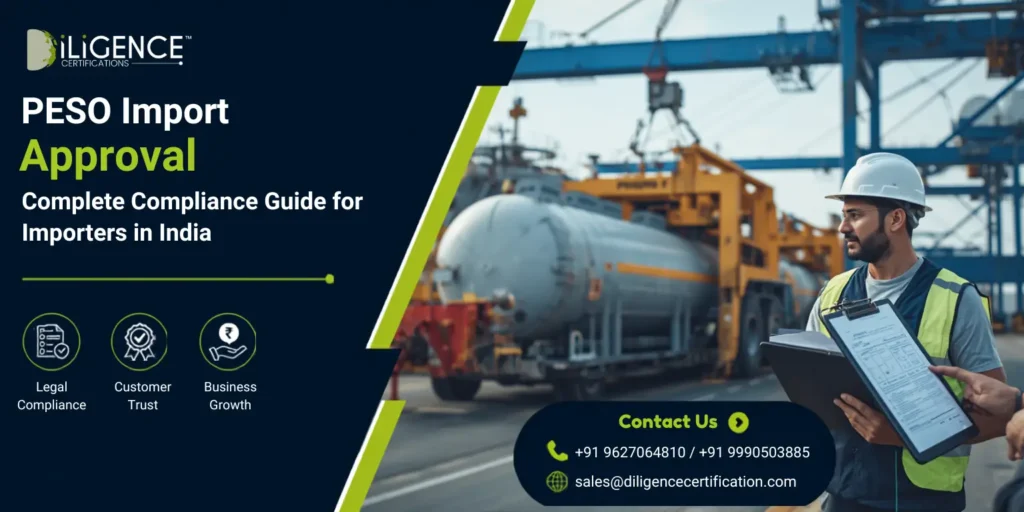
By - The Import Approval under PESO is a mandatory approval that is compulsory for the import of petroleum, explosives, gas cylinders, pressure vessels, and other dangerous goods into India.
- This approval guarantees that the imported material complies with the safety requirements of India and meets the regulation enforced by the Petroleum and Explosives Safety Organisation (PESO).
- Technical documents and safety-related information should be provided prior to getting approval from PESO.
Introduction
A few months back, an industrial equipment company from Europe approached Diligence Certifications when they faced problems delivering their pressure vessels to India. They had already performed all the quality checks on their products as per international standards and thought that their foreign manufacturing approvals would be enough for India.
As part of our compliance assessment, our team found out that the imported industrial equipment needed PESO import approval before they could be put to use commercially in India. They had already shipped their products but were unsure about customs clearance and installation timelines due to lack of regulatory approval.
Such is the case with most international suppliers and Indian importers. Most organizations are concerned about quality and delivery of their products to customers but often fail to consider country-specific safety approvals.
The PESO Import Approval process becomes crucial for organizations that import regulated products like gas cylinders, pressure vessels, petroleum-based equipment, hazardous material handling systems, etc.
We at Diligence Certifications can help you with the process of PESO import approval.
What is PESO Import Approval?
PESO Import Approval is the regulatory approval granted by the Petroleum and Explosives Safety Organisation for importing particular items under the jurisdiction of petroleum, explosives, compressed gas, and hazardous materials in India.
This approval indicates that the imported items satisfy the Indian safety regulations and are legal to use, store, transport, or operate in India.
PESO falls under the Department for Promotion of Industry and Internal Trade (DPIIT), Ministry of Commerce & Industry, Government of India. It is responsible for regulating the safety aspects of:
- Petroleum products
- Explosives
- Compressed gases
- Gas cylinders
- Pressure vessels
- Cryogenic containers
- Hazardous chemical storage systems
Unlike normal commercial imports, regulated products require additional evaluation because safety failures can create serious risks to people, property, and the environment.
A product manufactured outside India may meet international standards, but it still needs verification against Indian regulatory requirements.
Why is PESO Import Approval Required?
Inappropriate importation of hazardous or pressure equipment without appropriate authorization will pose legal or operational difficulties. PESO authorization guarantees that the products being introduced to the country satisfy the safety conditions laid down in accordance with the relevant regulations.
Ensures Compliance With Laws
- Organizations handling regulated products cannot import or utilize the equipment without satisfying the Indian safety regulations.
- PESO Authorization is a recognition of the compliance process of the equipment in accordance with the relevant safety laws.
Prevents Customs & Clearance Difficulties
- One of the problems that most importers face is the delayed shipping process due to lack of necessary regulatory approvals.
- The lack of necessary permissions might make clearance at customs difficult.
Confirm Product Safety Standards
- PESO assesses technical data in regards to the design, manufacturing process, test reports, and safety features.
- Such an assessment confirms the suitability of imported products in Indian operating conditions.
Customer Trust Building
Companies that purchase imported equipment prefer to work with suppliers who have all necessary regulatory approvals in place.
Which Products Require PESO Import Approval?
The requirement for PESO approval depends on the nature of the product, its usage, and applicable safety rules.
Some commonly regulated products include:
Gas Cylinders
- Importers dealing with LPG cylinders, industrial gas cylinders, medical gas cylinders, and compressed gas containers may require PESO approval before use in India.
- The approval process ensures that cylinder design, testing, and safety parameters comply with Indian requirements.
Pressure Vessels
- Pressure vessels used for storing compressed gases or hazardous substances often require regulatory assessment.
- Imported pressure equipment must meet applicable technical and safety conditions before installation.
Cryogenic Storage Equipment
Cryogenic tanks and containers used for gases such as oxygen, nitrogen, and argon may require PESO-related approvals depending on specifications and application.
Petroleum Handling Equipment
Equipment associated with petroleum storage, transportation, and handling may fall under PESO regulations.
Examples include:
- Storage systems
- Dispensing equipment
- Petroleum containers
- Safety-related components
Explosive-Related Products
Certain explosive materials, accessories, and equipment used in explosive manufacturing or handling activities require PESO permissions before import.
Difference Between Normal Import Approval and PESO Import Approval
Many businesses confuse general import procedures with PESO requirements.
A normal import process mainly focuses on customs, taxation, and trade documentation. However, PESO Import Approval focuses on safety compliance.
| Normal Import Process | PESO Import Approval |
| Related to commercial entry of goods | Related to safety-regulated products |
| Managed through customs procedures | Managed by PESO regulations |
| Focuses on trade compliance | Focuses on technical safety compliance |
| Applies to general products | Applies to hazardous and controlled products |
For regulated industries, completing customs procedures alone does not mean the product is approved for operation.
PESO Import Approval Process in India
PESO Import Approval consists of technical review, documentation review, and compliance check by the Petroleum and Explosives Safety Organisation.
Most importers believe that approval is possible even after their consignment reaches India. This poses unnecessary risks for them. It is important for businesses to get approvals before importing controlled products.
This normally includes the following steps:
Step 1: Identify Whether PESO Approval is Required
The initial stage is to ascertain whether the imported product requires PESO certification or not.
Organizations need to consider the following factors:
- Product type
- Use of the product
- Storage of the product
- Working pressure
- Classification of gas/petroleum
- Safety regulation that is applicable
Step 2: Evaluation of Technical Document
Once the requirement for approval has been determined, the next step for the importer is to gather technical information about the product.
Information evaluated by PESO normally includes:
- Design specifications of the product
- Manufacturing specification
- Details regarding materials
- Testing process
- Safety specifications
- Operating conditions
Step 3: Filing of Application
The applicant sends the required information through the concerned PESO online portal.
An application normally contains:
- Applicant details
- Importer details
- Manufacturer details
- Specification of the product
- Technical drawings
- Certificates
- Safety documents
- Accuracy of information is very important as it may give rise to inquiries by the authority if not accurate.
Step 4: Evaluation of Application by PESO Officers
After the submission of the application and documents, the application is evaluated by the PESO officers.
This evaluation process can be done through:
- Adherence to relevant rules
- Manufacturing standards
- Test reports
- Equipment specifications
- Safety considerations
- If further clarity on any matter is required, then the applicant will have to give the relevant information as well.
Step 5: Granting the Approval
After meeting all the required conditions, the PESO grants the approval for importing the particular product.
The importer needs to check:
- Approved product
- Manufacturer
- Conditions stipulated in approval
- Validating requirements
- Change in design of the product, manufacturer, or specification can necessitate another approval.
Documents Required for PESO Import Approval
It varies according to the product category and the type of approval that is needed. The documents required by importers include:
Documents of Company/Applicant
- Certificate of registration of the company
- Import Export Code (IEC)
- Registration for GST
- Proof of address of the business
- Authorization documents
- This set of documents serves as identification and authorization documents for the importer.
Manufacturer Documents
- Details of the foreign manufacturing company are important for importing any goods.
- These include the following:
- Profile of Manufacturer
- Details of Manufacturing facility
- Quality certificates
- Previous record of approvals, if any
- Authorization letter from the Manufacturer
Technical Documents
The technical documents are the most important part of the PESO approval process.
They include:
- Drawings of the product
- Calculations of design
- Technical specifications
- Certificates of material
- Process of manufacturing
- Test reports
- Inspection certificates
- Incomplete technical documents are one of the main causes of delay in approvals.
Test and Safety Certificates
- According to the category of the product, some certificates required are:
- Hydro test certificates
- Performance test reports
- Safety test reports
- Third party inspection report
- Test certificates prove that the imported product can run safely in India.
PESO Import Approval for Different Product Categories
PESO Approval for Gas Cylinder Import
Imported gas cylinders require careful assessment because they are used for storing compressed gases under high pressure.
The evaluation may include:
- Cylinder design
- Material specifications
- Testing standards
- Manufacturing compliance
- Safety markings
Importers should ensure that cylinders comply with applicable Indian requirements before shipment.
PESO Approval for Pressure Vessel Import
Pressure vessels are commonly used in chemical, pharmaceutical, energy, and industrial sectors.
Before importing such equipment, businesses may need to provide:
- Design drawings
- Pressure ratings
- Material details
- Testing reports
- Manufacturing certificates
A mismatch between approved design and supplied equipment can create compliance complications.
PESO Approval for Cryogenic Equipment Import
Cryogenic storage systems require special attention due to extremely low-temperature applications.
Products used for storing gases like oxygen, nitrogen, and argon may require evaluation of:
- Insulation systems
- Pressure control mechanisms
- Safety devices
- Manufacturing standards
Common Reasons for PESO Import Approval Delay
Many approval delays are avoidable when businesses prepare documents properly.
Incorrect Product Classification
- A frequent issue is applying under the wrong product category.
- Different products have different compliance requirements, and incorrect classification may lead to additional reviews.
Missing Technical Documents
- Technical drawings, test certificates, or manufacturer documents are often incomplete during initial submission.
- PESO evaluation depends heavily on accurate technical information.
Difference Between Imported Product and Submitted Documents
The actual product must match the details submitted during approval.
Changes in:
- Model number
- Capacity
- Design
- Manufacturer
- Material specifications
may require clarification or fresh approval.
Late Compliance Planning
Some businesses begin the approval process after shipment arrival.
This can affect:
- Customs clearance
- Installation schedules
- Customer delivery commitments
Early planning helps avoid these operational challenges.
Role of Testing in PESO Import Approval
Testing plays a significant role in verifying product safety and reliability.
Depending on the product, testing may confirm:
- Structural strength
- Pressure resistance
- Leak prevention
- Material quality
- Operational safety
International test reports can support the application; however, their acceptance depends on applicability and compliance with Indian requirements.
Importers should review testing requirements before placing manufacturing orders.
How Diligence Certifications Helps with PESO Import Approval
Obtaining PESO Import Approval requires understanding both regulatory requirements and technical documentation.
Many businesses face challenges because they lack experience with PESO procedures or are unfamiliar with documentation expectations.
Diligence Certifications supports businesses through:
Regulatory Consultation
Our experts analyse the product category and identify applicable PESO requirements before the application process begins.
Document Preparation Support
We assist in reviewing:
- Technical documents
- Manufacturer certificates
- Safety reports
- Application details
This reduces the possibility of rejection due to documentation errors.
Application Coordination
- Managing communication and responding to regulatory queries requires proper compliance understanding.
- Diligence Certifications helps businesses coordinate the approval process efficiently.
Compliance Gap Analysis
Before submission, we review available documents and identify missing requirements.
This approach helps companies avoid unnecessary delays.
Benefits of Obtaining PESO Import Approval
PESO Import Approval provides regulatory confidence to businesses importing safety-sensitive products into India. It is not only a compliance requirement but also a foundation for safe and uninterrupted business operations.
Smooth Customs Clearance
One of the major advantages of obtaining PESO approval before shipment is avoiding clearance-related complications.
When regulated products arrive without necessary approvals, importers may face delays, additional documentation requirements, or restrictions on product usage.
Completing compliance formalities in advance helps businesses maintain better control over their supply chain.
Legal Operation of Imported Equipment
Products such as gas cylinders, pressure vessels, and petroleum-related equipment must meet Indian safety requirements before commercial operation.
PESO approval confirms that the imported product has undergone regulatory assessment and can be used according to applicable conditions.
Improved Business Reliability
Companies working with industrial equipment often supply products to large organisations, government projects, and regulated industries.
Having proper PESO compliance improves confidence among:
- Customers
- Industrial partners
- Project consultants
- Safety auditors
Reduces Compliance Risks
Non-compliance can affect business reputation and create operational challenges.
A structured PESO approval process helps businesses identify regulatory requirements before importing products.
How Long Does PESO Import Approval Take?
The processing time for PESO Import Approval depends on multiple factors, including:
- Product category
- Completeness of documents
- Technical complexity
- Requirement of additional clarification
- Review by concerned authorities
Applications with complete and accurate documentation generally move faster compared to applications requiring repeated corrections.
Businesses should begin the approval process before shipment planning to avoid delays in project execution.
Factors Affecting PESO Import Approval Cost
The cost of obtaining PESO certification depends on the type of product as well as compliance criteria.
Key factors include:
- Product Category
- Various products require different criteria for technical assessment.
- Approval criteria for a gas cylinder can be different from that for an industrial pressure vessel.
Documentation Criteria
Products that require technical documentation, testing, and manufacturer certification may need extra effort to achieve compliance.
Testing and Inspection Requirements
If any testing and/or inspection is necessary, this will affect the total cost of compliance.
Consultancy Assistance
Many organizations seek professional help to minimize mistakes and facilitate the process of approval.
This includes hiring a compliance consultant who will identify compliance requirements and facilitate the whole procedure.
PESO Import Approval vs PESO License
Many businesses use these terms interchangeably, but they serve different purposes.
| PESO Import Approval | PESO License |
| Required for importing regulated products | Required for specific regulated operations |
| Focuses on product entry into India | Focuses on storage, handling, manufacturing, or operation |
| Generally related to imported equipment/products | Related to business activities and facilities |
| Evaluates product compliance | Evaluates operational safety compliance |
Understanding this difference helps businesses apply for the correct approval.
Conclusion
PESO Import Approval is a crucial aspect of compliance for those businesses that import controlled commodities, such as pressure vessels, gas cylinders, petroleum products, and equipment for handling hazardous materials, to India.
The approval process requires the appropriate classification of the product, correct documentation, and effective regulatory coordination.
Those business organizations which do their compliance planning prior to shipment will be able to avoid any kind of unwanted delay.
Our company, Diligence Certifications, can help you with the entire PESO Import Approval process.
Please feel free to get in touch with us for any help with regard to PESO compliance.
Frequently Asked Questions
What is PESO Import Approval?
PESO Import Approval is a regulatory approval required for importing certain petroleum, gas, explosive, and pressure-related products into India. It confirms that imported products meet applicable Indian safety requirements.
Which products require PESO Import Approval in India?
Products such as gas cylinders, pressure vessels, cryogenic containers, petroleum equipment, and certain explosive-related materials may require PESO Import Approval depending on their category and application.
How can I apply for PESO Import Approval?
Businesses can apply by submitting product details, technical documents, manufacturer information, test certificates, and other required documents through the applicable PESO application process.
Is PESO Import Approval mandatory before importing products?
For products covered under PESO regulations, approval is required before legal import and usage in India. Importers should verify requirements before shipment.
What documents are required for PESO Import Approval?
Common documents include company details, manufacturer certificates, technical drawings, product specifications, test reports, safety documents, and authorisation letters.
Can a foreign manufacturer apply for PESO Import Approval?
Foreign manufacturers can provide technical documents and support the Indian importer or authorised representative during the approval process.
What is the validity period of PESO Import Approval?
The validity period of PESO Import Approval depends on the approval category, product type, and conditions specified by PESO. Importers should check the approval document carefully and apply for renewal or extension wherever required.
Can imported pressure vessels be used in India without PESO Approval?
No, pressure vessels covered under PESO regulations should not be imported and operated without obtaining the required approval. Using non-approved equipment may lead to compliance issues and safety risks.
What are the common reasons for rejection of PESO Import Approval applications?
Common reasons include incomplete technical documents, incorrect product details, missing test reports, mismatch between submitted documents and actual products, and failure to meet applicable safety requirements.
Do I need PESO Import Approval for every imported product?
Not every imported product requires PESO approval. The requirement depends on the product category, intended use, technical specifications, and whether it falls under PESO-regulated rules.