BIS Certification
 CDSCO
CDSCO
 PESO
PESO
 CPCB
CPCB
 LMPC
LMPC
 WPC Approval
 Global Approvals
 TEC
TEC
 ARAI
ARAI
 BEE
BEE
 ISO Certification
 DGCA Certification
 NOC For Steel
 APEDA Registration























 Business Registration
 FSSAI Mark Certification












 (32).jpg)
 Legal Services
 Trademark Registration
 Copyright Registration
 Patent Registration
 By
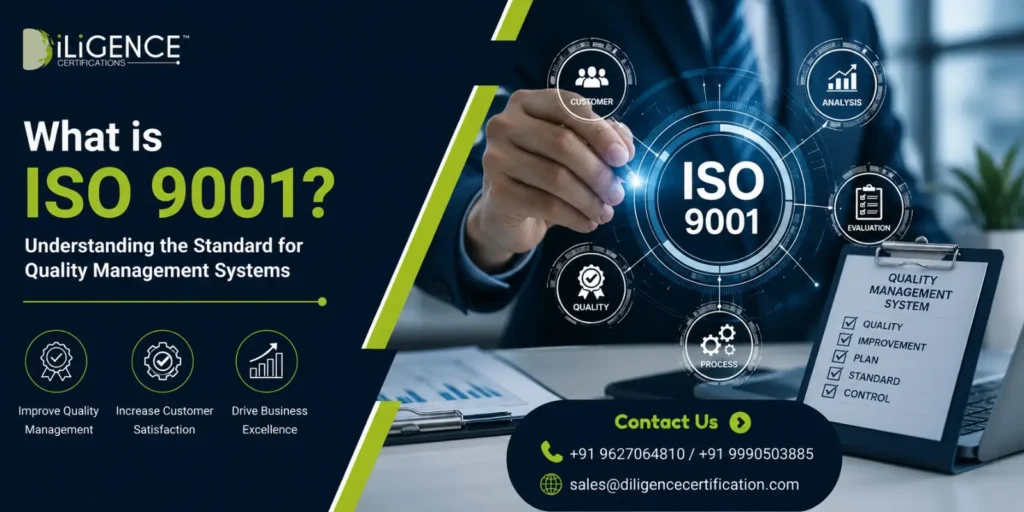
By - The ISO 9001 standard is really popular all over the world. It helps companies make products and keep their customers happy.
- Manufacturers who want to get the ISO 9001 Certification can make their work easier, reduce mistakes, follow the rules better and gain the trust of customers in India and other countries.
- Diligence Certifications is a company that helps manufacturers in India with things, like getting the documents and putting the ISO 9001 standard into practice, teaching people about it, doing audits and getting certified for ISO 9001.
Introduction : What Is ISO 9001
A mid-sized company that makes car parts recently contacted Diligence Certifications after losing two supply deals. The products they made followed all the rules but both customers asked the same thing when they looked at the company: “Do you have ISO 9001 Certification?”
The company thought that quality came from having workers and up-to-date machines.. The buyers wanted proof of a system that made sure everything was done in a consistent way, coul be tracked and kept getting better.
This is happening more and more in India’s manufacturing industry. Original equipment manufacturers, exporters, government buyers and global businesses often choose suppliers that have ISO 9001 because it shows they care about quality and have good ways of working.
If you have ever looked up “WHAT IS ISO9001” the short answer is that it is a known Quality Management System standard created by the International Organization for Standardization. It gives a way for companies to always meet what their customers need while making their work better and more efficient.
What Is ISO9001?
ISO 9001 is a standard that people around the world know about. It tells you what you need to do to set up a Quality Management System, make it work, keep it going and make it better all the time.ISO 9001 does not just look at the quality of products, it looks at how a company runs its business, how it treats its employees, how it keeps records of what customers think, how it deals with problems and how it can get better.
The version of ISO 9001 that everyone uses now is ISO 9001:2015.ISO 9001 is different from certifications because it does not just say a product is good it says the whole system a company uses to make products is good and can make consistent quality products.
What does ISO mean?
A lot of people think ISO is short for something.But that is not true ISO comes from the word “isos” which means equal.The people who made up the name International Organization for Standardization chose it because it means the thing, in many languages so ISO 9001 is the same everywhere.
What Is a Quality Management System (QMS)?
A Quality Management System is a framework that helps an organisation control and improve its operations.Of relying on individual experience or informal practices a Quality Management System establishes documented procedures for every critical activity.
These include:
- Purchasing
- Production
- Inspection
- Customer complaints
- Risk management
- Internal audits
- actions
- Continuous improvement
For manufacturers this translates into better consistency, reduced defects and improved customer confidence.
Why Is ISO 9001 Important for Manufacturers?
Manufacturing businesses have to deal with a lot of competition. The people who buy their products expect a lot from them. Customers want to know that they are getting a product every time. They expect a things, such as
* Consistent product quality
* On-time delivery
* Reliable documentation
* Traceability
* Process control
* Regulatory compliance
Manufacturing businesses need to meet these expectations. ISO9001 is a standard that helps manufacturers build systems that can do this. By fixing mistakes after the products are made ISO9001 helps manufacturing businesses prevent problems from happening in the first place. This way manufacturing businesses can make sure that their products are quality and that they are delivered on time. ISO9001 is important for manufacturing businesses because it helps them build trust with their customers.
Key Principles Behind ISO9001
The main idea of ISO 9001 is to follow some principles that everyone agrees on for managing quality.These principles are accepted around the world-
- Customer Focus is one of them.
Every company should try to understand what its customers want and keep working to make them happy.When customers are happy they come back to buy from you again.
- Leadership is also very important.
The people in charge of a company set goals for quality. Make sure everyone has what they need to do their job.They also create a work environment where everyone knows what they are supposed to do.
- Then there is the Engagement of People
Everyone who works for a company is responsible for quality.Every employee helps make the company’s processes and reduces mistakes.
- The Process Approach is another principle.
ISO 9001 wants companies to think of their work as a series of steps instead of separate tasks.This helps companies be more consistent and efficient.Improvement is something that companies should always be working on.It is a part of ISO 9001.Companies that make things regularly look at how they’re doing and try to find ways to do better.
- Evidence-Based Decision Making is also important.
When companies make decisions they should be based on facts and numbers not on what they think.This helps companies make decisions that will really help them.
- Relationship Management is the principle.
Companies should try to have relationships with the people they buy from and work with.This helps companies do well over time and ISO 9001 is all, about the ISO 9001 principles.The main goal of ISO 9001 is to follow these principles and make sure that the company is following the ISO 9001 principles.
Benefits of ISO9001 Certification
Getting Certification takes a lot of effort but the good things it does for your business in the long run are usually worth it.
- You get product quality because you have standard ways of doing things. This means you make mistakes and your products are more consistent.
- When you make products your customers are happy. They trust you more. You can work with them for a long time.
- You also make mistakes when you are making things. This is because you write down how to do things and people follow those steps.
- Your business runs smoothly when everyone knows what they are supposed to do. This means people do not do the work twice and you use your resources better.
- It is also easier to follow the rules when you have ISO 9001 Certification. This certification helps you do what your customers and the government want you to do.
- When you have ISO 9001 Certification people think your company is better. Many buyers only want to work with companies that have this certification because it shows you are professional and care about quality.
- You can also sell your products to people in other countries. Many international buyers want the companies they work with to have ISO 9001 Certification.
- Your employees also do a job when they know what they are supposed to do. When you write down how to do things everyone knows their role. They work harder.
Which manufacturers need to have the ISO 9001 certification?
The ISO 9001 standard is good for manufacturers of any size.
Some examples of these manufacturers are:
- Automobile manufacturer
- Auto component suppliers
- Electronics manufacturers
- Medical device manufacturers
- Chemical manufacturers
- product manufacturers
- Food processing companies
- Packaging manufacturers
- Textile manufacturers
- Engineering companies
- Metal fabrication units
- Machinery manufacturers
It does not matter if the manufacturer has 20 employees or 2,000 employees, the ISO 9001 standard can be used by the manufacturer.
Who can apply for the ISO 9001 certification?
The ISO 9001 certification is available to types of companies including:
- Proprietorship firms
- Partnership firms
- Private Limited companies
- Public Limited companies
- MSMEs
- Large manufacturers
- Exporters
- OEM suppliers
The size of the company does not matter when it comes to getting the ISO 9001 certification. The ISO 9001 certification is available to all types of companies from manufacturers, to large manufacturers and it is not restricted by the size of the company.
Main Requirements of ISO9001
When it comes to ISO 9001 manufacturers have to set up a few management processes.The main things that ISO 9001 requires include:
- Quality Policy: the people in charge should say what the company thinks about quality.
- Quality Objectives: the company should have goals for quality that can be measured and checked.
- Risk-Based Thinking: the company should think about what could go and try to stop it.
- Document Control: important papers and procedures should be correct and easy to find.
- Internal Audits: the company should regularly check if its Quality Management System is working well.
- Management Review: the senior managers should look at how the Quality Management System is doing from time to time.
- Corrective Actions: when something goes wrong the company should try to find out why. Make sure it does not happen again.
Common Misconceptions About ISO9001
A lot of manufacturers wait to get certified because they do not understand ISO 9001.Some things that people get wrong about ISO 9001 are:
- ISO 9001 is for big companies.
- If you get certified you will make products.
- You have to make your documents very complicated.
- You only need ISO 9001 if you sell things to countries.
- You only have to get certified
The truth is, ISO 9001 is, for any size company it is practical and it is meant to help companies get better and better not to make perfect products.
ISO 9001 Certification Process for Manufacturers
Every manufacturing business is unique. They all follow the same basic steps to get certified.The steps to get ISO 9001 certified are pretty straightforward.
Step 1: Gap Analysis
First you need to see how your current quality management practices compare to the requirements of ISO 9001:2015.This is called a gap analysis. It helps you find areas that need improvement before you can get certified.
Some common things that people find are missing include:
* Documented procedures that do not exist
* Quality records that are not good enough
* Responsibilities that are not clearly defined
* Customer complaint handling that is not working well
* Risk management practices that’re not strong
If you fix these problems early on it will save you time and trouble later.
Step 2: Develop the Quality Management System
After you do the gap analysis you need to create a Quality Management System.
This system should include things like:
* A Quality Manual if you have one
* Standard Operating Procedures
* Process maps
* Work instructions
* Risk registers
* Quality objectives
* Record formats
* Control procedure
Step 3: Employee Awareness and Training
If your employees do not understand their responsibilities your Quality Management System will not work.
You need to train them on things like:
- Your quality policy
- What they are responsible for
- What documents they need to keep
- How to focus on the customer
- How to think about risks
- What to do when things go wrong
- When your employees are well-trained they can help make your business better.
Step 4: Implement the QMS
Once you have all your documents ready you can start using your Quality Management System.
This means you need to:
- Keep quality records
- Watch your production processes
- Track your quality objectives
- Listen to customer feedback
- Control products that do not meet standards
- Record what you do when things go wrong
This is where you put your system into practice.
Step 5: Internal Audit
Before you can get certified you need to have an audit.This is where people in your company check to see if you are following the rules.
They look for things like:
- Gaps in your documents
- Processes that are not working right
- Products that do not meet standards
- Ways to improve
You need to fix any problems they find before the audit.
Step 6: Management Review
Your top managers need to review how well your Quality Management System is working.
They should talk about things like:
* What the auditors found
* What customers are saying
* How your processes are working
* If you are meeting your quality objectives
* If you need resources
* Ways to improve
The people in charge need to be involved in this process.
Step 7: Certification Audit
Finally you have an audit.This is where someone from, outside your company checks to see if you are following the rules.
The audit happens in two stages.
Stage 1 is where they review your documents and make sure you are ready.
Stage 2 is where they check to see if you are really doing what you say you are doing.
If you pass you get your ISO 9001 Certificate.This is what you need to get ISO 9001 certified.You need to follow these steps and make sure you are doing everythingThen you can get your ISO 9001 certification.
Documents Required for ISO 9001 Certification
The required documentation varies depending on the organisation’s size and operations. Common documents include:
Business Documents
- Certificate of Incorporation or Registration
- GST Registration
- PAN Card
- Factory Licence (where applicable)
- Organisation Chart
Quality Management Documents
- Quality Policy
- Quality Objectives
- Standard Operating Procedures
- Process Flow Charts
- Risk and Opportunity Register
- Internal Audit Reports
- Management Review Records
- Corrective Action Reports
- Customer Complaint Records
- Supplier Evaluation Records
Maintaining accurate and updated records is essential for successful certification and future surveillance audits.
How Long Does ISO 9001 Certification Take?
The certification timeline depends on factors such as:
- Size of the organisation
- Number of employees
- Complexity of manufacturing processes
- Number of production locations
- Existing quality systems
- Readiness of documentation
Businesses with well-established quality practices often complete the process more efficiently than organisations implementing a QMS for the first time.
Factors Affecting the Cost of ISO 9001 Certification
There is no price for certification for each company. The total amount you need to spend depends on:
- How big the company’s
- How many people work there
- How many places the business has
- What the certification covers
- How complicated the production is
- Help from experts
- Fees from the certification company
- What training is needed
Getting a review that is specific to your project gives a better idea of the cost.
Mistakes Manufacturers Should Avoid
Many delays happen because companies concentrate only on getting the certificate instead of making their processes better.
Some common mistakes are:
- Copying documents
- Not providing enough training for workers
- Keeping records that are not complete
- Doing internal audits that do not work well
- Not keeping track of quality goals
- Putting off fixing problems
- Seeing ISO 9001 as something that is done once and then forgotten
A good Quality Management System is part of daily work instead of just being there for inspections.
Why Manufacturers Trust ISO 9001
Big buyers and big companies often check suppliers based on how good their quality systems are-
- An ISO 9001-certified manufacturer shows that it has written down processes to control quality, track results and keep getting better. This helps risks for customers and makes the supplier more trustworthy.
- For manufacturers trying markets or applying for big deals certification can help them stand out when they are being checked as a supplier.
Why Choose Diligence Certifications?
Getting Diligence Certifications is not about having some papers ready. It is about understanding how your business works, finding out what could go wrong, teaching your employees what to do and making a Quality Management System that helps your business get better over time.
Diligence Certifications helps people who make things get certified with the following:
- Gap analysis
- QMS documentation
- Process mapping
- Employee awareness training
- Internal audit support
- Certification audit coordination
- Postcertification guidance
The way we do things is to make a management system that is easy to use and helps your business while also meeting the rules of ISO 9001. We want to help you get Diligence Certifications that really work for your business. Diligence Certifications is here to help you with your Diligence Certifications needs.
Conclusion
If you have been searching “WHAT IS ISO9001″ the answer goes beyond a quality standard. ISO 9001 is a management framework that helps manufacturers improve efficiency, lower operational risk, provide consistent quality and build customer confidence.
In today’s manufacturing world buyers are looking more and more for suppliers to show they have systematic quality management. Getting ISO 9001 Certification not builds trust but also helps with long-term business growth and strong operations.
Whether you are trying to get certification, for the time or updating your current Quality Management System Diligence Certifications can help you at every step-from putting things in place and writing documents to getting the certification done.
Frequently Asked Questions
What is ISO9001?
ISO 9001 is an internationally recognised Quality Management System (QMS) standard that helps organisations consistently deliver quality products and services while improving customer satisfaction.
Who should obtain ISO 9001 Certification?
Manufacturers, service providers, exporters, SMEs, large enterprises, and government suppliers can all benefit from ISO 9001 Certification.
Is ISO 9001 mandatory in India?
No. ISO 9001 is generally a voluntary certification. However, many customers, tenders, and supply chains require it as part of their vendor qualification process.
What is the latest version of ISO 9001?
The latest published version is ISO 9001:2015, which remains the globally accepted standard for Quality Management Systems.
How long is an ISO 9001 Certificate valid?
An ISO 9001 certificate is typically valid for three years, subject to successful surveillance audits conducted by the certification body.
Can small manufacturers apply for ISO 9001?
Yes. ISO 9001 is designed for organisations of all sizes and can be tailored to small, medium, and large manufacturing businesses.
Does ISO 9001 improve product quality?
ISO 9001 improves the processes used to produce products, leading to greater consistency, fewer defects, and enhanced customer satisfaction.
What documents are required for ISO 9001 Certification?
Typical documents include business registration records, quality policy, procedures, quality objectives, internal audit reports, management review records, and other QMS documentation.
Can Diligence Certifications help with ISO 9001 implementation?
Yes. Diligence Certifications provides end-to-end support, including gap analysis, documentation, training, internal audits, and certification assistance.