BIS Certification
 CDSCO
CDSCO
 PESO
PESO
 CPCB
CPCB
 LMPC
LMPC
 WPC Approval
 Global Approvals
 TEC
TEC
 ARAI
ARAI
 BEE
BEE
 ISO Certification
 DGCA Certification
 NOC For Steel
 APEDA Registration























 Business Registration
 FSSAI Mark Certification












 (32).jpg)
 Legal Services
 Trademark Registration
 Copyright Registration
 Patent Registration
 By
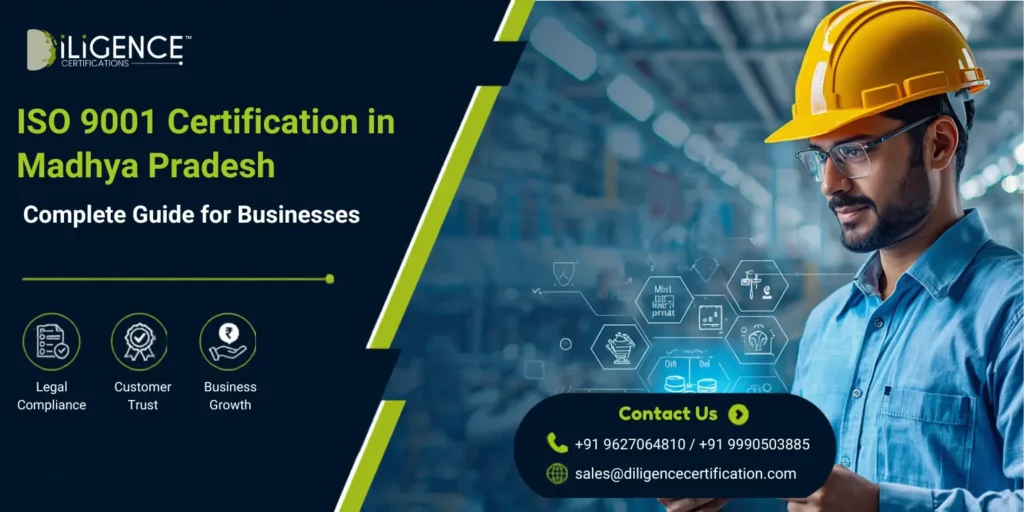
By - ISO 9001 Certification in Madhya Pradesh helps organizations create a globally accepted Quality Management System (QMS) that ensures quality, customer satisfaction, and efficient operations.
- Companies such as manufacturers, exporters, MSMEs, IT firms, healthcare providers, educational institutes, and service organizations in Madhya Pradesh can benefit from ISO 9001 Certification to gain more credibility in the marketplace.
- Our team at Diligence Certifications takes care of all of your requirements related to ISO 9001 Certification.
Introduction
A manufacturing company from the Pithampur Industrial Area, which is often called the “Detroit of India”, approached Diligence Certifications since it constantly lost bids even though the pricing was competitive. While discussing with procurement departments of various large OEMs, one thing kept repeating itself-ISO 9001 Certification.
The company had qualified engineers, good equipment and skilled workers but still didn’t have documented Quality Management System. The absence of a certified quality assurance program meant that buyers perceived increased operational risks.
This problem is not uncommon in many areas such as Indore, Bhopal, Gwalior, Jabalpur, Ujjain, Dewas, Satna and other industrial locations of Madhya Pradesh. The companies manage to produce high-quality products but have problems with providing quality procedures.
ISO 9001 Certification in Madhya Pradesh helps to solve this problem. It gives you internationally recognized proof that your organization uses documented procedures for consistent quality provision, customer satisfaction increase, operation improvement and management system continuous improvement.
Whatever industry you are operating in - manufacturing, food processing, pharmaceutical, IT, education, healthcare, logistics or engineering-ISO 9001 Certification will greatly improve your business reputation.
At Diligence Certifications we are assisting our clients in implementing practical Quality Management Systems instead of creating additional paperwork.
What is ISO 9001 Certification?
ISO 9001 Certification is an internationally accepted standard used for developing a Quality Management System (QMS). It is designed by the International Organization for Standardization (ISO), and it offers a system through which organizations can ensure the satisfaction of their customers by meeting all applicable requirements.
Unlike other systems, ISO 9001 does not dictate how organizations must function; instead, it offers guidelines for developing good processes. The principles of these processes include customer focus, leadership, process approach, risk-based thinking, decision making based on facts, and continual improvement.
Businesses in Madhya Pradesh that have obtained ISO 9001 Certification can be assured of the fact that quality has been built into their processes.
Why is ISO 9001 Important for Businesses in Madhya Pradesh?
Madhya Pradesh has developed into one of India’s prominent industrial states. It is home to sectors such as:
- Automobile manufacturing
- Pharmaceuticals
- Food processing
- Textiles
- Engineering
- Mining
- Chemicals
- Agriculture processing
- Information Technology
- Renewable Energy
Several customers, government bodies, multinationals, and foreign markets are increasingly demanding from their suppliers compliance with certified quality systems.
ISO 9001 certification in Madhya Pradesh helps business firms to compete with big firms due to their commitment to quality and proper business management.
Buyers get confidence not through products or claims of companies but from certified quality systems.
Which Businesses Should Apply for ISO 9001 Certification in Madhya Pradesh?
It is a popular myth that ISO 9001 is applicable only for factories. But, truth be told, nearly every organisation benefits from a Quality Management System.
These include:
Manufacturing Companies
Manufacturing companies get the advantage of standardised processes, reduction in defects, effective quality control, and minimum wastages.
MSMEs
Smaller organisations use ISO 9001 to establish credibility while bidding for contracts or approaching large customers.
Pharmaceutical Companies
Pharmaceuticals need quality documentation and process control. The ISO 9001 provides the structure while being complementary to other industry standards.
Food Processing Units
Food companies gain consistency, supply chain management, traceability, and customer trust.
Educational Institutes
ISO 9001 can help improve processes within schools, colleges, universities, and educational institutes.
Hospitals/Healthcare providers
Healthcare institutions can use ISO 9001 to improve their processes and customer services.
IT Companies
IT companies get the benefit of improved process management, communication, and documentation.
Logistics/Warehousing
Improved inventory management, accurate deliveries, customer service, and process monitoring are some of the gains for such businesses.
Key Principles of ISO 9001 Certification
It is the simple management philosophy embodied in ISO 9001 that makes it successful rather than complicated documentation.
Customer Orientation
- Organisations are created for the sole purpose of serving their customers. ISO 9001 motivates organisations to know the customer’s requirements, track customer satisfaction, and continuously enhance services.
- Happy customers usually become loyal customers, thereby decreasing the cost of marketing in the long run.
Management Commitment
- Quality programmes cannot be implemented successfully without the management’s involvement.
- Managers set the quality targets, provide resources, measure performance, and initiate continual improvement within the organisation.
Process Orientation
- As opposed to treating each department separately, ISO 9001 looks at an organisation as a whole made up of processes.
- For instance, any problem with purchasing affects production, which in turn affects delivery, thus affecting customer satisfaction.
- Managing all these processes effectively increases efficiency.
Risk-Based Thinking
- Modern businesses face numerous risks, including supplier delays, machine failures, quality issues, regulatory changes, and customer complaints.
- ISO 9001 encourages organisations to identify these risks proactively and establish suitable control measures.
Continuous Improvement
- Effective organisations use continual analysis of performance indicators, customer feedback, audits, and operational information to identify areas for improvement.
- Many small improvements made regularly can have substantial effects over time.
Data-based Decision Making
Decisions should be based on facts instead of making assumptions.
ISO 9001 encourages the monitoring of:
- Customer complaints
- Efficiency of production
- Quality of products
- Timelines of delivery
- Performance of suppliers
- Audit findings
- Corrective actions
- This will allow management to make sound decisions using valid data.
Benefits of ISO 9001 Certification in Madhya Pradesh
Many organisations initially pursue certification because customers request it. However, after implementation, they often realise that the operational improvements deliver even greater value.
Some of the major benefits include:
Improved Customer Confidence
Certification demonstrates that your organisation follows internationally recognised quality management practices, increasing trust among customers and business partners.
Better Process Control
Clearly documented procedures reduce operational inconsistencies and help employees perform tasks more efficiently.
Reduced Errors and Rework
Standardised processes minimise mistakes, reduce product defects, and lower the cost of rework or customer complaints.
Increased Business Opportunities
Many government tenders, large corporate buyers, exporters, and multinational companies prefer or require suppliers with ISO 9001 Certification.
Stronger Brand Reputation
Displaying ISO 9001 Certification reflects a commitment to quality, professionalism, and continual improvement, strengthening your market image.
Enhanced Employee Accountability
Clearly defined roles, responsibilities, and documented procedures improve accountability across departments and support better team performance.
ISO 9001 Certification Process in Madhya Pradesh
ISO 9001 Certification in Madhya Pradesh is more than just making a couple of documents. The whole idea here is to create a Quality Management System (QMS) which operates effectively on the field and promotes constant improvements.
At Diligence Certifications, we make the implementation process easier by matching ISO standards to your actual business practices and not by creating redundant documents.
Stage 1: Initial Gap Assessment
First things first - it is necessary to have an understanding of your company’s processes and compare them to ISO 9001 requirements.
In this gap assessment, our consultants assess:
- Current quality processes
- Structure of the organization
- Risks involved in the operation
- Customer management process
- Level of documentation
- Compliance
- Opportunities for improvement
- It helps us understand what needs to be done before obtaining certification.
Stage 2: Documentation Creation
Documentation is the very foundation of the QMS.
Here are some of the documents we usually create:
- Quality Policy
- Quality Objectives
- Process flow diagrams
- Standard Operating Procedures (SOP)
- Risk Register
- Instructions
- Forms & formats
- Quality Manual (where applicable)
- Records Management procedures
- Corrective Action Procedures
- Our documentation is tailor-made for each individual organization.
Step 3: QMS Implementation
The approved procedures are implemented across departments. Employees receive practical guidance on following the documented processes in their daily work.
Implementation usually covers:
- Production
- Purchasing
- Sales
- HR
- Stores
- Maintenance
- Quality Control
- Customer Support
Step 4: Employee Training
It is vital for the success of the QMS that employees know their roles and responsibilities.
The training program usually consists of:
- ISO 9001 awareness
- Process responsibility
- Document management
- Record keeping
- Reporting non-conformities
- Correction and prevention of non-conformities
- This makes sure that the system is realistic and practical.
Step 5: Internal Audit
Prior to the certification audit, an internal audit helps to establish if the system implemented conforms to the ISO 9001 standard.
An internal audit reveals:
- Process deficiencies
- Document deficiencies
- Operation inconsistencies
- Areas for improvements
- Corrective action is done prior to external audit.
Step 6: Management Review Meeting
Senior management examines:
- Feedback from customers
- Audit results
- Quality objectives
- Process performance
- Opportunities and risks
- Improvement measures
- Commitment of management is the requirement of ISO 9001.
Step 7: Certification Audit
The certification audit is performed by an accredited third party in two phases.
Stage 1 Audit
- Documentation audit
- Evaluation of readiness
- Validation of scope
Stage 2 Audit
- Verification department wise
- Interviews with employees
- Observation of process
- Verification of records
- If the organization fulfils the standard, ISO 9001 certificate is issued.
Documents Required for ISO 9001 Certification in Madhya Pradesh
Although requirements vary depending on the business, the following documents are commonly required:
- Company Registration Certificate
- GST Registration
- PAN Card
- Organisation Chart
- Scope of Business
- Quality Policy
- Process Documents
- Standard Operating Procedures
- Employee Records
- Customer Complaint Records
- Supplier Evaluation Records
- Internal Audit Reports
- Management Review Records
- Corrective Action Reports
- Calibration Records (where applicable)
- Production Records (for manufacturers)
How Long Does ISO 9001 Certification Take?
The timeline depends on:
- Organisation size
- Number of employees
- Number of locations
- Existing documentation
- Operational complexity
- Readiness of management
Small businesses generally complete implementation faster than large manufacturing facilities with multiple departments.
Factors Affecting ISO 9001 Certification Cost in Madhya Pradesh
There is no fixed government fee for ISO 9001 Certification. The overall cost depends on several business-specific factors, including:
- Nature of business
- Scope of certification
- Employee strength
- Number of operational sites
- Existing Quality Management System
- Documentation requirements
- Certification body’s audit fees
Choosing the lowest-cost provider often results in incomplete implementation. A well-planned certification process should improve operations, not just provide a certificate.
Common Challenges Before ISO 9001 Certification
Many organisations delay certification because they assume it is documentation-heavy or difficult to implement. In practice, most challenges can be addressed with proper planning and experienced guidance.
Common issues include:
- Limited understanding of ISO 9001 requirements
- Incomplete or outdated documentation
- Lack of employee awareness
- Resistance to process changes
- Poor record management
- Inconsistent quality practices
- Fear of certification audits
At Diligence Certifications, these challenges are addressed through practical implementation, customised documentation, employee training, internal audits, and end-to-end certification support.
Why Choose Diligence Certifications?
Selecting the right consulting partner is as important as choosing the certification body.
Businesses across India work with Diligence Certifications because we focus on building practical management systems that add value beyond compliance.
Our services include:
- Complete ISO consultation
- Gap assessment
- Documentation support
- Process implementation
- Employee awareness training
- Internal audits
- Certification coordination
- Post-certification support
Our consultants work closely with management teams to ensure that the Quality Management System integrates with existing business operations instead of becoming an administrative burden.
Conclusion
In the current competitive scenario, businesses need to showcase not only the quality of their product but also efficient management of their processes. ISO 9001 Certification in Madhya Pradesh is a structured way to help businesses become more efficient, gain more trust among the customers, decrease process variations and also grow in the long run.
No matter if you are manufacturing in Pithampur, dealing with pharmaceuticals in Indore, have your food processing plant in Bhopal or are an MSME exploring new markets, ISO 9001 can help you add more credibility to your business.
At Diligence Certifications, we can guide you through all the stages of the certification process starting from initial gap analysis to implementation, internal audits and coordination with accredited certification bodies.
If you plan to get ISO 9001 Certification in Madhya Pradesh, feel free to contact us.
Frequently Asked Questions
What is ISO 9001 Certification?
ISO 9001 is an internationally recognised standard for Quality Management Systems that helps organisations improve quality, customer satisfaction, and operational efficiency.
Who needs ISO 9001 Certification in Madhya Pradesh?
Manufacturers, MSMEs, exporters, healthcare organisations, educational institutions, logistics companies, IT firms, and service providers can all benefit from ISO 9001 Certification.
How long is an ISO 9001 Certificate valid?
An ISO 9001 Certificate is generally valid for three years, subject to successful surveillance audits conducted by the certification body.
Is ISO 9001 mandatory?
No. ISO 9001 is voluntary. However, many government tenders, multinational companies, and large buyers prefer or require ISO-certified suppliers.
Can a small business obtain ISO 9001 Certification?
Yes. ISO 9001 is designed for organisations of all sizes, including start-ups and MSMEs.
Does ISO 9001 improve customer satisfaction?
Yes. By standardising processes and focusing on continual improvement, organisations can deliver more consistent products and services.
What documents are required?
Typical documents include company registration details, quality policies, SOPs, process records, internal audit reports, and management review records.
Can ISO 9001 help win government tenders?
Many tendering authorities and procurement departments give preference to suppliers with recognised quality management systems.
Is employee training required?
Yes. Employee awareness and competence are essential for the effective implementation and maintenance of ISO 9001.
Why choose Diligence Certifications?
Diligence Certifications provides end-to-end support, including documentation, implementation, training, internal audits, and coordination with accredited certification bodies, ensuring a smooth certification journey.