BIS Certification
 CDSCO
CDSCO
 PESO
PESO
 CPCB
CPCB
 LMPC
LMPC
 WPC Approval
 Global Approvals
 TEC
TEC
 ARAI
ARAI
 BEE
BEE
 ISO Certification
 DGCA Certification
 NOC For Steel
 APEDA Registration























 Business Registration
 FSSAI Mark Certification












 (32).jpg)
 Legal Services
 Trademark Registration
 Copyright Registration
 Patent Registration
 By
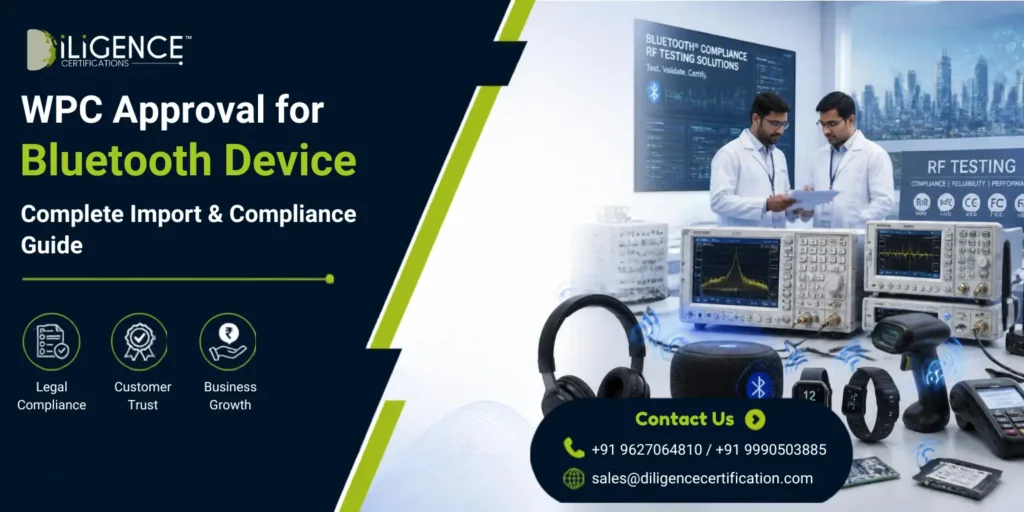
By - Bluetooth Device WPC Approval in India is a mandatory requirement for eligible Bluetooth devices operating in licence exempt frequency bands before import into or sale in India.
- Bluetooth device WPC Approval is given by the Wireless Planning & Coordination (WPC) Wing under the Department of Telecommunications (DoT) after conducting tests for technical compliance.
- Diligence Certifications provides assistance to companies for RF testing and application filing.
introduction
A consumer electronics importer contacted Diligence Certifications as thousands of Bluetooth speakers were being shipped to an Indian port. The products had received their certification abroad, and thus the importer thought that they could be directly shipped to the Indian market. But during the customs clearance process, the officials asked for WPC Approval as the products were wireless Bluetooth enabled products.
But this is something that happens more often than we think. Companies assume that just getting international certifications like FCC or CE will suffice for India but Bluetooth enabled devices working on the license exempt frequency band needs to follow wireless regulation in India.
WPC Approval for Bluetooth Device helps ensure compliance to the necessary wireless communication regulations and thus helps in avoiding customs issues, regulatory problems and commercial risks associated with them. Whether your business deals with manufacturing smart wearables, wireless headphones, Bluetooth speakers, POS machines, or Industrial IoT devices, knowledge of the process is important for your products.
This guide will cover everything that businesses need to know about WPC Approval for Bluetooth Device.
What is WPC Approval for Bluetooth Device?
Bluetooth Approval from WPC is a type of regulatory approval granted by the Wireless Planning & Coordination (WPC) wing, operating under the jurisdiction of the Department of Telecommunications (DoT) of the Government of India. The approval is granted to those wireless products which use Bluetooth technology in licence exempt frequency bands.
The main aim of such an approval is to ensure compliance of the Bluetooth enabled devices with India’s frequency regulation and operation without interference to the other communication systems. Those devices which meet the required criteria can be lawfully imported, marketed, distributed, and sold in India.
Many electronic products in today’s world contain Bluetooth technology; thus, WPC approval becomes a very necessary requirement for companies working with wireless technology. No matter what industry, healthcare, retail, smart infrastructures, etc. the product belongs to, the approval should be received prior to product distribution.
Companies, planning their regulatory activities ahead of time and before the importation, usually have an easier time with customs clearance and product launch.
Why is WPC Approval Required for Bluetooth Devices?
Communication through wireless devices takes place via certain radio frequencies which are regulated by the Government of India. Because of this, and because Bluetooth devices send wireless signals, regulatory authorities demand that the eligible devices meet certain technical standards that will enable efficient and interference-free use of spectrum.
WPC Approval for Bluetooth Device is a way to make sure that wireless products will work at permissible frequencies and also meet certain regulatory requirements. Otherwise, there can be possible problems such as customs delays, shipment delays, delayed launching of the products, among others.
Approval of WPC helps to maintain uniformity in the Indian wireless system where different wireless devices can work together without disturbing the communication network.
For businesses, getting the approval for WPC beforehand when importing products helps reduce the operational risk for the business.
Which Bluetooth Devices Require WPC Approval?
Many electronic products now include Bluetooth connectivity as a standard feature. If the product operates using licence-exempt wireless frequencies, it may require WPC Approval for Bluetooth Device before entering the Indian market.
Common examples include:
- Bluetooth Earbuds
- Wireless Headphones
- Bluetooth Speakers
- Smart Watches
- Fitness Bands
- Bluetooth Keyboards
- Bluetooth Mouse
- POS Machines
- Barcode Scanners
- Smart Home Devices
- Wireless Medical Devices
- Industrial IoT Equipment
- Bluetooth Remote Controls
- Automotive Bluetooth Modules
- Wireless Presentation Devices
Each product should be evaluated individually because approval requirements depend on its wireless specifications and operating frequency.
Who Needs WPC Approval for Bluetooth Device?
There are a number of types of firms that need to apply for the WPC Approval for Bluetooth Device when bringing wireless products into the Indian market.
They are:
- Product manufacturers
- Importers
- Brands owners
- Original equipment manufacturers
- Electronics distributors
- Online sellers
- Retail chains
- Industrial equipment suppliers
- Medical devices manufacturers
- IoT solutions providers
In any case, no matter how large the company is, all firms engaged in Bluetooth devices should check whether their products have to be approved by WPC.
Those firms that introduce more than one model of Bluetooth product need to do an individual examination of every model.
Benefits of WPC Approval for Bluetooth Device
Getting Approval for Bluetooth Device from WPC has other benefits apart from being just legally compliant. Companies that get approval for the product before importing into the country will be able to avoid problems in future operations and establish credibility for their business in India.
Major benefits include:
- Ensures compliance with the wireless communication standards of India.
- Makes it possible for the company to legally import and distribute Bluetooth devices.
- Ensures easier customs clearance of shipments.
- Prevents the company from facing any penalties or shipment detention issues.
- Improves the credibility of the product amongst distributors, retailers, and consumers.
- Increases confidence during procurement from the government and corporates.
- Allows the company to plan its inventory and product launch process effectively.
- Shows dedication towards regulatory compliance and responsible business operations.
- Facilitates expansion in the wireless product range.
- Enhances credibility of the business in the electronics industry of India.
WPC Approval Process for Bluetooth Device
WPC Approval for Bluetooth Device includes technical validation, documentation creation and regulatory assessment performed by the Wireless Planning & Coordination (WPC) Wing. A well-prepared application is crucial to minimize time that can be wasted due to incomplete documents or wrong technical information.
Step 1: Product Evaluation
First of all, the product must be evaluated to define if WPC Approval applies to this Bluetooth-enabled product. The wireless technology, frequency of operation, transmission power, antenna type, product model and its manufacturer, as well as purpose, will be analyzed to identify the correct approval type.
Step 2: Radio Frequency Test
A valid RF Test Report must be available for the Bluetooth device in question. Testing includes evaluation of operating frequency, power output, bandwidth, emission levels, modulation and behavior of radio frequency.
Step 3: Documentation Preparation
Upon completing the technical verification process, all necessary documentation will be compiled and checked. Proper documentation is key because any disparity between the products and the documentation often causes the regulators to ask for more information.
Step 4: Application Filing
The prepared application will be sent to the WPC Wing together with all technical documentation. The regulators will check the product’s details, compliance, and whether it meets the wireless communication guidelines of India.
Step 5: Approval
Upon completing the above processes successfully, the necessary WPC approval will be issued to the applicant for the Bluetooth product to be legally sold in India.
Documents Required for WPC Approval for Bluetooth Device
Preparing accurate documentation is one of the most important parts of obtaining WPC Approval for Bluetooth Device. Before submitting the application, businesses should ensure that every technical specification matches the RF test report and product details.
Common documents include:
- RF Test Report
- Product Technical Datasheet
- User Manual
- Product Photographs
- Block Diagram
- Circuit Diagram (where applicable)
- Antenna Specifications
- Manufacturer Authorisation Letter
- Company PAN Card
- GST Registration Certificate
- Import Export Code (IEC), where applicable
- Certificate of Incorporation
- Product Model Details
Additional manufacturer documents may be required for imported Bluetooth products.
RF Testing Requirements for Bluetooth Device
The significance of RF Testing in WPC Approval for Bluetooth Device is that it confirms the operation of the wireless module within the frequency bands exempted from Indian licensing authority without any harmful interference to other communications.
In the process of testing, operating frequency, transmission power, bandwidth, modulations, emissions, antennas, and general RF performance is determined. This technical information is included in the RF test report which becomes one of the most important documents in the course of the approval.
There are many delays in the course of approval due to submission of the RF report for some other models or incomplete technical information. Inclusion of proper RF report matching the Bluetooth device can speed up the approval process.
Cost Factors for WPC Approval for Bluetooth Device
The overall cost of obtaining WPC Approval for Bluetooth Device depends on several technical and documentation-related factors rather than a fixed government fee. Businesses should evaluate the complete compliance process while planning product imports or launches.
The total cost generally depends on:
- Product category
- Number of product models
- RF testing requirements
- Technical documentation availability
- Manufacturer support
- Product complexity
- Consultancy services
- Additional compliance requirements, if applicable
Planning the approval process early often helps businesses avoid unnecessary expenses caused by repeated document revisions or shipment delays.
Timeline for WPC Approval for Bluetooth Device
The time frame for WPC Approval for Bluetooth Device depends on how well-prepared the application is, having the available technical documents and RF test report and complexity of wireless products. Applications with proper documentation are usually processed faster compared to applications with queries for additional clarification.
Additionally, companies should be prepared to take into account the time needed for gathering the manufacturer’s documents, RF testing and answering regulatory questions. Starting the WPC Approval process prior to the importation of Bluetooth devices will assist in avoiding any delays at the custom office and will facilitate quick product launch.
With professional help from Diligence Certifications, companies are able to submit well-prepared applications.
Validity of WPC Approval for Bluetooth Device
Validity of WPC Approval for Bluetooth Device shall depend upon the nature of approval granted and the technical specification of the product submitted at the time of filing of the application.
If any modification is done to the wireless module, frequency band, antenna construction, transmission power, and other technical attributes, further evaluation under regulatory laws may become necessary before the modified product becomes eligible for import and marketing in India.
For continued compliance, businesses should:
- Make sure that the authorized product is according to the technical specifications provided.
- Consider compliance issues when you introduce modified products.
- Keep your technical information up-to-date.
- Consider regulations whenever there are changes in hardware and/or wireless characteristics.
- Consider compliance issues before importing modified Bluetooth devices.
Maintaining proper documentation and monitoring product modifications helps businesses avoid future regulatory challenges.
Common Mistakes to Avoid During WPC Approval
Many businesses face unnecessary delays because compliance activities begin only after products have been manufactured or shipped. Proper planning can prevent most approval-related issues.
Common mistakes include:
- Importation of Bluetooth devices prior to WPC approval.
- Submission of RF test report that is not corresponding with the actual product model.
- Supplying insufficient technical documentation.
- Incorrect use of product specifications in the application.
- Misconception that FCC or CE approval is equivalent to Indian WPC approval.
- Making any changes to wireless equipment after WPC approval without checking on the compliance requirements.
- Use of the wrong product classification for application.
Working with experienced consultants such as Diligence Certifications helps businesses identify documentation gaps early and complete the approval process more efficiently.
Why Choose Diligence Certifications?
Obtaining WPC Approval for Bluetooth Device requires technical expertise, regulatory understanding, and careful documentation. Diligence Certifications provides complete assistance to manufacturers, importers, distributors, and brand owners throughout the approval process.
Our services include:
- Product eligibility assessment
- RF testing coordination
- Technical document verification
- Application preparation
- Regulatory submission support
- Query handling with authorities
- End-to-end compliance guidance
Our objective is to simplify regulatory compliance while helping businesses launch Bluetooth-enabled products in India with confidence.
Conclusion
Devices with Bluetooth capability have become an integral part of contemporary consumer electronics, healthcare, industrial automation, retail and IoT devices. Getting WPC Approval for Bluetooth Device prior to importation and/or sale of products in India enables businesses to adhere to Indian wireless regulations and avoid delays at customs and commercial risks.
When planning for the certification process ahead of time, businesses will be able to conduct RF testings, document their product, and acquire regulatory approval without derailing the schedule of their product launch. With comprehensive assistance from Diligence Certifications, manufacturers and importers will be able to go through the certification process with ease.
Frequently Asked Questions
What is WPC Approval for Bluetooth Device?
It is the regulatory approval required for eligible Bluetooth-enabled products before they are imported or sold in India.
Who issues WPC Approval?
The Wireless Planning & Coordination (WPC) Wing under the Department of Telecommunications issues the approval.
Is RF testing mandatory?
Yes, RF testing is generally required to verify compliance with applicable wireless frequency requirements.
Which Bluetooth devices commonly require WPC approval?
Bluetooth speakers, wireless headphones, earbuds, smartwatches, fitness bands, POS machines, IoT devices, barcode scanners, and similar products.
Can Bluetooth devices be imported without WPC approval?
Eligible products should obtain WPC approval before import or commercial sale in India.
Does FCC certification replace WPC approval?
No. FCC approval does not replace Indian WPC regulatory requirements.
What documents are required?
RF Test Report, technical datasheet, user manual, product photographs, manufacturer authorisation, and company registration documents are commonly required.
How long does the approval process take?
The timeline depends on documentation quality, RF testing readiness, and regulatory review.
Can product modifications affect approval?
Yes. Changes to wireless modules, antenna specifications, or operating frequencies may require additional evaluation.
How can Diligence Certifications help?
Diligence Certifications provides complete assistance with documentation, RF testing coordination, application filing, and regulatory compliance.