BIS Certification
 CDSCO
CDSCO
 PESO
PESO
 CPCB
CPCB
 LMPC
LMPC
 WPC Approval
 Global Approvals
 TEC
TEC
 ARAI
ARAI
 BEE
BEE
 ISO Certification
 DGCA Certification
 NOC For Steel
 APEDA Registration























 Business Registration
 FSSAI Mark Certification












 (32).jpg)
 Legal Services
 Trademark Registration
 Copyright Registration
 Patent Registration
 By
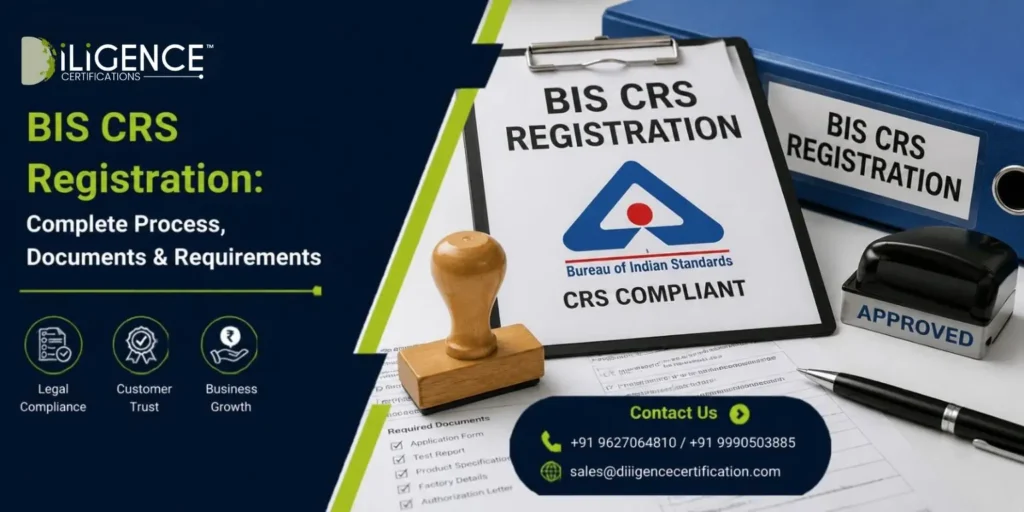
By - BIS CRS Registration is mandatory certification required for notified electronic products before they can be sold in the Indian market.
- Bureau of Indian Standards CRS Registration helps to ensure that electronic products comply with safety and quality standards as prescribed by Bureau of Indian Standards (BIS).
- Manufacturers are required to conduct product testing, submit required documents, and get Bureau of Indian Standards approval to lawfully manufacture/import such products.
Introduction
Safety and quality are two primary issues when purchasing electronic products in India. The LED lights, chargers, laptops, and gadgets should be compliant with the required standards before they are available to buyers.
The majority of the manufactures and distributors are experiencing delays due to their ignorance of the Bureau of Indian Standards compliance regulations. The product can be of high quality, but without the mandatory certification under the Compulsory Registration Scheme (CRS), it cannot be offered to buyers legally in India.
The Bureau of Indian Standards CRS Registration guarantees the compliance with the required Indian safety standards of electronic and IT products. The knowledge of the registration procedure, documents, criteria, cost, and timeframe will be helpful for businesses.
What is BIS CRS Registration?
BIS CRS Registration is a compulsory registration that is provided by the Bureau of Indian Standards (BIS) for electronic and IT products under the Compulsory Registration Scheme (CRS).
It is compulsory for manufacturers to get their Bureau of Indian StandardsCRS Registration before manufacturing, importing, or marketing of the notified products within the Indian market. The procedure requires product testing in Bureau of Indian Standards approved labs and documentation validation for compliance with Indian safety standards.
The list of products that require Bureau of Indian Standards CRS Registration include LED lights, IT products, consumer electronics, power adapters, batteries, and other notified electronic products.
Why is BIS CRS Registration Mandatory?
BIS CRS Registration is mandatory to ensure that electronic products sold in India meet required safety and quality standards. It protects consumers from risks such as electrical failures, overheating, and unsafe products.
The registration helps manufacturers:
- Ensure product safety through Bureau of Indian Standards -approved testing.
- Comply with legal requirements for selling CRS-covered products in India.
- Build customer trust through certified quality standards.
- Maintain consistent manufacturing practices and product reliability.
Types of BIS CRS Registration
Bureau of Indian Standards CRS Registration does not have categories like Basic Registration, State Licence, or Central Licence. Unlike other business licences, Bureau of Indian Standards CRS approval is based on:
- Product category
- Applicable Indian Standard (IS Code)
- Manufacturer details
- Testing requirements
The registration is issued by the Bureau of Indian Standards (BIS) and is valid across India.
Basic Registration
Bureau of Indian Standards CRS does not have a separate basic registration category. The approval process depends on the product type, applicable standard, testing, and manufacturer details.
State Licence
BIS CRS does not provide state-wise licences. A Bureau of Indian Standards CRS Registration issued by Bureau of Indian Standards is applicable throughout India.
Central Licence
BIS CRS Registration is managed centrally by Bureau of Indian Standards . The authority reviews applications, verifies documents, and grants registration after successful compliance verification.
Who Needs BIS CRS Registration?
Bureau of Indian Standards CRS Registration is required for manufacturers and businesses dealing with electronic products covered under the Compulsory Registration Scheme.
It is needed by:
- Electronic Product Manufacturers: Companies manufacturing products such as LED lights, mobile phones, laptops, adapters, batteries, and other notified electronic items.
- Importers: Businesses importing CRS-covered electronic products into India must ensure valid Bureau of Indian Standards registration before selling them.
- Foreign Manufacturers: International manufacturers exporting electronic products to India need Bureau of Indian Standards CRS Registration through an authorised Indian representative.
- Startups & New Electronics Brands: New businesses launching electronic products must obtain Bureau of Indian Standards approval to ensure legal market entry and consumer trust.
Difference Between BIS CRS Registration and Other BIS Certifications
Bureau of Indian Standards provides different types of certification schemes depending on product requirements.
| Basis | BIS CRS Registration | BIS Certification Licence |
| Purpose | Mandatory registration for notified electronic products | Product certification under specific schemes |
| Applicable Products | Electronics and IT products under CRS | Various industrial and consumer products |
| Testing | Required through Bureau of Indian Standards -recognised laboratories | Required as per applicable scheme |
| Authority | Bureau of Indian Standards | Bureau of Indian Standards |
| Approval Basis | Product registration | Certification/licence approval |
Eligibility Criteria for BIS CRS Registration
To apply for Bureau of Indian Standards CRS Registration, manufacturers must meet the requirements set by the Bureau of Indian Standards (BIS).
The key eligibility criteria include:
- Manufacturer Requirement: Registration must be obtained by the actual manufacturer, including foreign manufacturers exporting products to India.
- CRS Product Category: The product must be listed under the Bureau of Indian Standards Compulsory Registration Scheme. Common products include LED lights, laptops, mobile phones, adapters, batteries, and electronic accessories.
- Indian Standard Compliance: Products must meet the applicable Indian Standard (IS Code) requirements.
- BIS Approved Testing: Product testing must be conducted through a Bureau of Indian Standards -recognised laboratory.
- Manufacturing Details: Manufacturers must provide valid factory details and required compliance documents.
Importance & Benefits of BIS CRS Registration
| Importance of BIS CRS Registration | Benefits of BIS CRS Registration |
| Ensures legal compliance for manufacturing and selling CRS-covered electronic products in India. | Helps businesses build customer trust and improve brand reputation. |
| Protects consumers by ensuring products meet required safety and quality standards. | Provides better market opportunities with retailers, distributors, and online marketplaces. |
| Reduces the risk of regulatory action, product rejection, and market restrictions. | Supports business growth and creates confidence among customers and business partners. |
| Helps manufacturers maintain consistent product quality and compliance standards. | Strengthens brand credibility in the competitive electronics market. |
Documents Required for BIS CRS Registration
The following documents are commonly required for Bureau of Indian Standards CRS Registration:
- Company Registration Certificate
- Manufacturing Unit Address Proof
- Manufacturing Licence / Business Registration Proof
- Authorisation Letter (for authorised representatives)
- Product Technical Specification
- Product User Manual
- Product Photographs
- Circuit Diagram
- Block Diagram
- Bill of Materials (BOM)
- Product Label and Marking Details
- Bureau of Indian Standards Recognised Laboratory Test Report
- Product Test Report as per Applicable IS Standards
- Company Profile
- Trademark Details (if applicable)
- Authorised Person Contact Details
- BIS Declaration Forms
- Authorised Indian Representative Agreement (for foreign manufacturers)
Step-by-Step Process for BIS CRS Registration
The BIS CRS Registration process includes the following steps:
Step 1: Identify Product Category & IS Standard
Check whether the product falls under the CRS scheme and identify the applicable Indian Standard (IS Code).
Step 2: Product Testing
Submit product samples to a Bureau of Indian Standards -recognised laboratory for testing as per applicable safety standards.
Step 3: Obtain Test Report
Receive the laboratory test report confirming product compliance.
Step 4: Prepare Documents & Apply
Submit the Bureau of Indian Standards CRS Registration application with required documents, product details, and test reports through the BIS portal.
Step 5: BIS Verification
Bureau of Indian Standards reviews the application and documents. Any required clarification must be provided by the applicant.
Step 6: Certificate Approval
After successful verification, Bureau of Indian Standards grants the CRS Registration certificate, allowing the manufacturer to legally sell the product in India.
Validity, Timeline & Government Fees for BIS CRS Registration
| Validity | Timeline | Government Fees |
| Bureau of Indian Standards CRS Registration is valid for the period mentioned in the certificate. Manufacturers must apply for renewal before expiry to continue selling products legally. | The approval process may take several weeks depending on product testing, document accuracy, application review, and Bureau of Indian Standards verification. | The cost includes Bureau of Indian Standards application fees, registration fees, testing laboratory charges, and other applicable charges. Fees may vary based on product category and applicant type. |
| Registration details should be updated in case of changes in product design, manufacturing location, company details, or specifications. | Delays may occur due to incorrect product classification, incomplete documents, failed testing, or missing technical information. | Manufacturers should check the latest Bureau of Indian Standards fee structure before applying for registration. |
Common Mistakes to Avoid During BIS CRS Registration
Manufacturers and importers often face delays in BIS CRS Registration due to avoidable mistakes. The common errors include:
- Selecting Wrong Product Category: Incorrect product classification or IS Code selection can cause delays, additional testing, or rejection.
- Incomplete Documentation: Missing product details, incorrect company information, or incomplete test reports can slow down approval.
- Using Non-Recognised Laboratories: BIS only accepts reports from Bureau of Indian Standards -recognised laboratories.
- Ignoring Product Changes: Changes in product design, components, or manufacturing location may require Bureau of Indian Standards updates.
- Delaying Renewal: Late renewal can interrupt business operations and compliance status.
Why Choose Diligence Certifications for BIS CRS Registration?
Obtaining BIS CRS Registration requires proper documentation, product testing, and regulatory knowledge. Diligence Certifications provides complete compliance support to help businesses complete the registration process smoothly.
Key benefits include:
- Expert Guidance: Assistance in identifying applicable Bureau of Indian Standards standards, product categories, and compliance requirements.
- Documentation Support: Proper preparation and submission of technical and business documents to reduce errors.
- Testing Coordination: Support in coordinating product testing with Bureau of Indian Standards -recognised laboratories.
- End-to-End Assistance: Complete support from application preparation to Bureau of Indian Standards CRS Registration approval.
Conclusion
For electronic manufacturers and importers, BIS CRS Registration is not only a mandatory procedure but also one of the major steps towards developing their brands in India.
It proves that the electronic products conform to the safety standards and allows the businesses to operate legally in the Indian market.
An accurate knowledge about the eligibility criteria, documentation, testing, and approval procedure is essential for avoiding any issues with compliance.
Whether you have just started your business and launched the first electronic product or already operate in the market, correct guidance with the BIS CRS Registration will help to make the process easier.
In case you require professional Bureau of Indian Standards CRS Registration services, contact Diligence Certifications today.
Frequently Asked Questions
What is BIS CRS Registration?
BIS CRS Registration is an obligatory process of certification of electronic and IT products registered in accordance with the Compulsory Registration Scheme of the Bureau of Indian Standards.
Is BIS CRS Registration Mandatory in India?
Yes, BIS CRS Registration is obligatory for those products which are notified under the CRS scheme.
Which Products need BIS CRS Registration?
LED lamps, mobile phones, laptops, power adapters, batteries, electronic accessories, and all other electronic products notified under the CRS scheme require BIS CRS Registration.
Who can Apply for BIS CRS Registration?
The manufacturer of the concerned product can apply for BIS CRS Registration. Indian as well as foreign manufacturers can obtain the registration if their products come under the CRS scheme.
How long will BIS CRS Registration process take?
It depends upon testing of product, accuracy of documents, and verification by BIS. Usually, the application with proper documentation is processed quickly.
What is the validity of BIS CRS Registration?
Validity of BIS CRS Registration depends upon BIS regulations that are valid during the time of registration. The manufacturer needs to keep track of the expiry of certificate and seek its renewal in time.
Can the foreign manufacturers get BIS CRS Registration?
Yes, the foreign manufacturers can have BIS CRS Registration for their eligible products. They need an authorized Indian agent for communication with BIS.
What will happen if BIS CRS Registration is not done for a particular product?
Non-registration of BIS CRS for a product may invite regulatory scrutiny, loss of business opportunities, economic losses, and brand damage.
Why should companies seek professional assistance for BIS CRS Registration?
Professional assistance helps companies in identifying the requirements of the product, documentation, testing, and completing the registration procedure.