 BIS Certification
 CDSCO
CDSCO
 PESO
PESO
 CPCB
CPCB
 LMPC
LMPC
 WPC Approval
 Global Approvals
 TEC
TEC
 ARAI
ARAI
 BEE
BEE
 ISO Certification
 DGCA Certification
 NOC For Steel
 APEDA Registration






















 Business Registration
 FSSAI Mark Certification











 (32).jpg)
 Legal Services
 Trademark Registration
 Copyright Registration
 Patent Registration
 By
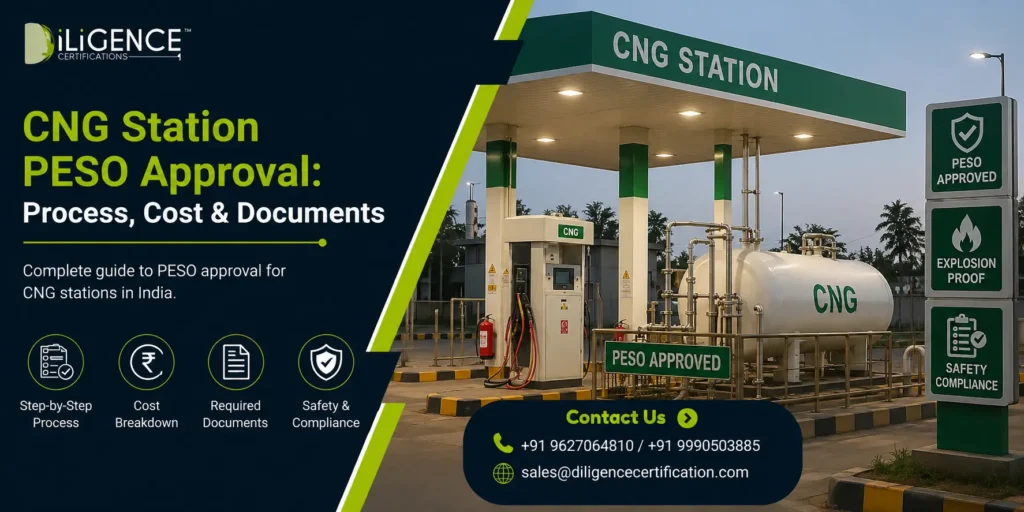
By - CNG Station PESO Approval is a mandatory regulatory approval for setting up and operating a Compressed Natural Gas (CNG) station in India where high-pressure gas storage, dispensing, and safety systems are involved.
- The approval is issued under the Petroleum and Explosives Safety Organization (PESO) to ensure that CNG infrastructure complies with prescribed safety standards, technical specifications, and statutory regulations.
- Businesses planning to establish a new CNG filling station can simplify the approval process by working with experienced compliance consultants such as Diligence Certifications, who assist with documentation, technical coordination, and regulatory approvals.
Introduction
A few months ago, a fuel infrastructure company approached Diligence Certifications after investing significantly in developing a new CNG station. Civil construction was complete, storage cascades had been installed, and dispensing equipment was ready. The only challenge preventing the station from starting commercial operations was regulatory approval.
The management believed that obtaining CNG Station PESO Approval was simply a paperwork exercise. However, during technical scrutiny, several safety observations were raised regarding equipment layout, emergency shutdown arrangements, and compliance documentation. These issues delayed commissioning until corrective measures were implemented.
Situations like this are common across India. Many businesses focus on construction and equipment procurement but underestimate the importance of regulatory compliance from the planning stage itself.
If you are planning to establish a CNG filling station, understanding CNG Station PESO Approval before construction begins can save considerable time, cost, and rework.
What is CNG Station PESO Approval?
CNG Station PESO Approval is the statutory approval required for facilities that store, handle, compress, and dispense Compressed Natural Gas under high pressure.
Since CNG is stored at pressures that may exceed 200 bar, every component of the station must comply with stringent engineering and safety requirements. The Petroleum and Explosives Safety Organization (PESO) evaluates whether the facility has been designed, installed, and tested according to applicable regulations before permitting operation.
The approval primarily focuses on:
- Public safety
- Safe storage of compressed natural gas
- Proper installation of pressure vessels
- Fire protection measures
- Electrical safety
- Emergency shutdown systems
- Hazardous area compliance
- Equipment certification
- Operational safety procedures
Without valid CNG Station PESO Approval, commercial operation of a CNG dispensing station may not be legally permitted.
Why is CNG Station PESO Approval Mandatory?
India is witnessing rapid expansion of city gas distribution networks and cleaner transportation initiatives. Thousands of commercial vehicles, buses, taxis, and private vehicles are shifting towards CNG because of its economic and environmental benefits.
As demand increases, so does the responsibility of maintaining safety.
Unlike conventional fuel storage, compressed natural gas remains under extremely high pressure. Even a minor installation defect can create significant operational risks.
PESO approval ensures that every CNG station is inspected against nationally accepted engineering and safety standards before becoming operational.
The approval helps ensure:
- Safe fuel dispensing
- Protection of employees
- Safety of customers
- Compliance with statutory regulations
- Reduced operational risk
- Standardized engineering practices
- Emergency preparedness
- Reliable infrastructure
For investors, it also reduces the likelihood of regulatory delays, project interruptions, and costly modifications after installation.
Who Needs CNG Station PESO Approval?
Several types of businesses require CNG Station PESO Approval depending on their operations.
These include:
City Gas Distribution Companies
Companies operating natural gas distribution networks establish numerous CNG stations across different cities.
Private Fuel Station Operators
Businesses setting up independent CNG dispensing facilities must obtain regulatory approval before commencing operations.
Oil Marketing Companies
Organizations expanding into alternative fuels require PESO approval for new CNG infrastructure.
Transport Corporations
Large fleet operators establishing dedicated refuelling stations for buses, trucks, or commercial vehicles also require approval.
Industrial Facilities
Manufacturing plants maintaining captive CNG dispensing systems for internal fleets may also fall under applicable PESO requirements.
Infrastructure Developers
Engineering companies developing turnkey CNG stations for government or private organizations must ensure that installations satisfy PESO requirements before handover.
Legal Framework Governing CNG Station PESO Approval
The approval process is governed by various Acts, Rules, and technical standards designed to regulate pressure systems and hazardous installations.
Important regulatory provisions generally include:
- Petroleum and Explosives Safety Organization (PESO) guidelines
- Gas Cylinder Rules
- Static and Mobile Pressure Vessel Rules (where applicable)
- Explosives Act provisions related to regulated installations
- Petroleum Rules for associated infrastructure
- National fire safety requirements
- Electrical safety standards
- Applicable Indian Standards (IS)
- Relevant international engineering standards wherever accepted
Businesses should always verify the latest regulatory provisions applicable to their specific project.
Key Components Examined During CNG Station PESO Approval
Many applicants assume that approval focuses only on gas cylinders or compressors.
In reality, PESO reviews the complete safety ecosystem of the station.
Storage Cascades
High-pressure gas storage systems are examined for structural integrity, pressure ratings, installation quality, and certification.
Compressors
Compressors must comply with approved technical specifications and operational safety requirements.
Gas Dispensers
Dispensing units should be installed according to approved layouts while maintaining necessary safety clearances.
Pipelines
High-pressure pipelines undergo examination for:
- Material specifications
- Pressure rating
- Welding quality
- Leak testing
- Routing
- Mechanical protection
Pressure Relief Systems
Every pressure system requires suitable pressure relief devices capable of safely releasing excess pressure.
Fire Protection Equipment
Adequate firefighting arrangements must be available throughout the station.
These generally include:
- Fire extinguishers
- Hydrant systems (where applicable)
- Emergency water arrangements
- Fire detection systems
Electrical Installations
Electrical equipment located in hazardous areas must comply with explosion protection requirements.
Improper electrical installations are among the common reasons for inspection observations.
Emergency Shutdown System
Emergency shutdown mechanisms should enable rapid isolation of gas flow during abnormal operating conditions.
Earthing and Lightning Protection
Proper earthing reduces electrical hazards while lightning protection safeguards exposed installations.
Safety Signage
Clear operational and emergency signage improves workplace safety and assists both employees and customers.
Benefits of Obtaining CNG Station PESO Approval
Beyond legal compliance, obtaining approval provides long-term operational advantages.
Improved Public Confidence
Customers are more likely to trust stations that comply with recognised safety standards.
Reduced Operational Risks
Proper engineering design significantly lowers accident risks.
Better Insurance Acceptance
Insurance providers often prefer facilities that comply with statutory safety requirements.
Easier Regulatory Compliance
Approved infrastructure simplifies future inspections and regulatory audits.
Enhanced Business Reputation
Compliance reflects professionalism and commitment to safety.
Long-Term Cost Savings
Identifying compliance issues during project development prevents expensive redesigns later.
Documents Required for CNG Station PESO Approval
Although documentation may vary depending on project scope, applicants generally need the following.
| Document | Purpose |
| Company Registration Certificate | Business identity verification |
| PAN and GST Details | Legal registration |
| Site Layout Plan | Overall facility arrangement |
| Equipment Layout Drawing | Technical review |
| Piping & Instrumentation Diagram (P&ID) | Engineering assessment |
| Pressure Vessel Details | Equipment verification |
| Storage Cascade Specifications | Safety review |
| Compressor Technical Documents | Equipment compliance |
| Fire Safety Plan | Emergency preparedness |
| Electrical Layout | Hazardous area assessment |
| Earthing Layout | Electrical protection |
| Equipment Test Certificates | Technical validation |
| Manufacturer Certificates | Product conformity |
| Calibration Certificates | Accuracy verification |
| Standard Operating Procedures | Safe operation |
| Emergency Response Plan | Incident management |
| Risk Assessment Report | Hazard identification |
| Land Ownership or Lease Documents | Site verification |
| Authorised Signatory Details | Application authentication |
Common Reasons for Delay in CNG Station PESO Approval
Many projects experience avoidable delays because compliance planning begins too late.
The most frequent issues include:
- Incorrect equipment layout
- Missing engineering drawings
- Non-certified pressure equipment
- Incomplete technical documents
- Improper hazardous area classification
- Insufficient fire safety arrangements
- Incorrect electrical installations
- Poor documentation management
- Non-compliance with prescribed safety distances
- Delayed response to inspection observations
Working with experienced consultants during the design stage often helps reduce these issues before submission.
Step-by-Step Process for CNG Station PESO Approval
Obtaining CNG Station PESO Approval is a structured process that involves technical scrutiny, document verification, inspection, and regulatory approval. While every project may have specific requirements depending on its capacity and design, the overall process generally follows the stages below.
Initial Project Planning
The approval journey should ideally begin before construction starts. During this stage, businesses prepare the proposed station layout, identify suitable equipment, and ensure that the project design follows applicable PESO safety requirements.
Early compliance planning helps avoid expensive modifications after installation.
Preparation of Technical Documents
Once the project design is finalised, the required engineering drawings and statutory documents are compiled.
This typically includes:
- Site layout drawings
- Equipment layout
- Piping and Instrumentation Diagram (P&ID)
- Fire protection plan
- Electrical layout
- Earthing layout
- Pressure vessel details
- Equipment certificates
- Risk assessment reports
Accurate documentation significantly reduces approval delays.
Application Submission
The completed application along with supporting documents is submitted to the competent authority for examination.
Officials review whether the proposal complies with applicable technical and safety regulations.
Technical Scrutiny
At this stage, experts carefully evaluate:
- Engineering drawings
- Equipment specifications
- Pressure ratings
- Hazardous area classification
- Fire safety arrangements
- Emergency shutdown provisions
- Compliance with statutory standards
If any deficiencies are observed, clarification or revised documents may be requested.
Site Inspection
After document verification, a physical inspection of the CNG station is carried out.
The inspection generally focuses on:
- Installation quality
- Safety distances
- Compressor installation
- Cascade mounting
- Gas dispensing units
- Fire protection equipment
- Electrical safety
- Earthing system
- Emergency arrangements
Inspecting officers verify that the actual installation matches the approved drawings.
Rectification of Observations
If inspection observations are raised, the applicant must complete the necessary corrections.
Examples include:
- Repositioning equipment
- Updating safety signage
- Improving fire protection
- Correcting electrical installations
- Submitting revised drawings
Prompt compliance with inspection observations helps speed up the approval process.
Grant of CNG Station PESO Approval
Once all regulatory requirements are satisfied, the approval is granted, allowing the facility to commence operations in accordance with applicable conditions.
Timeline for CNG Station PESO Approval
The actual timeline depends on project size, document readiness, inspection schedules, and response to observations.
| Activity | Expected Timeline |
| Documentation Preparation | Depends on project readiness |
| Application Submission | After document completion |
| Technical Review | Subject to authority verification |
| Site Inspection | Scheduled after scrutiny |
| Compliance of Observations | Depends on applicant response |
| Final Approval | After successful compliance |
Cost of CNG Station PESO Approval
There is no single fixed cost applicable to every project.
Approval expenses usually depend on factors such as:
| Cost Component | Depends On |
| Government Fees | Applicable regulations |
| Consultant Charges | Scope of professional services |
| Engineering Documentation | Project complexity |
| Equipment Testing | Technical requirements |
| Inspection Compliance | Site readiness |
| Rectification Work | Inspection observations |
Businesses should obtain a project-specific estimate before initiating the approval process.
Validity of CNG Station PESO Approval
The validity of approval may differ depending on the applicable licence, regulatory provisions, and operational conditions.
| Approval Aspect | Details |
| Validity | As prescribed by applicable regulations |
| Renewal | Required wherever applicable |
| Inspection | Periodic regulatory inspections may apply |
| Compliance | Continuous compliance is mandatory |
Operators should always monitor regulatory updates to avoid licence lapses.
Responsibilities After Receiving CNG Station PESO Approval
Receiving approval is only the beginning of regulatory compliance.
Operators are expected to maintain safety standards throughout the operational life of the CNG station.
Important responsibilities include:
- Conduct regular equipment inspections
- Maintain pressure vessels properly
- Perform periodic testing
- Keep firefighting systems operational
- Train employees in emergency response
- Maintain statutory records
- Update operating procedures
- Replace defective safety equipment immediately
- Cooperate during regulatory inspections
Continuous compliance helps ensure both legal conformity and workplace safety.
Common Mistakes Businesses Make
After assisting numerous businesses with regulatory approvals, one pattern appears repeatedly.
Many organisations invest heavily in land, compressors, and dispensing systems but postpone compliance planning until the project is almost complete.
Some common mistakes include:
Purchasing Non-Compliant Equipment
Imported or locally sourced equipment should meet prescribed technical standards before procurement.
Ignoring Safety Distances
Improper spacing between equipment can result in redesign requirements during inspection.
Incomplete Drawings
Missing engineering drawings often delay technical scrutiny.
Delayed Consultant Involvement
Professional guidance is most effective during the planning stage rather than after construction.
Poor Record Keeping
Incomplete certificates and test reports frequently become approval bottlenecks.
Why Businesses Choose Diligence Certifications
At Diligence Certifications, the focus is not limited to filing applications.
The objective is to help businesses complete the approval process with fewer delays by ensuring documentation, engineering coordination, and compliance activities are handled systematically.
Our assistance typically includes:
- Documentation support
- Technical compliance guidance
- Application preparation
- Drawing review
- Regulatory coordination
- Inspection assistance
- Observation compliance support
- End-to-end approval consultancy
Whether you are setting up a standalone CNG station or a large city gas distribution network, professional compliance planning can significantly reduce project delays.
Frequently Asked Questions (FAQs)
Is CNG Station PESO Approval mandatory?
Yes, approval is generally required before operating a CNG station handling compressed natural gas.
Who issues CNG Station PESO Approval?
The approval is issued by the Petroleum and Explosives Safety Organization (PESO).
Can a CNG station operate without PESO approval?
Commercial operation without the required regulatory approval may lead to legal action and operational restrictions.
What documents are required?
The application generally includes engineering drawings, equipment certificates, safety plans, company documents, and technical reports.
How long does the approval process take?
The timeline depends on documentation quality, project readiness, inspection schedules, and regulatory review.
Does every CNG station require inspection?
Yes, site inspection is an important part of the approval process.
Can approval be delayed?
Yes, incomplete documentation or non-compliance with safety requirements can delay approval.
Is renewal required?
Renewal requirements depend on the applicable licence and prevailing regulatory provisions.
Can consultants help with PESO approval?
Yes, experienced consultants assist with documentation, compliance planning, inspection coordination, and regulatory communication.
Why is PESO approval important?
It helps ensure public safety, legal compliance, and reliable operation of CNG infrastructure.
Tags
CNG Station PESO Approval, PESO Approval, CNG Station Licence, CNG Filling Station Approval, PESO Certification India, CNG Safety Compliance, Gas Cylinder Rules, Petroleum and Explosives Safety Organization, CNG Infrastructure, Fuel Station Compliance
Conclusion
Setting up a CNG filling station involves much more than installing compressors and dispensing units. It requires careful engineering, adherence to statutory safety standards, and successful completion of the CNG Station PESO Approval process.
Businesses that integrate compliance into the project from the planning stage are better positioned to avoid delays, reduce rework, and begin operations with confidence. From preparing technical documentation to supporting inspections and resolving compliance observations, every step contributes to a safe and legally compliant facility.
If you are planning to establish a new CNG station or require assistance with CNG Station PESO Approval, Diligence Certifications can provide end-to-end consultancy to help streamline the approval process and keep your project on track.
Frequently Asked Questions
Is CNG Station PESO Approval mandatory?
Yes, approval is generally required before operating a CNG station handling compressed natural gas.
Who issues CNG Station PESO Approval?
The approval is issued by the Petroleum and Explosives Safety Organization (PESO).
Can a CNG station operate without PESO approval?
Commercial operation without the required regulatory approval may lead to legal action and operational restrictions.
What documents are required?
The application generally includes engineering drawings, equipment certificates, safety plans, company documents, and technical reports.
How long does the approval process take?
The timeline depends on documentation quality, project readiness, inspection schedules, and regulatory review.
Does every CNG station require inspection?
Yes, site inspection is an important part of the approval process.
Can approval be delayed?
Yes, incomplete documentation or non-compliance with safety requirements can delay approval.
Is renewal required?
Renewal requirements depend on the applicable licence and prevailing regulatory provisions.
Can consultants help with PESO approval?
Yes, experienced consultants assist with documentation, compliance planning, inspection coordination, and regulatory communication.
Why is PESO approval important?
It helps ensure public safety, legal compliance, and reliable operation of CNG infrastructure.