BIS Certification
 CDSCO
CDSCO
 PESO
PESO
 CPCB
CPCB
 LMPC
LMPC
 WPC Approval
 Global Approvals
 TEC
TEC
 ARAI
ARAI
 BEE
BEE
 ISO Certification
 DGCA Certification
 NOC For Steel
 APEDA Registration























 Business Registration
 FSSAI Mark Certification












 (32).jpg)
 Legal Services
 Trademark Registration
 Copyright Registration
 Patent Registration
 By
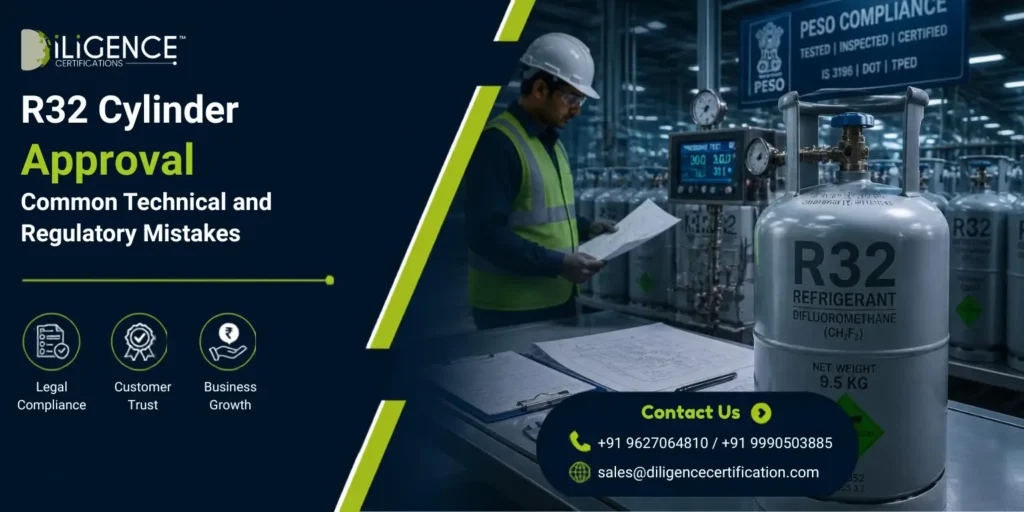
By - PESO Approval for R32 Refrigerant is related to the approval and manufacture/importation of cylinders meant to hold the R32 refrigerant under the Gas Cylinders Rules, 2016.
- R32 belongs to the class of A2L refrigerants; hence it has low toxicity and low flammability considerations when selecting, testing, filling, and handling the cylinders.
- It is important for manufacturers to identify the standard, testing, and PESO approval process to be followed for their particular cylinder.
Introduction
An equipment manufacturing company used to have a relatively simple requirement: bring in the R32 based equipment range and get a dependable supply of cylinders with the refrigerant in.
The engineering team’s role was to develop the equipment. The procurement department’s role was to get the refrigerant. But compliance requirements came much later, i.e. “what actually needs PESO approval - the R32 refrigerant, the cylinder, the filling process, or all of these things separately?”
It is very important.
R32, or difluoromethane (CH₂F₂) chemically speaking, is an HFC refrigerant. According to the Indian standard published by BIS, R32 falls under Category A2L, implying that R32 is less toxic and flammable. The same BIS material mentions the normal boiling point of around −52°C for R32 refrigerant.Hence, when a company talks about PESO Approval for R32 Refrigerant, the regulatory issue involved typically pertains to the cylinder or container used for storing/manufacturing/filling/transporting or importing R32 refrigerant, and not necessarily R32 itself as a separate PESO licence category.
There exists a category of Refrigerant Gas Cylinder Manufacturers by PESO, which exists next to categories of LPG valve manufacturers, CNG cylinder valves, multi-function valves, and other cylinder manufacturers.
Therefore, evaluation of the R32 project must come from two different perspectives - refrigerant properties and regulatory status of the cylinder containing it.
What Is PESO Approval for R32 Refrigerant?
PESO Approval for R32 Refrigerant is meant by the approval and compliance of the PESO concerning cylinders, which falls under the purview of thIt is not merely a certification process where PESO gives permission to use the refrigerant in the R32 cylinder. The approval process deals with the question of whether the design, materials, construction, testing, and manufacturing processes of the cylinder are compliant with the relevant requirements that apply under the Gas Cylinders Rules 2016.
PESO or Petroleum & Explosive Safety Organization is responsible for regulating the safety issues related to gas cylinders and has a procedure in place and approved manufacturers for various kinds of cylinders, such as refrigerant gas cylinders. The specific path of regulation will vary depending on the kind of cylinder, its construction, standard and gas service.
In the case of the R32 cylinder, the manufacturer should have a clear technical justification for the cylinder before starting manufacture. It involves establishing the standard, design pressure, water capacity, material specification, valve and threading arrangement, manufacturing process and cylinder marking.
The first error in the design process would be to simply rename an existing cylinder design that was designed for another refrigerant. The problem with this is that one must consider things such as gas service, pressure conditions, material appropriateness, and valve configuration for the actual service.
The actual purpose of getting PESO approval on this new cylinder is pretty clear-cut in this case: the proposed cylinder design needs to be able to function well in the role it is meant to play. The manufacturer must also be capable of replicating the design properly.
Why Is R32 Different From Some Traditional Refrigerants?
However, from the viewpoint of safety, one thing that should not be overlooked is the following:
R32 is designated as an A2L, and not an A1, refrigerant According to BIS description of safety classification of refrigerants, R32 is described as an A2L refrigerant having low flammability
Cylinder manufactures and refills have to take into account the following:
- Material compatibility
- Pressure conditions
- Valve suitability
- Leak prevention
- Filling procedures
- Ignition-risk controls
- Storage conditions
- Testing
- Ventilation
- Identification and marking
The cylinder therefore needs to be treated as part of the overall safety system.
Is PESO Approval Required for R32 Refrigerant Cylinders?
It depends on the purpose and the specific cylinder being considered.
As per the Gas Cylinders Rules, PESO has laid down its own criteria for cylinders for compressed and liquefied gases, and there is a separate approval for refrigerant gas cylinder manufacturers.
Thus, if an organization plans to manufacture cylinders for R32 use, then they cannot assume that industrial-gas-cylinder approval will automatically cover their product.
This means that the manufacturer must ensure that:
- What type of cylinder is being manufactured?
- Is it intended for R32 service?
- What is the cylinder construction?
- Which standard applies?
- What is the design pressure?
- What is the water capacity?
- What valve is fitted?
- What tests are required?
- What manufacturing approval route applies?
- Is the activity manufacturing, filling, storage, import or a combination?
Only after these questions are answered can the correct PESO pathway be determined.
Which Rules Govern R32 Cylinder Compliance in India?
Gas Cylinder Rules, 2016 is the primary regulation framework in force.
It is available on the website of PESO There are various activities regulated under the Rules, such as manufacturing, testing, filling, storage, transportation and importing gas.
Nevertheless, it is important not to mix various activities under the Rules For instance, PESO classifies Form-C as an application for issuance, modification or renewal of a licence for filling and/or storage of compressed gases in cylinders.
It is different from approving the design and manufacturing capacity of the cylinder manufacturer Import rules also follow their own path PESO Import Rules state that cylinders and valves should correspond to certain type and standards and are approved by the Chief Controller of Explosives.
R32 Refrigerant Cylinder Standards
Selecting the appropriate standard is one of the initial technical considerations.
- BIS has listed IS 3196 (Part 2) for welded low-carbon-steel cylinders of above 5-litre water capacity for low-pressure liquefiable gases except LPG. This is classified by BIS as one of the mandatory certification products.
- IS 3196 Part 2 is also mentioned in the current Scheme-I information from BIS in the context of cylinder standards according to Gas Cylinder Rules.
- However, this should not be misconstrued into implying that all R32 cylinders must necessarily have IS 3196 Part 2.
- The choice of standard depends on the actual cylinder design, capacity, gas service, materials and certification route.
- This is when manufacturers tend to make a costly error; that of selecting a standard and then adapting the product around it.
- The better method would be to do precisely the reverse.
- That is to say first determine the cylinder and its service, and then find out the relevant standard.
- BIS provides a facility called ‘Know Your Standard’ through which Indian Standards, amendments, certification information, testing laboratories, etc. may be searched.
PESO Approval for R32 Refrigerant: Step-by-Step Process
The PESO Approval for R32 Refrigerant procedure starts by determining the actual cylinder to use for R32 refrigerant. The manufacturer should be able to identify the type of cylinder, its structure, material, water capacity, operating pressure, test pressure, valve type, filling arrangement, and place of manufacture.
Step 1: Determine the Appropriate Standard
The appropriate cylinder standard must be determined prior to drawing preparation or testing.
Step 2: Prepare Engineering Drawings
Drawings must include the manufacturing code, design, raw materials, manufacture’s data, valves, threads, gas service, and water capacity. R32 service should be indicated in the drawings.
Step 3: Test the Materials Compatibility
Materials should be tested for mechanical properties and compatibility with R32 gas.
Step 4: Documentation for Manufacture and Testing
Manufacturing could consist of forming, welding, heat treating, machining, cleaning, inspecting, testing, marking, and release. Any necessary test and calibration data should be recorded.
Step 5: Submission of PESO Application
Once the technical file and testing have been completed, the appropriate PESO application should be submitted along with supporting documentation.
Step 6: Technical Examination and Inspection
PESO will inspect drawings, standards, materials, manufacturing procedures, testing facilities, inspection reports, markings, and quality control procedures.
Step 7: Approval and Approved Manufacture
Following satisfactory completion of the requirements, manufacture should occur according to the approved design. Any change to size, material, valve type, or design criteria should be reviewed for approval.
Documents Required for PESO Approval for R32 Refrigerant
These would vary based on the route of approval and the type of cylinders involved.
However, an R32 cylinder project may need documents in the following classifications.
Company documents
- Certificate of incorporation
- PAN
- GST registration
- Authorization documents
- Application details
- Factory address
- Documents establishing ownership or occupancy of the factory, as applicable
Technical documents
- Drawing of the cylinder
- Calculations for design
- Technical specification
- Manufacturing code
- Water capacity
- Working pressure
- Design pressure
- Test pressure
- Details of R32 gas service
- Valve specification
- Thread specification
Material documents
- Certificates for raw material
- Chemical analysis
- Mechanical properties
- Heat/Batch Identification
- Material Traceability
- Heat treatment data, as applicable
Manufacturing documents
- Flow chart of process
- Forming process
- Welding process, as applicable
- Heat treatment process
- Machining process
- Cleaning process
- Marking process
- Final inspection process
Testing documents
- Depending on the applicable standard
- Hydrostatic test data
- Burst test data
- Leakage test
- Dimensional inspection
- Material testing
- Non-destructive testing
- Heat Treatment confirmation
- Valve test
- Calibration certificates
The key here is not to have a lot of documents to give a good appearance to the application All the documents must relate to the R32 cylinder under manufacture.
What Does PESO Check for R32 Cylinders?
Cylinder Design
The cylinder design will provide its dimensions, volume, material, and pressure requirements.
Material
The material must be appropriate for the cylinder design and the refrigerant that is going to be used.
Resistance to Pressure
The refrigerant R32 is kept in a liquefied state. Therefore, pressure behaviour as temperatures change needs to be addressed in the design and testing.
Compatibility with Valves
The valves used with the cylinders need to be compatible with the refrigerant that is going to be used A properly designed cylinder using the wrong valve cannot be an acceptable design.
Minimizing Leakage
For an A2L refrigerant, the issue of leakage is very important The aim is to ensure minimal risk of leaking refrigerants in accordance with testing requirements.
Production Replication
The manufacturer must be able to duplicate the approved design continuously Therefore, the manufacturing control process becomes as important as the original design.
Markings and Cylinders Identification
Identification and marking of the cylinders must conform to the regulations.
R32 Refrigerant Safety and A2L Classification
A little bit more attention must be paid to R32 since its safety category will dictate the appropriate handling and packaging in cylinders.
In accordance with the technical documents of BIS, R32 belongs to the category of refrigerants called A2L. Here, the letter “A” shows lower toxicity, and the “2L” symbol shows that the refrigerant has lower flammability. To be precise, R32 is neither treated as highly flammable refrigerants like propane, nor as non-flammable gases.
From the perspective of the cylinder producer, this difference becomes important both during the design and production process, as the cylinder, valve and filling system must be suitable for R32 application with special attention to:
- Leak detection and maintenance of pressure integrity
- Valve and connection sealing
- Proper filling techniques
- Prevention of ignition sources
- Safe storage and handling
- Proper ventilation
- Emergency plans
- Employee safety training
- Cylinder identification and markings
The issue here is not to make R32 seem riskier than it actually is. The truth is, the requirement is proper handling of the refrigerant according to its A2L properties.
Refrigerant safety guidelines from around the world also classify A2L refrigerants as a special class of refrigerants with their own set of safety concerns relating to charge, design, and handling of the refrigerant. Manufacturers should take into account the classification of the refrigerant along with the cylinder standard and PESO requirements.
R32 Cylinder Filling and Storage
One issue which causes some confusion in the R32 cases is the distinction between cylinder approval and filling or storage permission. This is different from each other and thus should not be viewed as one and the same approval.
For instance, it is possible for an organisation to have a cylinder meeting all the PESO requirements, however this will not necessarily give permission to fill or store R32 in this cylinder. The business and its premises should then be considered to find out the relevant license or permission needed.
Form C of PESO is used to apply for the license to fill and/or store the compressed gas in cylinders. Therefore, it is important for organisations dealing with R32 to look at the relevant requirements according to their business. Compliance Assessment in this case should cover the full cycle of the R32 cylinder:
Cylinder manufacturing → Cylinder approval → Filling → Storage → Transportation → Import/Export, where applicable
This aspect is important since compliance does not automatically end upon approval of the cylinder itself. There could be other requirements that the facility used to fill the cylinders, the storage arrangements, the handling of the cylinders, and the transportation of the cylinders should follow. This is especially relevant in an R32 project.
Importing R32 Cylinders into India
It is highly imperative on the part of importers to be cautious while buying cylinders from foreign manufacturers.
According to PESO’s guidelines for importation of explosives-related materials, it is clear that cylinders and valves shall be of the kind as per the Schedule and approved by the Chief Controller of Explosives Moreover, it is also made clear from PESO’s forms page that Form-B is the application for grant or amendment of license to import cylinders It is thus evident that an importer cannot simply assume that the overseas certificate issued by the manufacturer will be considered as Indian regulation certificate.
Before placing a big order, it is necessary to verify:
- Cylinder standard
- Manufacturer approval status
- Test documentation
- Valve specification
- Gas service
- Capacity
- Marking
- Import documentation
- PESO applicability
That small compliance check can prevent a much larger logistics problem.
Common Mistakes in R32 Cylinder Compliance
Handling R32 as Any Other Refrigerant
R32 is a flammable refrigerant, therefore its handling is different from that of non-flammable refrigerants. It is the responsibility of manufacturers to take into account its flammability during the design and filling process of the cylinders.
Using the Same Design of an Existing Cylinder
Previously existing cylinder design was not the right way to start the R32 cylinder manufacturing process. It is important to check its pressure rating, materials, valves, capacity and standard.
Choosing the Applicable Standard Late
It is important to determine the applicable standard at the early stage of work. Otherwise, the drawings, tests and time spent will need to be redone.
Neglecting the Valve
It is also important to make sure the valve, its threads, connections and sealing arrangement comply with R32 application requirements.
Inconsistent Technical Documents
All technical documents should be consistent. For instance, if the cylinder design drawing states one water capacity, but the test certificate says another, it leads to technical questions and delays.
Cylinder approval vs filling licensing
The two are independent procedures. Form-C is an issue concerning the filling or storage licensing of compressed gases in cylinders and cannot be used in place of cylinder approval.
Cylinder import without verification of compliance
An overseas manufacturer’s approval or test certification cannot serve as compliance with the requirements of India. It is advisable to verify the required PESO approval, cylinder standards, and import of R32
PESO Approval for R32 Refrigerant: Timeline and Cost
There is no single cost or timeline that applies to every R32 cylinder project.
The project can vary according to:
- Cylinder construction
- Applicable standard
- Cylinder capacity
- Design pressure
- Number of models
- Testing requirements
- Manufacturing readiness
- Inspection requirements
- Documentation quality
- Indian or foreign manufacturer
- Technical observations
- Required revisions
Government fees are only one part of the overall project cost.
Additional expenses can arise from:
- Engineering drawings
- Design calculations
- Product testing
- Inspection
- Calibration
- Sample preparation
- Manufacturing modifications
- Documentation
- Professional consultancy
PESO’s FAQ states that the applicable fee for approvals is as prescribed in Schedule V of the Gas Cylinders Rules, 2016.
For this reason, businesses should obtain a project-specific assessment instead of relying on a generic online “R32 PESO approval cost.”
2026 Regulatory Update for R32 and Gas Cylinder Compliance
PESO’s regulatory environment continues to become more digital.
Its 2026 circular page includes developments such as barcode compliance for cylinders and containers, an online module for approval of domestic manufacturers of cryogenic gas cylinders, an online cylinder-conversion module under Rule 28 and other CNG/CBG-related updates.
These developments may not all apply directly to an R32 cylinder manufacturer However, they illustrate an important point PESO procedures should be checked close to the date of application A compliance file prepared using an old checklist may not reflect the current submission mechanism or documentation expectations.
How Diligence Certifications Can Help
R32 compliance sits at the intersection of refrigerant safety, cylinder engineering and regulatory requirements At Diligence Certifications, the practical approach is to first establish what the product actually is and which PESO route applies.
Support can include:
- PESO applicability assessment
- R32 cylinder category assessment
- Applicable-standard identification
- Technical-document checklist
- Drawing review
- Design-document coordination
- Manufacturing-process documentation
- Testing coordination
- Application preparation
- PESO filing assistance
- Technical-observation support
- Inspection coordination
- Amendment assistance
- Renewal guidance
For businesses dealing with multiple regulatory requirements, Diligence Certifications also provides broader and related certification assistance.The purpose is not to submit the maximum number of documents It is to make sure the right technical evidence is submitted for the actual R32 cylinder and the actual business activity.
Conclusion
Approval for R32 Refrigerant by PESO cannot be seen as simply an endorsement of the refrigerant.
The relevant question from the perspective of compliance planning will more often be: what is the cylinder used for R32, what activity is to be carried out, and what Gas Cylinders Rules requirements do the cylinder have? Since R32 is a A2L refrigerant, consideration of its low flammability properties must go hand in hand with considerations of cylinder construction, pressure, material compatibility, valve type, filling procedures and storage.
For manufacturers, the first step should start from the cylinder category and standard that applies. The rest of the way - technical drawing, material record, manufacturing process, testing and PESO certification - everything must follow on consistently from there For importers, the same is true even before this: first establish whether the foreign cylinder and manufacturer are PESO compliant If you wish to manufacture, import, fill or commercially deal with R32 cylinders in India, Diligence Certifications can provide guidance on the PESO route forward and coordination of documentation.
Frequently Asked Questions
Is PESO approval required for R32 refrigerant cylinders?
Where the cylinder and activity fall under the Gas Cylinders Rules, the applicable PESO approval and licensing requirements must be followed. PESO also maintains a specific category for refrigerant gas cylinder manufacturers.
What is R32 classified as?
R32 is classified as an A2L refrigerant, indicating lower toxicity and lower flammability characteristics.
Which standard applies to R32 cylinders?
The applicable standard depends on the cylinder type, construction, capacity and service. BIS lists standards including IS 3196 Part 2 for certain welded low-carbon-steel cylinders for low-pressure liquefiable gases other than LPG.
Is R32 a flammable refrigerant?
R32 is classified as A2L, meaning it has lower flammability characteristics. It should therefore not be treated as a non-flammable A1 refrigerant.
Is Form-C required for R32 cylinders?
Form-C relates to licensing for filling and/or storing compressed gas in cylinders. It is a separate regulatory activity from cylinder manufacturing approval.
Can an existing refrigerant cylinder be used for R32?
Not automatically. The cylinder's design, material, pressure rating, standard, valve and intended service must be evaluated against the applicable requirements.
Is PESO approval required for imported R32 cylinders?
Where the imported cylinders fall within the applicable Gas Cylinders Rules, the prescribed import approval/licensing requirements apply. PESO provides specific guidance for importing cylinders and valves.
Does PESO approve R32 itself?
The practical regulatory assessment is generally concerned with the cylinder, valve and related activity rather than treating the refrigerant name alone as a standalone PESO product approval.
What documents are required for R32 cylinder approval?
Requirements vary, but drawings, design parameters, material details, applicable standards, testing documents, manufacturer information and inspection evidence may be required. PESO's FAQ specifies several particulars expected in relevant design drawings.
How can R32 PESO approval delays be avoided?
Confirm the cylinder category and applicable standard first, then align the drawing, material, manufacturing process, testing records and application details before submission.