BIS Certification
 CDSCO
CDSCO
 PESO
PESO
 CPCB
CPCB
 LMPC
LMPC
 WPC Approval
 Global Approvals
 TEC
TEC
 ARAI
ARAI
 BEE
BEE
 ISO Certification
 DGCA Certification
 NOC For Steel
 APEDA Registration























 Business Registration
 FSSAI Mark Certification












 (32).jpg)
 Legal Services
 Trademark Registration
 Copyright Registration
 Patent Registration
 By
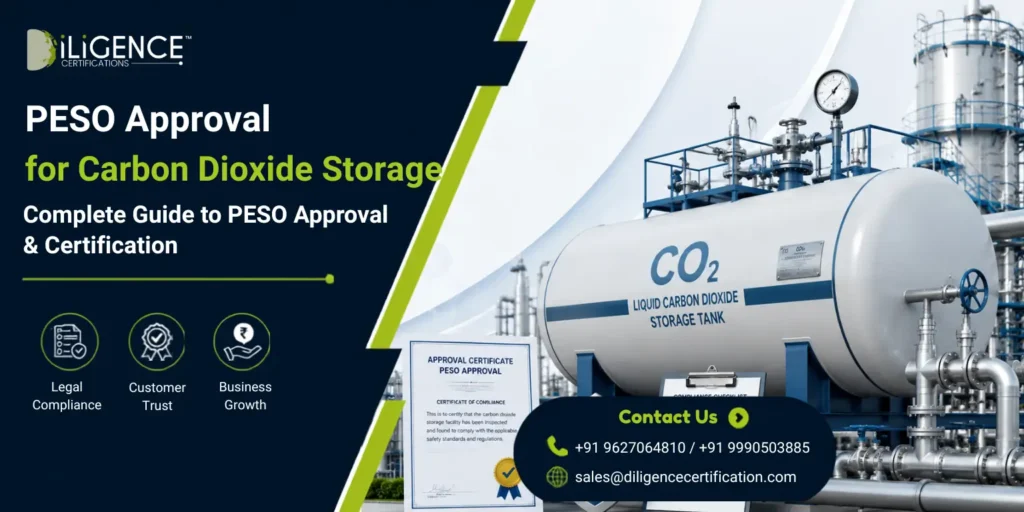
By - Includes complete details regarding the approval process for Carbon Dioxide Storage for industries, manufacturing units, food & beverages companies, pharma companies, hospitals, laboratories, and all other qualified organizations dealing with regulated carbon dioxide storage facilities.
- Involves qualification criteria, approval process, documentation, carbon dioxide storage safety aspects, license, compliance, and regulatory aspects.
- Includes complete procedure for PESO Approval for Carbon Dioxide Storage as per PESO regulations
Introduction
Carbon dioxide is a widely utilized industrial gas that finds its applications in various industries, such as food and beverages, pharma, hospitals, laboratories, refrigeration, manufacturing, and industrial processes. Since carbon dioxide can be stored under pressure, companies have to comply with the necessary regulations for installation of storage facilities for it.
PESO Approval for Carbon Dioxide Storage ensures compliance of eligible companies with the necessary requirements regarding the regulated storage systems. The exact type of approval or license varies according to the storage arrangement and the applicable PESO regulations.
In the case of liquid carbon dioxide being stored in pressure vessels, the applicable regulations will be SMPV(U) Rules, while for storage in cylinders there could be Gas Cylinders Rules depending on the activity.
Being aware of the applicable regulatory requirements prior to installation or modification of carbon dioxide storage facility will assist companies in proper planning of their documentation, technical arrangements, and safety.
storage and filling arrangement. PESO provides application and licensing procedure under these rules.
For companies, the acquisition of appropriate PESO Approval for Carbon Dioxide Storage helps in establishing proper safety procedures, regulatory compliance, documentation, inspection readiness, and management of carbon dioxide storage facilities.
What is PESO Approval for Carbon Dioxide Storage?
PESO Approval for Carbon Dioxide Storage is the regulatory permission granted by the Petroleum and Explosives Safety Organisation in respect of carbon dioxide storage installations, as required in relation to the nature of the gas, storage facility, pressure vessel, premises, and activities involved.
PESO assesses the regulated storage facilities to make sure that the installation, equipment, safety measures, documentation, and operations meet the applicable regulatory requirements.
The applicable regulatory requirement for the storage of liquid carbon dioxide in static pressure vessels is the SMPV(U) Rules. The SOP issued by PESO segregates liquid carbon dioxide from the other gases under the pressure vessels licensing regulations.
For the storage of carbon dioxide in cylinders, the Gas Cylinders Rules, 2016 may be applicable based on the nature of the storage, filling and/or handling activity. PESO also makes available form-C for such applications.
The services included in PESO Approval for Carbon Dioxide Storage are:
- PESO Approval
- Storage License Assistance
- Regulatory Compliance
- Documentation Support
- Application Filing
- Safety Compliance Guidance
- Technical Documentation Support
- Inspection Assistance
PESO approval helps eligible businesses manage regulated carbon dioxide storage activities in accordance with applicable safety and regulatory requirements.
Applications of PESO Approval for Carbon Dioxide Storage
Approval by PESO of CO2 storage may apply to many different sectors or industries where there is CO2 stored in containers, tanks, or liquid CO2 storage systems.
Such approval is dependent on factors such as type of storage, storage capacity, equipment, pressure conditions, and type of premises and the activity being conducted.
Some of the business or institutions that would need this PESO approval/license include:
- Food Processing Units
- Beverage Manufacturing Units
- Pharmaceutical Companies
- Hospitals
- Medical Facilities
- Chemical Industries
- Manufacturing Units
- Welding and Fabrication Units
- Industrial Gas Suppliers
- Laboratories
- Cold Storage Facilities
- Fire Protection Service Providers
- Research Institutions
- Industrial Plants
- MSMEs Handling Carbon Dioxide
Carbon dioxide storage is commonly associated with industrial and commercial operations where controlled storage and supply of the gas is required.
Obtaining the appropriate PESO approval helps organizations establish compliant storage arrangements and maintain safety requirements associated with pressure vessels and compressed gas systems.
Who Needs PESO Approval for Carbon Dioxide Storage?
Appropriate licensing may also be mandatory for companies that deal in any of the aforementioned processes related to the controlled carbon dioxide storage systems under relevant PESO regulations.
It depends upon the state of the carbon dioxide, storage devices used, configuration of pressure vessels, and the process being undertaken in the premises.
Companies that may require Applicable PESO Approval for Carbon Dioxide Storage include:
- Food Processing Companies
- Beverage Manufacturing Companies
- Pharmaceutical Companies
- Hospitals and Medical Facilities
- Industrial Gas Companies
- Chemical Manufacturing Units
- Manufacturing Industries
- Laboratories
- Cold Storage Operators
- Welding and Fabrication Businesses
- Research Facilities
- Industrial Plants
- Fire Safety Equipment Companies
- MSMEs
And Other organizations involved in regulated carbon dioxide storage activities.
PESO Approval for Carbon Dioxide Storage enables eligible businesses to manage their regulated storage facilities in accordance with applicable safety and regulatory requirements.
Types of Compliance Under PESO Approval for Carbon Dioxide Storage
Compliance considerations for PESO Approval for Carbon Dioxide Storage are determined by the kind of carbon dioxide storage system, rules that apply, pressure vessel configuration, premises, and the activity being performed.
Adherence to compliance will allow businesses to run their carbon dioxide storage operations safely and fulfill their ongoing obligations as per regulations.
Storage & Licensing Compliance
When businesses store carbon dioxide using regulated pressure vessels or cylinders, it is crucial for them to determine which PESO license or approval applies to the activity before proceeding.
The licensing requirements of the SMPV(U) scheme specifically cater to the storage of liquid carbon dioxide.
The storage compliance process generally includes:
- Storage System Details
- Pressure Vessel Information
- Carbon Dioxide Details
- Premises Information
- Applicable PESO Requirements
- Safety Arrangements
- Supporting Documents
Useful for:
- Food Processing Units
- Beverage Plants
- Pharmaceutical Companies
- Hospitals
- Industrial Units
- Gas Storage Facilities
Proper storage and licensing compliance helps businesses maintain regulated carbon dioxide storage systems safely.
Safety & Operational Compliance
Carbon dioxide storage facilities need suitable safety arrangements, proper equipment maintenance, operational controls, and appropriate emergency preparedness.
The exact requirements depend on the applicable rules and storage configuration.
This generally includes:
- Pressure Vessel Safety
- Storage Area Safety
- Safety Equipment
- Emergency Preparedness
- Operational Procedures
- Equipment Inspection
- Regulatory Monitoring
Useful for:
- Industrial Plants
- Beverage Manufacturing Units
- Pharmaceutical Facilities
- Hospitals
- Food Processing Units
- Industrial Gas Users
Following proper safety and operational requirements helps reduce the risks associated with pressurized carbon dioxide storage and supports safer facility operations.
Documentation & Reporting Compliance
Documentation is an important part of maintaining PESO compliance. Businesses need to maintain accurate information relating to their storage installation, equipment, inspections, approvals, and regulatory records.
Documentation generally includes:
- Storage Records
- Pressure Vessel Documents
- Equipment Details
- Inspection Reports
- Safety Records
- Regulatory Filings
- License Documents
Maintaining complete and updated documentation helps businesses demonstrate compliance during inspections, assessments, renewals, and regulatory reviews.
Documents Required for PESO Approval for Carbon Dioxide Storage
The documents needed for PESO Approval of Carbon Dioxide Storage will be based on the method of storage, pressure vessel/cylinder system, site, and regulations of the PESO. The preparation of these documents prior to application submission will make the approval process easier.
Generally, the required documents may include:
- PAN Card
- GST Registration Certificate
- Business Registration Certificate
- Identity Proof of Authorized Signatory
- Address Proof
- Site and Layout Plan
- Storage Installation Details
- Pressure Vessel Details
- Equipment Specifications
- Technical Documents
- Safety Arrangement Details
- Inspection or Test Documents, where applicable
- Authorization Letter, where applicable
- Other documents required under applicable PESO regulations
The precise documentation needs may differ based on the CO2 storage system and the regulations that apply.
PESO follows separate processes and forms under the Gas Cylinder Rules and SMPV(U) Rules, and so the documentation needs to be done based on the particular system.
Step-by-Step Process for PESO Approval for Carbon Dioxide Storage
It is made much simpler to get PESO Approval for Carbon Dioxide Storage when the person applying knows the requirements beforehand.
The normal process entails identification of the regulatory framework that applies, determining if you are eligible, document preparation, submission of the application, verification, inspection, compliance, and getting of the relevant license or approval.
This systematic process can benefit business organizations very much.
Step 1: Eligibility Assessment
Determining the eligible regulatory requirements is the first step in getting the PESO Approval for the Carbon Dioxide Storage.
This will be determined by:
- Kind of Carbon Dioxide Storage
- Storage system
- Arrangement of pressure vessels
- Nature of business
- Location of storage
- Operational activity
- Applicable PESO Rules
The assessment enables one to determine if the installation comes under:
- Gas cylinders rules
- SMPV (U) rules
- Or other regulatory requirements.
Step 2: Gathering All Required Documents
After determining the appropriate authorization requirements, the applicant must prepare all the required business, technical, storage, and safety documents.
The proper preparation of documentation is crucial since the submitted information is used by the regulatory body for assessing the storage facility.
The common documents may include:
- Business Registration Certificate
- PAN Card
- GST Registration Certificate
- Proof of Identity and Address
- Authorized Signatory Details
- Site and Layout Plan
- Storage Details
- Pressure Vessel Documents
- Technical Specifications
- Safety Arrangement Details
Accurate documentation allows the authority to review the proposed carbon dioxide storage facility more effectively.
Step 3: Filling Out the Application
After completion of all relevant paperwork, the applicant then submits the PESO application as per the relevant regulations and type of CO2 storage setup.
Generally, the application will require data about the applicant, site, storage setup, equipment, and compliance mechanism.
The application may cover:
- Business Information
- Applicant Information
- Storage Information
- Installation Information
- Technical Information
- Safety Information
- Contact Information
- Compliance Information
PESO provides online application facilities and specific forms under its regulatory framework.
The information in the application should be consistent with the supporting documents to reduce unnecessary queries or clarification requirements.
Step 4: Verification of the Application
Once submitted, the application will be scrutinized to verify whether the proposed carbon dioxide storage installation is in accordance with all the necessary regulations and safety standards.
These verification processes may consist of:
- Business Verification
- Document Verification
- Technical Document Verification
- Storage Installation Verification
- Safety Arrangement Verification
- Compliance Verification
Inspection or Technical Assessment may be necessary for the approval process if required.
Additional queries from the applicant may be made should any extra information be needed to proceed with the application process.
Step 5: Grant of PESO Approval
After completion of the applicable review, compliance requirements, and inspection or verification process, the relevant PESO approval or license may be granted according to the nature of the carbon dioxide storage activity.
PESO approval helps organizations to:
- Operate Under Applicable PESO Requirements
- Maintain Storage Safety Standards
- Meet Regulatory Requirements
- Improve Business Credibility
- Maintain Controlled Storage Operations
Obtaining the applicable approval demonstrates that the organization has addressed the regulatory requirements relevant to its carbon dioxide storage facility.
Step 6: Ongoing Compliance
The approval process for PESO Compliance does not signify that businesses’ obligation to comply ends forevermore. There is a need for firms to keep on maintaining their storage facilities, equipment, safety provisions, documentation, among other regulatory requirements.
Compliance ensures that companies are safe in their operations and minimize the likelihood of facing any regulatory problems.
Examples of compliance activities are as follows:
- Compliance Monitoring
- Safety Management
- Equipment Inspection
- Documentation
- Licenses Renewal
- Regulatory Reporting
- PESO Compliance
Consistent monitoring and updating assists in ensuring that companies maintain their CO2 storage sites.
Timeline, Cost & Validity of PESO Approval for Carbon Dioxide Storage
The timeline, cost, and validity of PESO Approval for Carbon Dioxide Storage depend on several factors, including the type of storage system, applicable PESO rules, document preparation, application review, technical assessment, inspection requirements, and licensing conditions.
| Timeline | Cost | Validity |
| The approval timeline depends on document verification, application processing, technical review, and inspection requirements. | The cost depends on the applicable government fee and professional service charges, if any. | PESO approval or license remains valid as per the applicable PESO rules and approval or licensing conditions. |
| Proper documentation helps reduce processing delays. | Additional charges may vary depending on the nature of carbon dioxide storage activities and applicable approval requirements. | Organizations should comply with applicable renewal, amendment, or update requirements whenever necessary. |
| Processing time may vary based on the completeness of the application and regulatory verification. | Proper planning helps manage the approval cost efficiently. | Maintaining updated storage, business, and technical information helps ensure continued regulatory compliance. |
Importance & Benefits of PESO Approval for Carbon Dioxide Storage
| Importance | Benefits |
| Helps organizations comply with applicable PESO regulations and carbon dioxide storage safety requirements. | Enhances business credibility and demonstrates commitment to safe gas storage practices. |
| Supports safe and controlled storage operations through regulatory compliance. | Improves confidence among customers, business partners, and regulatory authorities. |
| Encourages responsible storage practices and proper equipment management. | Enables smoother compliance with applicable PESO requirements. |
| Promotes long-term operational sustainability and regulatory discipline. | Reduces compliance risks and improves operational efficiency. |
| Helps organizations fulfill their legal and regulatory obligations. | Strengthens long-term business growth and industry reputation. |
Why is PESO Approval for Carbon Dioxide Storage Important?
PESO Approval for Carbon Dioxide Storage is important for ensuring safety, reliability, and regulatory compliance in facilities where carbon dioxide is stored in regulated cylinders, pressure vessels, or liquid carbon dioxide storage tanks.
Carbon dioxide is utilized by different industry sectors, including food and beverages manufacture, pharmaceuticals, healthcare, laboratories, refrigeration, welding, and industry manufacturing. If the storage system is subject to PESO regulation, the companies must ensure that their storage system is compliant with the relevant rules.
Where the storage facility involves liquid carbon dioxide storage, the applicable regulations include the SMPV(U) Rules, which specify that liquid carbon dioxide comes under pressure vessels licensing procedure in the PESO publication.
In case cylinder based storage is applied by the company, the Gas Cylinders Rules may apply as well, depending on the nature of the activities. PESO provides a set of licensing procedures for filling and storage of compressed gases in cylinders.
Having the right PESO approval will assist companies in clarifying their regulatory obligations and implementing effective storage practices.
Moreover, this compliance may increase the professionalism of the company in the eyes of customers, suppliers, business partners, employees, and regulators.
The importance of PESO Approval includes:
- Regulatory Compliance
- Storage Safety
- Operational Reliability
- Industry Recognition
- Quality Management
- Risk Reduction
- Sustainable Operations
PESO Approval helps businesses improve their storage practices while supporting safe, responsible, and compliant carbon dioxide handling.
Consequences of Non-Compliance with PESO Approval Requirements
Entities that do not adhere to PESO requirements might be faced with a number of problems related to operation, regulation, and continuation of regulated carbon dioxide storage operations.
Such entities might have credibility and other issues related to continuation and future plans of business operation.
Examples of these consequences are as follows:
Non-Compliance with PESO Regulations
Non-adherence to the storage safety standard regulations and requirements may lead to some compliance issues.
Action Taken by the Competent Authority
Action may be taken by the competent authority when an entity does not meet safety or regulatory requirements.
Operational Restrictions
There may be restrictions or limits imposed on the regulated storage operations until the necessary compliance actions are taken care of.
Business Activity Delay
The noncompliance issues may cause delay in getting the approvals or performing the storage activities and business expansion plans.
Approval Suspension
Non-compliance with the necessary requirements may have an impact on the existing approvals, permissions, or licenses.
Risks to Compliance
Non-compliance management can increase risks for businesses having CO2 storage facilities.
Business Reputational Losses
There might be an impact on the customer trust as well as that of other partners of the business because of regulatory concerns.
Reputational Losses
There might be some reputational losses of the professional nature as a result of the continuous occurrence of regulatory problems by the organization.
Problems With Growing the Business
The organization can face challenges when expanding the business to include new gas storage activities.
Obeying PESO regulations is important for businesses to ensure smoother operations in the future.
Renewal of PESO Approval for Carbon Dioxide Storage
Renewal/Update of the relevant PESO Approval for Carbon Dioxide Storage will be necessary for businesses required to keep themselves continuously compliant with the PESO regulatory scheme.
It will be necessary for businesses to ensure that there is an update on their approval/license, as well as an assessment if there is any change in their business operations, storage equipment, pressure vessels, premises, ownership, technical aspects, and operating conditions.
An up-to-date information on the approval will be helpful in ensuring compliance and preventing disruption.
The common steps involved in updating PESO Approval include:
- Updating Business Information
- Reviewing Approval Details
- Updating Storage Information
- Submitting Required Documents
- Maintaining PESO Compliance
- Checking Regulatory Requirements
Keeping PESO Approval for Carbon Dioxide Storage information updated helps businesses continue their regulated storage activities efficiently while maintaining applicable safety and regulatory standards.
How Professional Assistance Helps in PESO Approval for Carbon Dioxide Storage?
The right licensing or approval process for the storage of carbon dioxide depends on the proper knowledge of the regulatory framework and its technicalities, documentation process, storage, licensing process, regulatory inspections, and compliance issues.
For many businesses, managing all of this can prove to be a challenge especially when they are juggling their manufacturing process, operations, customers, and other areas of their business.
Businesses can benefit from professional consultants in understanding the PESO licensing process, qualification for such a process, documentation process, application process, regulatory inquiries, and compliance process.
Professional assistance generally includes:
- Understanding PESO Approval Requirements
- Eligibility Assessment
- Documentation Preparation
- Application Filing Assistance
- Compliance Guidance
- Technical Documentation Support
- Regulatory Advisory
- Application Status Tracking
- Query Resolution
- Post-Approval Compliance Support
The professional services generally cover:
- Eligibility Verification
- Documentation Assistance
- Online Application Support
- Regulatory Compliance Guidance
- End-to-End Approval Assistance
- Ongoing Compliance Advisory
With appropriate professional guidance, businesses can organize their carbon dioxide storage approval requirements more efficiently while focusing on their core operations.
Why Choose Diligence Certifications for PESO Approval for Carbon Dioxide Storage?
Getting PESO Clearance for Carbon Dioxide Storage involves good documentation, knowledge of PESO regulations, good technical data, and compliance with the respective safety standards.
Professional support could ensure that the entire process is better organized and would enable the organization to manage their documentation, applications, regulatory interaction, and compliance issues efficiently.
Diligence Certifications could provide professional support to the organization regarding certification and compliance, allowing them to handle their approval process while concentrating on their business.
The advantages of choosing Diligence Certifications include:
- Documentation Assistance
- Application Filing Support
- PESO Regulatory Compliance Guidance
- Approval Query Resolution
- End-to-End Approval Assistance
- Continuous Compliance Support
- Regulatory Guidance
- Process Management
With professional support from Diligence Certifications, obtaining PESO Approval for Carbon Dioxide Storage becomes a more structured process, helping businesses manage applicable documentation, application, inspection, and compliance requirements efficiently.
Conclusion
PESO Approval for Carbon Dioxide Storage is a key regulatory requirement for businesses running storage facilities where there are regulated carbon dioxide cylinders, pressure vessels, or liquid carbon dioxide storage systems.
The relevant regulations will vary depending on the type of storage system and regulations applicable to that installation. Liquid carbon dioxide storage falls under the SMPV(U) regulations, whereas certain cylinder-related activities may be governed by the Gas Cylinders Rules.
The right PESO approval/license would help businesses in addressing their safety, technical, operational, documentation, and regulatory requirements in relation to carbon dioxide storage.
PESO approval does not merely constitute regulatory paperwork for businesses involved in the storage of carbon dioxide. In addition to the above, it can aid in professional operation, safe storage of carbon dioxide, safety management, and regulatory discipline.
Documentation, maintenance of equipment, safety management, inspection preparation, regulatory compliance, and timely updates are some of the crucial factors in achieving compliant carbon dioxide storage operations.
For businesses already running carbon dioxide storage installations or those planning to install a new regulated storage facility, knowledge about the relevant PESO Approval for Carbon Dioxide Storage is quite valuable.
Frequently Asked Questions
What Is the PESO Approval for Carbon Dioxide Storage?
It is the required PESO approval/license that is relevant to the carbon dioxide storage activity.
Who Must Apply for PESO Approval for Carbon Dioxide Storage?
Businesses undertaking carbon dioxide storage in pressure vessels or cylinders can need the required PESO approval.
Is It Mandatory for Businesses to Apply for PESO Approval?
Yes, when the activity requires PESO approval.
What Documentation Is Needed for PESO Approval for Carbon Dioxide Storage?
Some of the documentation required are the business, storage, pressure vessel, technical and safety documentation.
PESO Approval Processing Time
The processing time varies depending on documentation, application, verification, and inspection process required.
PESO Approval Validity Period
Validity depends on the applicable PESO requirements, license category, and conditions of licensing.
Is It Possible to Apply for PESO Approval for Industries?
Yes, it is possible for eligible industries whose carbon dioxide storage activity comes under the applicable PESO regulations.
Why Is PESO Approval Important?
It helps companies remain compliant with regulations and ensures safe storage of carbon dioxide.
Is There Any Improvement in Storage Safety by Obtaining PESO Approval?
Yes, there is improvement in safety by adhering to the applicable regulations regarding storage, equipment, and safety.
How Can Consultants Help for PESO Approval?
Consultants can help in eligibility, documentation, application submission, compliance, and regulatory concerns.