BIS Certification
 CDSCO
CDSCO
 PESO
PESO
 CPCB
CPCB
 LMPC
LMPC
 WPC Approval
 Global Approvals
 TEC
TEC
 ARAI
ARAI
 BEE
BEE
 ISO Certification
 DGCA Certification
 NOC For Steel
 APEDA Registration























 Business Registration
 FSSAI Mark Certification












 (32).jpg)
 Legal Services
 Trademark Registration
 Copyright Registration
 Patent Registration
 By
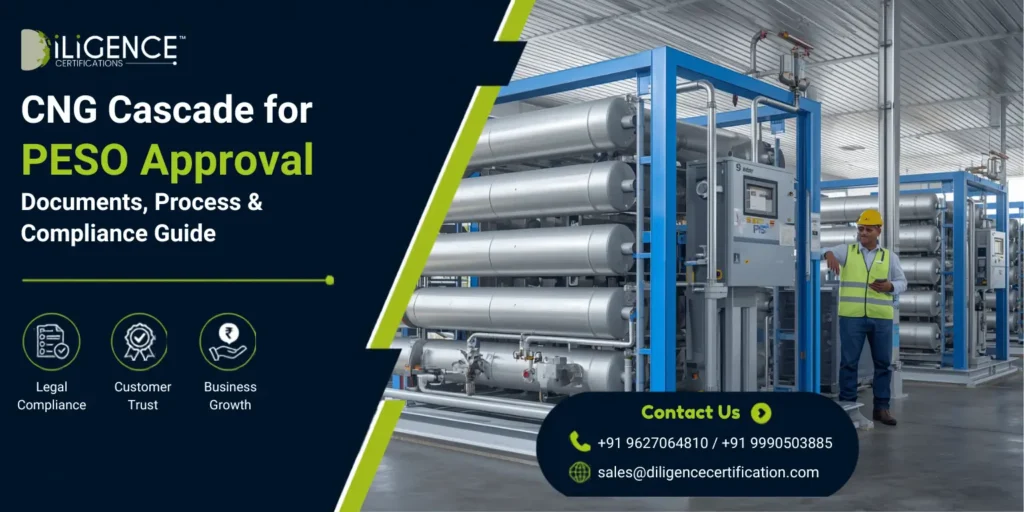
By - CNG Cascade PESO Approval is needed where the CNG cascade, the cylinders, and the installation thereof meet the criteria as per the Gas Cylinders Rules, 2016.
- The mode of approval will depend upon whether the cascade is going to be employed for storage purposes, filling, dispensing, transportation or for a mobile CNG system, so it needs to be decided prior to filing of the application.
- Correct drawings, documentation of cylinders and valves, safety distance, testing certificates, and information regarding the location need to be provided.
Introduction
A CNG project may be fully compliant on paper and yet face obstacles during the process of regulatory approval.
This scenario happens at times in industrial compliance projects: the cascade has been chosen, the compressor and the dispenser are included in the project scope and the site staff is set to begin installation. The problem arises when the regulation files are reviewed and a mismatch is found in the documentation, certificate, configuration or licensing process of the cascade.
This is where the concept of CNG Cascade PESO Approval comes into play.
The CNG cascade is more than just a grouping of high-pressure cylinders. It is the assembly of pressure containers used to store and transfer compressed natural gas. The components for regulatory review vary depending on the application of the cascade.
The regulatory regime includes the Gas Cylinders Rules, 2016, which is overseen by the Petroleum and Explosives Safety Organisation (PESO).
This is important since there is no such thing as a certificate that will suit all CNG cascades. The specific process of approval needs to be determined on the basis of how the cascade will be used.
What Is CNG Cascade PESO Approval?
Regulatory Approval for CNG Cascade PESO indicates the approval or licensing necessary for the CNG cascade in relation to the applicable to Petroleum and Explosives Safety Organisation (PESO).
A typical cascade has several high-pressure CNG cylinders that are linked via the same manifold. It is designed to hold and deliver the compressed natural gas in a systematic fashion.
Examples of applications of CNG cascades include:
- CNG dispensing stations
- Mother and daughter stations
- Daughter booster stations
- CNG storage and transfer systems
- Industrial CNG installations
- Mobile CNG arrangements
- CNG transportation and dispensing systems
- Certain CNG/CBG facilities
The applicable approval depends heavily on the actual configuration.
As an illustration, there will be various regulations to be followed when a stationary cascade is set up at a CNG station compared to a cascade attached to a truck. A cascade meant for storage and dispensing would also have a different set of regulations than an assembly that transports This is the reason why applicability assessment should always be the first step taken by professionals.
Which Rules Apply to a CNG Cascade?
Regulatory guidelines relating to CNG cylinder activities are mainly covered under the Gas Cylinders Rules, 2016 and The Gas Cylinders Rules, 2016 are posted by PESO on their official website and they provide the necessary forms and SOPs for the approval and licence process.
In case of companies handling compressed gas cylinders, the regulatory guidelines may relate to the following:
- Manufacture and approval of cylinders
- Filling of compressed gas
- Storage of compressed gas
- Testing and examination
- Installation arrangements
- Safety distances
- Valves and fittings
- Approved testing arrangements
- Licensing of premises
- Inspection and compliance
The official Form-C of PESO, for instance, is stated to be an application for a grant, renewal or modification of a licence to fill and/or store compressed gases in cylinders.
It is crucial to note that Form-C is not automatically supposed to be the entire licence requirement for all the CNG cascade projects because the licence framework varies depending on the specific project and the premises.
Why Is CNG Cascade PESO Approval Important?
CNG is held under high pressure. A malfunction with the cylinder, valve, manifold or pipework connections could have severe repercussions PESO approval is important from a safety point of view as well as being mandatory.
A correctly evaluated CNG cascade system should consider:
- Pressure containment
- Cylinder suitability
- Valve integrity
- Gas-tight connections
- Protection against mechanical damage
- Ventilation
- Safe access
- Fire and emergency provisions
- Appropriate safety distances
- Correct filling and dispensing arrangements
- Inspection and testing requirements
Regulations set by PESO regarding Gas Cylinder Regulations have provided certain conditions which must be met while installing facilities for the dispensing of CNG/CBG, which include conditions relating to the cascade, dispensers, compressors, pipelines, and fittings. In short, the regulatory authority is not concerned only about the cylinders.
Who Needs CNG Cascade PESO Approval?
The requirement can affect several categories of businesses.
CNG Cascade Manufacturers
Where cascades are used for regulated CNG applications, the manufacturers should demonstrate that the cylinders, valves, manifold design, material, manufacture, and associated parts meet the necessary criteria.
CNG Station Operators
The CNG station that is installing a cascade must confirm that the intended installation falls within an appropriate PESO licence and approved arrangement.
Importers
The importer who imports CNG cylinders, cascades, and related pressure equipment into India will have to ensure that they meet the relevant regulations in India prior to use.
CGD companies
City Gas Distribution companies might require approvals from PESO with respect to CNG installations, depending upon the installation type and activity carried out.
EPC Contractors
The EPC contractor must ascertain PESO requirements during the engineering phase and not when civil and mechanical construction are underway.
This is one of the most common practical problems encountered during compliance projects. The engineers may come up with the design first and then instruct the consultant to “get the approval.” This can be problematic in pressure gas installations.
What Documents Are Required for CNG Cascade PESO Approval?
The exact document list depends on the application, but a typical technical file may require several categories of information.
Technical Documents
These may include:
- Technical specification of Cascade
- General Arrangement Drawing
- Engineering Drawings
- Technical specifications of cylinders
- Certification of cylinders
- Technical specifications of valves
- Manifold specifications
- Piping specifications
- Pressure ratings
- Material specification
- Calculations, as applicable
- Test certifications
- Inspection report
- Manufacturers’ information
- Approval information of components
Site Documents
For a stationary installation, documentation may also cover:
- Site plan
- Layout drawing
- Location of cascade
- Building details
- Boundary details
- Compressor location
- Dispenser location
- Piping route
- Access arrangements
- Fire-safety arrangements
- Safety distances
- Emergency shutdown arrangements
Applicant Documents
Depending on the application, the file can also require:
- Company incorporation details
- Authorisation documents
- Applicant information
- Ownership or lease documents
- Previous licence or approval details
- Undertakings and declarations
- Competent-person documentation, where applicable
The exact list should be finalised after identifying the applicable PESO service and licence category.
CNG Cascade PESO Approval Process
Step 1: Determination of Regulatory Applicability
First, you will determine what the purpose of the cascade is.
- Does it have to do with storage?
- Is it associated with a CNG dispensing station?
- Is it going to be used for filling purposes?
- Is it mounted on a vehicle or trailer?
- Is it an import?
- Is it being manufactured in India?
- Is it going to be used in a mobile refuelling system?
Step 2: Cascade Design Review
The design review process of a cascade should be carried out before the application process is finalized Normally, the design review entails examining the configuration of the cylinders, manifolds, valves, pipework, pressures, supports, etc.
It is during this step that there is a merging of engineering and compliance aspects of the product design. The drawing which might be engineering-compliant will require modification from the regulatory side.
Step 3: Verify Cylinder and Component Documentation
Cylinder documentation is particularly important.
PESO has also issued a recent circular concerning verification of the validity of CNG cylinder test certificates before CNG filling. This reinforces the importance of maintaining current statutory testing documentation rather than relying only on historical certificates For a project involving multiple cylinders, the compliance team should maintain traceability between individual cylinders and their relevant certificates.
Step 4: Design the Site Layout
For stationary installation, the placement of the cascade should be shown in the site layout.
This site layout will identify all necessary equipment and the boundary line of the site where safety distance criteria can be checked against In terms of the Gas Cylinders Rules regulation, there are safety distances prescribed for CNG/CBG cascade installations. For instance, in these rules, different distances are specified according to total gas storage capacity.
Step 5: Complete and Submit the Application
This application is submitted online via the relevant PESO procedure along with the required documents.
PESO online application portal is available for petroleum, gas cylinders and SMPV applications It should be noted that submitting the application form is not sufficient. All technical information provided in the application must be consistent.
Step 6: Regulatory Scrutiny
PESO examines the submitted information If the reviewing authority identifies gaps, clarifications or discrepancies, the applicant may receive observations requiring a response.
Common causes of avoidable queries include:
- Mismatch between drawings and specifications
- Incomplete cylinder records
- Incorrect equipment description
- Missing safety details
- Inconsistent pressure information
- Unclear site boundaries
- Incorrect application category
- Unsupported technical claims
Step 7: Inspection, Where Necessary
- Based on whether the process is for obtaining a licence or approval, the step may be part of the process The installation should conform to what is stated in the approvals.
- This may seem elementary, but it is often overlooked. The layout plan submitted shows a particular cascade arrangement, but upon checking the installation, the cascade has been relocated nearer to a building. Such situations can be easily avoided.
Step 8: Issuance of Approval or Licence
- After complying with the regulatory requirements, PESO grants the approval/licence based on the conditions thereof.
- The installation is supposed to be kept in conformity with the requirements and licence conditions.
What Safety Requirements Matter Most for a CNG Cascade?
Distance Safety
The cascade should be sited based on the required safety-distance guidelines Distances should never be arbitrarily determined based on an obsolete drawing; the storage capacity, equipment arrangement and relevant guidelines must be taken into consideration.
Ventilation
Compressed Natural Gas is highly flammable compressed gas. Proper ventilation should be provided in the cascade area in accordance with the required guidelines The published guidelines by PESO deal directly with the ventilation requirements of CNG/CBG dispensing systems.
Cylinder Protection
Cylinders need to be protected from:
- Physical Impact
- Overheating
- Unauthorized Access
- Mismanagement
- Environmental Harm/Corrosion
Provision of support for the cylinder cascade system must also suit the specific design of the cascade.
Valves & Manifolds
Manifold is an important component of the cascade system Selection of valves and improper fittings/connections will make the entire cascade unsafe despite all the cylinders being up to the mark.
Emergency Shutdown
If required, emergency shut down provisions need to be included in the design and operation of the cascade Emergency facilities should not only be included in drawings but need to be known to trained personnel.
What Are the Common Reasons for CNG Cascade Approval Delays?
A CNG cascade application often becomes difficult because of small inconsistencies rather than one major technical failure.
Incorrect Approval Route
The applicant may select a licensing category without first mapping the actual activity.
Incomplete Technical File
One missing certificate may trigger further clarification, particularly when several cylinders or imported components are involved.
Drawing Mismatch
The cascade capacity, dimensions or equipment positions shown in different drawings may not agree.
Outdated Cylinder Test Records
Cylinder testing is not a one-time paperwork exercise. Validity and traceability matter.
Site Modification After Submission
Changing the physical location of equipment after submitting the layout can create a regulatory mismatch.
Poor Coordination Between Vendor and Applicant
The cascade manufacturer may have one set of specifications while the project consultant submits another This is why document control matters as much as technical knowledge.
CNG Cascade Approval for Imported Equipment
It is wrong to think that a certificate from another country is equivalent to getting regulatory clearance in India.
In addition, imported CNG cylinders may have certificates of testing done abroad along with manufacturers’ declarations and approvals from the other country. The above can serve as technical documentation, but the Indian regulatory requirement needs to be examined as well.
There are specific information and application procedures for gas cylinder-related work under PESO, which includes the import of cylinders. PESO form numbers include Form-B for applications regarding imports of cylinders.
Therefore, in case of imported cascade, the assessment process must be initiated even before import whenever possible.
CNG Cascade and the 2026 Regulatory Developments
The regulatory regime related to CNG and compressed gas infrastructure remains dynamic.
In April 2026, PESO has put out a circular on approval of CNG/CBG gas compressors to be installed on premises governed by Form E & F and G under the Gas Cylinders Rules, 2016 Also, some recent guidelines from PESO have been released with respect to CNG/CBG dispensing infrastructure and testing of CNG cylinders.
In addition, there is a draft of the Gas Cylinders (Third Amendment) Rules, 2026 which lays down certain additional conditions for CNG Mobile Refuelling Units. Since it is only a draft till now, it must not be considered as an existing regulation until it is notified It is worthwhile for companies undertaking CNG projects to bear in mind that the regulatory requirements may undergo changes during the period of the engineering project.
How Diligence Certifications Helps With CNG Compliance
At Diligence Certifications, the useful part of consultancy is not simply filling out a PESO application The work should begin with understanding the equipment and intended activity.
Our PESO compliance support can include:
- Applicability assessment
- Identification of the relevant approval/licence route
- Technical document review
- Drawing and layout coordination
- Documentation checklist preparation
- Application filing assistance
- Query and objection support
- Inspection preparation
- Amendment and renewal assistance
Diligence Certifications provides broader PESO licensing and compliance support for businesses dealing with compressed gases, CNG, pressure equipment and hazardous materials.
Conclusion
CNG Cascade PESO Approval must be considered as an engineering and compliance activity, not just a documentation procedure.
The cascade, cylinders, valves, manifold, piping, site layout, safety distances and operating system must all be compliant with the relevant regulatory system. The Gas Cylinders Rules, 2016 offer a solid base while PESO’s latest circulars, forms and procedures should be verified prior to any application submission.
As far as CNG equipment manufacturers, importers, CNG stations owners and CGD systems operators are concerned, the most appropriate action would be to find out which CNG Cascade PESO Approval path to follow prior to equipment purchase and site layout decision making.
Diligence Certifications can help with CNG Cascade PESO Approval applicability evaluation, documentation, technical coordination, application preparation, clarifications and inspections preparation regarding PESO issues.
Are you looking for the right CNG Cascade PESO Approval path for your project? Contact us at Diligence Certifications for CNG Cascade PESO Approval assessment.
Frequently Asked Questions
Is PESO approval mandatory for a CNG cascade ?
It depends on the cascade’s use, configuration and applicable PESO licensing requirements.
Which rules govern CNG cascades in India?
The Gas Cylinders Rules, 2016 are a key regulatory framework for CNG cylinder-related activities.
What documents are needed for CNG Cascade PESO Approval?
Technical specifications, cylinder certificates, drawings, valve details, site layout and applicant documents are commonly required.
Can an imported CNG cascade be used in India without PESO compliance?
4. Can an imported CNG cascade be used in India without PESO compliance? - Imported cascades must be assessed against applicable Indian regulatory requirements before regulated use.
Does PESO inspect a CNG cascade installation?
Inspection may be required depending on the applicable approval or licensing process.
How can I avoid delays in CNG cascade approval?
Submit accurate drawings, valid certificates, complete documents and ensure the installation matches the approved design.
Is there a separate PESO certificate called “CNG Cascade Approval”?
The applicable PESO approval or licence depends on the cascade’s activity, configuration and installation.
How long does CNG Cascade PESO Approval take?
The timeline varies according to the application type, documentation, scrutiny, queries and inspection requirements.
Who can apply for CNG Cascade PESO Approval?
Eligible manufacturers, operators, importers or other authorised entities can apply according to the applicable PESO requirements.
Can Diligence Certifications help with CNG Cascade PESO Approval?
Yes, Diligence Certifications can assist with applicability assessment, documentation, application filing, queries and inspection preparation.