BIS Certification
 CDSCO
CDSCO
 PESO
PESO
 CPCB
CPCB
 LMPC
LMPC
 WPC Approval
 Global Approvals
 TEC
TEC
 ARAI
ARAI
 BEE
BEE
 ISO Certification
 DGCA Certification
 NOC For Steel
 APEDA Registration























 Business Registration
 FSSAI Mark Certification












 (32).jpg)
 Legal Services
 Trademark Registration
 Copyright Registration
 Patent Registration
 By
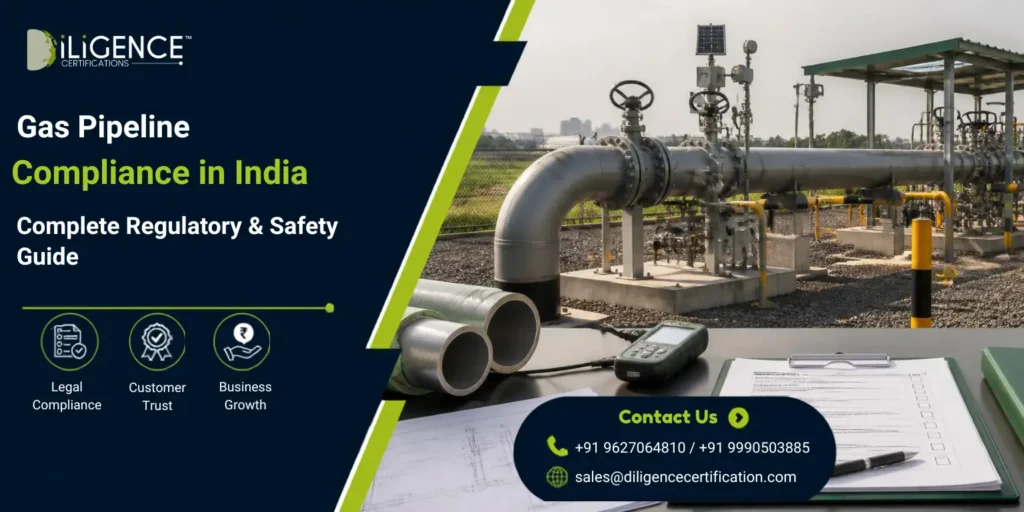
By - Gas Pipeline Compliance in India involves meeting applicable technical, safety, integrity, inspection and operational requirements for gas pipeline systems.
- Natural gas pipelines are subject to the applicable PNGRB technical and safety framework, while PESO requirements may apply to connected compressed-gas facilities, cylinders, storage and other regulated installations depending on the activity.
- Proper engineering, testing, emergency planning, documentation and ongoing integrity management are essential for safe and compliant gas pipeline operations.
Introduction
A gas pipeline may seem from the outside as simple as it gets. Steel pipe, a couple of valves, pressure controls and a connection to the receiving facility. When in reality the compliance burden behind it is much larger.
For example, imagine a company which has put up an industrial unit on one site and connected it through a natural gas pipeline supplied from the city gas network. The design engineers may have finished the construction task of the pipeline, but the task to prove the pipeline was designed, constructed, tested and commissioned to the requirements that are stipulated. Route data, pressure tests, emergency plans, isolation mechanisms, corrosion protection and operating procedures are of significance.
This is where Gas Pipeline Compliance is important.
For natural gas pipelines in India there are standards and technical safety regulations for them to conform with and then separate integrity management requirements maintained by PNGRB. The PNGRB regulatorypage currently shows Natural Gas Pipeline T4S Regulations, 2009 as amended up to July 23, 2025 and Natural Gas Pipeline Integrity Management System Regulations, 2012 as amended.
In the same breath, companies need to understand that every single gas pipeline is not covered by one single approval nor one regulatory authority. Requirements vary depending on what kind of gas is being used, and what design the pipeline is built to and with and up to what facility.
What Is Gas Pipeline Compliance?
Gas Pipeline Compliance means ensuring that a gas pipeline meets the applicable legal, technical, safety and operational requirements throughout its entire lifecycle - from planning and design to construction, commissioning, operation, inspection and maintenance.
It is not limited to obtaining a single approval or certificate. A compliant pipeline must be properly designed for its intended service, constructed using suitable materials and approved procedures, tested before commissioning, and operated under documented safety and maintenance practices.
For a gas pipeline project, compliance may involve requirements related to pipeline design, route and layout, material specifications, welding and joining, non-destructive testing, pressure testing, cathodic protection, leak detection, pressure control, isolation systems, emergency shutdown arrangements, inspection, maintenance and pipeline integrity management.
For natural gas pipeline systems in India, the applicable requirements may also involve the Petroleum and Natural Gas Regulatory Board (PNGRB) framework, along with other regulations and approvals depending on the type, location and purpose of the pipeline. Where petroleum, compressed gases or other hazardous substances fall within its jurisdiction, PESO(Petroleum and Explosives Safety Organisation)requirements may also become relevant.
Why Is Gas Pipeline Compliance Important in India?
Gas is widely used because it is efficient and convenient. That convenience also means a pipeline failure can have serious consequences.
A leak can create a fire or explosion hazard, interrupt industrial production and potentially affect people outside the facility Good compliance therefore serves two purposes: it satisfies statutory requirements and establishes a disciplined safety system around the pipeline.
For a business, effective compliance can help:
- Reduce leakage and fire risks
- Protect workers and nearby communities
- Improve pipeline reliability
- Support safe commissioning
- Reduce unplanned shutdowns
- Maintain inspection records
- Demonstrate regulatory conformity
- Improve emergency preparedness
- Protect equipment and connected facilities
The important point is that compliance should not be treated as a certificate kept in a file. A compliant pipeline needs controls that continue working after the approval stage.
Which Authorities Regulate Gas Pipeline Compliance in India?
There is no single answer for every gas pipeline.
PNGRB
The Petroleum and Natural Gas Regulatory Board (PNGRB) has an important regulatory role for natural gas pipelines and city or local natural gas distribution networks.
PNGRB’s current regulations page lists technical and safety standards for natural gas pipelines and separate regulations for integrity management. It also lists a separate technical and safety framework for city or local natural gas distribution networks.
PESO
The Petroleum and Explosives Safety Organisation (PESO) administers various safety rules concerning petroleum, explosives and compressed gases.
For example, PESO publishes the Gas Cylinders Rules, 2016 and its associated approval/licensing procedures.
This does not mean every natural gas pipeline automatically requires a generic “PESO gas pipeline certificate”. The actual requirement must be determined from the project configuration and applicable rules This distinction is important because using the wrong regulatory terminology can lead to an incorrect application strategy.
Other Authorities
Depending on the project, compliance may also involve:
- Local authorities
- Road authorities
- Railway authorities
- Environmental authorities
- Land-owning agencies
- Fire authorities
- Electrical safety authorities
- Factory or industrial safety authorities
- Other statutory bodies
The project should therefore begin with an applicability assessment.
What Are the Main Gas Pipeline Compliance Requirements?
1. Engineering Design
The pipeline must be designed for its intended gas, operating conditions and service environment.
Design considerations can include:
- Design pressure
- Operating pressure
- Pipe diameter
- Wall thickness
- Material grade
- Temperature
- Flow conditions
- External loads
- Corrosion allowance
- Valve arrangements
- Pressure control
- Safety systems
For natural gas pipeline design and installation, BIS has published IS 15663, covering design and installation of natural gas pipelines. Part 1 addresses laying of pipelines, while Part 2 addresses crossings and Part 3 covers pre-commissioning and commissioning.
The applicable statutory regulations must still be followed when using technical standards.
2. Route and Right of Way
For larger transmission or distribution systems, route planning is a major compliance consideration.
The project team should identify:
- Roads
- Railways
- Water bodies
- Existing pipelines
- Electrical infrastructure
- Buildings
- Industrial premises
- Sensitive locations
- Agricultural areas
- Other underground utilities
Crossings require careful engineering because the pipeline is exposed to additional construction and operational risks The route documentation should also remain consistent across drawings, surveys, permissions and as-built records.
3. Material Selection
Pipeline material must be suitable for the intended gas service and design conditions.
Material documentation may include:
- Pipe specifications
- Material certificates
- Manufacturer documentation
- Heat numbers
- Fitting certificates
- Valve certificates
- Welding consumable records
- Traceability documents
BIS identifies IS/ISO 3183:2019 among standards relevant to steel pipe for pipeline transportation systems The applicable project specifications and statutory requirements should determine the final material selection.
4. Welding and Jointing Compliance
For steel pipelines, welding quality is one of the most important construction controls.
A project may need appropriate:
- Welding procedures
- Welder qualification
- Welding records
- Joint identification
- Non-destructive examination
- Repair procedures
- Inspection documentation
For polyethylene or other pipeline systems, the relevant joining procedures and qualified personnel also need to be addressed The objective is straightforward: every joint should be installed and verified in accordance with the approved engineering and quality requirements.
5. Pressure Testing
Pressure testing is used to verify pipeline integrity before commissioning.
The test procedure should establish:
- Test section
- Test medium
- Test pressure
- Test duration
- Temperature considerations
- Pressure recording
- Acceptance criteria
- Safety precautions
- Test certificates
Testing records should be retained because they form part of the pipeline’s technical history.
A project should not rely only on a final statement saying “pressure test completed”. Proper records provide evidence of what was tested, under which conditions and with what result.
6. Corrosion Control
Corrosion can gradually weaken pipeline infrastructure without producing an obvious problem during normal operation.
Gas pipeline compliance can therefore involve:
- Coating systems
- Cathodic protection
- Corrosion monitoring
- Inspection programmes
- Electrical isolation
- Coating inspection
- Repair procedures
The appropriate corrosion-management system depends on the pipeline material, environment, design and operating conditions For buried metallic pipelines, corrosion control should be considered from the design stage rather than added after installation.
7. Valve and Isolation Systems
A pipeline needs a practical method for isolating sections during maintenance, leakage or emergency situations.
Valve arrangements should be consistent with:
- Pipeline design
- Operating philosophy
- Emergency response
- Pressure conditions
- Accessibility
- Maintenance requirements
Emergency isolation is particularly important because reducing the amount of gas that can escape after a pipeline incident can significantly affect the consequences of an event.
8. Leak Detection and Monitoring
Leak detection is an operational safety issue, not merely an instrumentation requirement.
Depending on the pipeline system, monitoring can include:
- Pressure monitoring
- Flow monitoring
- Control-room alarms
- Gas detectors
- Remote monitoring
- Valve-status monitoring
- Periodic patrols
- Instrument calibration
The system should allow operators to recognise abnormal conditions and take appropriate action.
9. Emergency Response and Disaster Management
A gas pipeline compliance programme is incomplete if it does not address what happens during an emergency.
Emergency procedures should consider scenarios such as:
- Gas leakage
- Fire
- Pipeline rupture
- Excessive pressure
- Third-party damage
- Equipment failure
- Natural hazards
- Unauthorised excavation
PNGRB maintains regulations covering Emergency Response and Disaster Management Plans, including a consolidated version updated through July 23, 2025 Emergency procedures should be practical enough for an operator to follow under pressure.
Gas Pipeline Integrity Management
A pipeline can be compliant when commissioned and still become unsafe later if integrity management is neglected That is why integrity management deserves separate attention.
PNGRB lists Natural Gas Pipeline Integrity Management System Regulations, 2012, as amended, alongside its natural gas pipeline technical and safety regulations.
An integrity-management programme can involve:
- Risk assessment
- Inspection planning
- Corrosion monitoring
- Defect assessment
- Pipeline patrol
- Leak surveys
- Repair planning
- Change management
- Incident investigation
- Record keeping
The practical lesson for operators is simple: commissioning is the beginning of the pipeline’s operating life, not the end of compliance.
Documents Required for Gas Pipeline Compliance
The exact document list varies according to the pipeline and approval framework.
Common technical and compliance records can include:
| Document | Purpose |
| Pipeline Design Basis | Establishes engineering assumptions |
| Route Map | Shows pipeline alignment |
| P&ID | Defines process and control arrangement |
| Pipeline Profile | Shows elevation and route characteristics |
| Material Certificates | Establishes material traceability |
| Welding Records | Demonstrates controlled fabrication |
| NDT Reports | Records inspection of joints |
| Pressure Test Records | Demonstrates integrity testing |
| Valve Data | Establishes equipment details |
| Corrosion Protection Records | Supports corrosion management |
| Emergency Plan | Defines response procedures |
| Inspection Records | Demonstrates ongoing monitoring |
| As-Built Drawings | Records the installed configuration |
| Operation & Maintenance Manual | Supports safe operation |
For projects involving compressed gas cylinders or related facilities, PESO’s Gas Cylinders Rules, 2016 and applicable licensing procedures may introduce additional documentation. PESO’s published forms include Form-C for the grant, amendment or renewal of a licence to fill and/or store compressed gas in cylinders.
What Standards Are Used for Natural Gas Pipelines?
There is no single standard that replaces all statutory requirements.
BIS has published IS 15663 for design and installation of natural gas pipelines. The standard covers laying of pipelines, crossings and pre-commissioning/commissioning through its different parts.
BIS also lists standards relating to pipeline transportation systems, gas measurement and polyethylene fittings within its petroleum and natural gas standards information.
At the regulatory level, PNGRB’s natural gas pipeline T4S framework must also be considered where applicable.
A good compliance file therefore connects three things:
Regulation → Applicable standard → Project implementation
Simply writing an Indian Standard number on a drawing is not sufficient if the actual installation does not follow it.
Common Gas Pipeline Compliance Mistakes
Treating Approval as a One-Time Activity
Pipeline safety continues throughout the operating life of the system.
Using Outdated Drawings
If site modifications are not reflected in the drawings, the compliance record becomes unreliable.
Ignoring Third-Party Damage
Excavation near buried pipelines can create serious risks. Route marking, patrolling and communication controls are important.
Weak Record Keeping
A technically sound pipeline can still face compliance problems if inspection and testing records cannot be produced.
Confusing PESO and PNGRB Requirements
Not every gas pipeline has the same approval pathway. The applicable authority must be identified from the actual activity.
Delaying Compliance Until Commissioning
Regulatory requirements should influence engineering decisions from the beginning.
PESO Compliance for Gas Pipelines: When Does It Apply?
This is the only place that business needs to be accurate with.
PESO covers various categories under compressed gas, under the Gas Cylinders Rules 2016 and other associated Regulations and rules. Gas Cylinders Rules can be found on their website, along with related FAQs and SOPs relating to approvals and licenses.
However, Gas Pipeline Compliance should not automatically be referred to as a solely PESO-centric requirement.
The PNGRB regulatory framework may govern the natural gas transmission pipeline, whereas the cylinder-filling / compressed-gas installation / storage related to the pipeline would be a PESO-centric event.
This is the reason why Diligence Certification recommends performing an applicability review before determining the appropriate license or approval that would need to be pursued.
A Practical Example of Gas Pipeline Compliance
Here’s an example of how an industrial manufacturer might go about connecting a plant to a natural gas grid:
Stage 1: Identify type of gas, origin of supply.
Stage 2: Decide on appropriate design and safety standards.
Stage 3: Plan pipeline path and engineer the system.
Stage 4: Specify pipeline and components (pipes, fittings, valves, safety devices).
Stage 5: Construct the pipeline under strict quality conditions.
Stage 6: Carry out inspections, leak testing and hydrostatic pressure testing.
Stage 7: Perform the final pre-commissioning inspections.
Stage 8: Develop operational procedures and plans for emergencies.
Stage 9: secure final regulatory consent and permits to operate.
Stage 10: Implement a program for inspection and integrity assessment during the operational life of the plant. If it seems quite a few more steps have been added then I agree. However there are more reasons to implement your way.
How Diligence Certification Can Help
Gas projects often involve several documents prepared by different teams: civil engineering, piping, instrumentation, safety, EPC contractors and operations.
The challenge is making all of them consistent.
Diligence Certification can assist businesses with:
- Regulatory applicability assessment
- PESO compliance guidance
- Pipeline approval support
- Document checklist preparation
- Technical-document review
- Drawing coordination
- Application assistance
- Regulatory clarification support
- Inspection preparation
- Compliance documentation
- Renewal and amendment guidance
Conclusion
Gas Pipeline Compliance is not merely an issue of securing a certification prior to commencing operations; it’s an ongoing system of engineering control, testing, inspection, integrity management and safe operation.
For natural gas pipeline development, PNGRB technical and safety system and integrity-management requirements are key considerations, althoughPESO regulations and guidelines can be relevant to applicable compressed gas facilities and activities within its regulatory remit. BIS standards, such as IS 15663, are also informative for technical aspects of natural gas pipelines.
The safest bet is to determine applicable regulations prior to finalizing engineering, ensure engineering records match actual installation, and maintain records throughout its operational lifespan.
If your company is in the process of building a new gas pipeline, undertaking retrofits, or assessing your current compliance state, Diligence Certification can provide support to aid you in regulatory assessment, engineering, PESO considerations, and compliance coordination.
Frequently Asked Questions
What is Gas Pipeline Compliance?
Gas Pipeline Compliance means ensuring that a gas pipeline is designed, constructed, tested, commissioned, operated and maintained according to applicable legal, technical and safety requirements.
Is PNGRB approval required for every gas pipeline?
Not every pipeline follows the same regulatory pathway. Requirements depend on the pipeline type, purpose, location and configuration.
Does PESO apply to gas pipelines?
PESO requirements may apply to compressed-gas facilities, storage, filling and other regulated activities associated with the gas system.
Which standards apply to natural gas pipelines?
Applicable requirements may include PNGRB regulations and relevant BIS standards such as IS 15663 for natural gas pipeline design and installation.
What documents are needed for pipeline compliance?
Common documents include design drawings, material certificates, welding records, NDT reports, pressure-test records, inspection reports and as-built drawings.
Is pressure testing required for gas pipelines?
Yes. Pressure testing helps verify pipeline integrity before commissioning, with test procedures and records maintained as part of the technical documentation.
What is pipeline integrity management?
It is the ongoing process of assessing risks, monitoring pipeline condition, conducting inspections, managing defects and planning necessary repairs.
Is compliance required after pipeline commissioning?
Yes. Gas Pipeline Compliance continues during operation through inspection, maintenance, integrity management, emergency preparedness and record keeping.
What are common gas pipeline compliance mistakes?
Common issues include outdated drawings, incomplete testing records, poor documentation, inadequate inspection and confusing PNGRB requirements with PESO requirements.
Can Diligence Certification help with Gas Pipeline Compliance?
Yes. Diligence Certification can assist with regulatory assessment, documentation, PESO-related guidance, application support and overall compliance coordination.