BIS Certification
 CDSCO
CDSCO
 PESO
PESO
 CPCB
CPCB
 LMPC
LMPC
 WPC Approval
 Global Approvals
 TEC
TEC
 ARAI
ARAI
 BEE
BEE
 ISO Certification
 DGCA Certification
 NOC For Steel
 APEDA Registration























 Business Registration
 FSSAI Mark Certification












 (32).jpg)
 Legal Services
 Trademark Registration
 Copyright Registration
 Patent Registration
 By
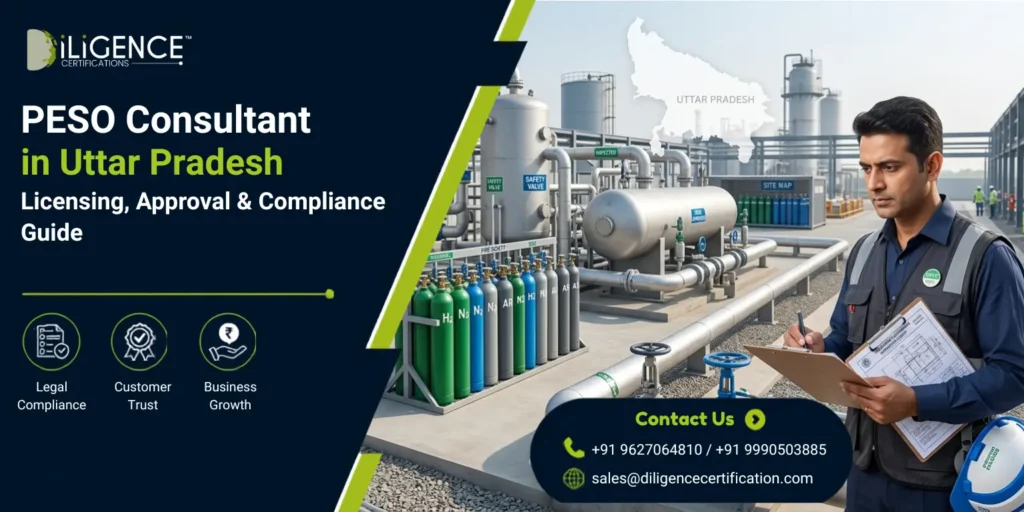
By - A PESO Consultant in Uttar Pradesh assists companies to ascertain whether their involvement with petroleum, gas, cylinder, pressure-vessel or explosives necessitates PESO clearance.
- Getting PESO clearance could entail an assessment of applicability, drawings, documentation, online filing, scrutiny and inspection based on the nature of the project.
- Diligence Certifications helps companies with PESO clearance, documentation, application process, compliance review, renewal and modification.
Introduction
A manufacturing unit in Noida planning a new compressed-gas installation, a chemical facility in Kanpur adding a pressure vessel, or for instance a petroleum storage installation close to Lucknow might have everything ready regarding the engineering aspects when it turns out that one major issue is still pending, which is to know what kind of PESO approval would be needed prior to the operation?
This is the point where difficulties could start.
PESO compliance does not only entail filing out an application form. The right regulation will depend upon the type of product, quantity, equipment, storage, site, and actual operations of the business.
The Petroleum & Explosives Safety Organisation (PESO) is the Government of India organization designated with the administration of certain regulatory requirements for petroleum, explosives, compressed gases, gas cylinders and pressure vessels.
In Uttar Pradesh, understanding the regulatory requirements right from the design stage can save unnecessary changes in the future A PESO Consultant in Uttar Pradesh can help link the project details with the right regulations.
What Is a PESO Consultant in Uttar Pradesh?
PESO Consultant in Uttar Pradesh offers professional guidance to organizations that might come under the purview of the regulations laid down by PESO (Petroleum and Explosives Safety Organisation).
The initial evaluation will be based on the actual process of manufacture, storage, filling, transportation, dispensing, importation, and usage of the organization.
The evaluation may cover the following:
- Petroleum or gas involved
- Material classification
- Storage quantity
- Cylinders and pressure vessels
- Tanks and connected equipment
- Filling or dispensing activity
- Manufacturing or processing activity
- Site location
- Plant layout and technical drawings
- Existing PESO approvals
- Proposed expansion or modification
After understanding the activity, the consultant will be able to assist in identifying the right PESO route and the related documents.
The assistance that can be rendered includes document verification, drawing coordination, preparation of applications, online submission, query responses for regulations, inspection preparation, and renewals or amendments.
It’s not about just submitting any paper. The application must represent what is actually proposed or installed at the site Diligence Certifications renders services for PESO consultancy and regulations for companies in India.
Why Is PESO Compliance Important for Businesses in Uttar Pradesh?
The industrial infrastructure of Uttar Pradesh consists of manufacturing, chemical, pharmaceutical, engineering, food processing industries, petrochemicals, gas and warehouse industries.
The industrial estates located at Noida, Greater Noida, Ghaziabad, Kanpur, Lucknow, Agra, Meerut, Mathura and other places might contain installations using regulated petroleum products, gases, cylinders, or pressure equipment.
This compliance criterion will be modified due to changes in the installation.
If a plant initially had two pressure vessels and later added another pressure vessel, it will be an increase in capacity from the production point of view. But from the compliance point of view, it will require evaluation of the new piece of equipment on the basis of relevant standards prior to its installation.
A similar scenario is possible if there is re-location of storage tanks, increasing their capacity or introducing new gases through pipe work.
Thus PESO compliance needs to be taken care of during the engineering and project planning phase and not after construction.
Who May Need PESO Approval in Uttar Pradesh?
There is no universal PESO licence applicable to every industrial business Applicability depends on the material, quantity, equipment, storage arrangement and activity.
Businesses that may need to assess PESO requirements include:
- Petroleum storage facilities
- LPG installations
- Compressed-gas facilities
- Industrial gas suppliers
- Gas-cylinder filling units
- Gas-cylinder manufacturers
- Gas-cylinder testing facilities
- Pressure-vessel installations
- CNG and LNG-related facilities
- Chemical manufacturing units
- Pharmaceutical facilities
- Petroleum handling businesses
- Certain pipeline projects
- Explosives and fireworks businesses
- Ammonium nitrate-related facilities
- Importers of specified regulated equipment
- Manufacturers of specified pressure equipment
The important point is that the name of the industry does not by itself determine the licence.
Which PESO Rules Apply in Uttar Pradesh?
The applicable framework depends on the material and activity.
Petroleum Rules, 2002
The Petroleum Rules, 2002 deal with specified activities with regard to petroleum, including storage, transportation, and handling.
The requirement may vary depending on petroleum categorization, quantity, storage setup, and premises. The Petroleum Rules that are currently in force have been published by PESO on their official website.
Gas Cylinders Rules, 2016
The Gas Cylinders Rules, 2016 deal with specified activities with regard to gas cylinders, including manufacturing, filling, storage and other activities.
Form-C that is available in the official forms of PESO deals with grant, modification or renewal of a licence to fill and/or store compressed gas in cylinders.
This rule applies to companies running industrial gas or cylinder-based operations.
SMPV(U) Rules, 2016
The Static and Mobile Pressure Vessels (Unfired) Rules, 2016 apply to the specific pressure vessels being used for storing and transporting of the compressed gases including cryogenic liquids.
According to PESO’s SOP, the scheme is designed for applying to static and mobile pressure vessels and gases including LPG, LNG, cryogenic liquids and liquid carbon dioxide.
Explosives Rules, 2008
Specific activities relating to the manufacturing, possession, storing and handling of the explosives may be covered by the Explosives Rules, 2008.
It is necessary to identify whether the requirement is applicable based on the type of explosives, quantity, activities and premises.
Ammonium Nitrate Rules, 2012
Specific activities relating to ammonium nitrate are covered by the Ammonium Nitrate Rules, 2012.
Companies have to assess applicability before arranging the storage or handling.
PESO Jurisdiction for Uttar Pradesh
Uttar Pradesh comes under the Central Circle of PESO, Agra According to the jurisdiction order of PESO, Uttar Pradesh and Uttarakhand come under Central Circle with Allahabad and Dehradun as sub circles.
According to the latest public information page of PESO, Central Circle Office is based in Agra and Allahabad Sub Circle Office is based in Prayagraj Jurisdiction information is very helpful in organizing regulatory matters.
Nevertheless, one must consider the latest application procedure and official jurisdiction information from PESO rather than using an older method of submitting applications.
Another advancement done by PESO is that their licensing system has been taken to the next level and it has become paperless. According to its annual report, all 49 licensing modules across different regulatory frameworks were functioning as paperless modules.
Documents Required for PESO Approval in Uttar Pradesh
There is no single document list for every PESO application.
Depending on the activity, documents may include:
- Company incorporation documents
- PAN and GST details
- Authorised signatory information
- Land ownership or lease documents
- Site plan
- Plant layout
- Process description
- Storage capacity details
- Tank specifications
- Pressure-vessel specifications
- Cylinder details
- Pipeline drawings
- Equipment datasheets
- Manufacturer certificates
- Test certificates
- Inspection reports
- Fire and safety arrangements
- Existing PESO licence
- Declarations and undertakings
The bigger issue is not simply collecting documents They need to match each other.
If the capacity mentioned in the application differs from the vessel datasheet, or the equipment shown on the drawing is different from what is installed, the applicant may have to address unnecessary clarification A technically complete application can still become difficult if the information is inconsistent.
Why Are Technical Drawings Important for PESO Compliance?
Technical drawings help explain the physical arrangement of a regulated installation.
Depending on the project, they may show:
- Storage tanks
- Pressure vessels
- Gas cylinders
- Pipelines
- Valves
- Filling points
- Buildings
- Boundary limits
- Access routes
- Fire-fighting arrangements
- Safety equipment
- Relevant installation details
One common issue occurs when a project drawing is prepared during the design stage but the actual installation changes during construction.
For example, a pressure vessel may be shifted because of a civil-work constraint.
That may seem like an engineering adjustment, but the business should assess whether the revised arrangement affects its regulatory documentation.
The site, technical drawing and PESO application should tell the same story.
PESO Approval Process in Uttar Pradesh
Step 1: Understanding the Process/Activity
- It begins with the actual business process itself.
- This means understanding the commodity involved, its quantity, equipment used, manner of storage and usage.
Step 2: Checking PESO Applicability
- The activity is checked against the appropriate regulations.
- Such regulations may be under the Petroleum Rules, Gas Cylinders Rules, SMPV(U) Rules, Explosives Rules or others.
Step 3: Review of Installation Plan
The plan, equipment and safety arrangements are evaluated.
Step 4: Preparation of Technical & Business Documents
According to the appropriate procedure, drawings, specifications, certifications and company documentation will be made.
Step 5: Filing of Application
The relevant application is filed using the relevant PESO online application facility.
The annual report of PESO shows that all online application facilities for the major PESO regulatory frameworks have been put in place.
Step 6: Scrutiny Under Regulatory Process
There may be examinations for conformity.
Step 7: Answering Queries
In case there are queries from PESO, the application will need to provide clarification, modified drawing or documentation.
Step 8: Inspection, where Necessary
If inspection is necessary, the site itself must be prepared and in accordance with the documents provided.
Step 9: Approval/License
Upon fulfilling all requirements, the appropriate approval/license may now be granted.
Step 10: Ensure Compliance
Additional approval/license may be necessary in case of changes to the site.
What Does a PESO Consultant Actually Handle?
A consultant’s role is wider than completing an online form.
Regulatory Applicability
The consultant reviews the actual activity and helps determine which PESO requirements may apply.
Technical Documentation
Equipment specifications, layouts and supporting documents are checked for consistency.
Application Preparation
The application and supporting information are organised according to the applicable process.
Online Filing
The consultant can assist with coordinating the online application.
Regulatory Queries
If observations are raised, the consultant can help prepare the required response.
Inspection Preparation
Where inspection is applicable, the business can review the site and documents before the regulatory inspection.
Renewal and Amendment
Changes to capacity, equipment, ownership or installation may require regulatory attention. Existing approvals should therefore be reviewed when the project changes.
Common PESO Compliance Mistakes in Uttar Pradesh
Businesses may face problems by choosing the wrong approval, submitting mismatched documents, or making site changes without checking PESO requirements.
Choosing the Licence Without Considering the Undertaking
The undertaking needs to be considered first by the business.
It is better to start with the name of the licence rather than the correct application process.
Preparing Drawings in the Last Step
PESO considerations will be easily addressed if taken into consideration in the planning stage.
Providing Inconsistent Information
Technical data about equipment capacity, quantity, location and specification need to be kept consistent.
Considering Existing Approval is Enough to Accommodate Expansion
Expansion in terms of addition of vessel, tank, cylinder storeroom or other equipment needs to be carefully evaluated.
Failing to Consider Construction Modification
Any modification in equipment location, piping and/or storage setup may need regulatory review.
Relying on Old PESO Requirements
PESO keeps on updating the regulations, procedures, forms and other relevant documentation. The business needs to be sure about the latest requirements before filing.
PESO has official pages on its website that contain latest gas regulations like Gas Cylinders Rules and SMPV(U) Rules.
Timeline, Cost and Validity of PESO Approval
There is no universal timeline or cost for every PESO application.
| Factor | What affects it |
| Timeline | Application category, documentation, scrutiny, queries and inspection |
| Cost | Government charges, testing, technical work and consultancy |
| Validity | Depends on the specific approval or licence |
| Renewal | Depends on the applicable statutory requirement |
For example, a new pressure-vessel installation is different from a gas-cylinder licence renewal.
Similarly, a petroleum storage project may require a different level of technical preparation from a modification to an existing installation.
The correct estimate should therefore be based on the actual project scope, not a generic PESO price or timeline.
Benefits of Professional PESO Consultancy
| Compliance area | Practical benefit |
| Applicability assessment | Helps identify the appropriate regulatory route |
| Technical review | Helps identify inconsistencies |
| Drawing review | Helps align the proposed installation with documentation |
| Documentation | Creates an organised submission |
| Filing support | Helps coordinate online submission |
| Query handling | Helps address regulatory observations |
| Inspection preparation | Helps compare site conditions with submitted documents |
| Renewal and amendment | Helps manage future regulatory changes |
For larger industrial facilities, this coordination becomes useful because engineering, procurement, operations and compliance teams often work separately.
A consultant can help ensure that the regulatory requirements are considered alongside the engineering decisions.
PESO Compliance for Industrial Businesses in Uttar Pradesh
Uttar Pradesh has a wide range of industrial operations, so PESO applicability can arise in different ways.
- A chemical manufacturer may use regulated gases.
- A pharmaceutical facility may operate pressure equipment.
- A manufacturing unit may require compressed gases for production.
- A petroleum-related facility may handle regulated petroleum products.
- An LPG or gas facility may need to assess cylinder or pressure-vessel requirements.
The common mistake is to assume that the same approval applies to all these businesses.
It does not.
The correct requirement depends on what is being handled, how it is stored and what the facility is doing with it.
Example: Pressure Vessel Installation
Consider a manufacturing facility in Greater Noida planning to add a new pressure vessel.
The procurement team may have already selected the equipment. The engineering team may have prepared the foundation. The production team may be planning commissioning.
A PESO compliance review at this stage can examine the vessel specifications, capacity, gas involved, installation arrangement, connected piping and relevant drawings.
If a regulatory issue is identified before installation, the project team has a better opportunity to address it without major rework.
Current PESO Regulatory Position
The official PESO portal should be treated as the primary source for current regulatory information.
Businesses should verify the latest:
- Applicable rule
- Approval category
- Application form
- Technical requirements
- Online procedure
- Government charges
- Jurisdiction
- Amendments
- Inspection requirements
- Post-approval conditions
PESO publishes the Petroleum Rules, 2002, Gas Cylinders Rules, 2016 and SMPV(U) Rules, 2016 through its official website.
The official forms database also shows application forms for activities including compressed-gas cylinder filling/storage, petroleum import and storage, petroleum transportation and other regulated activities.
Why Choose Diligence Certifications for PESO Compliance in Uttar Pradesh?
Understanding regulations and technical considerations is required to be PESO-compliant.
Even though a company could have a professional engineering department, it might still require assistance from experts to identify the correct PESO pathway, arrange the documents and submit an application.
Diligence Certifications helps companies become PESO-licensed and comply with PESO regulations when handling petroleum products, compressed gases, cylinders, pressure vessels, etc.
The support can include:
- PESO applicability assessment
- Licence requirement identification
- Documentation support
- Technical document review
- Drawing coordination
- Online application assistance
- Regulatory query support
- Inspection preparation
- Renewal assistance
- Amendment support
The method is simple; it involves understanding the business first, then determining the requirement to comply with and prepare the compliance documentation in light of the installation.
This may help firms that are carrying out operations in Noida, Greater Noida, Ghaziabad, Kanpur, Lucknow, Agra, Meerut, Mathura, and other areas in Uttar Pradesh in getting their act together.
Conclusion
A PESO Consultant in Uttar Pradesh can assist you in finding out whether a particular pathway is the right one for your project prior to installing the project which involves any petroleum, gas, cylinders, pressure vessels or explosives.
The first step should start from the activity itself. Find out the product, its quantity, the equipment used, how it will be stored, and what purpose will be served by it.
The PESO applicability and technical documents can be worked out thereafter.
Uttar Pradesh comes under PESO Central Circle Agra, while Allahabad and Dehradun come under sub-circles as per the jurisdictional structure of PESO.
For new installation or modification projects, it will be easier to do compliance assessment prior to project commissioning rather than working on documentation correction later In case of need for PESO license and approval, Diligence Certifications can help assess the need for it and Start with a PESO applicability assessment before finalising your installation.
Frequently Asked Questions
What is a PESO Consultant in Uttar Pradesh?
A PESO Consultant in Uttar Pradesh helps businesses assess PESO applicability and provides support for licensing, documentation, application filing, regulatory queries, inspections, renewals and amendments.
What does PESO stand for?
PESO stands for Petroleum and Explosives Safety Organisation. It is responsible for administering specified regulatory requirements concerning petroleum, explosives, compressed gases, gas cylinders and pressure vessels.
Who may need PESO approval in Uttar Pradesh?
Businesses dealing with specified petroleum products, compressed gases, gas cylinders, pressure vessels, explosives and other regulated materials may require PESO approval depending on their activity.
Which PESO jurisdiction covers Uttar Pradesh?
Uttar Pradesh falls under the Central Circle of PESO at Agra, with Allahabad and Dehradun identified as sub-circles under the published jurisdiction order.
Which rules can apply to a business in Uttar Pradesh?
Depending on the activity, the applicable framework may include the Petroleum Rules, 2002, Gas Cylinders Rules, 2016, SMPV(U) Rules, 2016, Explosives Rules, 2008 or Ammonium Nitrate Rules, 2012.
What documents are needed for PESO approval?
Documents vary by application but may include site layouts, technical drawings, equipment specifications, certificates, company documents, storage details and safety-related information.
Can PESO applications be submitted online?
Yes. PESO operates online and paperless licensing modules across its major regulatory frameworks.
Does every pressure vessel require the same PESO approval?
No. Requirements depend on the vessel, material, capacity, installation and intended use under the applicable rules.
Can an existing PESO licence cover a facility expansion?
Not necessarily. New vessels, tanks, storage capacity or significant modifications should be assessed to determine whether amendment or additional approval is required.
Can Diligence Certifications help with PESO compliance in Uttar Pradesh?
Yes. Diligence Certifications provides PESO consultancy support covering applicability assessment, documentation, application coordination, regulatory queries, inspection preparation and related compliance requirements.